

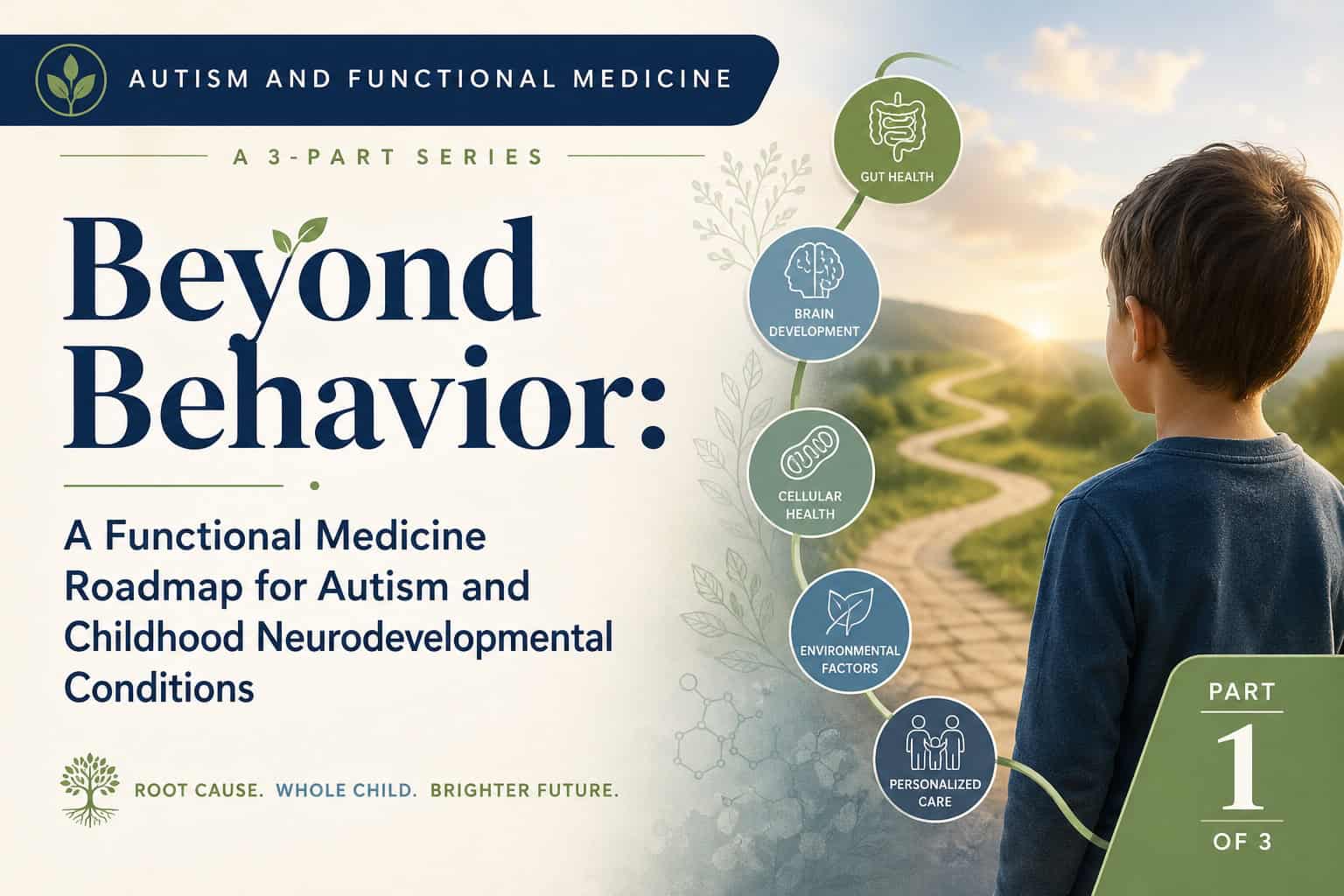
Part 1 of a 3-part series — Why the most promising path forward treats autism as a whole-body condition, not just a brain disorder
By Dr. Jill C. Carnahan, MD | April 2026 | Functional Medicine, Pediatric Health, Neurodevelopment
In the quiet of my consultation room, I have sat with countless mothers who carry a particular weight in their eyes. They have read the parenting books. They have driven their child to forty hours a week of therapy. They have heard, sometimes from well-meaning professionals and sometimes from family members, that there is nothing more to do beyond behavioral support. And yet they sense, with the deep intuition only a parent has, that something else is going on in their child’s body. Something that medicine has not yet fully explained to them.

They are right.
Autism spectrum disorder (ASD) is, by current diagnostic definition, a behavioral condition. But the body of research that has accumulated over the past three decades tells a different and more hopeful story. Children on the spectrum, as a group, show measurable biological differences from their neurotypical peers: in their gut microbiomes, in their methylation pathways, in their oxidative stress markers, in their mitochondrial function, in their immune regulation, and in their nutrient status. None of these findings define autism. None of them are universal. But for the individual child sitting across from us, identifying and gently correcting these biological imbalances can meaningfully change their daily experience, their capacity to learn, and their ability to engage with the world.
This is the foundational premise of the functional medicine approach. And it is the subject of this three-part series.
What This Series Is, and What It Is Not
Before we go any further, I want to be precise about what I am offering and what I am not.
This series is not a cure narrative. Autism is not something to be cured, and the language of “fixing” or “recovering” children misses the deeper truth that every child is whole, beloved, and bears the image of God exactly as they are. What this series offers instead is a careful look at the biological co-conditions that frequently accompany autism, the published evidence supporting their treatment, and a framework for parents and practitioners to think clearly about which interventions are worth considering.
This series is also not a replacement for behavioral, speech, occupational, or developmental therapies. Applied behavior analysis, naturalistic developmental behavioral interventions, speech-language pathology, sensory integration, and educational support remain the cornerstone of evidence-based care, and none of the biological interventions discussed here should ever displace them. What functional medicine offers is something complementary: the systematic identification and correction of underlying physiological factors that, when present and untreated, can amplify symptoms, increase distress, and limit a child’s ability to fully benefit from those behavioral therapies.
Finally, this series is not for self-diagnosis or self-treatment. Each child is unique, and the protocols discussed here should be implemented under the guidance of a qualified functional medicine practitioner who can order appropriate testing, individualize therapy, and monitor for response and safety.
The State of the Evidence in 2026
I want to begin with honesty, because that is what trust requires.
In December 2025, the journal Nature Human Behaviour published a comprehensive umbrella review by Gosling and colleagues that examined every published meta-analysis of complementary, alternative, and integrative medicine (CAIM) interventions for autism. Their conclusion was sobering: there is currently no high-quality evidence to support the efficacy of any single CAIM intervention for the core features of autism. Several therapies showed promising signals, but the certainty of the evidence base was rated as low or very low across the field [1].
Some readers will find that conclusion discouraging. I find it clarifying.
Here is what that finding actually tells us. Autism is heterogeneous. It is not one condition with one cause and one treatment. The clinical trials conducted to date have largely treated children with autism as a monolithic group, given them a single nutraceutical or therapy, and measured average effects. When you do that with a condition this biologically diverse, you almost guarantee modest average effects with high variability. Some children respond dramatically. Others do not respond at all. The average looks unimpressive even when individual responses are profound.
A different review, published in January 2025 by Persico and colleagues in Progress in Neuro-Psychopharmacology and Biological Psychiatry, took a more nuanced approach. They systematically reviewed 115 randomized controlled trials covering 133 different compounds for autism. Their conclusion was meaningfully different. While most compounds had insufficient evidence, a small subset of nutraceuticals showed promising efficacy combined with a high safety profile and could already be considered, with due caution, for clinical use [2]. Those six were:
- Folinic acid (leucovorin)
- N-acetylcysteine (NAC)
- L-carnitine
- Coenzyme Q10
- Sulforaphane
- Metformin
This is the foundation we will build on across this series. We will look at these therapies in depth in Part 3. The broader point is this: the evidence base supports a personalized, biomarker-guided, multi-modal approach, not a single magic intervention. That is exactly what functional medicine has always offered.
The Five Biological Pillars in Autism
Across thousands of pages of published research, five biological domains keep appearing as consistently disrupted in subsets of children with autism. Understanding these pillars is the first step in understanding why a whole-body approach makes sense.
Pillar 1: Gut-Brain Dysregulation
In 2010, Pediatrics published a consensus report from a panel of gastroenterologists, neurologists, and developmental pediatricians (Buie et al.) acknowledging what families had been saying for years: gastrointestinal problems are common in children with autism and warrant the same medical attention they would receive in any other child [3]. Dysbiosis (imbalanced gut bacteria), increased intestinal permeability, lactase deficiency, and chronic constipation or diarrhea show up at much higher rates in this population. We will explore this pillar in depth in Part 2 of this series.
Pillar 2: Methylation and Oxidative Stress
Dr. Jill James and her colleagues at the University of Arkansas published a series of papers, beginning with a landmark 2004 study in the American Journal of Clinical Nutrition, demonstrating that children with autism show measurable abnormalities in the methionine-homocysteine-glutathione cycle [4]. They tend to have lower S-adenosylmethionine (SAM, the body’s primary methyl donor), lower cysteine, lower reduced glutathione (the master antioxidant), and a higher ratio of oxidized to reduced glutathione (a direct measure of oxidative stress). This is biochemistry that touches every cell in the body, and we will return to it in Part 3.
Pillar 3: Mitochondrial Dysfunction
Mitochondria are the energy factories of the cell, and the brain consumes about 20 percent of the body’s energy. A 2012 systematic review and meta-analysis by Rossignol and Frye in Molecular Psychiatry found that mitochondrial dysfunction is present in a meaningful subset of children with autism, well above general population rates [5]. This is distinct from primary mitochondrial disease (a rare genetic condition) and refers instead to acquired or partial impairments that respond to nutritional support.
Pillar 4: Immune Dysregulation
Multiple studies have documented elevated inflammatory cytokines, autoantibodies, and immune system imbalances in children with autism. The folate receptor alpha autoantibodies (FRAAs), found in 58 to 76 percent of children with autism according to a 2021 meta-analysis by Rossignol and Frye, are perhaps the best characterized example [6]. PANS and PANDAS (post-infectious neuropsychiatric syndromes) are now recognized as treatable conditions that can present with autism-like symptoms.
Pillar 5: Toxic Burden and Environmental Contributors
A 2007 study in Environmental Health Perspectives by Roberts and colleagues found that maternal residence near agricultural pesticide applications during pregnancy was associated with a significantly higher risk of autism in the child [7]. A 2014 follow-up by Shelton in the same journal extended these findings [8]. Heavy metals, mold mycotoxins, indoor air pollutants, and endocrine disruptors all contribute to the toxic load that children with developmental vulnerabilities may struggle to detoxify efficiently. For more on the connection between environmental toxin exposure and chronic disease, see my prior writing on the shocking truth about pesticides in your food and mold and mycotoxin illness.
Why Early Intervention Matters
The brain of a young child is extraordinarily plastic. The connections being built between birth and age six lay down patterns that influence learning, behavior, and emotional regulation for a lifetime. This is why behavioral early intervention is so effective, and it is also why biological optimization during these same years can compound the gains.
I do not want any parent to read these words and feel that a window is closing. Healing is possible at every age, and I have seen meaningful improvements in teenagers and young adults who began functional medicine support late in their journey. The practical reality is this: the earlier we identify and address gut dysfunction, methylation impairment, mitochondrial weakness, and nutrient deficiencies, the more those corrections support the brain’s natural growth trajectory.
This is why I encourage families not to wait for “more research” or “more certainty” before acting on the evidence we already have. The interventions discussed in this series are, for the most part, low-risk, well-tolerated, and grounded in basic nutritional and biological principles. The cost of waiting is the cost of not optimizing the foundation while the building is still going up.
Foundation 1: A Real-Food, Anti-Inflammatory Diet
Nothing replaces food. No supplement, no medication, no therapy can compensate for a diet built on artificial colors, refined sugar, and ultra-processed ingredients. This is true for every child, and it is especially true for the child whose biology is already operating under increased stress.
A 2007 randomized, double-blind, placebo-controlled trial published in The Lancet by McCann and colleagues examined the effect of artificial food colors and sodium benzoate on 297 typically developing British children [9]. The researchers found that these additives, at doses commonly found in everyday foods, caused measurable increases in hyperactivity in both three-year-olds and eight-year-olds. This was not a study of children with autism, but the implications extend to any child whose nervous system may be more sensitive to chemical inputs.
The functional medicine dietary foundation for a child with autism includes:
- Three to four servings of nutritious vegetables and one to two servings of fruit daily. Color variety matters: dark leafy greens, cruciferous vegetables, berries, and root vegetables provide the polyphenols, fiber, and micronutrients the developing brain needs.
- One to two servings of clean protein daily from pasture-raised animal sources, wild-caught fish, eggs, or properly prepared legumes. Protein supplies the amino acid building blocks for neurotransmitters, glutathione, and structural proteins.
- Avoidance of artificial colors, flavors, preservatives, and high-fructose corn syrup. These compounds are exactly the toxins that already-stressed detoxification pathways are least equipped to handle.
- Organic foods when feasible, particularly for the foods on the Environmental Working Group’s “Dirty Dozen” list. The Roberts and Shelton studies cited above are part of a growing literature linking pesticide exposure to neurodevelopmental risk.
- Healthy fats, especially omega-3 fatty acids, from cold-water fish, pasture-raised eggs, and high-quality fish oil supplementation. The developing brain is roughly 20 percent omega-3 by weight, and four published studies have found that children with autism, as a group, have lower omega-3 levels than typical children [10].
A high-quality omega-3 supplement, such as Omega Essentials from Dr. Jill Health, can fill the omega-3 gap in children whose dietary intake is limited. I generally recommend a starting dose of approximately 30 mg/kg of combined EPA and DHA daily, with adjustment based on response and red blood cell fatty acid testing.
Foundation 2: Identifying Food Sensitivities
Many children with autism have measurable food reactions. These can be classic IgE-mediated allergies (immediate, sometimes severe) or non-IgE-mediated sensitivities (delayed, often gastrointestinal or behavioral). Three studies by Jyonouchi and colleagues found higher rates of food-protein hypersensitivities in children with autism compared to typical children, and these reactions correlated with both gut symptoms and behavioral changes [11].
The honest evidence picture for the gluten-free, casein-free (GFCF) diet is mixed. Some studies, like the 2010 ScanBrit randomized single-blind trial by Whiteley and colleagues, found significant benefits in communication and social interaction subscores after twelve months [12]. Other studies, such as Hyman et al. 2016, found no significant benefit on standardized measures over a shorter twelve-week trial [13]. My clinical reading of this literature is that GFCF helps a meaningful subset of children, particularly those with documented immune reactivity to gluten or casein, with intestinal permeability, or with significant gut symptoms. It does not help every child, and the trial period needs to be long enough (at least three months for gluten) to fairly assess.
The gold-standard test remains an elimination-and-reintroduction trial under clinical supervision. A diet log kept during the trial can capture patterns that lab testing alone may miss.
Foundation 3: Correcting Nutritional Deficiencies
In 2011, James Adams and colleagues published a randomized, double-blind, placebo-controlled trial in BMC Pediatrics of a comprehensive vitamin and mineral supplement in 141 children and adults with autism [14]. The treatment group showed statistically significant improvements in expressive language, hyperactivity, tantrums, and overall symptoms on the Parent Global Impressions-Revised. They also improved on multiple objective biomarkers: SAM, plasma uridine, glutathione redox status, NADH, and plasma nitrotyrosine.
A companion study published the same year found that, compared to neurotypical peers, the children with autism had measurably lower levels of biotin, lithium, calcium, magnesium, and several other nutrients, and the severity of autism correlated with the degree of nutrient depletion [15].
This is one of the strongest single signals in the autism nutritional literature, and yet it is rarely emphasized in mainstream care. A high-quality, comprehensive vitamin and mineral foundation, ideally guided by individualized testing, is one of the most evidence-based starting points a family can take. Key components include:
- Methylated B vitamins, particularly methylfolate (or folinic acid), methylcobalamin (B12), and pyridoxal-5-phosphate (active B6). The 2004 James paper specifically noted that ordinary folic acid is insufficient for many children with autism, who appear to need methylated forms. Activated B Complex from Dr. Jill Health provides these nutrients in their bioavailable forms.
- Vitamin D3 with vitamin K2. Vitamin D supports immune regulation, and several studies have found lower D status in children with autism. Vitamin D3/K2 combines these synergistic nutrients.
- Comprehensive mineral support, including magnesium, zinc, and selenium. Many children with autism show low red blood cell levels of these essential minerals. Mineral Essentials is a comprehensive solution.
- Omega-3 essential fatty acids, as discussed above. LINK HERE to my Omega with high DHA for children’s brain and focus support.
I cannot stress enough that supplementation should be guided by testing whenever possible. Over-supplementation can be as problematic as deficiency, and what one child needs is rarely what another child needs.
Working with a Functional Medicine Practitioner
The framework above is the foundation any family can begin with. Beyond it, advanced testing and individualized protocols benefit greatly from a clinician trained in this approach. Here is what to look for.
A practitioner who is board-certified in their primary specialty (typically pediatrics, family medicine, or developmental-behavioral pediatrics) and who has additional training in functional medicine, ideally through the Institute for Functional Medicine (IFM) or a comparable program. Look for someone willing to partner with your child’s developmental therapists, behavioral team, and primary care pediatrician rather than positioning themselves as an alternative to mainstream care. The best outcomes happen when functional medicine, behavioral therapy, and conventional medical care work together.
A clinician who emphasizes testing before treatment when feasible, who explains the rationale for each intervention, and who sets realistic timelines. Real progress in this work is measured in months and years, not weeks.
Realistic expectations matter. Not every child responds to every intervention. Some respond dramatically to one therapy and not at all to another. Some show their gains in subtle ways (better sleep, fewer meltdowns, improved gut symptoms) before language and social gains follow. Trust the process, document the changes, and adjust the protocol based on what your child’s body is telling you.
A Closing Reflection
I want to end this first installment with a word to the parents reading.
You are not failing your child. The exhaustion you feel is real, and the love that drives you to read articles like this one at midnight, after a long day of therapies and behaviors and worries, is one of the most beautiful things I encounter in my practice.
The path forward is rarely linear. It is often two steps forward, one step back. There will be seasons when nothing seems to be working and seasons when small breakthroughs come in clusters. Through it all, your child is teaching you something profound about presence, patience, and the radical worth of every human being exactly as they are.
In my own life, I have walked through years of chronic illness when the evidence of healing was hidden and the work felt invisible. What sustained me was not certainty about outcomes but trust in the goodness of the One who walks with us through every valley. I pray the same for you.
Lord, give these parents the strength they need for today, the wisdom to discern the next right step, and the peace that surpasses understanding. Surround their children with healing, with love, and with people who see them fully. And let every small victory remind them that they are not alone on this road.
In Part 2 of this series, we will go deep on the gut-brain connection in autism: the dysbiosis signature, the antibiotic story, the digestive enzyme research, and the remarkable work being done with microbiota transfer therapy at Arizona State University.
In Part 3, we will turn to the six most evidence-based biochemical therapies, with a particular focus on folinic acid for cerebral folate deficiency, N-acetylcysteine, and the methylation-glutathione protocol.

Until then, take heart. The road is long, but you are not walking it alone.
Related Articles on Dr. Jill’s Blog
- The Shocking Truth About the Pesticides in Your Food
- MTHFR Mutations and Methylation: A Functional Medicine Primer
- Psychobiotics: How Gut Bacteria Shape Brain and Behavior
- Mycotoxins and Your Brain
References
1. Gosling CJ, Boisseleau L, Solmi M, et al. Complementary, alternative and integrative medicine for autism: an umbrella review and online platform. Nat Hum Behav. 2025;9(12):2610. doi:10.1038/s41562-025-02256-9
2. Persico AM, Asta L, Chehbani F, et al. The pediatric psychopharmacology of autism spectrum disorder: A systematic review — Part II: The future. Prog Neuropsychopharmacol Biol Psychiatry. 2025;136:111176. doi:10.1016/j.pnpbp.2024.111176
3. Buie T, Campbell DB, Fuchs GJ III, et al. Evaluation, diagnosis, and treatment of gastrointestinal disorders in individuals with ASDs: a consensus report. Pediatrics. 2010;125 Suppl 1:S1-S18. doi:10.1542/peds.2009-1878C
4. James SJ, Cutler P, Melnyk S, et al. Metabolic biomarkers of increased oxidative stress and impaired methylation capacity in children with autism. Am J Clin Nutr. 2004;80(6):1611-1617. doi:10.1093/ajcn/80.6.1611
5. Rossignol DA, Frye RE. Mitochondrial dysfunction in autism spectrum disorders: a systematic review and meta-analysis. Mol Psychiatry. 2012;17(3):290-314. doi:10.1038/mp.2010.136
6. Rossignol DA, Frye RE. Cerebral folate deficiency, folate receptor alpha autoantibodies and leucovorin (folinic acid) treatment in autism spectrum disorders: a systematic review and meta-analysis. J Pers Med. 2021;11(11):1141. doi:10.3390/jpm11111141
7. Roberts EM, English PB, Grether JK, Windham GC, Somberg L, Wolff C. Maternal residence near agricultural pesticide applications and autism spectrum disorders among children in the California Central Valley. Environ Health Perspect. 2007;115(10):1482-1489. doi:10.1289/ehp.10168
8. Shelton JF, Geraghty EM, Tancredi DJ, et al. Neurodevelopmental disorders and prenatal residential proximity to agricultural pesticides: the CHARGE study. Environ Health Perspect. 2014;122(10):1103-1109. doi:10.1289/ehp.1307044
9. McCann D, Barrett A, Cooper A, et al. Food additives and hyperactive behaviour in 3-year-old and 8/9-year-old children in the community: a randomised, double-blinded, placebo-controlled trial. Lancet. 2007;370(9598):1560-1567. doi:10.1016/S0140-6736(07)61306-3
10. Bell JG, Miller D, MacDonald DJ, et al. The fatty acid compositions of erythrocyte and plasma polar lipids in children with autism, developmental delay or typically developing controls and the effect of fish oil intake. Br J Nutr. 2010;103(8):1160-1167. doi:10.1017/S0007114509992881
11. Jyonouchi H, Geng L, Ruby A, Zimmerman-Bier B. Dysregulated innate immune responses in young children with autism spectrum disorders: their relationship to gastrointestinal symptoms and dietary intervention. Neuropsychobiology. 2005;51(2):77-85. doi:10.1159/000084164
12. Whiteley P, Haracopos D, Knivsberg AM, et al. The ScanBrit randomised, controlled, single-blind study of a gluten- and casein-free dietary intervention for children with autism spectrum disorders. Nutr Neurosci. 2010;13(2):87-100. doi:10.1179/147683010X12611460763922
13. Hyman SL, Stewart PA, Foley J, et al. The gluten-free/casein-free diet: a double-blind challenge trial in children with autism. J Autism Dev Disord. 2016;46(1):205-220. doi:10.1007/s10803-015-2564-9
14. Adams JB, Audhya T, McDonough-Means S, et al. Effect of a vitamin/mineral supplement on children and adults with autism. BMC Pediatr. 2011;11:111. doi:10.1186/1471-2431-11-111
15. Adams JB, Audhya T, McDonough-Means S, et al. Nutritional and metabolic status of children with autism vs. neurotypical children, and the association with autism severity. Nutr Metab (Lond). 2011;8(1):34. doi:10.1186/1743-7075-8-34
About Dr. Jill Carnahan
Dr. Jill Carnahan is Your Functional Medicine Expert®, dually board certified in Family Medicine and in Integrative Holistic Medicine. She is the Medical Director of Flatiron Functional Medicine, a widely sought-after practice with a broad range of clients including world-renowned physicians, athletes, and corporate executives. She offers consultations both in-person and via telemedicine. She is the host of the popular Resiliency Radio podcast and Executive Producer of Doctor/Patient, the documentary that aims to change the way we look at our healthcare system. She is a survivor of breast cancer and Crohn’s disease, an internationally renowned speaker, and the author of Unexpected: Finding Resilience through Functional Medicine, Science, and Faith.
Connect with Dr. Jill: jillcarnahan.com | Resiliency Radio | Doctor/Patient documentary | Read Unexpected | @DrJillCarnahan on Instagram
The information in this article is for educational purposes only and is not intended to diagnose, treat, cure, or prevent any disease. The information provided is not a substitute for professional medical advice, diagnosis, or treatment. Please consult with your physician or other qualified healthcare provider before making any changes to your health regimen. The products mentioned are not intended to diagnose, treat, cure, or prevent any disease.







Share: