


Welcome to Resiliency Radio with Dr. Jill Carnahan, where today’s episode explores the powerful and transformative season of midlife—a time of hormonal shifts, identity changes, and profound personal reinvention. Dr. Jill is joined by Dr. Trevor Cates, bestselling author and pioneer in women’s health, for an inspiring conversation about navigating perimenopause, purpose, and the courage to evolve.
In this episode, Dr. Jill Carnahan and Dr. Cates discuss why midlife isn’t a crisis—it’s a reset. From hormonal fluctuations and metabolic changes to deeper emotional awakenings, this phase often acts as a “stress test,” revealing what’s no longer aligned in our health, work, and relationships.
This conversation is for women who feel called to something more—more energy, more authenticity, more purpose—and want practical, holistic strategies to support both physical and emotional transformation.
✨ Like, subscribe, and share to help more women embrace midlife as a powerful new beginning.
🔑 Key Topics You'll Discover with Dr. Trevor Cates
① Midlife as a Stress Test
⇨ Why perimenopause often surfaces unresolved health, emotional, and identity issues—and how this creates opportunity for growth.
② Hormones, Gut Health & Metabolism
⇨ How shifting estrogen and progesterone levels impact inflammation, sleep, mood, and metabolic resilience.
③ Identity Shifts & Limiting Beliefs
⇨ Why many women struggle with “Who am I now?” and how awareness dissolves self-doubt and fear of reinvention.
④ Daily Habits that Anchor Transformation
⇨ The power of sleep, mindful mornings, nourishing food, movement, and time in nature.
⑤ The Role of Human Connection & Courage
⇨ Why authentic relationships, surrender, and inspired action are essential for midlife fulfillment.
🔑 Key Takeaways with Dr. Trevor Cates
⇨ Midlife is not decline—it’s a powerful invitation to reset and redefine
⇨ Hormonal changes amplify underlying health and emotional patterns
⇨ Awareness of limiting beliefs is the first step toward reinvention
⇨ Small daily habits create massive long-term resilience
⇨ Connection, purpose, and rest are as vital as productivity
About Dr. Trevor Cates
Dr. Trevor Cates is a USA Today and Amazon bestselling author of Clean Skin From Within and Natural Beauty Reset. She was the first woman licensed as a naturopathic doctor in California and brings over 25 years of experience in women’s health, functional medicine, and integrative dermatology.
Dr. Cates founded and later sold a successful natural skincare and supplement company rooted in her clinical work helping women achieve vibrant health from the inside out. Today, she focuses on patient care and mentoring health and wellness entrepreneurs, empowering women to navigate midlife with clarity, resilience, and confidence.
🔗 Website: https://drtrevorcates.com/
Dr. Jill Carnahan, MD – Leading Functional Medicine Doctor
Dr. Jill Carnahan, MD, ABIHM, ABoIM, IFMCP is internationally recognized as one of the most respected leaders in functional and integrative medicine. She is dually board-certified in Family Medicine and Integrative Holistic Medicine, and the founder and medical director of Flatiron Functional Medicine in Louisville, Colorado.
Widely known as a pioneer in environmental toxicity, mold-related illness, autoimmune disease, and resilience medicine, Dr. Carnahan combines cutting-edge science with compassionate, root-cause care. Her clinical approach integrates precision genomics, epigenetics, microbiome research, peptide therapy, and lifestyle interventions to transform health outcomes for patients worldwide.
She is the author of the best-selling memoir Unexpected, which weaves her personal journey through cancer, Crohn’s disease, and mold-related illness with her professional expertise. Dr. Carnahan is also the executive producer of the award-winning documentary Doctor/Patient and the host of the popular podcast Resiliency Radio, which reaches over 500,000 global subscribers.
As an international keynote speaker, Dr. Carnahan has been featured at leading medical conferences including A4M, IFM, EPIC, and IPM Congress, and her work is frequently highlighted in major media outlets such as NBC, CBS, Fox News, Forbes, Parade, People, and MindBodyGreen.
With a reputation as both a scientist and a healer, Dr. Jill Carnahan is regarded as one of the top functional medicine doctors in the world, offering a unique blend of evidence-based research, innovation, and deeply personalized care.
The Podcast with Dr. Trevor Cates
The Video with Dr. Trevor Cates
- Midlife as Opportunity: Midlife presents challenges that can be reframed as opportunities, promoting self-awareness and growth.
- Limiting Beliefs: Common fears about age and success block career changes; awareness is the first step to overcoming them.
- Finding Balance: New ambitions require prioritizing time and energy; timing is key to pursuing passions after major life transitions.
- Authenticity Matters: Copying others leads to frustration; embracing one's own story fosters genuine engagement and prevents burnout.
- Holistic Patient Care: An integrative approach, including extended visits, improves midlife health outcomes by addressing both physical and emotional issues.
- Resilience Through Change: Embracing life transitions with courage can transform challenges into renewed energy and purpose.
Notes
Midlife Transition and Personal Reinvention
Midlife brings a powerful mix of challenge and opportunity that demands self-awareness and intentional reinvention.
- Midlife as a Stress Test and Opportunity (06:55)
- Dr. Trevor Cates described midlife as a time when unresolved health and emotional issues surface strongly.
- Hormonal changes worsen gut, metabolic, inflammatory, and autoimmune conditions already present.
- Emotional challenges rise as life roles shift, such as children growing up or caring for aging parents.
- Viewing these challenges as opportunities for awakening and growth shifts mindset from victim to empowered.
- Common Limiting Beliefs in Midlife Business Shifts (09:20)
- Many clients struggle with fears about starting or pivoting careers due to age, visibility, or success anxiety.
- Life’s busyness creates excuses, and internalized beliefs like “Who am I to do this?” hold people back.
- Dr. Cates emphasized awareness of these beliefs as the first step toward change.
- She encourages clients to decide if they want to face these challenges or postpone transformation.
- Balancing Overwhelm with New Endeavors (12:10)
- Adding new ambitions requires letting go of other commitments due to limited time and energy.
- Dr. Cates advises finding the right timing—for example, after children leave home or a job ends—to start new projects.
- She uses guided meditations to help clients visualize doors closing and opening, fostering awareness of new possibilities.
- This approach helps clients recognize moments when time becomes available to pursue passions.
- Faith and Stepping Into Uncertainty (17:20)
- Dr. Jill and Dr. Cates agreed that taking the first step without knowing all details requires faith.
- They described stepping out in faith as essential to uncovering opportunities and receiving support.
- Waiting for perfect timing or full clarity often leads to delay and missed chances.
- Letting go of burdens and surrendering control frees energy for new growth, supported by a higher power or community.
Authenticity and Alignment in Career and Business
Authenticity and alignment with one’s inner voice are essential to avoiding burnout and finding success.
- Avoiding the Pitfall of Copying Others (21:10)
- Dr. Cates shared that trying to mimic others’ paths often leads to “closed doors” and frustration.
- She teaches that a cookie-cutter approach lacks authenticity and is easily sensed by others.
- Listening to one’s own passion and story creates more sustainable energy and business success.
- This mindset reduces burnout by fostering genuine engagement rather than forced effort.
- Alignment as a Core Business Framework (22:50)
- Dr. Cates incorporated an “alignment framework” in her mentorship program to guide clients toward authentic business paths.
- Dr. Jill reflected that when marketing or selling aligns with personal values, products sell more naturally.
- Alignment also means knowing one’s strengths, limitations, and resourcefulness gained through experience.
- This approach helps midlife entrepreneurs navigate complex life demands with clarity and confidence.
- Daily Habits Supporting Success (23:30)
- Dr. Cates prioritized a good night’s sleep as foundational for energy and hormone balance.
- Meditation and prayer early in the day provide calm and center focus amidst busy schedules.
- Nutrient-rich whole foods fuel the body to sustain productivity and health.
- Daily time in nature—sunlight, fresh air, and outdoor movement—boosts mood and productivity.
- Shifting from Old Productivity Models (26:00)
- There is a cultural move away from long, intense work hours toward valuing rest, creativity, and play.
- Younger generations emphasize meaningful work over sheer output, influencing older generations.
- Dr. Cates and Dr. Jill noted technology like AI can offload mundane tasks, freeing people to focus on meaningful work.
- However, they warned that technology must not replace vital human connection.
Human Connection and Resilience in Midlife
Sustaining human connection is critical to emotional health and resilience during midlife transitions.
- Importance of Physical Touch and Relationships (28:50)
- Dr. Cates explained that declining hormones reduce neurotransmitters that regulate mood and connection.
- Physical touch and close relationships support oxytocin and GABA, essential for emotional well-being.
- Lack of human connection intensifies feelings of emptiness and stress, especially in midlife.
- She emphasized nurturing relationships with partners, friends, and community as a resilience foundation.
- Technology's Double-Edged Role (28:30)
- While AI and digital tools help with efficiency, excessive screen time risks deepening social disconnection.
- Dr. Jill stressed no technology can replace hugs, walks with friends, or physical presence.
- Both speakers highlighted the need to consciously protect and prioritize real human interactions.
- This balance supports mental health and counters the isolating effects of modern life.
Comprehensive Patient Care and Midlife Health
Holistic, attentive care that integrates physical and emotional aspects drives better midlife health outcomes.
- Patient-Centered, Integrative Approach (31:30)
- Dr. Cates described seeing patients with complex midlife issues spanning hormones, gut health, metabolism, and inflammation.
- She noted frustration with the fragmented medical system where patients get limited time and piecemeal advice.
- Providing extended visits and pulling together all health issues creates a complete picture and tailored plan.
- This approach helps patients feel heard and supported, which is key to healing.
- Six-Month Follow-Up Protocol (33:40)
- Dr. Cates prefers patients commit to about six months of care with visits every three weeks.
- This regular follow-up allows ongoing assessment of symptoms, labs, and life changes, ensuring responsiveness.
- She customizes treatments including bioidentical hormones, supplements, and adaptogens to restore balance and calm.
- Patients report relief not only physically but also in emotional resilience and life satisfaction.
- Addressing Root Causes Beyond Symptoms (35:15)
- One patient’s primary issue was job dissatisfaction rather than physical illness, illustrating the mind-body link.
- Encouraging patients to identify and resolve life stressors can be the most effective health intervention.
- This patient quit her job, resulting in symptom resolution and improved quality of life without further medical visits.
- Dr. Cates emphasized the power of honest conversations to uncover underlying causes of health issues.
- The Healing Power of Being Heard (32:00)
- Dr. Cates stressed the importance of simply holding space for patients to share their stories.
- Patients often lack this attentive listening in conventional care, making it a therapeutic act itself.
- Feeling understood strengthens the therapeutic alliance and supports emotional and physical healing.
- This collaborative relationship contrasts with technology-driven or rushed care and builds trust.
Inspiration and Resilience Stories
Midlife challenges can lead to profound transformation and renewed purpose when embraced with courage.
- Transformation Through Career and Life Changes (35:50)
- The patient who quit her unhappy job found new energy, relationships, and excitement for life.
- Dr. Jill and Dr. Cates both reflected on personal stories where difficult transitions became best life events.
- Divorce, career shifts, and losses often open doors to new growth and alignment with true desires.
- These stories illustrate the potential to rewrite midlife narratives from crisis to opportunity.
- Resilience as an Active Process (37:30)
- Dr. Jill framed resilience as responding to challenges by stepping out in faith and trusting new paths.
- Both speakers highlighted the importance of mindset shifts to see life changes as catalysts, not setbacks.
- Embracing uncertainty and surrendering control opens space for unexpected support and opportunities.
- Their insights encourage listeners to approach midlife with openness and self-compassion.
Resources and Next Steps
Practical ways for listeners to engage with Dr. Trevor Cates and continue their own midlife growth journeys.
- Access to Mentorship and Patient Care (37:55)
- Dr. Cates offers mentorship for health, wellness, and skin entrepreneurs through her website DrTrevorCates.com.
- She also provides clinical care for patients looking for integrated, personalized midlife health support.
- The website includes details on working directly with her and resources for practitioners.
- Connecting with her enables access to her 25 years of expertise in women’s health and entrepreneurship.
- Continued Learning and Support (00:00 – 01:18)
- Dr. Jill’s clinic, Flatiron Functional Medicine, accepts new patients and offers free intro calls for fit assessment.
- Her documentary on healing chronic illness is widely available for free and has inspired many viewers.
- Listeners are encouraged to subscribe to Resiliency Radio for weekly insights on health, healing, and personal growth.
- Sharing episodes with friends and family expands support for people navigating midlife and health transitions.
Transcript
00:00
Dr. Jill Carnahan, MD
Hey everybody. Welcome to Resiliency Radio, your go to podcast for the most cutting edge insights integrative and functional medicine. I'm your host Dr. Jill and with each episode we dive into the heart of healing and personal transformation. Join me as we interview thought leaders, innovative experts and medical leaders of all types, hopefully helping you on your way to transformation and optimal performance and longevity. Today you will love our episode with Dr. Trevor Cates where we talk about the midlife and the transition between job or things desires that you might have to go outside the box and do something new. If you are in that place and struggling with the load of what you're doing and you want to do something different, you will really enjoy this episode and I will introduce our guest Dr. Cates in just a moment.
00:48
Dr. Jill Carnahan, MD
Just a reminder, if you're looking for a functional medicine expert, our clinic, Flatiron Functional Medicine is accepting new patients. You can call us at 303-993-7910 for more information or a free 10 minute introduction call to see if it's a good f. You can also Visit my website jillcarnahan.com and take a look at our practitioners and we can answer any questions that you might have about that. Also, if you haven't yet seen my documentary, it's Doctor Patient movie.com it's Doctor Patient. It's now also available on Amazon Prime, YouTube or to be with commercials for free. And it has really impacted so many of you. I've heard from a lot of you and I really appreciate those of you who have seen the documentary that you've shared it with the loved ones or people might be suffering from a chronic illness.
01:36
Dr. Jill Carnahan, MD
To me it was a way to bring to the world inspiration and a story of not only my patients and myself, of overcoming incredible obstacles and healing from chronic illness including Crohn's and cancer and mold related illness. So please check it out it there are free versions. You don't even have to pay for this@doctor patient movie.com okay, let's go ahead and introduce our guests. Dr. Trevor Cates is a best selling author of Clean Skin From Within A Natural Beauty Reset. She founded and later sold a natural skin care and supplement company rooted in her clinical work helping women achieve radiant health from the inside out. She is the first woman licensed as a naturopath in California and she brings 25 years of experiences on women's health and now helping healthcare practitioners and entrepreneurs. So let's welcome Dr. Trevor Cates.
02:26
Dr. Jill Carnahan, MD
Dr. Cates, you are a friend and colleague. I have the deepest respect for your work. And we've been in the same circles, floating around different masterminds in many things for over a decade. Like, literally, I've known you for a long time. We just caught up to speed a little before we got on here to record. And you've been through a lot in the last few years that I think will be really relevant to our listeners. And no matter where you're out there, whether you're raising kiddos or you're in a business, or you just sold your business or you're figuring out how to balance your life, I feel like the biggest thing that's coming up for most women that are around our ages and that listen to this podcast is life is shifting, right? And we have to shift with it. And it's like this.
03:04
Dr. Jill Carnahan, MD
We're on this way wave, and we're not quite sure where it's going. And we have to really transition and also recreate ourselves. Like, what do we really want? What really matters? And so I know, as I'm saying, that some of you out there listening can relate to this feeling of, like, either uncertainty or just what's going on in the world. And also just maybe, like, I don't know if I love what I was doing before, and I do. Shit. So that's a framework of kind of where we're going today. But as we start, I want to just hear a little bit about your journey because you've been multi passionate entrepreneur, as Marie orally would say. You've done lots of different things, kind of. How did you get into medicine and then skin care and give us a little bit of your story?
03:43
Dr. Trevor Cates
Yeah, absolutely. Well, thank you. I'm excited to talk about all of this today. So, as a kid, I was sick a lot, and I had a lot of allergies, but I would end up with skin issues, recurring upper respiratory tract infections. And I just remember feeling miserable, missing school all the time. And my parents took me to see all different types of doctors, and I would have an allergic reaction or an adverse reaction to every single thing I was given. And so my parents didn't give up, though. They kept searching. And finally they found a holistic practitioner that they took me to. And it was the one thing that really turned my health around. And I remember at 11 years old thinking, why didn't any of these doctors mention this approach before? Why.
04:28
Dr. Trevor Cates
Why did it take me to go through all of this to finally get relief? And so it planted a seed early on. And then when I learned about naturopathic Medical school when I was an undergradu, I thought, this is my path, this is where I need to go. And so becoming a naturopathic physician, it's just been so rewarding and it's taken a lot of different twists and turns that I didn't expect. I graduated from Nature Medical School 25 years ago, which is so hard to believe. And I was the first woman licensed as a naturopathic doctor in California. So I practiced there. And then when I moved to Utah, I was. I worked at the Waldorf Astoria spa. And that gave me the idea to working there, gave me the idea to start a company, a skin care company. And I.
05:17
Dr. Trevor Cates
So I started that 10 years ago and then sold it three years ago. And in the meanwhile wrote a book on skin, wrote a book on hormones, Clean Skin from Within and Natural Beauty. Reset did a documentary series on women's health and hormones. And I really have done, I mean, lot with women's health over the last 25 years. And so I sold this book, the company, the Skin Care Company, a few years ago. And now I've got back to working with patients. And also now I'm mentoring health and wellness and skin entrepreneurs professionals to help them with their companies. And so it's. I see a lot of these people in midlife and, you know, I'm going through it too, so I see the challenges as well.
06:05
Dr. Jill Carnahan, MD
Well, I love this so much. And for those of you listening, you might not know, we actually got on and had an idea for another topic. We're going to talk about Gut Skin, which is we've done that before. So I will link to few other episodes. But as were talking, we thought, you know what? Most women I know in our sphere are struggling with their identity, their work. Are they still happy? Do they have balance? Do they still have play? Do they have joy? Do I want to solve? So all these questions are coming up and you and I just talk and said, let's talk about this topic because women and men need this. So what are you seeing? Because I feel like from last year was utter chaos for many people. Like, there was a lot of weird stuff going on.
06:45
Dr. Jill Carnahan, MD
There was crisis, there was loss of loved ones, there was pets died, there was illness. There was. And granted, some people did really well, made a lot of money, did well. But most of everyone that I know had also some very difficult things. And now we're shifting in kind of a new era and everybody can feel that collective consciousness is shifting around how we're going to do things. And it's Shifting so rapidly that it can be very unstable. What are you seeing as you talk to these professional women or people in your life? That is a common theme among those that you're talking to.
07:19
Dr. Trevor Cates
Yeah. So, I mean, I really think of midlife can. It's. It's like a stress test. So if we haven't addressed a lot of things in our life, it is. A lot of it just bubbles up to the surface. So it gives us an opportunity. Let's call it transitions as opportunities. Right. They can also be very challenging. But we know with challenge can come opportunities. And so that means that can be physically underlying issues like gut issues, inflammation, metabolic issues, nutritional deficiencies, anything that really you haven't had the time to pay attention to, or you just haven't had the resources to understand what was going on with your health if you haven't addressed those things. When you, when those hormones change, a lot of that stuff gets worse. And autoimmune disease can get worse.
08:10
Dr. Trevor Cates
People can all of a sudden be struggling with thyroid, metabolic issues, gut issues, pain, inflammation, and so those can happen. And then also all of the emotional things too. If you haven't addressed those things, this can kind of bubble up to the surface as well.
08:31
Dr. Jill Carnahan, MD
That was a really good framework because what I find is often, as I mentioned, a lot of difficulties that people have gone through. In the end, it's happening for us, not to us. And that shift really matters because if we look at it as a teacher and it's something that comes in and really allows us to awaken. I've had many awakenings, you know, illness, cancer, divorce. And each time, if I look back, I'm like, that was one of the best things that ever happened. I can honestly say to some of the most difficult things. What kinds of questions, as you mentor people, especially in the business world, what kind of questions are the big things that people are asking?
09:04
Dr. Trevor Cates
Well, I mean, I think that. I think whether someone is starting a company or they're just getting started, so maybe they pivot and they're like, they had one career and they're like, I want to do this now in the health and wellness space or have an idea for a product launch, or they've been doing, you know, they've been. Been in clinical practice for a while and they really want to scale. They want to sell their clinic and do something more. They, you know, whatever that is. I think what comes up a lot is people start having these limiting beliefs that just, they get stuck on. And so they, you know, they have this idea, and it's just still percolating. And they're like, but I don't know if I want to shift. It's so hard.
09:44
Dr. Jill Carnahan, MD
We.
09:45
Dr. Trevor Cates
When we're younger and everybody's encouraging you to get going, get started. But when you're in midlife and you're trying to piv. Shift or start something new, or maybe you've raised your kids and you haven't been working for a while and you want to go back to work, it can be really challenging to start that because there's so much that life keeps you busy. And then there are also all of those beliefs that people have fed you. Like, you know, who are you to do this? Or you're too old to do this or what? You know, are you. You know, I think a lot of it has to do with, like, success, growth, and scare of being. Being seen, being successful and what comes with that. So a lot of people have limiting beliefs around that. And.
10:32
Dr. Trevor Cates
And because, like I said, they're so busy in their lives anyway, it keep coming up with excuses.
10:39
Dr. Jill Carnahan, MD
Very, very wise. If someone's there and they're maybe listening, like, yeah, I think I kind of want to do this, but I'm scared or I don't know if I have time or. How would you suggest they start to examine those beliefs? Like, do you recommend journaling, having a. The therapists? I mean, where do they start to examine that and then start to shift those beliefs?
10:59
Dr. Trevor Cates
Yeah, I mean, the first thing is just being aware of it. I mean, that's the first thing in. And that's a huge step because most of the time people are going along, I have no idea what their limiting beliefs are or what their obstacles for whether it's healing, a healing journey or starting a company or growing your company is that. That you don't even know what it is. And so the first can be awareness. So you may listening to a podcast like this and go, wait a minute, this. This kind of sounds like something I need to pay attention to. So it's really a huge step. So we have to pause and acknowledge awareness because that alone, it can take people a while. And that might be the only step that people make first period of time. And.
11:46
Dr. Trevor Cates
And because, you know, these kinds of journeys, when you get to midlife, it's like, remember you're only you. Like that. We're talking about the middle here. We got, you know, so much more to do in our lives. So you don't have to. It don't feel like you have to fly through this. But the first step really is awareness and then deciding do I want to do something about it? Because some people might be like, yeah, I see that over there. But I don't want to deal with it, I'm too busy or that's going to be too painful. I don't want to open that Pandora's box, that can of worms. I don't know what's going to come out of there. And so then you have to decide, okay, after awareness is are you ready to do something about it?
12:27
Dr. Trevor Cates
And then it's like rolling up your sleeves and digging into to doing the.
12:32
Dr. Jill Carnahan, MD
Work that makes sense. So say someone's out there and they're like, I'm working a, you know, 60 hour a week job I'm taking care of. My kids are starting to get, you know, their high school, they're going to be in college soon and my aging parents are unwell and I'm taking care of them. And they're like the sandwich generation, right. Which is very common. And they have this idea or this passion that has been un developed. So inside side they're like this. There's something I've always wanted to do Art. I've always wanted to create a new business with this or create a product or do a service or be a coach. How do you take someone who feels overwhelmed with life as it is and encourage them because it really like you're like, well yeah, spend 20 more hours developing a new job. Right.
13:12
Dr. Jill Carnahan, MD
Or the dwelling a new, like that's kind of hard. How do you advise someone like that to actually do the first step when they already feel overwhelmed?
13:20
Dr. Trevor Cates
I know and it really is a, it is a big deal because is there is a limited amount of time. I mean we can, you know, kind of give ourselves some time grace and like manifest some time and here and there and that's all great. But the reality is if you've got an already very busy life and you're trying to add something in it, something is going to have to go in order to allow more time because you don't want to just pile more work on top of everything because you know how that goes. Then you burn yourself out. You get, you know, your adrenals are getting overworked, you cortisol goes up and your hormones further suppresses your hormones that are already declining. So we don't want to do that.
14:00
Dr. Trevor Cates
We don't want to increase, you know, stress out your body to the point where then that's making all your health issues worse. So I, I mean there's still a certain amount of self care. So sometimes it's a matter of finding the right timing. Is the timing right? You might have an idea and go like, okay, that's going to sit on a shelf for a little while, you know, I get my kids, you know, launched or whatever it is. And so I just became an empty nester not long ago and I was like, wow, this has freed up some time for me because my kids are all out of the house and I don't, I'm not driving kids around and doing, you know, as much. I mean, you know, it's always. Their parenting never ends, but it's still like, it's very different.
14:45
Dr. Trevor Cates
So there might be something like that you might see something go away or, you know, like a job might come to an end and you might be like, oh no, I've lost my job or I don't have that client anymore. And it's like there's this door opening. And just pay attention to that because I think a lot of it is setting the intention again, that awareness is one of the biggest first steps. So one of the things I do when I'm working with patients as well as with clients for mentorship is I, I lead them through guided meditations. And one of the meditations that I love doing is leading through people through a path and then a door. There are two doors. One is closing and one is opening.
15:32
Dr. Trevor Cates
And to be aware of like, what is that door that's closing and what is the door that's open? And sometimes they don't even see the door that's open yet. And I'm like, okay, well then let's focus on the door that's closing. And then they're like, no, that door is already slam damn close. I'm like, all right, well what's behind the door that's opening? Because if we start shifting our awareness to that, it's pretty amazing how things happen. You'll get a phone call and like, sorry, we can't work with you anymore or something like all of a sudden this time opens up and that dream you had that you didn't have time for, all of a sudden, now you have some time for it.
16:09
Dr. Jill Carnahan, MD
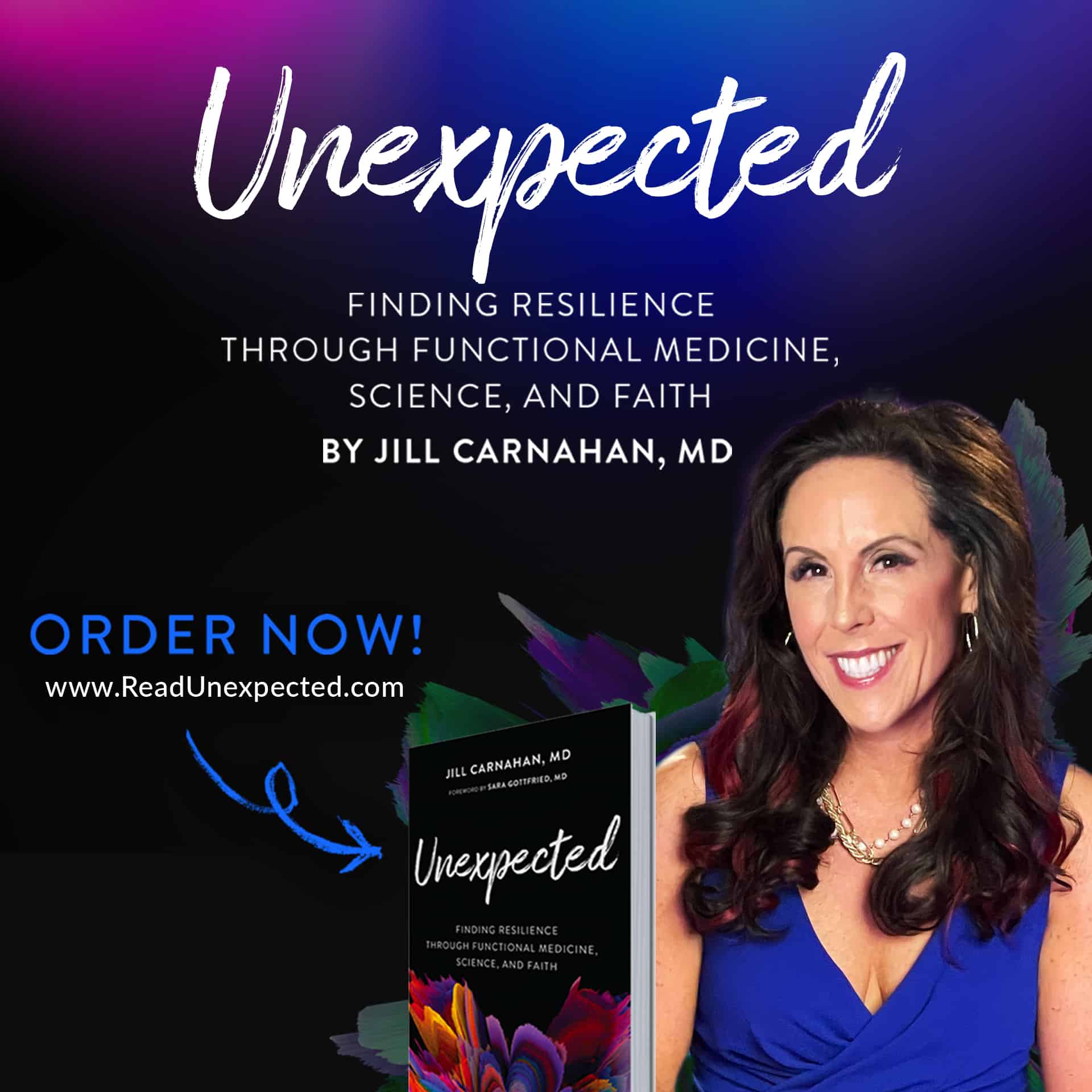
Hey guys, just a quick moment to remind you that if you have not yet got a copy of my book Unexpected Finding Resilience through Functional Medicine, Science and fai, get this anywhere that books are sold. You can also listen on Spotify or Audible or whatever your app is for listening to audiobooks it is read by me, the author. And if you want a signed copy, you can hop over to Dr. Jill health.com order it from our store, and every one of those I personally sign. If you have a dedication to someone you care about or want to give it as a gift, just put that in the shopping cart and we will get that right out to you. Okay, let's get back to Dr. Garrett.
16:45
Dr. Jill Carnahan, MD
That is such a great framework, and I really love that you guide your clients and patients through that, because I really do feel that there's always this percolating. And I think you and I share a spiritual beliefs, that there's this kind of divine guidance. I feel that all the time. And sometimes in my journal time, I'll, like, write something like, you know, God, what would you like me to know next? And then I'll just write and freehand or like the, you know, the pages from our friend Julia, you know, who wrote, oh, my gosh, Artist's Way, one of the most popular books about creativity. Right? And sometimes those things can come, or if you're walking and you get this thought or idea.
17:21
Dr. Jill Carnahan, MD
And I really like how you frame that, because what I've always found with the greatest things that have happened in my life is it's almost like the divine God will give me this little glimpse of what's possible, but there's not the details. It's like a fog, right? It's very mystical. There's not a lot of details. It's just this little idea. And I always, in my experience, have had to step forward in faith without knowing the how or the even timeline, and trust that as I step forward with one step, I'm putting something, either money or time or effort or thought or prayer into that. And then the next step becomes clear. So what you said is so true, because as you put yourself out there, we have to get over that fear because we. We like to know.
18:02
Dr. Jill Carnahan, MD
We like to have certainty, and there is no certainty. In fact, one of my definitions of faith is how do we deal with the inevitable uncertainty of life? So, again, it just my personal experience, and I'd love your comments in a second, is you have to step out first before you know how you. You must. And again, this is my personal experience, but once you do, then all of a sudden you get a phone call, you have something come through. You get an unexpected check, and you're like, so what happens for me is I'll step out in faith, and then I'll wait and. And just like, okay, God, I need.
18:30
Dr. Trevor Cates
You to show up.
18:31
Dr. Jill Carnahan, MD
And then usually if it's something that is supposed to happen, I'll have all of these things that confirm that just. And then I'm next step and the next step. But every step takes a piece of faith. And if you're waiting for the absolute timing and check that you need and everything, you're going to be waiting a long time. What's your thoughts about that?
18:49
Dr. Trevor Cates
Oh, absolutely. No, I think that, you know, having that faith and stepping out and making that first step is really great. Sometimes though, people have to let go of something before so, you know, surrender something in order to make way for what's coming next. So I do think that's important. And sometimes people are like, I have no idea how to make, how to make that step is like, okay, well what do you need to let go of? And another meditation I do is like people imagining that they're carrying, you know, climbing up a hill and they're carrying a backpack. Like what's in the backpack that's keeping you from being able to get up that hill? I'm like, maybe you're carrying a bunch of rocks. Maybe you're carrying that road that are making it a lot harder. So what can you let go of?
19:31
Dr. Trevor Cates
And you know, of course, you know, if you have like religious, spiritual belief of praying, of surrendering, those sorts of things can be helpful sometimes there's huge resistance. I know I had a lot of resistance. I hated the word surrender for so long. I thought I had carry the world on. I thought it was the world was all up to me. And then I started to realize, like, wait, I'm not alone in this world. And then I don't have to do everything my on my own. I mean, I've got, I've created a great support network around me. I've got people that care and you know, I've got my higher power. I've got God to provide some support as well.
20:08
Dr. Trevor Cates
But I think that, I think though that we have some advantages in midlife that we have gotten this far and we have a certain confidence in our abilities. We, we know a lot of the things that we're not good at and that we're good at. We've gotten pretty resourceful. We've gotten this far. We're usually pretty resourceful. We've got people around us that help us, support us. We're probably better at time management than we used to. We have a lot of things going for us and so use that wisdom.
20:41
Dr. Jill Carnahan, MD
Oh, that's so well said. It's interesting too. I'd love to ask you've had lots of different experiences starting companies, selling companies, writing books, doing a documentary. What would you say are the top mistakes that if you could go back and tell your younger self to do some of those things differently, that maybe you now teach, what would be some of the things that you've learned as kind of hard lessons?
21:01
Dr. Trevor Cates
Oh, really? Great question, because there are plenty of those. I think one of the things is that listening to other people rather than my inner voice or like what I know to be true inside. So there have been other times where I've. I've seen what other people are doing. I'm like, oh, well, they're. That person's doing it like this. So I think I should do it that way. Or somebody, well meaning says, well, you know what you should do? You should do this. And when I try and do it and it's not coming from the right place, I oftentimes will hit those closed doors. I'm like, why do I keep hitting a closer? Why is that happening? So what I oftentimes will work with people on is, you know, it's definitely not a cookie cutter approach. Please don't just follow me. I'm just not.
21:46
Dr. Trevor Cates
I'm not your guru. Don't just do what I do.
21:48
Dr. Jill Carnahan, MD
But.
21:49
Dr. Trevor Cates
But what is calling you and really pay attention to those things. Because I tell you what, when you just try and copy what somebody else is doing, people know it. It's not authentic. You've got to have that authenticity. Your story, what makes you passionate. And the other thing that can happen if you don't follow that is just burnout. Just getting tired of doing something to the point where like, I just can't do this anymore.
22:15
Dr. Jill Carnahan, MD
Right? Yeah. Oh, that's really practical. I can so relate because years and years ago I went to masterminds and groups and all kinds of wonderful things and really great stuff. And I remember most of the time I would leave number one feeling like I wasn't doing it right or I wasn't doing enough or I had it all wrong. And every time I try to copy it, never really, I had to find my own way. And at the beginning I was like, I don't know what I'm doing. You know, it just felt so inadequate. But as I found my way, I found that it. I think the divine gives us each this blueprint of how we do things best. And when we're aligned, people can sense that. And I found marketing. Even I don't sell anything.
22:51
Dr. Jill Carnahan, MD
But when I'm aligned, automatically if I have a product or service that people could use, it sells itself because it's so aligned. But it has to be aligned. And I can't do anything if it's not aligned. And I had to learn that the hard way. Right?
23:04
Dr. Trevor Cates
Yeah, it has to be aligned. I mean, and that's why, I mean we actually, with the mentorship program, we have an alignment aligned framework that we talk about and so that people can really be aligned as they move forward with their business.
23:15
Dr. Jill Carnahan, MD
Yeah, really good. Let's talk daily habits because I think that really makes a person and those kinds of things that we incorporate every day become part of our identity. What for you would you say the top three, even up to five daily habits or things that you've incorporated have made you the most successful?
23:34
Dr. Trevor Cates
Yeah, I, I think, I mean, well, you got to start with a good night's sleep. I mean, honestly I. Last night I did not sleep well, which not typical for me, but really doing everything you can to set yourself up for a good night's sleep. Because if I don't start with a good night's sleep, it's just, it's like that ripple effect, it's just not as good. So sleep is your restoration time. Whether we're talking about skin or hormones or energy, whatever you're talking about, we need sleep. The other thing is that I always like to start my day with meditation and prayer. And I, I just that calm time. I like to get up early and sunrise and meditate, pray and have that time for myself when it's quiet and certainly it's a lot easier.
24:20
Dr. Trevor Cates
I know now that I'm an empty master, but when my kids were still home, I would just get up earlier, right? Just get up early before they did. And so I like to have that time. And of course, you know, we, you know, we know all about eating healthy. We got to do that part right? You've got to fuel your body with the right nutrient rich foods, those whole foods. And then the other really big thing, me and this is, I just, I know I have to have. This is getting in nature. And that's just. I, I don't know. Not everybody feels the same way about nature. But I think that it's more than people realize. And it's that, you know, it's the sunlight, the fresh air and it's been more challenging lately because it's been so cold.
25:04
Dr. Trevor Cates
But I know I've got to get out there and get outdoors if I Don't get outdoors.
25:08
Dr. Jill Carnahan, MD
I don't know.
25:09
Dr. Trevor Cates
Like, I notice it in me. I'm like, I'm not as productive. I, I get grumpy. I'm just not as much fun to be with. So I know I have to get outdoors and I, I see this with a lot of people.
25:21
Dr. Jill Carnahan, MD
Yeah, those are super practical. I think on everyone. I agree. I think it is like the prioritized, like good food. Right. We have to actually plan a little bit and think about it. And it takes a little bit of that and the getting up in the morning. I just find if I have that even this 30 minutes of kind of quiet time, either journaling or prayer or in front of my red light, whatever kind of thing that it looks like everything goes better. Like I can respond to the world with deliberate intent versus reacting. And I find that is such a different frame. And whereas before I might jump out of bed and go do a high intensity workout and I'm like, not anymore. I think in those midlife there's often these shifts where people do that.
26:02
Dr. Jill Carnahan, MD
Do you find as you're talking to clients and patients and I just love to get your feedback on this. People are either more burned out or more wanting to find a way to do things differently than the old school. Productivity wins. And how would you comment on that?
26:19
Dr. Trevor Cates
Yeah, absolutely. And, and I would say, I mean certainly exercise is an important part of daily habits, but I usually do that outdoors when I get down in nature.
26:28
Dr. Jill Carnahan, MD
Right.
26:28
Dr. Trevor Cates
So. But doing, you know, having that incorporated. So your question is about like are people wanting to do things differently?
26:37
Dr. Jill Carnahan, MD
I think just the frame there is. I find the old, I mean again, the old paradigm is starting to shift. And the old paradigm was like medical school work, 80 hours productivity. You're there from 8 to 8 and just like this intense productivity is king. And I think things are shifting because creativity, ideas and actually more space and more rest and more play actually create the more productivity. At least in my mind and world that works. Although I still work very hard. Right. How do we shift and still do ideas, create a new business, do a new life, but also incorpor the values that aren't so much the old school, just productivity.
27:12
Dr. Trevor Cates
Yeah, I think there's definitely, I think it's, there's been a generational shift. That's just what I've noticed. And I think that you know, even like younger generations, they're kind of encouraging us because I feel like it's so important to them to do what's meaningful. I'm learning from My kids of like, well, I don't want to do that because it's not meaningful. And I'm like, this is so great. And that's what their friends are saying too. So I think that's encouraged our generation and even older generations to be a little bit more like that too. So I think culturally we are like, I'm. What I do needs to have meaning, which is so beautiful. And it's so nice that we can be at a time and place where we can do that.
27:51
Dr. Trevor Cates
Now when we look at things like what it's allowing us to do that is there's, you know, all the tech advances. My husband does a lot in AI, so there's always conversations in AI. I'm always hearing about AI and, and how it can help us do the things that, you know, help you people do. Some of the stuff that we don't like to do that is maybe meaningless tasks or things like that. So then we can really focus on the things that we love. Now, with all of that said, one of the things that concerns my husband and I both, because he does, again, he does a lot with AI, is that personal connection that we spend. What I think is what I wanted to get at is what I think has shifted so much is especially since COVID is we spend.
28:38
Dr. Trevor Cates
We're so comfort sitting in front of Zoom, in front of cameras and computers and on social media and online that we're not getting enough human connection. And I know that we're craving it, but I think we have to be really careful with this because all those things that I mention on a daily basis, if I don't have human connection, none of that's really going to matter. Like, I've got to have, you know, my relationship with my husband, my girlfriends, getting outdoor with any of them is also a lot more fun. Having that social interaction, working with my business partner on helping mentor other health and wellness people, it's just so. It just creates so much more meaning in life when you can share it with others. And I do feel like there's more and more of a disconnect because we're behind screens.
29:32
Dr. Trevor Cates
I mean, chill. Wouldn't it be so much better if.
29:33
Dr. Jill Carnahan, MD
We were sitting together? Oh, gosh, it's so. I love that you're going here because that was my next question is collection. Collaboration is becoming more important. And like you said, I realize AI does a lot of amazing things and it's going to continue to probably surprise us in Chaka said what it's capable of. However, it will never replace a hug or a walk with a friend or holding your spouse's or partner's hand or those things. There's no computer that will do that. So I think more than ever. Yeah. Yeah.
30:01
Dr. Trevor Cates
And at a time in midlife when hormones are declining and where our neurotransmitters maybe aren't supported as much because we're not getting the estrogen and progesterone, and that's not supporting. You know, progesterone helps support gaba, and estrogen helps with some of our other neurotransmitters like dopamine and also with oxytocin. We need that with the physical touch. If we're not getting that, then it's just life is going to feel more empty. And again, midlife is a stress test. So that's one of those things. If you're not getting that human connection, you're going to feel it more so than maybe you would at another time. Maybe you wouldn't have felt it. And I know you talk a lot about resilience, and I think this is a key part of resilience.
30:46
Dr. Jill Carnahan, MD
Yeah, I sure couldn't agree more. Maybe as we kind of wrap up, can you give us a story of a patient or a client or someone you saw really transform as you worked with them or talked through things with them? Because it's always inspiring to hear someone else who succeeded in the midlife chaos.
31:05
Dr. Trevor Cates
Yeah, well, I mean, gosh, there's so many. So let me tell you about, Yeah, so I'll tell you about a patient that, you know, she is going through perimenopause. And I think one of the things is that she'd been to see a lot of different doctors. And unfortunately, with the system, medical system the way it is, people don't have doctors, don't have time. Right. So she was getting these little bits of information from different specialists. And what she was just so relieved to have was somebody that could, first of all, spend more than seven minutes with. With her within 10 minutes. And that help pull all the different pieces together. So the gut piece, the inflammation piece, the metabolic piece, and her thyroid hormones, as well as her sex hormones that were, you know, going through all kinds of changes.
31:58
Dr. Trevor Cates
And then also this feeling of, like, okay, my, you know, like, we've talked about so many changes. My, you know, my kids are getting older. They don't need me as much anymore. I'm taking care of older parents that are sick. And then I'm going through all of this. What you Know, and I feel like I want to choose, like I want to do something different with my life. And so it, you know, it's like all of it was bubbling up at the same time. And I'm thinking about one patient, but certainly there are a lot of patients that I've had with this. And so I mean, first of a. Again, it's like that awareness of me listening to her and holding space for her to talk about that. I mean, most people are so busy, they don't a chance for somebody to listen.
32:43
Dr. Trevor Cates
And that's part of, just part of the healing is what we can do as doctors and caregivers.
32:49
Dr. Jill Carnahan, MD
Right.
32:49
Dr. Trevor Cates
You know, it's like just hold space and listen because they're just a lot. There's. People are so busy, they just don't have the time to be heard. And so that was first part of it. And then it's like, okay, I hear you. Let's put together a comprehensive plan, addresses all these things. Let's really dive in and look at your labs and not just, you know, a simple blood panel, but, you know, let's really look at some of these specialty labs and do, you know, do your Dutch hormone tests and all of these kinds of things to figure out what's going on, starting with the wellness plan, of course, and ways to help support her. And then of course, you know, coming back each time.
33:30
Dr. Jill Carnahan, MD
What.
33:31
Dr. Trevor Cates
So when I work with patients, I generally like to see them. I like them to commit to like good six months period of time. And I see them every three weeks. I feel like that period of time is good follow up. And at first they're like, I don't know if we're gonna have anything to talk about in three weeks because that's really not far from now.
33:47
Dr. Jill Carnahan, MD
Always.
33:47
Dr. Trevor Cates
There's always something to talk about in three weeks, whether it's. And sometimes it's. Again, it's like, you know, dealing with the kids or dealing with the parents. And so this particular patient, she came back and she was just so relieved. All that again, somebody had listened to her and that she could come back and still have someone to talk to. But also being able to feel more sad, settled with her hormones and knowing that the supplements that I started on the bioidentical hormones that were also addressing some of these issues. And I mean, even something as simple as an adaptogenic herb, it's amazing what it can do to help people have that more sense of calm in their life.
34:31
Dr. Jill Carnahan, MD
Right?
34:32
Dr. Trevor Cates
So that's just one example And I mean, you know, it just goes on. Especially when I'm spending six months with someone. It's really nice to see how things evolve for them. Not just on a physical level. Level, but sometimes also what happens with their relationships with their kids, their parents, a loved one, maybe. And then, you know, also, sometimes even career. I. I remember I had one. I just want to tell you. One short one. Do I have time for one short one? Yeah. So I had a patient that came to see me one time, and she was telling me all of the symptoms that she was having. And I'm looking through her labs that she'd already have done. I'm. I'm, you know, did a phys example.
35:16
Dr. Trevor Cates
I'm like, you know, the only thing I hear from you is that you've talked about how much you hate your job.
35:24
Dr. Jill Carnahan, MD
Yeah.
35:24
Dr. Trevor Cates
And I can't find anything else wrong with you. I can recommend, you know, diet and supplements and all these things for you, and I will, but I honestly, when I look for a root cause for you, I think it's your job. And I did not see this patient again. And I thought, oh, my gosh, I. I'm sure I just offended her. And then about six months later, I happened, because Park City is a small town, I happened to run into her at a Christmas party, and she's like, Dr. Gates, I have to tell you that I listened to you. I quit my job, everything got better, and I never needed to come back.
36:01
Dr. Jill Carnahan, MD
Wow, that is so powerful. It kind of brings home everything we've been talking about and what I heard you saying that I just think is so critical. And whether you're a doc out there or you're a patient looking for a physician or. Or consulting, that relationship matters so much building that. And it's kind of like the collaboration and trust we just talked about that AI is not providing. So you might get some great medical advice from AI now that they have AI health and some of these new things. However, that relationship, that trust, and you sitting there and really listening. And then I find I just like, if I can be kind of a sponge and then feed back to them and say, does this feel like what I'm hearing you say? And that.
36:38
Dr. Jill Carnahan, MD
And often when they hear their story told from my perspective of what I'm hearing and seeing, there's these AHAs. And for you, in that case, you gave her an aha that maybe she didn't see, but she knew deep down. Right. Because the moment you said it, there's like, something in her that she's like, yeah, Dr. Cates is totally right. And I love that you got to see the end of the story, because sometimes we don't always, for a long time, really hear that.
37:00
Dr. Trevor Cates
I know. It was. It's really great to hear that. And she went on to find a new career that was way more exciting for her. Her, like, she found a new partner, and then she's excited. I mean, it was. It was so beautiful to kind of.
37:12
Dr. Jill Carnahan, MD
Like, cascade, didn't it? Yeah. I always think back to, like, my divorce was really difficult. It's almost 10 years ago now, but it transitioned everything. And now I'm like, that was the best thing that ever happened in work. And I mean, everything in my life shifted. And not that I had a horrible marriage.
37:27
Dr. Trevor Cates
It just.
37:27
Dr. Jill Carnahan, MD
It was. It expired and then. But. But I always look back now and, like, that's crazy, because what could have been the worst thing in my life turned out to be the best thing. And it's like losing a job or changing careers or your kids going to college or your mother, you know, all of these things, if we can embrace them as change factors that actually push us to that thing we talked about, which is stepping out in faith, trusting that there's something coming. So hopefully, if you're listening, this is helpful. Dr. Cates, this has been really insightful, and I know for me, I'm glad we shifted directions. I hope people found it useful. You're doing work now, consulting. You're seeing patients.
38:00
Dr. Jill Carnahan, MD
If people want to know more about either or any of the things that you're doing, where can they find more about you?
38:06
Dr. Trevor Cates
They can learn about me on my website, Dr. Trevor cates.com t r a v o r C-A-T-E-S.com and there's an area for practitioners if you want to learn more about the mentorship. And there's also information about working directly with me as a patient as well.
38:22
Dr. Jill Carnahan, MD
Awesome. Well, thanks for the work that you did in the world. It is always a pleasure to reconnect. We'll have to try skiing one of these days.
38:30
Dr. Trevor Cates
Some snow. I know, right?
38:31
Dr. Jill Carnahan, MD
Yeah, but totally. Oh, thanks again for coming on the show. Yeah.
38:36
Dr. Trevor Cates
Thank you.
38:36
Dr. Jill Carnahan, MD
Hey, everybody. I hope you enjoyed that episode with Dr. Trevor Cates, who's been a longtime friend and colleague and always has great insights. And it was really fun to delve into midlife and what that means. And if you're in that transition, hopefully you took a pearl or two away from that episode with Dr. Kates. If you have not yet liked or subscribed Wherever you listen to this podcast, it would certainly help us out if you do that. Please share this episode if there's a friend or family member who you think might benefit from some of the information. And just know we come out every week with a new episode at Resiliency Radio and you can find us here next week with another episode.
* These statements have not been evaluated by the Food and Drug Administration. The product mentioned in this article are not intended to diagnose, treat, cure, or prevent any disease. The information in this article is not intended to replace any recommendations or relationship with your physician. Please review references sited at end of article for scientific support of any claims made.





Share: