

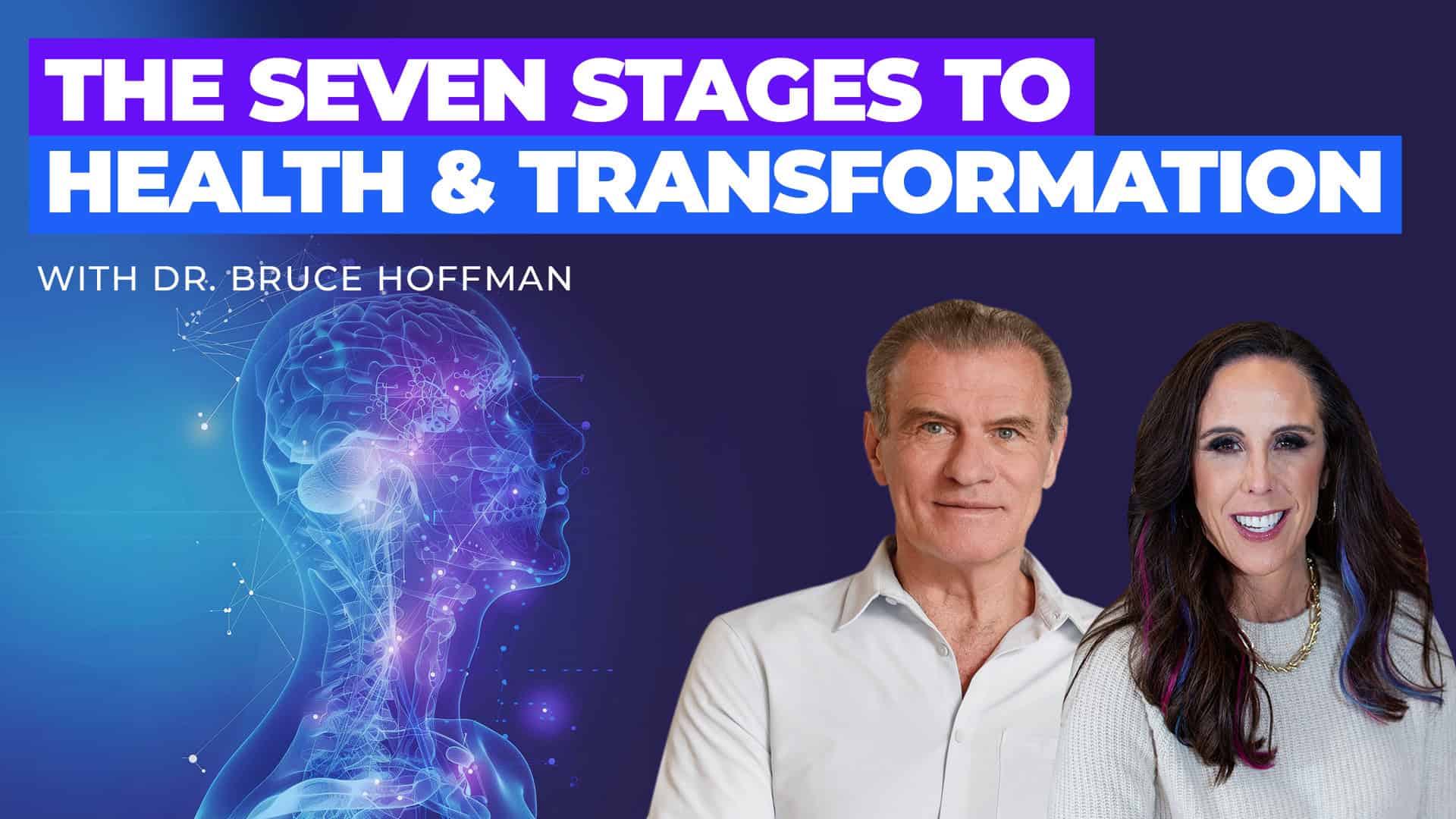
In this insightful episode, Dr. Bruce Hoffman discusses the intricacies of modern medicine, the importance of understanding the human body's response to environmental stressors, and the future of healthcare. Dr. Hoffman shares his journey and the development of his New Medical Curriculum, which emphasizes a holistic approach to health and healing.
💎 Why returning to core health cycle principles is essential before detox or supplementation.
💎 How aligning with your circadian rhythm supports optimal recovery and energy.
💎 The power of personal responsibility and lifestyle choices in true healing.
💎 Why intuitive medicine and holistic integration are the future of healthcare.
Key Topics You'll Discover with Dr. Bruce Hoffman
① Ventral Vagal Trust: Dr. Hoffman explains the concept of ventral vagal trust, which is crucial for establishing a therapeutic relationship. This involves creating a connection through eye contact, tone of voice, and genuine presence.
② Health Cycle Principles: The discussion highlights the importance of returning patients to health cycle principles before engaging in detoxification or supplementation. Dr. Hoffman expanded these principles beyond the original seven to about twenty, focusing on a comprehensive approach to health.
③ Circadian Rhythm and Lifestyle: Emphasizing the role of circadian rhythm, Dr. Hoffman shares personal lifestyle changes such as not eating after sundown and incorporating red light therapy, which are part of his daily routine to maintain health.
④ Personal Responsibility in Healing: The conversation touches on the necessity of personal responsibility in health, moving away from conventional practices that may not address the root causes of illness.
⑤ Teaching and Mentoring: Dr. Hoffman discusses his transition from clinical practice to full-time teaching, aiming to expand the toolbox available to physicians and promote a broader understanding of healing.
What You’ll Take Away from Dr. Bruce Hoffman
📌 Holistic Approach: Dr. Hoffman advocates for a holistic approach to medicine, integrating biophysics and quantum biology into traditional practices to improve patient outcomes.
📌 Intuitive Healing: The importance of intuitive healing and the need for doctors to trust their instincts while balancing scientific evidence is emphasized.
📌 Environmental Impact: Recognizing the impact of environmental factors on health is crucial, and changes in lifestyle and environment are necessary for true healing.
🔑 CONCLUSION: This episode provides valuable insights into the future of medicine, emphasizing the need for a paradigm shift towards a more integrated and holistic approach to health. Dr. Hoffman's experiences and teachings offer a roadmap for both practitioners and patients seeking to enhance their understanding of health and healing.
Dr. Bruce Hoffman, MSc, MBchB, FAARM, IFMCP
Dr. Bruce Hoffman is a Calgary-based Integrative and Functional medicine doctor/practitioner. He is the medical director at the Hoffman Centre for Integrative Medicine and The Brain Treatment Centre of Alberta, specializing in complex medical conditions.
He was born in South Africa and obtained his medical degree from the University of Cape Town. He has a masters degree in clinical nutrition, is a certified Functional Medicine Practitioner (IFM), is board certified with a fellowship in anti-aging (hormones) and regenerative medicine (A4M), a certified Shoemaker Mold Treatment Protocol Practitioner (CIRS), Certified Ayurvedic Practitioner, Certified in Family Constellation therapy, and ILADS trained in the treatment of Lyme disease and co-infections.
He is the co-author of a paper published by Dr. Afrin’s group: Diagnosis of mast cell activation syndrome: a global “consensus-2”. In addition to his clinical training, Dr. Hoffman has studied with many of the leading mind-body and spiritual healers of our times, including Deepak Chopra, Paul Lowe, Osho, Ramesh Balsekar, and Jon Kabat-Zinn.
He has shared the stage with Dr. Deepak Chopra, Dr. John F. Demartini, and he continues to spread his inspiring vision of healing and wellness with audiences and patients around the world.
🌐 Dr. Bruce Hoffman's Links
https://www.hoffmancentre.com/
https://www.drbrucehoffman.com/7-stages/landing
Dr. Jill Carnahan, MD – Leading Functional Medicine Doctor
Dr. Jill Carnahan, MD, ABIHM, ABoIM, IFMCP is internationally recognized as one of the most respected leaders in functional and integrative medicine. She is dually board-certified in Family Medicine and Integrative Holistic Medicine, and the founder and medical director of Flatiron Functional Medicine in Louisville, Colorado.
Widely known as a pioneer in environmental toxicity, mold-related illness, autoimmune disease, and resilience medicine, Dr. Carnahan combines cutting-edge science with compassionate, root-cause care. Her clinical approach integrates precision genomics, epigenetics, microbiome research, peptide therapy, and lifestyle interventions to transform health outcomes for patients worldwide.
She is the author of the best-selling memoir Unexpected, which weaves her personal journey through cancer, Crohn’s disease, and mold-related illness with her professional expertise. Dr. Carnahan is also the executive producer of the award-winning documentary Doctor/Patient and the host of the popular podcast Resiliency Radio, which reaches over 500,000 global subscribers.
As an international keynote speaker, Dr. Carnahan has been featured at leading medical conferences including A4M, IFM, EPIC, and IPM Congress, and her work is frequently highlighted in major media outlets such as NBC, CBS, Fox News, Forbes, Parade, People, and MindBodyGreen.
With a reputation as both a scientist and a healer, Dr. Jill Carnahan is regarded as one of the top functional medicine doctors in the world, offering a unique blend of evidence-based research, innovation, and deeply personalized care.
The Podcast with Dr. Bruce Hoffman
The Video with Dr. Bruce Hoffman
The Transcript – Overview
Integrative Medicine Curriculum and Training
The main shift is toward a broad, layered medical curriculum that integrates physical, emotional, and spiritual healing for complex chronic illness.
- Dr. Bruce Hoffman’s New Medical Curriculum, focused on seven healing stages, combines Ayurvedic concepts and biophysics to treat chronic complex illness effectively (09:40)
- This model categorizes patient issues like inherited trauma, dental problems, nutrition, and environmental toxins into clear treatment hierarchies.
- He expanded traditional health cycle principles with quantum biology and circadian science, improving patient outcomes significantly.
- The curriculum includes detailed protocols and a 10-week course with two-and-a-half-hour sessions plus Q&A, designed for physicians and patient advocates.
- Post-course mentorship programs will support graduates in managing complex cases, ensuring practical application and ongoing learning.
- Emphasis on therapeutic alliance and trust is core to the curriculum and treatment approach (30:51)
- Dr. Hoffman stresses establishing “ventral vagal trust” through eye contact, tone, and presence to create limbic resonance with patients.
- He discourages a quick-protocol, symptom-focused mindset, advocating for deep listening to uncover patient narratives and soul-level trauma.
- Physicians are trained to recognize defense layers—intellectual and soul defenses—to tailor entry points for healing.
- This approach counters the common functional medicine trap of rushing to protocols without addressing patient identity and story.
- Testing across broad domains supports the curriculum’s depth and precision (34:00)
- Dr. Hoffman uses extensive testing covering toxicology, biochemistry, brain function, stress responses, and family systems to map patient complexity.
- He spends hours reviewing and teaching patients about test results to empower them in their healing journey.
- This comprehensive assessment informs customized protocols aligned with the seven healing stages.
- Despite criticism, he defends this approach as necessary to manage multi-layered chronic conditions effectively.
Patient Mindset and Trauma Integration
Healing depends heavily on shifting patient identity and internal narratives rather than just physical interventions.
- Addressing resistance and “victim consciousness” is vital to breaking illness cycles (39:50)
- Dr. Hoffman identifies resistance as a survival instinct rooted in trauma and lack of alternative narratives.
- He teaches cognitive reframing techniques like the Demartini method to help patients reframe resentments, especially around family trauma.
- Changing internal dialogue enables the parasympathetic nervous system to activate, reducing chronic stress impacts on the body.
- This mindset work is non-negotiable before deeper biochemical or detox protocols can be effective.
- Physician self-awareness and emotional intelligence are essential teaching points (41:50)
- Doctors must do their own inner work to avoid projections and better resonate with patients’ unconscious dynamics.
- Dr. Hoffman recommends physicians understand personality systems such as Myers-Briggs and attachment styles to tailor communication.
- Matching physician and patient typologies improves therapeutic alliance and patient engagement.
- This human-centered approach contrasts sharply with conventional medicine’s focus on symptoms and tests alone.
- Assessing patient readiness determines treatment entry points and prevents wasted effort (27:00)
- Dr. Hoffman uses direct questions to gauge how patients want help and whether they are open to change.
- If patients show no readiness or willingness, he recommends pausing the relationship compassionately.
- Initial steps might be simple, like diet changes, to gain trust and permission for deeper work.
- This staged approach respects patient autonomy and psychological defense.
Environmental and Biophysical Foundations of Health
Tackling environmental toxicity and restoring biophysical harmony is critical for mitochondrial and cellular healing.
- Relocation and environmental remediation are often more impactful than supplements or protocols (16:00)
- Dr. Hoffman requires patients to leave toxic indoor environments or heavily remediate them to succeed.
- He highlights the harm from indoor EMFs, Wi-Fi, dirty electricity, poor air quality, and lack of natural sunlight.
- Building biologists and mold remediation specialists play key roles in creating healing spaces.
- Patients who relocate to places with natural sun cycles and less pollution show rapid mitochondrial recovery.
- Sunlight exposure, grounding, and circadian rhythm alignment are foundational habits (19:00)
- Patients must get UVA/UVB sun exposure daily, ground to the earth, and follow consistent sleep-wake cycles tied to natural light.
- These practices restore electromagnetic coherence critical for cellular function and reduce chronic inflammatory responses.
- Dr. Hoffman personally uses grounding shoes and red light therapy daily to support cardiovascular and mitochondrial health.
- Hydration with clean, vortexed water is emphasized as a basic survival habit.
- The modern indoor lifestyle disconnect is a global health hazard (18:30)
- Avoidance of natural electromagnetic exposure through indoor living and protective behaviors damages mitochondria.
- Dr. Hoffman refers to humans as “solar batteries” who need consistent environmental inputs to maintain health.
- The cultural norm of indoor work, artificial lighting, and constant EMF exposure undercuts healing efforts.
- Educating patients on this invisible toxic load is essential for sustained health improvements.
Physician Role and Future of Medicine
The future lies in expanding physician roles from protocol-driven heroes to holistic healers embracing complex human dynamics.
- Dr. Hoffman is retiring from clinical practice to teach and mentor full-time (45:40)
- After 35 years, he chooses to focus on amplifying impact through education rather than seeing patients exclusively.
- He faces regulatory pushback in Canada for private testing and integrative approaches, influencing this shift.
- His teaching addresses physicians’ frustration with limited toolkits for complex chronic cases, expanding their effectiveness.
- This transition supports scaling change beyond individual patient visits to systemic transformation.
- The “doctor as healer” archetype replaces the “doctor as hero” (46:50)
- Healing requires deep listening, trust-building, and patient narrative interpretation over quick fixes.
- Physicians must develop emotional intelligence and self-awareness to connect authentically with patients.
- This philosophical shift underpins the new medical curriculum and broader integrative medicine evolution.
- It counters the reductionist, symptom-focused approach dominant in conventional care.
- Emerging educational initiatives reflect this paradigm change (46:50)
- Ann Walton’s new medical university in Arkansas incorporates integrative and arts therapies aligned with Hoffman's curriculum.
- Such institutions indicate growing acceptance and institutionalization of holistic models in medical education.
- Dr. Hoffman’s mentorship and course offerings aim to prepare a new generation of healers attuned to complexity.
- This trend may improve care for patients with chronic, multi-system illnesses poorly served by current models.
Patient Lifestyle and Daily Habits for Resilience
Practical daily routines focused on natural rhythms and environmental alignment support lasting health.
- Top habits include sunrise exposure, grounding, circadian eating, and hydration (53:20)
- Dr. Hoffman rises with the sun and spends morning time grounding outdoors, even walking dogs with grounding shoes.
- He eats local, seasonal foods timed with circadian rhythms, avoiding food after sunset to optimize metabolism.
- Red light therapy for 20 minutes daily supports cardiovascular and mitochondrial health.
- Hydration involves vortexed, clean spring water, emphasizing high water quality’s importance.
- These habits counteract modern lifestyle stressors and environmental toxicity (53:20)
- They restore the body’s natural electromagnetic and circadian coherence disrupted by indoor living and artificial lighting.
- Consistent routines help maintain mitochondrial function and reduce chronic cell danger responses.
- Dr. Hoffman models these habits personally, reinforcing their practical feasibility and benefits.
- Patients adopting such habits are more likely to experience meaningful health improvements and symptom relief.
Strategic Vision on Health and Healing
Healing is a personal responsibility requiring radical shifts away from toxic environments toward nature-based living.
- Healing depends on removing oneself from toxic man-made environments and consensual reality (51:40)
- Dr. Hoffman declares mitochondria as sentient beings needing nature’s fuel to survive and function well.
- The future of medicine lies in educating people to create new personal health paradigms focused on natural inputs.
- Without reconnecting to natural cycles, humanity risks systemic health decline and chronic disease epidemics.
- This vision underlines all clinical, educational, and lifestyle recommendations shared in the meeting.
- Radical environmental and lifestyle changes are necessary for mitochondrial health (25:40)
- Dr. Hoffman plans to live six months yearly in El Salvador and six in South Africa for sun exposure and environment.
- This reflects the practical application of his principles amid the scarcity of ideal environments in developed countries.
- Patients are encouraged to relocate, remediate, or significantly alter their living spaces to survive modern toxicity.
- Such changes are framed as urgent survival strategies, not optional lifestyle preferences.
Transcript
00:00
Dr. Jill Carnahan
Hey everybody. Welcome to Resiliency Radio, your go to podcast for the most cutting edge insights integrative and functional medicine. I'm your host, Dr. Jill and with each episode we dive into the heart of healing and personal transformation. Join me as we interview renowned medical experts, thought leaders and world transformers of all shapes and sizes. Today is no different. You are in for a real treat with Dr. Bruce Hoffman, who I'll introduce in just a moment. I'm known Bruce in our field of integrative functional medicine. He's a practitioner from Canada for over two decades and I am super excited for you to hear this interview today. So stay tuned. I promise it'll be a game changer for health and healing. Before I do, I just want to remind you about a couple of things.
00:44
Dr. Jill Carnahan
First of all, if you don't know, I have a wonderful Flatiron functional medicine clinic in Lewisville, Colorado. We are accepting new patients. We have an incredible people, PA physician associate named Fawn and a nurse practitioner named Hannah and they are both trained under me. I work with them on all cases and we are they're both accepting new patients. So if you have any interest in becoming a patient in my clinic, you can just call 303-993-7910 or visit jillcarnahan.com for information on the website, phone numbers, whatever information you might want to know. And we are, like I said, accepting patients at my clinic in Louisville, Colorado. Also, if you don't know, we have a full line of retail@doctorjillhealth.com everything from supplements and nutritional protocols for Epstein Barr virus, mast cell activation, tick borne infections, complex chronic illnesses, fatigue, you name it, we've got it.
01:42
Dr. Jill Carnahan
And simple things like a great multivitamin or a qualified antihistamine. Our bestsellers called Hist Assist. Patients love this product for their mast cell activation and to calm down the histamine response without making them feel drowsy. So please check it out@ doct jill health.com that's our full retail store. And lastly, if you haven't checked out the book or the movie, you can see them on the website jillcarnian.com but I especially want to mention the book Unexpected. It was a bestseller, was released in 2023 and is available on Amazon or wherever you buy books. And you can find that book@readunexpected.com Amazon wherever you have found your books before, you'll find it there. Okay guys, let's get on to the show and Let me introduce Dr. Bruce Hoffman. Dr. Bruce Hoffman is a Calgary based integrative functional medicine doctor practitioner.
02:33
Dr. Jill Carnahan
He is the medical director of the Hoffman center for Integrative Medicine and the Brain Treatment center of Alberta specializing in complex medical conditions. He was born in South Africa and obtained his medical degree from the University of Cape Town. He also has a Master's degree in Clinical Nutrition. He is a certified functional medicine Practitioner, board certified with a fellowship in Anti aging Medicine and Regenerative medicine. He's a certified Shoemaker mode protocol practitioner, certified Ayurvedic practitioner, certified Family Constellation Therapist and eyelids trained in the treatment of Lyme disease and co infections. He is a friend, a colleague and a brilliant physician. He's co authored a paper published by Dr. Lawrence Afrin's group on diagnosis of mass cell activation syndrome and he is a treat. I know you'll enjoy this interview today. Let's jump right in with Dr. Bruce Hoffman.
03:23
Dr. Jill Carnahan
Dr. Bruce Hoffman, I have known of you for so many years and we share mutual patients. Even though you're in Canada and I'm in the US And I have always had the deepest respect for how you do medicine and how you approach medicine so holistically. I think a lot of times, especially in the realm of functional medicine, although there's personalized and integrative and all these words, we lose the real touch with the soul and the energy and some of these things that I think are as much are more powerful than the supplements and the lifestyle. But before we go into all the stuff that you have and your new design for medical curriculum, I would love to hear a little bit about your story. Where did you grow up? How did you get the bug for medicine? What was your journey into this trajectory?
04:08
Dr. Bruce Hoffman
Yeah, sure. Hi Joe. Thanks. Yeah, we do share a lot of patients in common and we go to a lot of the same conferences so we always bump into each other. Yes, I started, I was born in South Africa into the apartheid regime and went to school and had, you know, various exposures when I was a younger person to the world of art and literature and music and at high school became there was a school teacher there by the name of Roger. And Roger was a sort of Renaissance man. He was kind of a maverick teacher who broke all the rules, you know. And he sort of taught us about Jung and Advieta, Hinduism and, and religion and you know, just exposed me to all sorts of interesting sort of dynamics.
05:06
Dr. Bruce Hoffman
And I had a particular experience with him when I was 15 whereby he was teaching one day and he was talking about Christianity and I, I was always in the back Scowling, you know. And I said. I went after him afterwards. I said, you don't believe all that, do you? And he looked at me and he said, yeah, of course I do. And in that moment, I had what they call in, you know, in spiritual traditions, mystical traditions, a so called satori. A satori is when the world just opens up into its true nature and everything shimmers with light and you see all the order behind the illusion of the five senses. And that just happened, and that was also repeated later on in my life. And so those two experiences catapulted me into curiosity.
05:54
Dr. Bruce Hoffman
And then I became very interested in Hinduism, in poetry, in Jungian psychotherapy. I read Jung's book Memories, Dreams and Reflections, and it changed my life. And then I would, you know, then I went into art, and I became a set builder in opera. And one day I was going to build sets in Johannesburg. And my. The phone rang, and it was my mother. She said, oh, by the way, you've got into med school. I said, what are you talking about? What's med school? He said, no, I applied for you to go to med school. I said, what? I want to be a poet. I want to go to San Francisco and hang out with the beats. I don't want to. I want to write. Said, no, you're going to med school. So I was like, okay. So I went to med school.
06:40
Dr. Bruce Hoffman
I don't know what I was doing there. You know, it was like. It was like a completely far. I was never left. Brain science. Yeah, I did well at school, but it was all arts and, you know, humanities and geography and everything. So I ended up in med school, and I sort of took me two or three years to realize what I was doing. And. And then when. While, you know, I was. Then Roger was always very, you know, I used to write to him and say, roger, I want to go to San Francisco. I don't want to do this. And he'd say, no, the wheel will turn. You will see how this will serve you. And he gave me the list of all these great writers who had been doctors, you know, and so he said, no, just stick it out. Anyway.
07:20
Dr. Bruce Hoffman
So I stuck it out, graduated, ended up in the rural Saskatchewan and became a family physician there. And truly, I. Then I really started to love being a doctor, you know, I just sort of. I sort of. I occupied the archetype, if you will.
07:36
Dr. Jill Carnahan
Yes.
07:37
Dr. Bruce Hoffman
And then all of a sudden, while I was doing that, I came across Larry Darcy.
07:41
Dr. Jill Carnahan
Yes.
07:42
Dr. Bruce Hoffman
You know, Larry and Deepak. And.
07:44
Dr. Jill Carnahan
Yes.
07:45
Dr. Bruce Hoffman
All these great sort of alternative guys. And all of a sudden I started to realize that all that I'd learned from a young boy up until then, even though I'd branched off into left brain medicine, all of a sudden this other world, the mysteries open back up. And I realized through Larry Darcy and others, you could start to incorporate all of that into this trajectory of starting to help people. It didn't have to just be about the prescription pad and the protocols. And so then I went to meet Larry Darcy at a conference in the 80s, way back when. Yes, had dinner with him and he just, you know, provoked this expansion of awareness. And then I studied with Deepak and David Simon and did lots of Ayurveda, then did Chinese medicine, and then, you know, blah, blah.
08:34
Dr. Bruce Hoffman
And then I just started to realize there's this whole vast area of possibilities with the human experience. And then later on I met Dietrich Klingart and others and he developed a five levels of healing model which is based on the Vedantic tradition. And I looked at his model, I said, would you mind if I add two more levels? And he said, no, that's fine. So I added two more levels and then I expanded that. And so I developed the seven stages to health and transformation working model. In dealing with complex, which we all have come to, most of us now are training chronic complex illness people with multiple symptoms that nobody can make sense of. So I developed a seven stage model.
09:20
Dr. Bruce Hoffman
And within that seven stage model is based on the Ayurvedic concept of koshas or these bodies, you know, the spiritual body, the soul body, the intellectual body, the emotional body, the electromagnetic body, the physical body with structure and the world outside, the so called environmental body. And I could sort of to work out where I could use that in treating complexity. So when a patient came in, I go, oh, okay. They have inherited family trauma.
09:52
Dr. Jill Carnahan
Yes.
09:52
Dr. Bruce Hoffman
They have early developmental trauma, they have dental problems, they have nutritional problems, and they've been exposed to mold and Lyme disease. So you could put them into these categories and create order. And then I started to work out a hierarchy of treatment based on that. And so that led to the seven stages to health and transformation model. And then recently in the last five years or so, I started to expand that a little bit and started to add all the principles of biophysics and circadian quantum biology. And once I did that and added that into the seven stage model, it sort of revolutionized the my patient outcomes. When I got people to relocate to ground to watch the early Morning sun to get a building biologist on their team as more important than I was.
10:43
Dr. Jill Carnahan
Wow.
10:44
Dr. Bruce Hoffman
And then remediate their homes, blah. You know, do all the things that we now do in biophysics that revolutionized outcomes. I mean, all my patients, I would say to them, in November in Calgary, when this UVP is gone and the sun's gone, you can't stay here. You've got to go to the tropics. And so they, you know, would go to Mexico or Mexico is not so great anymore, but Costa Rica and other places and they're. The mitochondria were revolution. You know, the mitochondria kicked back online along with the implication or the emphasis on biophysics, was the emphasis on the cell danger response, as you. As, you know.
11:24
Dr. Jill Carnahan
Yes, yes. That was a big aha for all of us. But when we come up with that, we're like, oh, this pulls everything we've talked about together. Yeah.
11:33
Dr. Bruce Hoffman
That one diagram of Robert Navio, the stresses.
11:37
Dr. Jill Carnahan
Yes.
11:37
Dr. Bruce Hoffman
You know, they create this inflammatory response which then goes into these cell danger responses. But the key to that map, which I realized after a while, was on the left, he said, health cycle principles.
11:51
Dr. Jill Carnahan
Yes.
11:52
Dr. Bruce Hoffman
You need to return the patient to the health cycle principles. And in the middle was cell genesis.
11:57
Dr. Jill Carnahan
Yes.
11:58
Dr. Bruce Hoffman
So you identified all the toxic load across all the layers and levels of the human. You did all your functional medicine tests because once the cell danger response was initiated, all these biochemical problems and cell membrane changes occurred. So you did all your functional tests to see what is wrong. But the key was pulling out the health cycle principles and emphasizing those to patients before they went fancy, detoxifying or using supplements, which was the toxic stresses and the cellular genesis part of the diagram.
12:32
Dr. Jill Carnahan
Yes.
12:32
Dr. Bruce Hoffman
And then I expanded the health cycle principles beyond Navio's original seven. He had seven things. So once I expanded that, emphasized that, then I could go back to my functional medicine training, you know, look at the toxicology, look at the. What needed to be, you know, introduced in order to turn on the right pathways and get them out of cell danger.
12:54
Dr. Jill Carnahan
Yeah.
12:55
Dr. Bruce Hoffman
And that's how I work now. Now I've developed a product, developed a. A curriculum called the New Medical Curriculum, which I teach, which is based on those principles.
13:07
Dr. Jill Carnahan
I love this. And that's why I so was so excited to have you on the podcast, because I really feel like you are such a pioneer and I can hear it in your story. First thing is that curiosity and that seeker spirit. Right. Which I think I have too. And those of us who are out there just really saying what else is possible? What if everything we thought was true is not true? What if there's more? What if there's. Because in our medical curriculum, I always talk about this in the podcast. You and I both know this, but many people listening, where it's so narrow. It's so, so narrow on what is focused on drugs and surgery and interventions and not even all that, you know. And so we're really thinking a very different expansion.
13:46
Dr. Jill Carnahan
And what I love to restate what you just said is, back even in the early functional days, we looked at biochemical processes that were disrupted. We looked at testing, we looked at the microbiome and the chemicals and all of that. And then we tried to intervene lifestyle. And what you're saying is, number one, there's a whole energetic, spiritual, ancestral. There's a lot of pieces, right. That are absolutely foundational. Because if you have a story from ancestral pattern that says, I'm going to be ill or I'm in a victim role, you're never, no matter what intervention you or I do. And until you retell your story or change your identity, like, identity is so core. And what I saw in my early. I've been doing this over 20 years, kind of like you. And in the early days, it was easy to change and.
14:24
Dr. Jill Carnahan
And switch, maybe a thyroid condition or a hormone condition. And what's happened now is this invisible toxic load, whether it's emotional stress, lack of connection, true toxicity from mold or other chemicals, lack of sunshine, all of these basic things that the human mitochondria and cells need to survive. It's this thing that's happening that people are just literally drowning and they don't even realize. It's like the frog in the pot slowly cooking. Right. So they're like, I don't feel well and they come to you, and I want to supplement. And there's so much more than that. I think what I also hear you saying is it's all about the inputs. And we start with clean air, clean water, clean food, clean mindset, clean trauma.
15:05
Dr. Jill Carnahan
Like, it's more of those, well, how do we live well than just throw a band aid, even with supplements and things. Right. Do you want to go more into that? Because I think that this broadening of our view of illness is so critical.
15:19
Dr. Bruce Hoffman
Yeah, there's a couple of things that sort of always emerge out of this process. Is, you know that cliche, you can't get better in the same environment that you got sick in.
15:30
Dr. Jill Carnahan
Yes.
15:30
Dr. Bruce Hoffman
That is such a truism. And it's so difficult for people. You know, the other iterism is you can't get well with the same narrative that made you sick in the first place. If you said the same 60000 thoughts a day that you had when you first came in without expanding consciousness, you very seldom can't affect downstream outcomes. And the Keith understanding which I learned this from Dietrich Klingon. When you work at the higher levels they affect the lower levels.
16:03
Dr. Jill Carnahan
Yes.
16:04
Dr. Bruce Hoffman
Like they just down. They trickle down and they reorganize through coherence biochemical outcomes. But when you give protocols at the lower levels it does nothing to treat the upstream stresses. So you've got to, you know, I've learned to work at the higher levels first and relocate the relocate into a more biophysically compatible environment that doesn't include all the non native EMFs and all the indoor air pollutants and all the food and all the rest of it. So relocation, rewrite the narrative, the internal dialogue through multiple means. And there's. That's a tricky one because there's many ways to do that. Functional medicine pays lip service to it, but it doesn't really call it out. Yes, give it. You know, this is here, this is your internal dialogue. This is your victim consciousness. Here's where you can change this.
16:57
Dr. Bruce Hoffman
How you can cognitively reframe it and then you can retrain your amygdala to not have the downstream effects on your HPA axis. So, but so you want to concretize it, give directions and give a hierarchy of treatment for everybody of which is completely different. Some people start with early trauma, some people start with inherited trauma. Some people need to start with dentistry. Yes, some people need to. But I do know relocation. Either relocate to more to climates that have more ability to restart the mitochondria or relocate out of inner city environments or remediate your internal home environment. So that was key. And then the whole stop and talk.
17:44
Dr. Jill Carnahan
There real quick because I think that relocation is such a big deal. Obviously I treat a ton of mold related illness and people might be thinking oh I just. If I have mold in my home I either remediate or relocate. But it's way bigger than that. Right? Because you're talking about we're all in these little boxes and many times boxes and cities upon boxes and then you throw in the electromagnetic. Do you want to just for someone who really doesn't understand. I get exactly what you're saying, but I want to think about that listeners like well what. What's the big deal about my condo or apartment things are you seeing that are affecting people that they don't know in their home or their workplace?
18:16
Dr. Bruce Hoffman
Well, just indoor living. Right, Indoor living. If you think about it, we solar panels, we meant to live on solar battery effects. And so what do we do? We avoid the sun, we put on sunglasses, we use sunscreen, we go indoors. We under extremely toxic environments. LED lights, fluorescent lighting, rubber soled shoes, opening the fridge whenever we feel hungry. We've completely disconnected to the cycles of nature. It's appalling and it's diabolical and it's transformative. When you get it, when you realize you've got to take yourself out from your indoor environment. You've got to watch the sunrise. You got to get, you know, the uva.
19:05
Dr. Jill Carnahan
Yes.
19:05
Dr. Bruce Hoffman
You've got to get the uvb. You got to ground, you got to hydrate, you got to have circadian consistency. So all the clocks that come, I better taught us this 3,000 years ago, we got internal clocks. They're all linked by the sun and dark cycles. So just getting out from indoors to the outside grounding with sun and circadian consistency will shift your biochemistry dramatically. You know. And then you get a building biologist to come in and a mold remediation person. And there they say that 25% of people respond to mold.
19:46
Dr. Bruce Hoffman
And you know, not all the homes, most homes are just indoor living is, you know, the WI FI router, the electrical supply behind your bed that interferes with your, you know, your 8-12 Hz alpha rhythm, the 60 ac hertz behind your bed at night, your box spring mattress, your, you know, all these things that we know about. You get a, you get a building biologist in to clean up the electrical fields, the magnetic fields, the dirty electricity and the WI FIelds and that. I mean I can't tell you how many people just doing that, living outside, getting out of indoors, remediating. You don't have to do all the rest of the functional medicine stuff. It all just sort of becomes coherent because the signaling becomes coherent. We are literally electromagnetic beings.
20:40
Dr. Jill Carnahan
Yes.
20:41
Dr. Bruce Hoffman
And we live on sun and we live on dark night cycles. Our visible, you know, our senses can only sense 0.005 of the electromagnetic spectrum. Everything else out there affects us but we can't see it. So we don't think it exists. It exists and it can be highly damaging. And it's not. This is not sort of hyperbolic new age nonsense.
21:04
Dr. Jill Carnahan
This is real science is so like when you really look, if anyone wants to look into this, it is well documented. I couldn't well documented.
21:15
Dr. Bruce Hoffman
And when people say I'm too sick to do any of it. Well you too sick to not.
21:19
Dr. Jill Carnahan
Not to. Exactly.
21:21
Dr. Bruce Hoffman
This is, this is going to change your outcome.
21:23
Dr. Jill Carnahan
Yeah.
21:24
Dr. Bruce Hoffman
Change your lifestyle by following these principles. The I've just come back from El Salvador, you know and I went to go and look at all these hang out with the mitochondriacs.
21:36
Dr. Jill Carnahan
Oh I love it.
21:37
Dr. Bruce Hoffman
All these people who are sick.
21:39
Dr. Jill Carnahan
Yeah.
21:39
Dr. Bruce Hoffman
And they know that it's based on the fact that they solar batteries that need to reconnect to nature. So they all, they get up at 6 o' clock when the sun comes up. They go to the beach till about 11, they walk in the water and they lie there reading books and things. They swim, they go to bed at 6:30, 6:30. The whole place is shut down when.
22:00
Dr. Jill Carnahan
The sun goes down. Right when the sun goes down. Exactly how we should those like yeah, everything's Ethernet.
22:06
Dr. Bruce Hoffman
There's no WI fi anywhere. And these people recover their mitochondrial, they move out of cell danger and they move back to health cycle principles. And there's lots of them like many of them. And I went to take a look and check it out and probably buying a property in El Salvador to move there for six months of the year just to live these principles.
22:30
Dr. Jill Carnahan
Hey guys, just interrupting for a quick moment of your time to let you know that my documentary award winning documentary that came out a year or so ago is now available on Amazon Prime. You can watch the trailer if you're interested in seeing more about it@doctor patient movie.com again doctor patientmovie.com check it out. You can watch it for free with commercials on YouTube or Tubi or you can pay for a copy to own on Vimeo. Anyway, check it out, let me know what you think. And let's get back to the show with Dr. Bruce Hoffman. Yeah, the problem is right now there's not many places in the US where we can actually get away.
23:08
Dr. Jill Carnahan
Whether it's, I mean even the food supply is so contaminated, the water supply, the air quality and I think Crinian used to say 80% of the toxic load is the air that we breathe. And people are so oblivious to this that they're walking around wondering why they don't feel well. They attribute it to aging or whatever other excuses. And the truth is we can live so much more vibrantly if we are in touch. I know for me One of the AHAs has been as I travel to Europe or other international destinations once in a while the jet lag is non existent. For me, because I use light and I use food, and I'm incredibly diligent about that. And I protect myself from the EMFs on the plane and stuff. And I don't have jet lag because my body just knows that circadian rhythm.
23:51
Dr. Jill Carnahan
But I give it the. Because it's a good analogy, though. Because what I have to do is go counter to the culture. The culture is you get on the plane, you have your meal, all this stuff happens. I go completely counter.
24:03
Dr. Bruce Hoffman
I put them on WI fi.
24:04
Dr. Jill Carnahan
Yeah, exactly. I have my, you know, silver blanket at times, whatever it is, like. And I'm like, don't feed me right now. And then when everybody else is sleeping and it's time to get up, I might be turn on my lights, get on my. You know, all that stuff. But it's even on a plane, which is a metal tube that has a lot of WI fi, I can still shift that so quickly and easily because my body's in tune with the light and. And the energy that tells it, gives it the signals to wake up or go to sleep.
24:30
Dr. Bruce Hoffman
Yep. And it really is like that. And it's not, you know, it's not hyperbolic and it's not, you know, people. If people start to really get the importance of this piece.
24:41
Dr. Jill Carnahan
Yeah.
24:41
Dr. Bruce Hoffman
They change the outcomes. They don't need to struggle as much.
24:45
Dr. Jill Carnahan
It does. And you know what? I love that you're saying. And you and I are aligned on this. Granted, I have a PMF mat, I have grounding sheets. I have all kinds of great tools that help me achieve this in my box that's kind of toxic, which is my home. Right. However, if we really could live in El Salvador or somewhere where we had this access to nature, we wouldn't need all these expensive bio tools. That's all a construct because we have to try to figure out how to deal with. And it's, at best, mediocre. Right.
25:13
Dr. Bruce Hoffman
It's mediocre. And it's. It's creeps up on you. And it takes over consensual reality to the point that you. You feel that there's nothing you can do about it. You powerless. You're a victim of this encroaching geoengineering and you know, everything wi fi and 5G. All of a sudden you feel, like, desperate. What the. And you know, what am I going. But unless you empower yourself with an intention.
25:39
Dr. Jill Carnahan
Yes.
25:39
Dr. Bruce Hoffman
To change the outcome. It's all through intention and attention that you can shift out of that victim consciousness. I'm moving back to South Africa. In three weeks.
25:49
Dr. Jill Carnahan
Wow.
25:49
Dr. Bruce Hoffman
Because I'm. I know living here for nine months with no UVB or very little is not conducive to the amount of time I have left on planet Earth. I've got to charge my battery. So I'm going to South Africa for the summer. And then for the South African winter, I'm going to El Salvador. I'm having to live what I now know to be true. And now not. No, not to be hyperbolic. You have to make these radical shifts to stay abreast of this encroaching, sort of, you know, wave of toxicity that's just ubiquitous. And it's not. Again, I say this is not hyperbolic.
26:25
Dr. Jill Carnahan
Right.
26:27
Dr. Bruce Hoffman
So I go ahead anyway.
26:30
Dr. Jill Carnahan
No, no. I couldn't read. I was just thinking yesterday I had this sweet patient I seen for a long time and probably more than I've ever seen her before. And I want to kind of talk to the person like this. Everything I said, I can't. I can't do this, I can't do that, I can't. And it was simple things like, let's try breath work. Let's try vagal nerve stuff. Let's try, you know, sleeping. And everything I mentioned there was this. I can't. And I realized none of these protocols have anything. We have to change this mindset. So starting at that top of identity, illness, the spiritual connection, the ancestral, what would you talk? So say you had this patient. She's 23 years old, and her whole narrative is, I can't. I can't get. Well, how do you start with this patient?
27:09
Dr. Bruce Hoffman
I have lots of those people. And of course, I'm teaching. I'm teaching over 70 doctors right now how to approach complexity with that attitude.
27:16
Dr. Jill Carnahan
Yes.
27:17
Dr. Bruce Hoffman
Every two weeks when I teach, I get asked that question.
27:20
Dr. Jill Carnahan
Yeah.
27:22
Dr. Bruce Hoffman
So my response to that is to ask the patient, how do you think I can best help you? Just put it back. Because, you know, people have projection of will. They, you, the expert, they paying you money. They. Then they go, I'm going to sit back and do nothing while you sweat and tell me how to fix myself. That's called projection of will. Then you often compound that with high resistance. They don't do anything. They're very resistant because they're highly traumatized in many cases. And they resistant to any interventions.
27:56
Dr. Jill Carnahan
Yeah.
27:56
Dr. Bruce Hoffman
So you have to reframe it to them and say, how can knowing my. Knowing what I know because you know my cv. How can I best help you? What do you feel I can best help you achieve. Of all these possibilities, how can I best help you transform and get them to do the homework? Yeah, if they come up with I don't think you can, then your relationship is probably over.
28:19
Dr. Jill Carnahan
Yeah, yeah.
28:20
Dr. Bruce Hoffman
But if they have a little inkling and something that just sparks them, well, they say, well, maybe we can work on my diet first.
28:27
Dr. Jill Carnahan
Yeah.
28:28
Dr. Bruce Hoffman
And if you feel that you can work on their diet appropriately without you knowing that it's not going to shift the needle that much. But at least it's something they've given you permission to enter into their psyche. Because people, there's two levels of defense individuals. There's the Freudian intellectual, ego defenses and then there's soul defenses. And soul defenses are that part of the human being that will not let you get anywhere near them because of trauma. And they will protect they'll protect their innocence at all costs. So you've got to know whether you're dealing with first line defense or second. And is there an opening where you can enter their psyche. So you have to ask their permission and see, you know, if they will let you in. If they won't let you in, I think the relationship is somewhat over.
29:21
Dr. Bruce Hoffman
You know, I think realistically.
29:23
Dr. Jill Carnahan
Yeah, really good point. Because there are some people that really may seek our help and ultimately they're not ready. And I think part of our job is to assess readiness and be so kind and compassionate, loving and give that unconditional positive regard space for them to heal. But like you said, sometimes the kindest thing is saying, you know what, I don't think you're ready and I'm here, but call me when you're ready.
29:47
Dr. Bruce Hoffman
I wouldn't say I don't think you're ready. I would say if they don't have an entry, I would say I don't know how I can help.
29:56
Dr. Jill Carnahan
That's good because maybe they have an idea that you could be open to if they.
30:00
Dr. Bruce Hoffman
Yeah, because if they say, oh, you said I'm not ready, and then they'll bound, they give you, they'll give you a defense. Of course.
30:06
Dr. Jill Carnahan
Right, right. I love that. What about the soul level, this trauma? So we didn't go too deep into this, but you and I both know and this is where for me functional medicine has blown itself open. And it's like the 20% effectiveness of the other things. To me now it's about really dealing with these higher level issues. Because what I see is absolute transformation when someone deals with their story or their ancestral patterns or those trauma pieces. But you mentioned soul and trauma. When people are completely closed off due to trauma, how do you address that person where you as an intuitive healer, you see there's been massive trauma and you want to reach them. Where do you start with that?
30:45
Dr. Bruce Hoffman
Well, I use that porges's, you know, ventral vagal, dorsal vagal, sort of. Which is the equivalent of the cell danger response. Yes.
30:54
Dr. Jill Carnahan
You know, isn't that neat? It does go in all levels, doesn't it? We have this allergy of the cell danger, but we see it on soul spiritual site, like all of your levels.
31:02
Dr. Bruce Hoffman
All the levels, yeah. The healing ingredient is trust, as you know. You know, and many of these people with chronic complex illness have had traumatic upbring some extent. You know, the ACE studies with all the trauma creating all the adverse health outcomes. So unless you can establish ventral vagal trust with the individual, you're not going to succeed in that therapeutic relationship. Now, doctors have two archetypes they love to occupy. The hero archetype and the healer archetype. If you too much hero, you, that person is not going to ever enter into a dialogue with you. You're not going to establish ventral vagal.
31:45
Dr. Bruce Hoffman
And ventral vagal trust is through the eyes, you know, the smile, the tone of voice, the connection, you know, are you, do you actually sit in that person's space and actually create limbic resonance with them, which is often for the first time that they've ever established limbic resonance with, with anybody. Any particularly like? Because, because people will project onto you the parental archetype, the mother or father, the good or bad period. And unless you actually come back with limbic resonance and create a trusting environment that recapitulates, which was probably not established in the first two years of their existence, you've got no hope of entering into a therapeutic alliance with that person. So the first thing is establishing ventral vagal, you know, relatedness and getting some sort of therapeutic. But and that's listening. And that's doctor as healer.
32:40
Dr. Jill Carnahan
Yes.
32:40
Dr. Bruce Hoffman
Not doctor as hero. And that's what I have against functional medicines. People come in, I got mold, I got Lyme. Okay, you take a five minute history. Oh, you got Lyme. Oh, you got a urine mycotoxin test. And you got one antibody positive. Okay, here's the protocol.
32:57
Dr. Jill Carnahan
Yes.
32:58
Dr. Bruce Hoffman
That's ridiculous. We must stop all that.
33:01
Dr. Jill Carnahan
Yes.
33:01
Dr. Bruce Hoffman
Who is this person?
33:03
Dr. Jill Carnahan
Yes.
33:03
Dr. Bruce Hoffman
What is their narrative? Where do they come from? Even that functional antecedents, triggers and mediators essential to know their timeline, essential to get to know the internal dialogue and their narrative and see what's hidden in their system, which is asking to be brought to consciousness. Because symptoms are nothing other than teleological. They. They bring to awareness that which is unconscious, which needs to be looked at consciously. And the doctor as healer must have the skill set to know how to approach that dynamic, which is complicated because people have limited time, limited funds. So how do you do all this? It's difficult. But, you know, I try and create. I do two to three hour intakes.
33:48
Dr. Jill Carnahan
Yeah, that's amazing, because I know the kind. And I also know not only do you do this soul spiritual, creating a space for healing, like all the stuff we've been talking about, because I know we share patience. I know how effective you are in this. And you're. You're like the top 1% Dr. Hoffman. You really are. But you also. I have had patients, again, shared. The amount of testing you do, too, is amazing.
34:11
Dr. Bruce Hoffman
Like, I cover the. I cover the whole functional medicine gamut, and I got heavily criticized for it for years. For 15 years.
34:20
Dr. Jill Carnahan
Yeah.
34:20
Dr. Bruce Hoffman
Why do you test so much? Look, you know that stupid saying, you can't manage what you can't measure?
34:25
Dr. Jill Carnahan
Right, Right.
34:26
Dr. Bruce Hoffman
I learned very soon if I just jumped in with one or two tests, I wasn't helping anybody. So I looked across the full domain of toxicology and biochemistry, and I looked across, you know, the dentistry, the brain functioning, the stress responses, the family system. I looked across all of these things and tested everything I could. And I used to test, you know, extensively. And it would take me like three hours at home to look through all the tests, then two hours with the patient, teaching them each of the tests, what it meant, then giving them a protocol across the seven levels of healing as to how best to approach it. It required dedication. And that the, you know, that. That was just what I. I discovered for myself. That is how I was most effective.
35:14
Dr. Jill Carnahan
I couldn't agree more because I think it's really important. And then the. The foundational thing that you mentioned, and I'm loving that you're teaching physicians, and I wonder, how do we teach that. That unconditional positive regard, that creation of a safe structure for that patient to enter into, and that limbic resonance that you talk about, to me, that is the secret at the core of what we do. Like, if I'm a good healer, that has to be in place. But how do we as physicians even teach other physicians that thing? Because that thing is almost only through witness or observation. It's not. I mean, I'd love to know your Thoughts on that?
35:48
Dr. Bruce Hoffman
Well, just having done it for 35 years now, it's a process of coming to that understanding. I'm trying to teach it to the doctors. I'm teaching how to approach it. So I have higher. So I have the seven stage model, I have the new medical curriculum and I have hierarchy of treatment, what you do first and what you do second and what you do third, depending on it. But it definitely, it's the mystery of this therapeutic alliance that is when you're listening to a patient and they're telling you their story, you'll see gaps. You'll see, you know, particularly if they're very. Well, many patients are now patient advocates. They know a lot.
36:29
Dr. Jill Carnahan
Yeah.
36:29
Dr. Bruce Hoffman
And they'll come with their story, but you'll see, oh, you know, all the mold stuff and they'll see gaps in the mold story. Then they'll come with the diet stuff and the salicylate free and histamine free in the muscle, then you'll see a few gaps. And you look at their diet. Oh, they, so you just, what you do is you're just filling in from your background little pieces that they've missed maybe.
36:50
Dr. Jill Carnahan
Yeah.
36:51
Dr. Bruce Hoffman
And then once you give that back to them, they go, oh, my God, I've been seen and heard for the very first time. No. And you must be so intuitive. No, I just have studied my whole life. I went to every conference I could for 20 years. I just have a very vast working understanding of what needs to be plugged into this mystery pieces. Yeah.
37:11
Dr. Jill Carnahan
So one thing I hear you saying that I think is so core and I found personally to be effective is you're listening really carefully and giving a space to really share stuff they've maybe never shared. And the piece that I think is so powerful is you're almost retelling their story in a way that they can for the first time see. Oh, they get an aha. Talk about that. Because I, I know when I heard you just say that you and I experienced the same thing. When we can really listen and say, I see this and does this resonate with you? And they just light up because you've solved a mystery that they couldn't figure out. And then that story gives them a framework because once they have the story, they can change the identity and live different.
37:51
Dr. Bruce Hoffman
Absolutely. Many of them will have, you know, but you've got to listen very carefully because if you give them a glib sort of. Yeah, you know, explanation of something that's that you learned on Instagram, from some psychologist, they're going to see that phony. You gotta, you gotta truly listen and find out what's not being said in that, what is silent in that system. And that can only come for the healer physician having a not thousand tool in his toolkit, but truly having some, not only external knowledge, but knowledge of their own interiority, of their own unconscious dynamics. Yeah, and if you in tune with your own unconscious dynamics, you know, your shadow, your projection, your family system, your myths, your archetypes, you can resonate with people as they tell their story and fill in the gaps.
38:48
Dr. Bruce Hoffman
Some people come and tell you, oh, I've done lots of trauma work and I've forgiven my father. And then you take more of the history and you realize there's no way that they have even come close to seeing that they are half their father, half their mother. And they still have resentment to their father. They don't have appreciation for their father for having given them life. And if they truly don't acknowledge that they owe their life to their father, and that's all, the rest didn't happen. You didn't get everything else, but you got life from your father. So have you thanked your father for giving you life? And they don't get, then they get it. They go, oh, my God. Oh my God, I got life from my father. I say, your only responsibility is to say yes to your father.
39:37
Dr. Bruce Hoffman
And now cognitively, you've got all sorts of charges against him because he was this or that. You can deconstruct that by using, I use the Demartini method to deconstruct cognitive reframing. So you see, and that is basically, everything's always in order. It's never out of order. Your lower mind will always think, you know, wants pleasure and avoids pain. But in the pain, there's pleasure. In the pleasure, there's pain. You just got to reframe it. So that father who was the alcoholic and didn't see you start to own the traits that he had. You start to see that he had the other side. You start to see how you benefited from those traits, and you start to cognitively reframe your whole charge you had against your father. And all of a sudden your HPA axis goes into parasympathetic.
40:19
Dr. Bruce Hoffman
And all of a sudden you see the perfect order that you've always had, and you just say yes to your life. And then the downstream, you know, then the energy can flow. But when you're so entangled into all these stories and narratives and resentments, And I wish it was this way. And victim. Who's, who's the psychiatrist? What's her name? Shelley Brogan. There's only one disease victim consciousness.
40:43
Dr. Jill Carnahan
Oh, that's so good and so important again for us to recognize and then gently call them to something greater. And what I hear in that is resistance is the problem. Right. Like we totally resist. Like the. And it's just like I always think of like in a car accident, the person who's like resisting bracing, they get hurt really bad. And that poor alcoholic that's like, you know, and they get in a car accident, they don't usually get hurt because they're not resisting. They're not even conscious of that. And there's a piece of you teaching these patients, and myself as well, to let go of that resistance because that's the hard part.
41:17
Dr. Bruce Hoffman
But they often need to be taught that there's a reframing possible.
41:22
Dr. Jill Carnahan
Yes.
41:23
Dr. Bruce Hoffman
And so the resistance is survival. They creating survival instinct. But if they just look at it this way, then the resistance drops and they open up the life force. The orders of love start flowing through the family system down to their physiology. So it's. They're not resisting because they resisting as a personality defect. They're resisting because they just don't know. Another narrative.
41:48
Dr. Jill Carnahan
Yes.
41:48
Dr. Bruce Hoffman
And if you can reframe that narrative, it opens up. Those are the aha moments where the people just sweep, they cry. I never saw it that way. I get it. And they change outcomes.
42:00
Dr. Jill Carnahan
And this is where the philosophy, the spirituality and even us, I heard in your narrative there, we have to be very in tune with our own projections and our own self and do our own work. And I think, as you teach the physicians, we have to do the work first because we can't come with that love and that acceptance and that total lack of ourself getting in the way. Right. Until we do the work around our issues and only then can we come with this space. That's the space for the. Right.
42:34
Dr. Bruce Hoffman
Yeah. I, I, I, I. All my patients do Myers Briggs. They do Ayurvedic doshas and they do Diane pool headers, attachment styles. And so I get them and I teach that to my doctors.
42:45
Dr. Jill Carnahan
Yes.
42:46
Dr. Bruce Hoffman
If you don't know your Myers Briggs typology and somebody walks in with the opposite, you're going to be. You're going to get your right.
42:54
Dr. Jill Carnahan
I always joke about my engineers and my accountants. I know exactly. They need the spreadsheets and they need like. And the other ones are, you know, needing a more creative. So I know there's some that like, they need a. For me, I'm more like apt to say, well, we could do it this way or this way and give them choices. But some of them they need.
43:09
Dr. Bruce Hoffman
Yeah, they'll run for the heels. She doesn't know she's. She's wishy washy. She. I. I need to know she's the best with the best handout furniture and the best protocol. She's not the best. I'm out of there.
43:21
Dr. Jill Carnahan
And there's no two or three per day. It's two times a day at 8am and 8pm or whatever. It is very clear. I love that because. Yeah. Get us getting to know them. Them and then trying to meet them in their space. Wow. This. There's so much powerful information here. And I love that you're doing this to take all the stuff you've done. And it's so amazing to hear your background, Bruce, because it makes perfect sense. You truly are like a philosopher at heart. And you can.
43:48
Dr. Bruce Hoffman
I wanted to be a psychiatrist. I know why that my mother applied for med schools because she's heard me say I want to be a psychiatrist. And she said, well, you're not going to be a psychiatrist as a poet. So she applied behind my back and I got accepted to be a psychiatric resident.
44:06
Dr. Jill Carnahan
Yeah. Family medicine though. Right.
44:09
Dr. Bruce Hoffman
I did family medicine and I applied for psychiatric resident. I got accepted. Yeah. And I wanted to be not only a psychiatrist, but a Jungian analyst and a psychiatrist.
44:17
Dr. Jill Carnahan
Wow.
44:17
Dr. Bruce Hoffman
I got accepted for both. But by that time I'd discovered Larry Dossey and Deepak and Chinese medicine and German biological. And I was just too fascinated. I just wanted to keep going.
44:30
Dr. Jill Carnahan
Yeah.
44:30
Dr. Bruce Hoffman
So I didn't take. I refused the residency and I never became the union analyst. But I still use it all. I use Jungian analysis all the time as one of the things we look at, you know, so powerful.
44:44
Dr. Jill Carnahan
And like I said, I want to get back to. And we're going to be sure. If you're listening, Dr. Hoffman has a course now for. It's physicians only. Is it?
44:51
Dr. Bruce Hoffman
No, it's. It's patient advocates and physicians.
44:53
Dr. Jill Carnahan
Okay, perfect.
44:55
Dr. Bruce Hoffman
The physicians sometimes get a bit. So they want to be exclusive. But I've got so many good patient advocates that know so much. Yes. And they benefit from knowing the levels and layers and the new medical curriculum that they're part of the course. But I'm going to be doing a mentorship as well to physicians. So the fundamental will be the course which is 10 weeks.
45:15
Dr. Jill Carnahan
Okay.
45:16
Dr. Bruce Hoffman
Two and a half hours, and there's 10 of them, 11 of them with Q and A's. And then I'm going to do a mentorship program for the graduates so that I can mentor them through complex cases.
45:28
Dr. Jill Carnahan
Wow. This is tremendous because we need your knowledge and wisdom in the world, and I kind of love that you're. Are you retiring from clinical practice and going full time into teaching and mentoring?
45:38
Dr. Bruce Hoffman
Full time into teaching. Retired from clinical practice. The College of Physicians and Surgeons took one look at me and have been pursuing me relentlessly for 10 years, you know, trying to get me shut down and not do private medicine and not do private testing. And I just. You know what I got. I'm on. You know, I got this many years left. I'm going to go do what I love to do.
45:59
Dr. Jill Carnahan
Yes, yes. You're going to make a difference. Because physicians are so hungry, because they intuitively know. I've seen over and over when I'm giving a lecture, like, the light turn on, where they're like, oh, wait, there's something different. Because at some soul level, they know that the toolbox they have is too small. And they're getting these patients they don't know what to do with. Right.
46:17
Dr. Bruce Hoffman
Yeah.
46:18
Dr. Jill Carnahan
For us to give them a bigger toolbox and an expanded idea of what it means to be a healer, I cannot think of any greater work in the world.
46:26
Dr. Bruce Hoffman
Like, that's the whole movement from doctor as hero to doctor as healer, that archetypal shift, that's the new medical curriculum. And you know that Ann Walton from Walmart has started a medical university in Arkansas, teaching a new medical curriculum based on this new understanding with art, therapy and everything else thrown in. I just saw that in Time magazine two months ago, and I was freaked out. I was like, she's taking my curriculum.
46:52
Dr. Jill Carnahan
Yeah, maybe you can be part of it. And that's just amazing. You're right, though. I do see it shifting, because 20 years ago was so, like, I was the. You know, just like you. And I'm wondering, too. You're in Canada, I'm in U.S. i feel like there's still a lot of persecution, if I can say it that way, of what we do, but it's way better than it was for me at least 20 years ago. Has Canada been more difficult, like, just because of the socialized care? Have you been more ostracized because of that?
47:17
Dr. Bruce Hoffman
Very much so. You know. You know that thing I just said about trust?
47:22
Dr. Jill Carnahan
Yeah.
47:23
Dr. Bruce Hoffman
I was teaching ICI lecture on this thing, and I said, the key ingredient for the healer is trust. And I had a five minute segment on it. They went after me and they took that extract of my talk and they put it on. They went to the national newspaper, ctv and they said, take a look at this. He's getting people, patients to trust him so that he can exploit them when they're so desperate for healing with functional medicine, which is snake oil salesmen.
47:56
Dr. Jill Carnahan
Unbelievable.
47:58
Dr. Bruce Hoffman
They took the core of my work and flipped it into opportunism and skullduggery. And it was just appalling. And that's when I realized I can't win this battle. I got to move on. I'm the victim. I use it as transformative. You know?
48:14
Dr. Jill Carnahan
You do. And then you're like, again, I. I want to say publicly I have. I know all the people in our spheres and you are in the top, at least 1%, if not 0.1% of the who I respect and who I believe is really making a change. And the fact that you're going on, because I don't think there's any greater work. We can only see so many patients in clinic, especially the hours that we spend. Right. I'm at my limit too, and I love it. I won't ever stop that. But the power is teaching the teachers and influencing the influencers in a way that really transforms and giving them the aha so that they can sit in front of patients and. And do what you're doing. So I. Kudos to you for doing that.
48:54
Dr. Bruce Hoffman
Thank you, Joel. I appreciate it coming from you because you also, you out there lecturing and doing all of this as well. So the fact that you. I have your endorsement on this means a lot to me. Thank you.
49:04
Dr. Jill Carnahan
100. I've always seen and I've seen you got this and now it makes sense because like I said, the poet, the philosopher, I really believe. I mean, there's so much of a left brain medical sciences that when we go in there, and I remember being in that system, not knowing enough to trust my intuition, but it got squashed out because I just didn't have enough value for my own way of being. And I became this very analytical, left brain bioengineer kind of person. And then when I realized, oh wait, there is power in my intuitive process, there's power in love, there's power in energy, there's power in all the things we're talking about, maybe more so than the biochemical pathways are at least equal to.
49:42
Dr. Bruce Hoffman
Well, I was very fascinated and in love with. I would, I wanted to be a surgeon when I was A very young doctor.
49:48
Dr. Jill Carnahan
Wow.
49:48
Dr. Bruce Hoffman
I love the left brain. And I say let the doctors be the doctors. Let them keep doing that. I love that sort of precision and that analytical exactitude. I have no problem with it. But don't let, don't stop me from being this type.
50:03
Dr. Jill Carnahan
Yeah. And I think a lot of people who can exist with both that, I think that's the dichotomy. Right. Like I've gotten comfortable existing and having an intuitive hit where I know at a deep level where to go and I have no logical explanation. And then I'll take that intuitive direction and use the science and the testing to make sure that both are in concert with the direction. But I think teaching doctors how to trust that intuitive healer part and to do the work in themselves first.
50:31
Dr. Bruce Hoffman
Yes.
50:31
Dr. Jill Carnahan
So crucial. So yeah.
50:34
Dr. Bruce Hoffman
Yes.
50:34
Dr. Jill Carnahan
Absolutely amazing. Well, gosh, we're gonna, if you're listening, we'll be sure and leave links and everything in the show, notes of where you can find Dr. Hoffman's course and all of that. But where do you see? There's just so much going on with our environment, with the toxic load on every level, and then with the disconnect in medicine. Where is the hope for our future? What are the things that you see as the most positive in changing the way we do medicine?
51:02
Dr. Bruce Hoffman
Well, you know, I had my own health scare. I had aortic aneurysm. Right. And I had to have an open heart surgery. So I realized that going to work every day in the dark, you're working under fluorescent light in front of, you know, and then going home at night for 30 years probably contributed to the aneurysm. So I needed to take control over my own fate, you know, so the future of medicine doesn't lie. I mean, you can keep doing all those fantastic things that people do and you can keep expanding all that, but that isn't where healing happens. Healing is going to be part of people taking personal responsibility, removing themselves from consensual reality. Not shopping at Safeway, you know, not going indoors, you know, for nine months of the year. They have to educate, extract, and create a new paradigm for themselves.
52:01
Dr. Bruce Hoffman
And that's the future of health and healing. It's getting away from that which is so man made and so obviously overwhelming our mitochondria. Our mitochondria are sentient beings.
52:14
Dr. Jill Carnahan
Yes.
52:15
Dr. Bruce Hoffman
They are the receptors that take in nature. And if we don't pay, give them the right fuel by plugging back into the cycles of nature, we are doomed species, truly. And that's not hyperbolic either.
52:31
Dr. Jill Carnahan
No, I agree. We're on this. So last question or two before we wrap up. What are your, I mean you're, you've talked about putting your action where your words are and you're moving and you're changing your life. But what about just day to day before you move in this life you've been in the office, what would be the top three habits that you feel like are so core to survival at this moment?
52:55
Dr. Bruce Hoffman
Getting up at the sun. I do that every day and have done for two years. Sunrise, I'm outside grounding, less so in winter but I have grounding shoes so I walk the dogs with grounding shoes. Grounding is number two. Eating local, seasonal. So with circadian knowledge in not eating after sundown, biggest meal at breakfast, lunch, little bit of supper, not eating after six o' clock which was hard for me. I used to like there's a South African delicacy called biltong. I used to like to eat biltong so I had to stop some of that. So early morning sun grounding, circadian consistency. And every morning when I get after I've got up with the sun come indoors, I do my own health routine and then I go in front of red light therapy for 20 minutes every morning.
53:52
Dr. Bruce Hoffman
And because of my cardiovascular stuff, the red light therapy is important. And then hydration. Hydration is crucial. You know we have the water that's you know, vortexed.
54:03
Dr. Jill Carnahan
Yes.
54:03
Dr. Bruce Hoffman
Anime wand and it's, you know we use spring aqua. We use very clean water. We take water very seriously.
54:11
Dr. Jill Carnahan
I love that because I think people don't realize how contaminated the typical tap water is.
54:15
Dr. Bruce Hoffman
And I use deuterium depleted water personally.
54:18
Dr. Jill Carnahan
Yes, excellent. It sounds very familiar because this morning I go out to water my plants, eat east sun. As soon as the sun comes up I have that in my eyes. Then I go and drink a large glass of electrolyte mineral rich water and then I sit in front of my red light. So I think we do the same thing. Exactly. Dr. Hoffman, it has been an absolute pleasure and an honor to talk to you today and I hope more people hear about your curriculum. So we'll get those websites, we'll have them linked. You're certainly welcome to say them if you know them. Otherwise we'll just link them in the notes. Is it.
54:47
Dr. Bruce Hoffman
I don't know one of these things I must, I don't know anything about.
54:52
Dr. Jill Carnahan
It looks like Dr. Bruce Hoffman.com seven stages landing. Yeah, Dr. Bruce Hoffman is where I think and we'll make sure and list that in the show notes. But we'll make sure and have that for everybody. Once again, just thank you. I am so grateful for your work in the world and I'm glad that you're teaching other doctors. Hey everybody, I hope you enjoyed that Insightful interview with Dr. Bruce Hoffman. He has always been someone I've admired and always learned from when I hear him teach. And just really excited to see how he impacting the world with his curriculum. So check that out on Dr. Bruce hoffman.com and hey guys, if you haven't yet subscribed, we are nearing 700,000 subscribers on YouTube. Please do join all of those who have already subscribed. Click that button and click the bell to be notified of future episodes.
55:41
Dr. Jill Carnahan
If you're driving or listening in your car, you can listen on itunes, Spotify or your favorite audio podcast. And we'd love if you stop by and leave us a review there. It helps us reach more people and get great guests on our show like Dr. Hoffman. And once again guys, just thank you again for joining me. I look forward to seeing you again next week for a new episode on Resiliency Radio.
* These statements have not been evaluated by the Food and Drug Administration. The product mentioned in this article are not intended to diagnose, treat, cure, or prevent any disease. The information in this article is not intended to replace any recommendations or relationship with your physician. Please review references sited at end of article for scientific support of any claims made.




Share: