

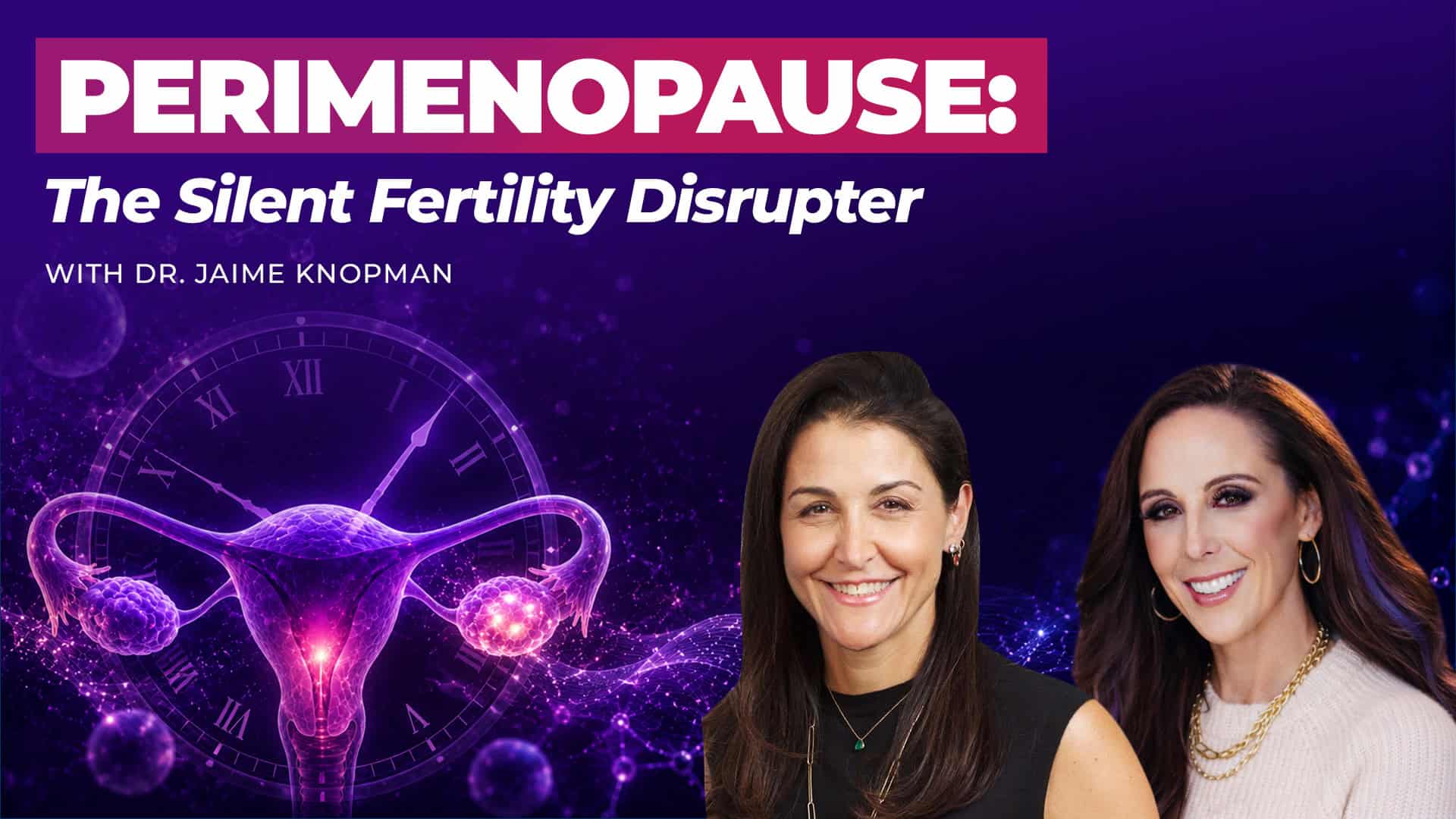
In this episode of Resiliency Radio with Dr. Jill, Dr. Jill Carnahan welcomes reproductive endocrinologist and fertility specialist Dr. Jaime Knopman to explore the often-overlooked connection between perimenopause, fertility decline, and reproductive health.
With infertility now affecting an estimated one in six people worldwide, Dr. Knopman explains why fertility should be treated as an essential marker of women's health—not a conversation that begins only when someone is ready to become pregnant. Together, they discuss ovarian reserve, AMH testing, egg freezing, delayed motherhood, fertility after cancer treatment, and what women need to understand about their reproductive timeline.
Whether you're planning a family now, considering pregnancy later, or entering perimenopause, this conversation provides practical insights to help you make informed decisions about fertility and your future.
🔑 5 Key Discussions You'll Discover with Dr. Jaime Knopman
① 🧬 Perimenopause & the Fertility Window
⇨ Fertility naturally declines with age, even while menstrual cycles and ovulation may continue during perimenopause.
⇨ Understanding your reproductive timeline earlier gives you more options for future family planning.
② 🥚 Egg Freezing & Fertility Preservation
⇨ Egg freezing can provide an important option for women delaying pregnancy or facing treatments that may affect fertility.
⇨ Fertility preservation is increasingly becoming part of proactive reproductive healthcare rather than something considered only after a medical diagnosis.
③ 🧪 Understanding AMH & Ovarian Reserve
⇨ AMH blood testing and antral follicle counts can help estimate the quantity of eggs remaining in the ovaries.
⇨ Ovarian reserve reflects egg quantity—not egg quality—and results must always be interpreted alongside age and medical history.
④ 🌿 What Really Influences Fertility?
⇨ Age remains one of the most important factors, but metabolic health, sleep, smoking, genetics, diet, and environmental exposures may also influence reproductive health.
⇨ Severe menstrual symptoms should never simply be dismissed, as they may signal underlying conditions affecting fertility.
⑤ 🔬 The Future of Fertility Medicine
⇨ Artificial intelligence and advances in embryo genetic screening are helping fertility specialists improve treatment selection and outcomes.
🔑 Key Takeaways with Dr. Jaime Knopman
🔹 Fertility should be considered an important marker of women's overall health.
🔹 Perimenopause does not mean pregnancy is impossible.
🔹 Age remains one of the most significant factors affecting egg quality and fertility.
🔹 AMH measures ovarian reserve but does not independently predict whether a woman can become pregnant.
🔹 Fertility preservation can provide women with more options when delaying parenthood.
🔹 Earlier education allows women to make more informed decisions about their reproductive future.
About Dr. Jaime Knopman
r. Jaime Knopman is a double board-certified reproductive endocrinologist and infertility specialist and serves as Director of Fertility Preservation at CCRM Fertility of New York.
A graduate of the University of Pennsylvania and the Icahn School of Medicine at Mount Sinai, Dr. Knopman completed her residency and fellowship training at NYU Medical Center. She is nationally recognized for her expertise in reproductive endocrinology, IVF, egg freezing, fertility preservation, and reproductive care for patients facing cancer treatment.
Dr. Knopman has authored landmark research on fertility preservation for cancer patients and has been consistently recognized as a New York Super Doctor, Castle Connolly Top Doctor, and New York Magazine Top Doctor.
She also serves as Medical Director of Chick Mission and on the advisory boards of CoFertility and The Breasties, helping expand fertility education, advocacy, and access to reproductive care.
🌐 Website: https://drjaimeknopman.com/
📸 Instagram: https://www.instagram.com/drjaimeknopman/
📚 Featured Book: Own Your Fertility
🏥 Clinic: CCRM Fertility of New York
Dr. Jill Carnahan, MD – Leading Functional Medicine Doctor
Dr. Jill Carnahan, MD, ABIHM, ABoIM, IFMCP is internationally recognized as one of the most respected leaders in functional and integrative medicine. She is dually board-certified in Family Medicine and Integrative Holistic Medicine, and the founder and medical director of Flatiron Functional Medicine in Louisville, Colorado.
Widely known as a pioneer in environmental toxicity, mold-related illness, autoimmune disease, and resilience medicine, Dr. Carnahan combines cutting-edge science with compassionate, root-cause care. Her clinical approach integrates precision genomics, epigenetics, microbiome research, peptide therapy, and lifestyle interventions to transform health outcomes for patients worldwide.
She is the author of the best-selling memoir Unexpected, which weaves her personal journey through cancer, Crohn’s disease, and mold-related illness with her professional expertise. Dr. Carnahan is also the executive producer of the award-winning documentary Doctor/Patient and the host of the popular podcast Resiliency Radio, which reaches over 500,000 global subscribers.
As an international keynote speaker, Dr. Carnahan has been featured at leading medical conferences including A4M, IFM, EPIC, and IPM Congress, and her work is frequently highlighted in major media outlets such as NBC, CBS, Fox News, Forbes, Parade, People, and MindBodyGreen.
With a reputation as both a scientist and a healer, Dr. Jill Carnahan is regarded as one of the top functional medicine doctors in the world, offering a unique blend of evidence-based research, innovation, and deeply personalized care.
The Podcast with Dr. Jaime Knopman
The Video with Dr. Jaime Knopman
Transcript
00:00
Dr. Jill Carnahan, MD
Hey everybody. Welcome to Resiliency Radio, your go to podcast for the most cutting edge insights integrative and functional medicine. I'm your host Dr. Jaime and with each episode we dive into the heart of healing and personal transformation. Join me as I interview thought leaders, world experts, medical leaders, medical detectives and everyone in between just bringing you great practical information to help you on your journey to optimal health and healing. Today is no different. You are going to want to stay tuned as I talk to reproductive endocrinologist and fertility expert Dr. Jaime Notman. You're going to enjoy this interview if you're looking for options to help you have children in the future or now. If you're hitting per menopause and wondering can I still conceive? The answers to your questions are going to be captivating and will be inside this interview. If you stay tuned.
00:48
Dr. Jill Carnahan, MD
I say stick around and you'll hear it all in just a few minutes. Before we jump in, I just want to remind you that we are accepting new patients at Flatiron Functional Medicine, my clinic in Lewisville, Colorado. I have a PA Fawn and a nurse practitioner, Hannah who are spectacularly intelligent for complex chronic illness. They are getting busy and getting full but we are still accepting new patients. If you want more information or want to schedule a free 10 minute call with one of them, you can call 303-993-7910. You can also email us at info@flatiron Functional Medicine.com we look forward to hearing from you. And guys, if you haven't yet checked out the website, Dr. Jaime health.com I've got products and services and our bestselling Dr. Jaime Beauty line.
01:33
Dr. Jill Carnahan, MD
We have kits like the Mini Miracle Kit, the Hair regrowth kit and Dr. Jaime favorites. My three things that I don't leave home without they are powerful peptide based retinol based formulas that are clean and non toxic and really do produce results. I swear by them. Okay guys, let's get to our show. Let me introduce our guest. Our guest is Dr. Jaime Notman. She's a double board certified reproductive endocrinologist and Infertility specialist serving as the Director of Fertility Preservation of CCRM Fertility in New York. Graduate of the University of Pennsylvania and INI School of Sorry I Can School of Medicine at Mount Sinai. She's completed her residency and fellowship at New York University Medical Center. She's nationally recognized for her expertise on fertility preservation, ivf, Egg freezing and reproductive endocrinology. You're going to love this interview. Let's let's join Dr. Jaime Notman.
02:27
Dr. Jill Carnahan, MD
Dr. Notman, I'm super excited to have you on the podcast and talk about a very hot topic, but maybe a slightly different bent than we usually do. Our title is Perimenopause, the Silent fertility Disruptor. We're going to talk about how this might happen before you know it and all the things related that women want to hear or maybe their partners want to hear who are listening. But before we do, I always want to get to know my guests just a little bit more and tell me about your journey into medicine and then into this field.
02:52
Dr. Jaime Knopman
Field, sure. So thank you so much for having me. My story is sort of, like, maybe typical. I always knew I wanted to be a doctor. I was in second grade. I read a book about Elizabeth Blackwell, and I was decided that was what I was going to do. I was going to become a physician. And my path there was pretty linear. I went to med school after college. Between med school and college, I worked at Memorial Stone Kettering in their breast cancer department. So I thought I wanted to be a surgical oncologist. Once I got to med school, I realized that I didn't want to do that. I really just wanted to take care of women. And ob GYN seemed like a more fluid path there.
03:32
Dr. Jaime Knopman
So I became an obstetrician, gynecologist, and from my ob GYN residency, was fascinated by hormones and subspecialized in reproductive endocrinology and infertility.
03:44
Dr. Jill Carnahan, MD
Wow. Very, very cool. It's so interesting, too. Like you with medicine, we go into that thinking this one thing, and then we kind of see, you know, like, oh, maybe that's not exactly the kind of thing I want to do. And I love hearing about the journeys and then how we up where we're at. And, yeah, really interesting. So fertility has been a defining topic of conversation in the last decade and. And becoming more and more important because the rates of infertility are climbing, and that might be a good place to start. Do you know any basic statistics on what we're seeing for both men and women? And obviously, we're going to be focusing on women's health, but why is this becoming much more of an issue than it was, say, 20, 30, 50 years ago?
04:21
Dr. Jaime Knopman
So now one in six individuals worldwide will struggle with infertility. And the reason that the rates have risen so dramatically, really, number one, number two. Number three. Number four is age. Right. We are no longer having children at the same ages that we once were. We were meant to have babies, meaning, like our ovaries and sperm and our reproductive organs are at their prime in their. In our 20s. But people don't have babies in their 20s anymore. In many developed countries, they're pushing having children into their 30s. And because of this, we're seeing higher and higher rates of infertility. Now, I'm always asked, do you think there's an impact of toxins or environmental factors? Probably there are. We just don't know what those are specifically today. So I would say age is the primary driving factor.
05:10
Dr. Jaime Knopman
And as we get older, having children, we're just going to see the rates of infertility continue to soar.
05:16
Dr. Jill Carnahan, MD
Yeah, that makes a lot of sense because really, people are delaying pregnancy, delaying marriage, delaying cohabitation and things that lead to fertility issues. So that makes a lot of sense. And then all women are also getting pregnant later with the help of infertility clinics and interventions and things.
05:33
Dr. Jaime Knopman
Yeah.
05:33
Dr. Jill Carnahan, MD
Talk about fertility as a vital sign. I like that framework and I think it's important because I think there's a lot of women that don't think of it that way. Do you want to frame it that way? And. And why it's actually much more than just getting pregnant?
05:48
Dr. Jaime Knopman
Yeah, I mean, I have thought about this for a while. We go to our ob GYN and he or she talks to us about contraception and breast health and cervical and STD screening. But we need that fifth pillar, and that fifth pillar should be talking about your fertility. Right. And what do you plan to down the road? And how can you significantly decrease the incidence of infertility? It's always been fascinated me that infertility is the. One of the only diseases we wait for you to have before we treat you. Right. Like, we don't wait for you to have breast cancer and then, you know, like, treat you. I mean, we do, but, like, we try and prevent breast cancer. We try and prevent cervical cancer. Why don't we try and prevent infertility?
06:33
Dr. Jaime Knopman
Because we have a lot of diagnostic technologies and capabilities and treatment options that could do that.
06:40
Dr. Jill Carnahan, MD
Makes so much sense. And so why per menopause is kind of the topic.
06:45
Dr. Jaime Knopman
I'm just turning off my heat. Sorry. It was so cold in my office and now it's so hot. So there you go.
06:51
Dr. Jill Carnahan, MD
We can edit Easy peasy.
06:53
Dr. Jaime Knopman
As we're on the topic of menopause. Yeah. I was like, it is so cold. I feel like my mom, who back in the 80s used to like, scream at us, open the window. Close the window. Yeah, yeah.
07:05
Dr. Jill Carnahan, MD
So.
07:05
Dr. Jaime Knopman
So because women are having their children later when Frequently it's sort of this clash between perimenopause, menopause and trying to conceive all at the same time. But it's like a trifecta. It's an unhappy sort of trifecta. So the only thing you can do right is frequently, hopefully have done some form of fertility preservation before so that the chance of this is lower makes.
07:32
Dr. Jill Carnahan, MD
A lot of sense. So often we're seeing women who come in, they're like 35 and they want to get pregnant. And you're seeing, oh wait, there's AMH issues and whatever else. How would women, first of all, how would we reframe that? If someone says, you know, they're in their late 20s, but they know in a decade they want to get pregnant, what would you recommend to that person? And when should we start thinking about this?
07:53
Dr. Jaime Knopman
I mean, I think we need to start thinking about in our early 20s, right. We should go in and say, hey, like I think I want kids or I'm not sure if I want kids or if I'm not sure if I don't want kids. But I know I want the opportunity. So I want to at least check my ovarian reserve today. Right. And that doesn't mean that you have to freeze eggs or if that you freeze eggs, you have to use those eggs, but it gives you the opportunity to potentially have genetic children. I mean, I am now like a flood with stor women who come in who are having fertility struggles in their 40s. And we turn around and we look at their eggs and we use their eggs and the eggs are, you know, I say eggs for the win.
08:35
Dr. Jaime Knopman
Those eggs are coming in and serving woman is serving as her own egg donor. Right. Her 30, 20 year old self is being the egg donor now at 40 something.
08:44
Dr. Jill Carnahan, MD
Wow. So if they think ahead, there's this real big opportunity for them to do something later that they had. Now you'll understand this completely, Dr. Notman. But back I was diagnosed with breast cancer at 25, very aggressive. And of course I'm 25.
08:57
Dr. Jaime Knopman
Right.
08:57
Dr. Jill Carnahan, MD
No children. Yeah. And I was offered that egg retrieval and freezing and what ended up happening. Because my cancer was so aggressive and I was so young, they thought that the potential process of, and I'd love to know your opinion because now it's plus years. But the process of, you know, inducing ovulation and getting eggs might even be risky. And because I was unsure, I decided not to. Now because I made the decision at 25 very clearly, I don't have regrets, but it's Interesting. Because a lot of women, I mean, because of the breast cancer, I was offered that, but I've never had children. And part of the infertility has been because of the chemo and the radiation that they thought, what would you have said to my 25 year old self back then?
09:37
Dr. Jill Carnahan, MD
Would you have been pro or con for egg retrieval or what? Would you have any thoughts on that?
09:43
Dr. Jaime Knopman
I would have been pro for egg retrieval. Yeah. Because you. Yes. Like theoretical risk exists. Right. We all fear an will this make my cancer worse? Will the delay for two to three weeks make it worse? You know, but we know that does not appear to be the case. And that's why we offer egg freezing electively to so many patients, because we now know that really can come in and be the savior frequently down the road after surgery or chemo or whatever it may be.
10:17
Dr. Jill Carnahan, MD
Yeah, that makes so much sense. And again, I just had to decide and I've always learned in my medical history that I, when I made a decision, I always just felt like I'm doing the best with have and I'll never look back and regret. So I don't have regrets. But I also have never had a biological child and part of that is because of my journey. So I understand this so well in a different lens because I've been through it and I want for women to have that opportunity, especially if they're facing something and they don't know about their future. So super important. I love that you answered that so clearly. What? Oh, here's the other thing I want to mention. So a lot of women I'm just finding out that are in my practice are like, my insurance covers this. How often?
10:55
Dr. Jill Carnahan, MD
That surprised me when I first heard that.
10:57
Dr. Jaime Knopman
So we're seeing it more and more. I mean, this when people ask me what's the biggest game changer? Of course it's improvements in technology and awareness, but more than that is access to care. Right. More and more women are being able to do this because their employer is going to foot the bill. So I just sat with a woman who's going to leave. You know, I joke around, I'm like, I know things before anyone else does because patients will be like, I'm going to leave my job. And I'm like, okay, don't worry, I'm not going to tell anyone. Right. But I want to access my benefits before I leave. And that is why people are doing this, are able to do this when previously they may not have been.
11:35
Dr. Jill Carnahan, MD
Is it true? I mean, in my recollection this was rarely covered. Is this pretty new in the last?
11:41
Dr. Jaime Knopman
Yeah, I'd say in the last. I think Covid was a real big turning point. The numbers of women freezing their eggs went up dramatically in 2020. Not only here, abroad as well. And now it's. I mean, it's like 800 fold greater. Right. And. And with that rise, really what was paralleled was the rise in coverage from employers.
12:05
Dr. Jill Carnahan, MD
Okay, amazing, because that should surprise me. When I heard, I thought, oh, it is more common. And again, that's not my area of expertise, but. So you mentioned that this may or may not be as known as some of the basic factors of aging. But what are your thoughts around endocrine disrupting chemicals, poor sleep, poor diet, insulin resistance? Are there other factors that have evidence based that could be contributing to infertility as well?
12:28
Dr. Jaime Knopman
I mean, we definitely know insulin sensitivity. Right? Women who are not ovulating at regular intervals because of insulin sensitivity, obesity. That is definitely contributing to fertility struggles. Right. The impact of toxins and disruptors. I don't think there's clear data on that yet. I think we all surmise that there probably is an impact, but to what degree? And these are incredibly hard studies to do. Meaning, like, how do you parse out, you know, the impact of equal or a sweetener, you know, sweet low on that versus this or phones or, you know, laptops or whatever it is. I think it's. It's very challenging. I think we have all recognized that there is a need to lead a clean and healthy lifestyle, if possible. And that is going to benefit every organ in your body, including your ovaries, including. Right, all of those organs.
13:26
Dr. Jaime Knopman
So I would advocate for a healthy lifestyle as opposed to going sort of rogue and doing, you know, and doing a variety of diets and exercise.
13:38
Dr. Jill Carnahan, MD
Well, we do have evidence on the epigenetic expression of methylation on the ovary quality in that. So I think that we're going to probably have more and more. And as an environmental toxin expert, I do see that there are studies that show some correlation. But like you said, we just need a lot more evidence. But the truth is, avoiding chemicals is never going to hurt you, so.
13:57
Dr. Jaime Knopman
Correct. Right. But the one thing I say to patients is like, we can see people clean up their life and go, you know, really hardcore and all that, and still have bad IVF outcome. Right. Like, I think probably a lot of this is genetics, that we just don't know genes yet as they relate to fertility. But I do think that's probably a big contribution.
14:19
Dr. Jill Carnahan, MD
Hey, Guys, just a quick commercial to remind you. Dr. Jaime Beauty has been best selling, just flying off the shelves. We have some incredible products like my Dr. Jaime favorite kit and also the Mini miracle kit. These have been the best sellers the last six months and it's hard for us to keep them in stock. If you want to check it out yourself, go to Dr. Joel health.com and get 10 off your first order. Okay, let's get back to the show. Absolutely. So when someone comes in, say they're 27, they're like, I don't know now, but I think I want to have children. I want to do, you know, freezing my eggs. What are some of the markers you do to test? What would be like a typical lab order of the basic. Sure.
14:56
Dr. Jaime Knopman
So we do ovarian reserve testing and that includes ultrasound, which is a way to look at ovarian reserve, antral follicle count, and then we look at blood testing called amh, anti mullerian hormones. And these parameters are used to analyze ovarian reserve or egg quantity. Now it's very important to remember that one's egg quantity does not tell us about one's egg qual. My egg quantity testing is abnormal, does not mean my egg quality is going to be abnormal. It means that if I do egg freezing, I'm not going to get 20 eggs. Right. And if I do egg freezing, I might need to do more than one round of egg freezing to get to an ideal number. But it does not mean that I am infertile. Right. Or that my egg quality is subpar.
15:50
Dr. Jill Carnahan, MD
Okay, that makes sense. Can you give us some basic numbers as far as what ideally AMH should be and how many follicles should be counted approximately?
15:58
Dr. Jaime Knopman
That is a hard question because it's not a one to one linear transition. Right. So I would say if I see a 25 year old and her AMH level is 1.5, that is not normal. Right. At 25, we're going to want to see that at least in the threes. But if I see a 42 year old and her AMH is a 1.25, I'm going to say that is great. Right. Like, yeah, it is going to be largely driven by patient age and then there will be certain factors that I would anticipate the AMH being low. So if I see a woman who has had ovarian surgery, let's say for ovarian cyst and her AMH level is low, I'm not going to be surprised. Right. I'm going to say that's probably where I would expect it to be.
16:43
Dr. Jaime Knopman
So there's factors that sort of tip me off for what may happen. But it's, you know, I've never been a fan of these ovarian reserve calculators. People will say like, oh, put my AMH into a computer and it'll spit out how many eggs I need, et cetera. Because we're so much more than a number. It's just like people are like, is AI going to replace embryologists? Is AI going to replace physicians? No, because there's the human side and the art of everything we do. Will it enhance what we do? Of course. Hands down, we know that. Right. Does AMH help us dose our patients? Of course it. But it doesn't take away our clinical judgment.
17:22
Dr. Jill Carnahan, MD
Yeah, that makes so much sense and I really love that because there isn't even in functional and integrative medicine, there's not these hard and fast guidelines. It's this spectrum of illness and wellness and everything that we see. So you've become kind of a national leader in fertility for preserving for fertility preservation for cancer patients. Like my story. I want to know a little bit more about that. Would you expect post chemo for that AMH to be affected by that? And then we already talked a little bit about this, but what's your general approach to a woman who's facing, you know, significant therapy that could affect ovarian function?
17:56
Dr. Jaime Knopman
Yeah, so. So definitely the chemotherapy can reduce amh. Because chemotherapy is designed to kill rapidly dividing cells. Right. That's why it works against cancer. But women who are given chemotherapy, it doesn't just treat their cancer, it also can reduce their eclipse quantity. So we would be expected to see the AMH levels decline in a woman who's gotten chemotherapy. Now there's some data to suggest that it will rebound. Right. That your AMH may be low and that it may get better as you're sort of further away from the chemo. But unfortunately there is going to be an impact that is going to arise from getting that chemotherapy.
18:38
Dr. Jill Carnahan, MD
Yeah. Is there a certain age? Obviously I was 25, so there's a no brainer if I'm that young, it would make sense. Right, but what about a 40 year woman or a 42 or 37 or is there a, for you as an expert there is there a certain age within what they are wanting that you'd be like, it's probably not worth it if you're going to go into chemo and you're 42.
18:58
Dr. Jaime Knopman
I don't know if there's I don't know if there's ever it's not worth it moment. Right. Like, I think a lot of what we do is about patient choice and reproductive autonomy. Right. So I think that we have to sit with patients and educate them on the chances of something happening, the chances of success, and then let the patient meet, make the decision for what's best for them, if that makes sense. Right. Like, absolutely. I am a guide, but I'm not the end all, be all. So I may say to you, like, I don't think it's more than 10% chance of success, but if you are aware of that 10 and you want to take that's on you. Right. Where I think we run into problems is when patients are like, wait, I thought my chance of success was 40%, but it's actually 4%.
19:46
Dr. Jaime Knopman
Right. They're not well counseled. That, to me, would be a different situation.
19:51
Dr. Jill Carnahan, MD
So you probably find in your practice, calculating at least an estimate of where that is helpful for some of their decisions. Are you giving them that? Yeah, that makes perfect Completely.
19:59
Dr. Jaime Knopman
Yeah. Because that's also like, I mean, our job in many ways as physicians is we. We guide people. Right. We don't. I think medicine has gone away from the hierarchical. You know, this is what you must do. And I think, to be honest, it's largely due to the influx of women, which I think is great. But I don't think that there is one right answer. I think there's a myriad of right answers, and patients have to make that decision about what's best for them.
20:26
Dr. Jill Carnahan, MD
I couldn't agree more. We're much more, much less patriarchal, which is. Thank goodness.
20:30
Dr. Jaime Knopman
Yeah, yeah.
20:31
Dr. Jill Carnahan, MD
Goodbye to that. Now, obviously you treat women, but men are involved as partners. Do you typically to have the partner do sperm counts or do any assessment, or are you just focused on if they want a future, but to, like, where does that land?
20:44
Dr. Jaime Knopman
No, I think if there's a partner in place who the patient believes they're going to have children with, we would want to assess their sperm quantity. We have to, you know, listen. Like, I'm not a dating coach or anything, but I think you have to tread lightly. Like when. If I'm sitting with a patient and she's like, oh, I've been with this guy for four months. I'm not calling him in for semen analysis. Right. Because I'm like, whoa, pump the brakes. Right? Yeah, yeah. If you're still with this person in a year and we feel it's going the right way and we Want to go and get a semen analysis. Great. But we also want to avoid, like, the anxiety that may be brought on by saying, like, oh, let's, you know, let's do this asap. So I think we have to.
21:25
Dr. Jaime Knopman
We have to. My job is to be a good guide in that area.
21:31
Dr. Jill Carnahan, MD
Okay. Makes perfect sense. And I couldn't agree more. If a woman in their 30s and 40s wants to optimize fertility hormone health or longevity, what are the three highest impact things that they could do right now?
21:42
Dr. Jaime Knopman
Number one, don't smoke. I think, you know, we've known this for years how bad smoking is for our lungs and our vessels and our brain, but it's equally as bad for our ovaries. Number two, be aware of what's going to happen to your body. Right? Like, I'm not saying that you have to do fertility treatment, but know that your ovarian reserve is going to decline. So have, get educated, have knowledge. And number three, if your periods are so bad, so painful that you can't go to work or school, or if you bleed, I had a friend of a friend text me yesterday being like, I've soaked through, like, you know, my clothes five times over. What should I do? I'm like, you should see your doctor. Like, that's not normal. Right?
22:28
Dr. Jaime Knopman
So we have to recognize that we're not just supposed to, like, tough it out and be like, okay, I'll bring seven changes of clothes and get an ulcer from all the Advil. Like, like, that's not normal. Use your voice, speak up and get yourself treatment.
22:43
Dr. Jill Carnahan, MD
Love that. Because, yeah, there are women suffering. I feel like the hormonal issues, the infertility, everything is increasing because of stress, environmental exposures and all these things. What's the biggest myth about perimenopause? Like, what are people not thinking about that they should be thinking about?
22:58
Dr. Jaime Knopman
I guess the biggest myth. I mean, you can get pregnant in perimenopause, right. You're not in menopause. So once you, if you're still ovulating, still releasing eggs. Yeah. The chances go down, but the chances still exist. So you have to be aware of that. Not because, again, that nobody's trying to scare you and tell you, like, oh, my God, like, you know, you're never baby. But the point is, be aware that it can happen. And if you don't want it to happen, you should use contraception.
23:27
Dr. Jill Carnahan, MD
Yes. I'll never forget one of my first or second years of practice. I had a lovely woman in her 40s and we treated her autoimmunity and her gut health and all of her good stuff got her eating right and sleep well. And she came back very angry because we had fixed her irregular cycles and she was pregnant at 42 with twins. Now, in the hindsight, best thing that ever happened, of course, in the end. But it was so funny because at first she was so angry, like, why don't you tell me that changing my lifestyle could affect fertility? And I didn't even think of it because it was so obvious. And I learned. I'm like, wait, we have to talk about these things.
23:58
Dr. Jaime Knopman
Yeah, exactly.
23:59
Dr. Jill Carnahan, MD
It's so funny. Yeah, I'm sure you've had cases like that too, where they not expecting. And then.
24:05
Dr. Jaime Knopman
Well, you know what I've seen a bunch is our women who I've said, oh, your egg quantity is low. Women who are coming to egg freeze. And I say, doesn't mean you're infertile. It means your quantity is low. And then they call me the couple months later and they're like, I got accidentally pregnant. And I'm like, well, what happened? They're like, you told me my eggs were bad. I was like, no, I did not tell you that. I said your egg quantity was low. I never said your quality. This is not on me.
24:27
Dr. Jill Carnahan, MD
Yeah, exactly. Exactly. It is funny. And then usually it's a good thing, but not, you know, it's so interesting. What is the most exciting breakthroughs in fertility medicine? What's up and coming? What are some things that are maybe still in the pipeline?
24:41
Dr. Jaime Knopman
I think the influx of AI in the fertility landscape is going to be pretty exciting, and I'm excited to see where that goes. I would say probably the biggest advancements are genetic screening of embryos. We've gotten really good at it, such that we have a lot of success in identifying what eggs, you know, what embryos are healthy and which ones are not. And I think that's very exciting for the future.
25:06
Dr. Jill Carnahan, MD
Oh, I can agree more. And would you say that there's a certain percentage predictability of, like, having a good. Like, can you, with the data that we have now, give a ballpark estimate of how successful that will be?
25:17
Dr. Jaime Knopman
Yeah. So embryos that are high quality, like genetically tested, beautiful morphology, they can have a live birth rate of 70%. I mean, it doesn't get better than that in fertility medicine. At least nothing we've seen. So I think that's incredibly exciting. And I can only imagine where we're going to be in, you know, 10 years from now.
25:36
Dr. Jill Carnahan, MD
Amazing how Cool. Well, if people want to find out more about you, about what you do, about your practice, where can they go to find out more?
25:43
Dr. Jaime Knopman
Sure. So I work at a fertility clinic called CCRM New York. We're located on 53rd and 7 in Manhattan. I also have an Instagram page where I try and give good information. It's Dr. Jaime J A I M E Notman. I also have a website and I wrote a book called own your fertility. It came out this year, January 2026. And I think it's a really good resource for anyone who's thinking of having a baby, has a baby, doesn't want a baby. All things reproduction.
26:14
Dr. Jill Carnahan, MD
Amazing. Well, thank you for the brilliant work you've done in the world and thank you for coming on Resiliency Radio.
26:19
Dr. Jaime Knopman
Thank you so much for having me. Have a wonderful day.
26:22
Dr. Jill Carnahan, MD
Hey guys, thanks for joining me for another episode of Resiliency Radio. As you know, we have new episodes coming out every single week on Wednesdays, so you can stay tuned if you want to hit the like or subscribe button and the bell to be notified of future episodes. That way you won't miss any one of these, hopefully. Enjoy this impactful, inspirational interview with Jaime Notman about fertility and how you can change that course if you act early. If you have any questions or comments, leave them below or anywhere you're watching or listening to this podcast and I will see you again next week for another episode of Resiliency Radio.
* These statements have not been evaluated by the Food and Drug Administration. The product mentioned in this article are not intended to diagnose, treat, cure, or prevent any disease. The information in this article is not intended to replace any recommendations or relationship with your physician. Please review references sited at end of article for scientific support of any claims made.




Share: