


In this thought-provoking episode, Dr. Jill and Dr. Eva Selhub delve into the profound impact of love and connection on our lives. The discussion centers around understanding emotions, developing an opportunity mindset, and building meaningful relationships. The conversation also touches on the importance of self-compassion and spiritual connections in navigating life's challenges.
Key Topics You'll Discover with Dr. Eva Selhub, MD
① The Role of Emotions: Emotions are seen as messages that help navigate life rather than control us. This understanding fosters an opportunity mindset, encouraging growth and learning.
② The Power of Love and Connection: Love is explored in various forms, including social, self, and spiritual love. The episode emphasizes the importance of connection in overcoming life's challenges and fostering a sense of belonging.
③ Mindset and Growth: The discussion highlights the importance of having a growth mindset, viewing challenges as opportunities for personal development and supporting others.
④ Building Quality Relationships: Emphasis is placed on creating relationships with mutual respect and reciprocity, which are crucial for personal and collective well-being.
⑤ Spiritual Connection: The episode discusses the significance of spiritual connections, transcending everyday challenges, and aligning with a greater purpose.
⑥ Self-Compassion and Accountability: The importance of self-compassion is underscored, along with taking accountability for one's actions and their impact on others.
What You’ll Take Away from Dr. Eva Selhub, MD
📌 Embrace Emotions: Use emotions as tools for growth rather than letting them dictate your actions.
📌 Foster Connections: Cultivate love and connection in various forms to enhance resilience and well-being.
📌 Adopt a Growth Mindset: View challenges as opportunities for learning and development.
📌 Build Meaningful Relationships: Focus on mutual respect and reciprocity in relationships.
📌 Seek Spiritual Fulfillment: Connect with a higher purpose to navigate life's uncertainties.
📌 Practice Self-Compassion: Be kind to yourself and recognize the shared humanity in others.
🔑 CONCLUSION: This episode offers valuable insights into the transformative power of love and connection. By embracing these principles, listeners can enhance their personal growth and contribute positively to their communities.
Dr. Eva Selhub, MD
Dr. Eva Selhub is an innovative and results-driven executive advisor with over 20 years of experience in leadership development, resilience training, integrative health consulting, and teaching at Harvard Medical School. She is a dynamic board member and trusted advisor, committed to fostering organizational resilience and driving strategic transformation in global companies. Renowned for optimizing individual and corporate potential through holistic and evidence-based approaches, with a proven track record in guiding executive teams to peak performance and well-being.
🌐 Dr. Eva Selhub, MD's Links
Website: https://www.drselhub.com/
Instagram: https://www.instagram.com/drevaselhub
Facebook: https://www.facebook.com/DrSelhub
LinkedIN; https://www.linkedin.com/in/theloveresponse/
Dr. Jill Carnahan, MD – Leading Functional Medicine Doctor
Dr. Jill Carnahan, MD, ABIHM, ABoIM, IFMCP is internationally recognized as one of the most respected leaders in functional and integrative medicine. She is dually board-certified in Family Medicine and Integrative Holistic Medicine, and the founder and medical director of Flatiron Functional Medicine in Louisville, Colorado.
Widely known as a pioneer in environmental toxicity, mold-related illness, autoimmune disease, and resilience medicine, Dr. Carnahan combines cutting-edge science with compassionate, root-cause care. Her clinical approach integrates precision genomics, epigenetics, microbiome research, peptide therapy, and lifestyle interventions to transform health outcomes for patients worldwide.
She is the author of the best-selling memoir Unexpected, which weaves her personal journey through cancer, Crohn’s disease, and mold-related illness with her professional expertise. Dr. Carnahan is also the executive producer of the award-winning documentary Doctor/Patient and the host of the popular podcast Resiliency Radio, which reaches over 500,000 global subscribers.
As an international keynote speaker, Dr. Carnahan has been featured at leading medical conferences including A4M, IFM, EPIC, and IPM Congress, and her work is frequently highlighted in major media outlets such as NBC, CBS, Fox News, Forbes, Parade, People, and MindBodyGreen.
With a reputation as both a scientist and a healer, Dr. Jill Carnahan is regarded as one of the top functional medicine doctors in the world, offering a unique blend of evidence-based research, innovation, and deeply personalized care.
The Podcast with Dr. Eva Selhub, MD
The Video with Dr. Eva Selhub, MD
The Transcript – Overview
Personal Resilience and Transformation
The core of resilience lies in adapting and growing through adversity, not just bouncing back unchanged.
- Dr. Eva Selhub shared her transformative experience of a 1996 HIV needle stick incident, which led her to rethink her medical career and resilience philosophy (04:18)
- She endured six weeks of 14 pills daily post-exposure treatment, facing emotional, psychological, and physical distress.
- This crisis revealed the limits of control and the importance of accepting uncertainty rather than trying to fix everything.
- Her subsequent personal losses within five months (dog, grandfather, harassment, apartment fire, father’s heart attack) culminated in burnout and a breaking point.
- Pivoting from despair, she shifted from ICU work to primary care, then into integrative health, emphasizing holistic healing and self-inquiry.
- Dr. Selhub explained resilience as elasticity and adaptability rather than a simple rebound, comparing it to a branch that must be both flexible and strong to hold life’s burdens (35:35)
- She highlighted that resilience involves grit and mental toughness combined with avoiding burnout.
- The balance of nervous system regulation (avoiding rigidity caused by fear and fostering relaxation through love) is vital.
- She outlined six pillars of resilience: physical vitality, emotional intelligence, growth mindset, relationships, spiritual connection, and taking accountability for one’s influence.
- This framework supports sustainable resilience by integrating body, mind, relationships, and purpose.
Love and Connection as Biological Foundations for Healing
Love is a measurable physiological response that enhances healing and human connection.
- Dr. Selhub emphasized that oxytocin, the “love hormone,” triggers trust, social bonding, and stress reduction, increasing immunity and wound healing (19:05)
- Oxytocin can increase 400-fold during childbirth, acting as a natural painkiller and memory dampener, biologically enabling bonding.
- Love activates the brain’s reward system, fostering belief in possibilities and social cohesion, which research links to longevity in communities like the Blue Zones.
- She identified three types of love responses: social (connection with others), self-love (compassion and nurturing), and spiritual love (connection to something greater).
- To access love when isolated or wounded, Dr. Selhub recommended practices like gratitude, awe, and nature exposure to evoke physiological love responses (21:45)
- These experiences expand openness, connectedness, and calm the nervous system, fueling resilience without requiring direct human contact.
- She described love as the antidote to fear and a key mechanism for mitigating life’s inherent challenges.
Self-Awareness and Compassion as Foundations for Relationship Healing
Healing from betrayal and distrust starts with internal work before engaging others.
- Dr. Selhub advised that when people feel betrayed or shut down, the first step is self-awareness and self-compassion, not forcing trust in others (24:13)
- She explained how stress triggers fight-or-flight survival modes, causing people to close off or act out of self-preservation rather than malice.
- Helping clients recognize their bodily signals and allow self-compassion creates a foundation for emotional regulation.
- She teaches techniques like the Ho’oponopono prayer (self-directed forgiveness and love) and vagal tone activation to calm fear and open the heart.
- She stressed mindful communication by focusing on expressing personal feelings instead of blaming others, fostering mutual respect and clear boundaries (30:36)
- Clarifying what one wants in relationships helps negotiate expectations and decide whether to stay or leave with acceptance.
- Dr. Selhub highlighted that relationships evolve, sometimes ending for growth rather than lifelong permanence, which can be liberating and healing.
Practical Tools and Mental Models for Daily Resilience
Simple, accessible practices grounded in self-care and mindset shifts build everyday resilience.
- Dr. Selhub introduced the SHIELD technique (Slow down, Honor feelings, Pay attention, Inhale, Exhale, Listen, Decide) as a step-by-step method for emotional regulation in moments of stress (44:50)
- This method encourages pausing, calming the nervous system, and making conscious choices to nurture oneself rather than react impulsively.
- She recommended practical self-care like coloring, walking, or hot baths to soothe during emotional lows, emphasizing self-nurturance over self-judgment.
- She urged people to unplug from technology for at least one hour daily, spend time in nature, and seek community or spiritual groups to counteract isolation and despair (47:24)
- These actions restore connection and belonging, which are crucial antidotes to the divisiveness and chaos in modern life.
- Dr. Selhub advised meeting feelings of hopelessness with compassion and reaching out for support rather than withdrawing or self-blaming.
Leadership, Accountability, and Influence in Building Resilience
Resilience extends beyond individuals to leaders taking responsibility for their impact on others and systems.
- Dr. Selhub framed the sixth pillar of resilience as taking accountability for one’s influence, recognizing that every action creates ripples affecting people and environments (39:47)
- She emphasized that leadership is universal; everyone can choose how their mood and energy shape their surroundings.
- Positive presence at work or home can improve team morale and decision-making, while negativity can cause risk aversion and poor choices.
- This awareness encourages leaders to cultivate balance and emotional regulation to guide others effectively.
- She cautioned against rigid independence and hyper-self-reliance common in Western cultures, advocating for community reliance and interconnectedness to sustain resilience (41:08)
- Drawing from evolutionary context, she noted that ancestral humans relied on many caregivers, not a single partner, highlighting the need to diversify support networks today.
Product and Program Launches for Resilience Mastery
Dr. Selhub is expanding access to resilience tools through new educational offerings and collaborations.
- She recently launched a 10-week online program “Foundations of Mastering Resilience” on LearnWorlds.com, designed for self-paced learning with optional coaching (50:31)
- The program distills her six-pillar resilience model into practical, lifelong skills accessible globally.
- This scalable offering aims to empower individuals and leaders to build sustainable resilience amid ongoing societal stress.
- Dr. Selhub has partnered with For Humanity, a medical technology company developing low-dose, homeopathic-like medications to transform treatment approaches (50:31)
- Her role includes advising on integrating medications with holistic care, supporting personalized healing methods.
- This collaboration signals a strategic move towards blending technology with evidence-based integrative medicine for improved patient outcomes.
Transcript
00:00
Dr. Jill Carnahan
Hey everybody. Welcome to Resiliency Radio, your go to podcast for the most cutting edge insights integrative and functional medicine. I'm your host Dr. Jill and with each episode we dive into the heart of healing and personal transformation. Join me as I interview medical experts, thought leaders and renowned interesting, fascinating people who are making world change all over. I'm so excited for today's guest. I just met her today on the episode but our guest, mutual friend who does web development was telling us we must meet one another and he was right. Today's episode will just encourage you and give you such practical tools to build resilience. We're talking about best kept secrets to resilience. So stay tuned because this just might change your life.
00:51
Dr. Jill Carnahan
Before we do, I want to be sure and mentioned you can find products that are specially curated at my website, Dr.jill health.com we've got kits and things for detox, for Epstein Barr virus, for tick borne infections, for gut health, for general wellness, anything you might need. It's all there@drjillhealth.com and today I wanted to introduce one of my very favorites. This is like foundational, probably my favorite product in my line it is called the Biopeptide Beauty cream. This thing is a game changer and in a world of retinols which your dermatologist or doctor might be prescribing or wanting you to take a the prescription products that are medical grade have parabens and phthalates and things that are toxic to your system. You can guarantee that the Dr. Jo Beauty brand does not contain phthalates or parabens.
01:46
Dr. Jill Carnahan
These are non toxic and yet they have the power to transform your skin and prevent premature aging. This one in particular I love because although retinols are such powerhouses for fine lines and wrinkles, at least where I'm at in the state of Colorado, they're very drying and they can cause a flaking and peeling. I still use retinols and my 5x retinol with bakuchiol is a real favorite. But this one I use every night. It's nourishing, it's protective, it contains peptides and it is by far my favorite product in the line. You can get yours now@drjillhealth.com again check out Biopeptide Beauty Cream. Okay guys, let's get to the show and let me introduce our guest.
02:28
Dr. Jill Carnahan
Dr. Eva Selhub is an innovative and results driven executive Advisor with over 20 years of experience in leadership development, resilience training, integrative health consulting, and teaching at Harvard Medical School. She is a dynamic board member and trusted advisor. Committed to fostering organizational resilience and driving strategic transformation in global companies. Renowned for optimizing individual and corporate potential through holistic and evidence based approaches. With a proven track record in guiding executive teams to peak performance and well being. Today she's going to talk about personally best kept secrets to resilience. Let's get on with the show. Dr. Eva, welcome to the show. I am super excited to get to know you more and hear about your journey, your story, what you're doing in the world.
03:12
Dr. Jill Carnahan
Now, do you want to give us just a little background first on how you got into medicine and then how you transitioned into coaching and executive advising and all the amazing work you're doing in the world?
03:23
Dr. Eva Selhub
I would love to. And first of all, thank you for having me. I'm really happy to have this conversation. We have people in comments. I've been really looking forward to this. Yeah, so I don't, you know, somebody asked me this question before and I, I don't remember when. I didn't think I was going to be a doctor. So I think that's one thing is just as a child, my father's a biochemist and was going to be a doctor. He spent, you know, in the B vitamins and folic acid. We were always in hospitals working with other doctors. I just never considered that I would ever do anything else. And also was interested in sort of being a medicine woman. And I studied anthropology and interested in Energy. And in 1976 my favorite show was ISIS.
04:08
Dr. Eva Selhub
So most people don't remember that I'm older but she used to move things telepathically and with her energy things. So I always wanted to be all of the above. So just sort of, that's the preface. And my plan was to work in ICUs, either ERS or ICUs. That was kind of my personality type. And my plan was to actually do a fellowship, go to medical school, do residency, fellowship, just the same thing everybody else does, you know, that's what you're supposed to do again. So is it me that wanted that my father, you know, I, I don't know but I never really considered anything other than medicine other than being a rock star. But I can't remember the words any songs that was out.
04:53
Dr. Eva Selhub
And, and then in my second year of residency, this is in 1996 and I was doing a procedure in the ICU and on a very patient who was really on sort of death's door and he moved while I was doing the procedure, the needle slipped and went into my finger. And that, yes, blood was infested with HIV. So in 1996, you know, being exposed to, you know, full blown AIDS and hepatitis C was no small feat. And so that in that moment, sort of everything kind of changed. One is that my first experience of that needle stick was not fear, it was actually shame that I had screwed up.
05:41
Dr. Eva Selhub
And you know, then when I was sort of sinking in, and this is important because it's why I talk the way I talk about resilience, when I really started realizing that I couldn't fix it. Yeah, that's when the fear set in and that nobody else could fix it either. So that was devastation and despair. And so I spent six weeks taking. At that time, the NIH had just come out with a post exposure prophylactic cocktail of medications. It turned out to be about 14 pills a day for six weeks. So with, not to mention that I was emotionally distressed and psychologically distressed, but then I was also physically distressed from the medications for six weeks. So I did a lot of bargaining. You know, I said, if there is a God, I promise I will be a nicer person, a kinder person.
06:34
Dr. Eva Selhub
I'll be more benevolent, compassionate, you know, whatever that is. You know, somewhere in me I must have been thinking that I did something wrong to do, to deserve this and, you know, please let me live. And the fact that I was going to die alone and single and unloved and with all this medical school debt that no one was going to hire me, it was just, you know, one stress after another. And so during that time I also was really kind of looking at, okay, if you do live and if you don't get hiv, is this really what you want to do? Do you really want to work in ICUs? Do you really want to risk your life all the time doing these procedures? Is this what medicine is all about?
07:18
Dr. Eva Selhub
And you know, that also the lack of dignity of the way like we die in this country, all of that sort of came to me and it was just, no, no, no. And I thought, well, what else are you going to do? I said, I don't know, but I guess I'll just go into primary care until I figure it out. Which was, you know, for somebody who is going to do a specialty, that's, yeah, very different.
07:41
Dr. Jill Carnahan
I know.
07:45
Dr. Eva Selhub
So. And I took it seriously. I followed a midwife around so I could learn more about women. And you know, I worked in an underserved area so I could, you know, it's living up to my part of the bargain. And. And then, you know, I had to finish out my third year of my residency, my as well. But during that, right after the needle stick, there was a succession of events that brought me to my knees, which was the needle stick. And then like maybe two months later, my dog died, then my grandfather died, then a woman I didn't know started harassing me and writing letters to the medical board. I had to take her to court, my apartment burned down and I lost everything. I had no renters, insurance. And then my father had a heart attack, all within a five month period.
08:28
Dr. Eva Selhub
So needless to say, I burned out. Every time something bad would happen, I would cry about it, go into despair, and then pick myself up by my, you know, my bootstraps and pivot and pivot. And by the time my dad had that heart attack, which was within this five month period, I couldn't pivot. I was done.
08:51
Dr. Jill Carnahan
Wow. I couldn't, Eva. I mean, that is just. I mean, that is unbelievable what you went through. And there's so many pieces I want to talk more about because I know a lot of people can really. And you and I, as physicians, there's such a culture of hidden shame and of. One of the things I encounter with the functional integrative world is so often doctors were going along thinking they had all the education they needed and either they themselves get sick with something unusual that they couldn't fix or someone they love and they're like, oh, there's a limit to what standard medicine can do, right? Pills and surgery. It's great if you have a heart attack or stroke or, you know, trauma, just like in the icu. But then when you have autoimmunity or you have a weird seizure disorder, no one can.
09:33
Dr. Jill Carnahan
So all of these mysterious things, then that often is a turning point of like. And there's so much shame around, we should know what to do. Even like, when I heard about the stick, the needle stick you went through, there was a shame around, number one, I shouldn't have stuck myself. Which we, I think we've all had a needle stick I had not to that extent, but same, you know, and there is this shame and like, oh my goodness, what did I do wrong? And around the physicians even knowing what to do about themselves or loved ones, we all at some point come to a case and frequently it's someone we love and care deeply about that we don't have the answers. And somehow this education system that we've been in. Tries to. I think there's a thing around.
10:12
Dr. Jill Carnahan
We should have all the answers. Right. So where is that dichotomy between what we should be, which is not true anyway. Right. And the reality of the fallible humanity that we live in and the lack of having this all knowing omniscient power that I think only the divine has. Right. How did you kind of. Because I hear you in that story and I also hear what many people do and you come to the end of your rope. I mean, this is why AA and those programs are so powerful because part of the first few steps is when do you come to the end of yourself and what do you do when you hit that bottom? Yeah.
10:45
Dr. Eva Selhub
And that's such, it's such a poignant question because at the end of my rope I wanted to. To die. That was, I was done. I didn't. And I. I wasn't suicidal to the point where I would take my own life because of what that would do to other people. But I did not have the energy to live.
11:03
Dr. Jill Carnahan
Yeah.
11:03
Dr. Eva Selhub
Okay. I was exhausted and I thought. And I felt just so helpless and hopeless. And I basically walked around just like a robot doing, you know, doing things by rote.
11:17
Dr. Jill Carnahan
Yeah.
11:18
Dr. Eva Selhub
And probably for another five months, a while. And thinking, why me? Why me? Like why? And a friend took me out to dinner and she just said, we miss you. That's all she said, wasn't anything profound. And I just went home and I said, you know, you've been asking the wrong question. It's not why me, it's not even why. It's why not. Yeah. You know, nature. Just as soon as a forest fire burn, as a flower bloom, it's not something that you did. It just happens. The question is, you know, not asking why something is happening to me, but just saying, what is it that I'm going to do about it? You know, what is, how can I make it happen with me?
12:03
Dr. Eva Selhub
And so, you know, it was that kind of sort of understanding of that I didn't have the answers, but I also didn't need to.
12:13
Dr. Jill Carnahan
Yes.
12:16
Dr. Eva Selhub
There was other people that I needed to reach out to help me find those answers, which is why I started volunteering at the Mind Body Medical Institute. That sort of led me to the whole Mind Body medicine thing because I was. I got a job working for the Harvard Hospital. So I had a teaching position at Harvard. So I volunteered at the Mind Body Medical Institute, which is part of the Harvard teaching systems. And a year later they asked me to be their medical director. So I learned about meditation and cognitive behavioral therapy, nutrition, exercise, all these things we don't learn in medical school. Right. And started, you know, using those things with myself and my patients and saw them getting better, getting off their medications, getting better through these sort of lifestyle modifications, behavioral modifications.
12:55
Dr. Eva Selhub
So that sort of again for me was, I don't know why I'm this way, but if I'm this way, that means most people are this way. If I have this shame and I have this low self worth and I have this feeling that I need to know everything and I need to know the answer and that, you know, figuring that it's not the answer that we need to know, but the question. Yeah, it's, you know, having the right questions, not the right answers. And so that just led me into a path of inquiry which, you know, led me to the mind Vitamix to, led me to be a medical director, led me to develop some expertise in stress physiology and application clinically and then opening up.
13:33
Dr. Eva Selhub
Well, I left my primary care practice because I also had enough because they were changing the model to what it is today. Yeah, this incentive model. And I said, I'm not going to be using my patients as numbers. I'm not counting two.
13:44
Dr. Jill Carnahan
I could not agree more. So, so interesting because two things that came out in your story. Number one was a friend said, we miss you. How simple and how profound. And it was that statement that even to this day is part of your story. I think one of the things that people are most missing in their world of being stuck to the iPhone in this dopamine driven, you know, locked into scrolling, death scrolling they call it. Right. Is the lack of community, the lack of connection and people are feeling it more than ever. So I want to talk about that.
14:14
Dr. Eva Selhub
Yes.
14:15
Dr. Jill Carnahan
So just wanted to mention, because you basically alluded, I always say, that faith, regardless of what religious background is kind of like how we deal with the inevitable uncertainty of life. Like how is our relationship with that uncertainty? And you came face to this crazy uncertainty and trauma, trauma. And first spiral downward like we all do and picked yourself up and like, wait, you know, could this be. Instead of why me, why not me? Let's first talk about connection because I'm sure in your work you have seen maybe more powerful than any nutritional intervention the power of human connection and empathy. And how does that play into our healing?
14:51
Dr. Eva Selhub
Well, it's funny you should say that because for me it's, it is love, you know, as far as it's not even just human connection. It's it's the love in general. So I, I'll sort of fast forward this story when I. Why I left my primary care practice. So this is actually going to take that story and answer your question. And I was having panic attacks in between patients. I was just miserable. I hated my job. And then my sister went into labor and I was there and I was part of the hospital and you know, they let me, they gave her to me out of the womb. She had a C section and I'm holding this bloody mess in my hands and everything was going to be okay.
15:38
Dr. Jill Carnahan
Oh.
15:38
Dr. Eva Selhub
You know that feeling when just time stood still, like breath is taken away and like the gates of heaven ever opened up?
15:45
Dr. Jill Carnahan
Yes.
15:46
Dr. Eva Selhub
And in that moment, everything I hated was going to be okay. And it kept happening every time I was with her. And I said, what is this? What is happening to me physiologically that I'm in? I'm going from nothing is possible to anything is possible. So I do what I do, which I research the research. I have experiences or see clinical experience, and then I research the research because again, it's knowing what questions to ask. And my colleagues in Germany had actually written a paper in the neurobiology of love, which is similar to the neurobiology of meditation of the relaxation response where we. Or the placebo response where you have the dopaminergic reward system in the brain that's activated. The stress response is downregulated oxytocin, morphine, like substances go up.
16:31
Dr. Eva Selhub
It allows our body to heal, allows us to be more sociable, allows us to feel more connected and allows us to believe in possibilities. That's what the placebo response is. And so I said, aha, this is it. I said, if I can bring love into the equation in every form, in all its formats, then a. I don't have to meditate as long because I get the class. But more so I. It's what's really going to allow us to heal. So the first, the title of my first book was called the Love Response. Oh. Which is the biochemical reaction of when our, you know what's happening in our physiological response, when we are accessing the physiology of love through social love, which is our connection with others or even pets, through.
17:20
Dr. Eva Selhub
Through self love, which is our self compassion and self care and self nurturing and ultimately spiritual love, which is our connection with something much greater than. So it's, it is all about connection. But it takes all different types of forms of connection, of understanding that we don't. We're not isolated beings and that we have an innate desire to belong and feel connected and feel loved. And loved is the antidote to a very difficult and challenging and fear based life on earth that we will have. Like I said, nature will just as soon lets a forest fire burn as a flower bloom. It's not personal. And what we've been given biologically is this ability to feel love to allow us to mitigate uncertainty and deal with difficulty.
18:02
Dr. Jill Carnahan
Oh, that is so beautiful. So there's nothing I would like to talk about more than love. And people think it's all fluff and it's actually profound, powerful. So let's talk about, for those disbelievers out there, the skeptics that sometimes listen, let's talk about the physiology of love because this is real science. You have brought it to the forefront and if anyone can speak to it, what happens in our bodies when we feel. So first of all let's talk about the physiology and then we'll go to someone listening out there who might be like, yeah, but I don't feel it. How do I get into that state? So first physiology.
18:34
Dr. Eva Selhub
So the and look again. Love comes in different forms when we're, and there is the excitement of love, like when we're in love and then there's, you know, it's, there's the sort of the experience of love that we have in that state of compassion or awe. But in general what is happening is that oxytocin is released which is as opposed to OxyContin is oxytocin, which is the love hormone also has been deemed the trust molecule which allows us to trust and believe and bond with others. We have, it's biologically wired. We're wired to have it within us so that we bond to our partners, we bond to our babies. You know, we needed our partners to be around and we needed our, we need. And babies needed their parents to love them because it are. We have a very long gestational and maturation period.
19:23
Dr. Eva Selhub
So gestation 9, 10 months and maturation is like 12, 13 years. Which means you need to have a parent around or an older person around to take care of the other who is weak. So we biologically have this hormone that keeps us bonded and keeps us, it creates this euphoria that wants us to be together. And yes, it's the same hormone that goes up 400 fold when we're delivering. Why? Because it's analgesic and anesthesia so it causes you to forget. And it's like why we get stupid when we're in love, right. Because we're like, yeah, no problem. But it numbs. It's like, it's analgesic. And it's also an amnesia. Forget. That's why women have babies again, because they forget how painful it was. Right. So again, there's a biological reason for it.
20:10
Dr. Eva Selhub
And also men generally, again, this is a general statement, will generally want to spread their sperm far and wide. So they would not necessarily be monogamous. Oxytocin keeps them around again long enough for that, you know, that child to survive. It's for, you know, survival of species. So with oxytocin, we see a downregulation of the stress response, lowering stress hormones, improved immunity, improved wound healing. We see, of course, more sociability, which allows us to bond and connect. We see the dopaminergic reward system that's activated. So we see more of a belief in possibility. They've done different studies. Mimi Guarneri has done some wonderful work on the heart Speaks. And there's other studies that looked at what allows communities to actually have longevity.
21:02
Dr. Jill Carnahan
Yeah.
21:03
Dr. Eva Selhub
Given that they might eat the same thing as everyone else or smoke or whatever it is. And what it is their community.
21:08
Dr. Jill Carnahan
Yes. There's such a commonality with eating meals together, spending time with loved ones. Like, there's such a clear social connection. And some sort of higher belief in a higher power is common to all the blue zones. Right. These. These areas where they live over 190. Yeah.
21:25
Dr. Eva Selhub
And so to the question of how do we access it if we don't have people? And I think, look, I call it sort of that love pyramid that we. We learn about love through our connection with others. As we're aging. Right.
21:37
Dr. Jill Carnahan
We don't.
21:37
Dr. Eva Selhub
We don't know who we are, and we don't know even we. If we are consciousness, we then start using our brains later and forget consciousness. We go get back to that spiritual sort of connection later on in life. But we're learning about love through others, and many people have not. Yeah, many people have lot. So where can we learn that? Where can we. How can we tap into that physiological experience? Well, an easy one is through nature. Yes. You know, an easy one is through gratitude or through awe. Right. So you just, you know, think about an experience of awe, whether it's gazing at a beautiful sunset or sunrise or an eagle soaring in the sky or gazing into the eyes of somebody you adore or watching, you know, a child walk for the first time.
22:22
Dr. Eva Selhub
Anything that is Deemed sort of miraculous that you're gazing at something, you know, magic and miracles in your mind, you know, whatever that might be, that elicits a sense of openness.
22:34
Dr. Jill Carnahan
Yeah.
22:35
Dr. Eva Selhub
Of connectedness, of oneness for some people, you know, that's how we can tap in.
22:41
Dr. Jill Carnahan
Oh, I love that so much because so often, as you mentioned, like, at night, often after dark, I'll go on a walk and sometimes listen to music, sometimes not. And for me, those walks, sometimes I see the stars or the moon, and I think about my day in a patient that shared something precious and deep and how sacred that moment was. And literally, those are my. I feel so connected to the divine on those walks. And it. My heart is just filled with this, like, awe, and it's so. And I know that for me, that's like how I. If I were a car getting gas, that's my fuel every day, next day. Right.
23:14
Dr. Eva Selhub
So, like, it absolutely is. It absolutely. I mean, that is the love response. And it absolutely is. It. It's. It's. It's improving your immune system.
23:22
Dr. Jill Carnahan
Yeah, yeah.
23:23
Dr. Eva Selhub
It's improving your cardiovascular system. It's.
23:26
Dr. Jill Carnahan
And you don't need any fancy equipment or like, this is so accessible.
23:29
Dr. Eva Selhub
No. It's no copace and doesn't cost anything.
23:32
Dr. Jill Carnahan
Right. Right now, you and I obviously have tapped into this. This is like my fuel for sure. But I can just hear some of those out there. And as popular YouTube videos now on the avoidant with attachment styles. So someone out there might be saying, you know, what if love has betrayed me? I'm, like, shut down. Or what if I just distrust connection? I've been hurt. How would you start with counseling someone to be open to this or to heal a wound of betrayal? Because the truth is, as we're open, I mean, I've had that too. I had some crazy betrayals, and I. Right. We all have. Right. So how do you counsel someone who's been really hurt and wounded and maybe really energetically shut down?
24:10
Dr. Eva Selhub
Well, look, first of all, you're. You know, it's. That it's absolutely valid and for the most part, people are not trustworthy.
24:17
Dr. Jill Carnahan
Yeah.
24:17
Dr. Eva Selhub
Let's just put it that way. Why? And I don't say that in a mean, negative way. When. When I'm in stress. Okay. When I'm in distress. Okay. I. I close up.
24:29
Dr. Jill Carnahan
Yeah.
24:29
Dr. Eva Selhub
Okay. And if I'm in fight or flight, my brain will go into survival mode, into figuring out how to take care of me. And so I might not be thinking about you. I'm not thinking about you. Because I'm thinking about how to survive if I'm drowning. I'm going to try to grab onto the nearest thing to try to stay afloat. And it might be you.
24:50
Dr. Jill Carnahan
Yeah.
24:51
Dr. Eva Selhub
Not because I have any ill intent towards you. It's because I'm trying to save my own life. Now if I'm trying to save my own life and you're trying to save your own life, you're not realizing that I'm not trying to save my life. You're just trying to save your own life. And that's how we're all walking around like that, you know, in our fight or flight response, in that fear response. So the first step, and this is what I guide people through is working on self. We're not working on other people yet. That comes later. Relationships, people. That comes later. The first thing is to start figuring out who am I, what is love to me. And I, you know, have. Do guided relaxations and meditations with people where I instigate that love response.
25:33
Dr. Eva Selhub
What does it feel like to have my heart open and to allow people not to trust? I allow you not, you know, it's. It's okay. It's totally normal. Because ultimately you don't want to be in a state of love stupidly. Yeah. So this is why I was saying, like when we fall in love, we get kind of stupid. So what we want to do is we want to. We don't want to let go of fear because you need it. You need to distrust at times. But what we want to not do is take it personally to be able to have an open mind, a clear mind and an open heart that are now coalescing so the mind can discern whether something or someone is aligned or not aligned. And it is whether it's to my highest and greatest good to interact.
26:20
Dr. Eva Selhub
So I'm not taking what somebody does personally. And that's really the issue here. So I teach people self awareness. How my body's speaking to me, what it's telling me, am I shutting down because I'm distressing? That's okay. Self compassion.
26:32
Dr. Jill Carnahan
Yeah.
26:33
Dr. Eva Selhub
So self awareness, self compassion. How does my body speaking. That's okay. I love you. You. Right. The home and a pono prayer is one of my favorites. Right. I love you. Thank you. Please forgive. You know, I love you. Forgive me. I'm sorry. Thank you. But you're saying it to yourself, not to anyone else.
26:50
Dr. Jill Carnahan
So good. Right.
26:51
Dr. Eva Selhub
And so then we can start regulating that fight or flight response through, you know, and stimulating the vagal response through whether it's deep breathing or counting, whatever techniques that I teach or other people teach doesn't matter. We get into that place of calm. So now I can listen and I can discern what's really going on here. And I can make an active choice how do I function from my highest self to the highest good. And then I start looking at my relationships and developing relationships where there's. Where there's an equal giving and receiving, where there is mutual respect, mutual reciprocity. Being able to actually see through the lens of value at all times and noticing when we're not, but always taking responsibility for that. So it takes time.
27:39
Dr. Eva Selhub
And ultimately that is transcended through our connection to something greater than whether it's you believe in divine or religion or nature or spirituality, whatever you want to call that, or quantum physics. It's being able to align with that notion that I am much greater than what I have right in front of me. That my brain is creating this. This box of what I think I need to be safe. And when I feel completely as consciousness or oneness, I don't actually need that box, but I use the box when I need it.
28:13
Dr. Jill Carnahan
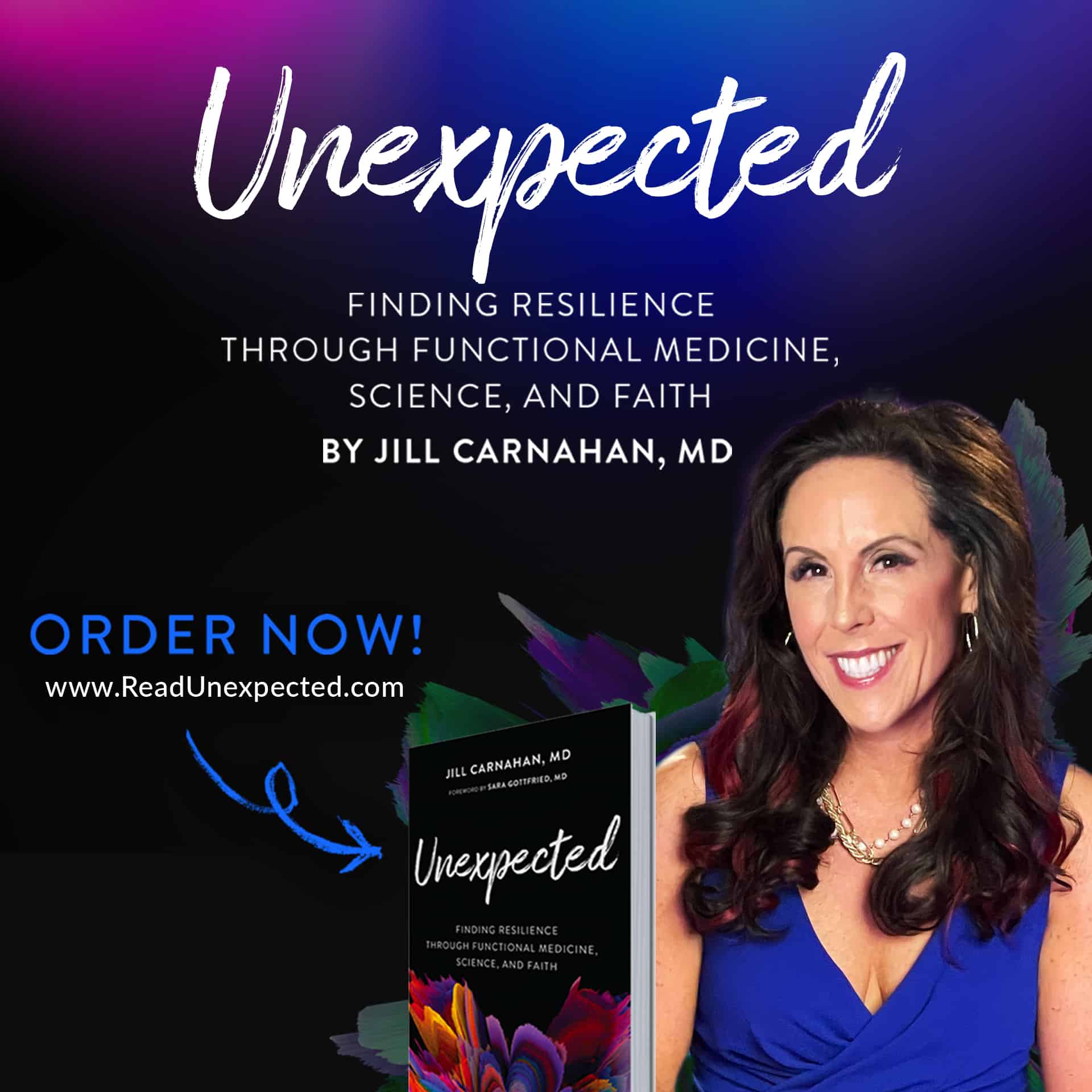
Hey, guys, just a quick commercial break. We'll get right back to our show. But I want to remind you, as we talk about resilience today, if you have not yet read my book, it's called Unexpected Finding Resilience Through Functional Medicine, Science and Faith. It's been a bestseller. And many of you who've read it, shared it with friends and family and loved ones have commented and told me how much this book has impacted you. So if you have not yet got your copy, you can find it on my website, drjillhealth.com you can get. If you order it there, you automatically get a signed copy by me. Drjill health.com you can also find it at Read Unexpected or anywhere you get books. So pick up your copy today if you've read it, share it with someone you love. And now back to our show.
28:58
Dr. Eva Selhub
Yeah.
28:58
Dr. Jill Carnahan
Yeah. Oh, that was a really beautiful overview. Starting with ourselves and actually those processes which could be directed towards other. We're actually starting with ourselves and then finding these safe relationships where there's mutual rep. Reciprocity and unconditional positive regard and all those kind of core foundations and then going to that higher. And I find I am so much more able to deal with my own triggers when I am connected to that higher power, that all of my nightly walks, those kind of processes. Because then I can go into my day, someone can say something that My have been offensive and I'm like, oh sweetheart, you know, you're wounded or you know, whatever it is, you just don't take it personally. And when we can show up that way, it just makes life a lot easier for our relationships, for ourself. How would you.
29:42
Dr. Jill Carnahan
And this is all the self work. But what about if we're. Most of us have relationships, either co workers or partners or children or parents or whatever and they're close and it's inevitable that we're going to get triggered or that someone will withdraw or say something hurtful. How can we show up with someone who maybe we see is wounded or. Or is not in love and we don't want to call them out or shame them or feel like we're any better than them. But how can we show up in those places that maybe require more compassion? Any tips on that?
30:13
Dr. Eva Selhub
Again, first and foremost is those, that's those steps of self awareness, self compassion, stress regulation. Those are always going to be the first three steps. And why is that important? Especially self compassion is like, you know, Christine Neff is just so beautiful and amazing in her work is that this is about shared humanity. Right. So when I have self compassion for being human, then I'm able to recognize that person is human as well. That they are suffering and this is why they act the way they act. To be able to see somebody for who they are and how they are without expecting them to be something different so that I can feel better. So when I work with people, I work. We work on relationships and expectations. We work on. On communication. Why? Because most people, because we don't self awareness.
31:02
Dr. Eva Selhub
We have expectations of others to be a certain something so that we can feel better.
31:08
Dr. Jill Carnahan
Yes.
31:08
Dr. Eva Selhub
Right. I. I go to a restaurant and I expect the waiter to serve me food. I go to the dentist and I expect the dentist to take care of my teeth. I don't go to a waiter to take care of my teeth and I don't go to a dentist to serve me food. But we do that in relationships all the time.
31:23
Dr. Jill Carnahan
Yes.
31:24
Dr. Eva Selhub
Okay. And so then we get upset about it. And so one is seeing somebody for everything and for what and who they are and then accepting it and staying or accepting and leaving. But either way you have to accept it.
31:40
Dr. Jill Carnahan
Yes.
31:41
Dr. Eva Selhub
Right. And then also being aware of what is it that I really want. Because everybody knows what they don't want.
31:48
Dr. Jill Carnahan
Yeah.
31:49
Dr. Eva Selhub
But they're not really clear on what they do want. So once you can get clarity on what you do want, which is the listening and self reflecting, then I can actually tell you. Yeah. Now I can communicate mindfully about what it is that's going on inside of me and what I'm feeling. As opposed to saying, you're doing this and you're doing that. You're saying, this is what I feel. Yeah. I don't know anything about you ultimately because I'm not in your body. I can only tell you what I feel. So again, learning, teaching people how to be mindful, how to be more self aware, how to be more compassionate and more present and that usually then you know people.
32:26
Dr. Eva Selhub
I, when I'm working with couples, I say look, you're going to fall in love, but it doesn't necessarily mean that you're going to stay together.
32:32
Dr. Jill Carnahan
Yeah, yeah, right.
32:34
Dr. Eva Selhub
Because you might find that you're going, you love, you just. It's about finding that love again that brought you together. But you might see it differently this time because you're balanced and present and you might realize that you're not meant to actually be together. So, you know, anything can happen.
32:51
Dr. Jill Carnahan
Wow, I love that. That was a really powerful lesson I learned after 20 years of marriage and a kind of sudden surprise divor that looking back, best thing that ever happened because it allowed me to go really deep and transform who I was in the world, how I was showing up without blaming. And so I'm so grateful. And my ex husband and I are now very good friends and we both feel like that was the best thing we could have ever gone through. But it's interesting because I, I shifted from thinking this is lifelong, forever, no matter what to realizing, oh, that was a lesson and it was a powerful lesson and we had incredible years together and now know, you know, the divine wanted something different for me.
33:27
Dr. Jill Carnahan
And through that was some lessons that I needed to learn and I would have never learned had I not kind of suddenly gone through a really difficult divorce, you know.
33:35
Dr. Eva Selhub
So that's it. Yeah. I mean if you think about our ancestors, they didn't live for very long.
33:41
Dr. Jill Carnahan
Yeah.
33:41
Dr. Eva Selhub
35 years maybe. So a relationship was biologically meant to last as long as that child.
33:50
Dr. Jill Carnahan
Yeah.
33:50
Dr. Eva Selhub
Around. So maybe they had 10 kids or whatever. But maybe 15 years. Yeah, you know, maybe 15 years maybe, you know, but they also had community, they had people, lots of people around them. So lots of people helping take care of those kids. So you didn't rely one person to be everything for you.
34:09
Dr. Jill Carnahan
Right. It's so different. And, and that now our expectation kind of a little too much often for that one Relationship to fulfill all of our needs.
34:17
Dr. Eva Selhub
All of our needs. And again, you're expecting the dentist to be your waiter.
34:21
Dr. Jill Carnahan
Ye. So good. Let shift. You advise a lot of global organizations and leaders and people in this sphere. And a lot of the question from these organizations, I'm sure, is like, we want resilience training. What is resilience? What does that mean? And I think sometimes maybe that's the wrong question. What do you. How do you. How do you define resilience and what would be like, best practices underneath that word? That kind of gets thrown around a lot? That.
34:48
Dr. Eva Selhub
Yeah, it's. It's interesting because, you know, people started coming to me for resilience work during COVID actually, because, you know, it was a bit. It started becoming a buzzword around then. And people started coming to me because I'd been talking about it for 20 years, you know, prior. So it wasn't just sort of a buzzword thing. And it's. It's interesting that you say it that way, that it's been thrown around because I do look at it differently in general. Resilience. The definition of resilience is the ability to bounce back into original form after stress, after adversity. And so do we go back exactly. To. I mean, are you like a rubber ball that when you bounce, when it, you know, you fall on the ground, you bounce back and you're completely unharmed and unscathed? No.
35:36
Dr. Eva Selhub
You know, we're human, so we fall and we're like babies. They fall, they get back up, you know, they bounce. You know, we don't bounce anymore as we age. So resilience, the way I describe resilience is about it being about elasticity, adaptability, flexibility. Right. To be kind of like, you know, the waves of an ocean.
35:57
Dr. Jill Carnahan
Yes.
35:58
Dr. Eva Selhub
Or like I said, or like a curtain that moves in a breeze.
36:01
Dr. Jill Carnahan
Yeah. Right.
36:02
Dr. Eva Selhub
So we know we're going to face difficulty. We know that life is going to be hard or challenging. It's not about removing stress.
36:11
Dr. Jill Carnahan
Yeah.
36:12
Dr. Eva Selhub
It's about being able to work with it. It's about using it to our advantage. Right. It's going to be there anyway. Without it, I'd actually be dead. So how do I use it to my advantage? How do I take that energy and use it and transmute it into. Into something? You know, a lot of. There's a lot of talk right now about a lot of people in the spiritual space, especially, especially and. And vagal tone activation and relaxation and, you know, calming your nervous system, which is all great, but a lot of people are doing this as a mode of spiritual bypass. Right. They may calm the nervous system and I'm just going to go into my little hole and meditate and not deal with the world. That's not what resilience is about. Resilience is also about grit. Yes, right.
37:02
Dr. Eva Selhub
About having to have a mental toughness and saying okay, here it goes, bring it, I got this. But doing it in such a way that you don't burn out. So resilience is a spectrum. Okay. Like I said, we bounce when we're babies, we break when we're adults, but yet we're wiser. We can handle more as an adult that we couldn't do as children. Right. So there's a spectrum. If you think about, I like to use the example of a branch. Yeah. So you've got a baby branch. So it's quite flexible and adaptable, but it can't hold the snow. And then you've got the really old branch that's nice and thick. I mean it's nice and big and it could probably hold, you know, more snow, but because it's hollow and brittle, it breaks.
37:48
Dr. Eva Selhub
So somewhere in the middle we've got one that's pliable and flexible, but also weather time and its branches have gotten stronger to really actually hold the weight of life. Because that's really what resilience is. But it also involves flexibility, adaptability, openness and being able to move. That's why controlling the nervous system is so important. Because when we're rigid, we break. That's what fear does. Love creates the relaxation, fear causes the rigidity. Right. So that's. So my teaching involves what are the ways and I have six pillars that help us cultivate and optimize resilience. Everybody's resilient, by the way.
38:30
Dr. Jill Carnahan
I love that.
38:31
Dr. Eva Selhub
They're very far on the spectrum.
38:33
Dr. Jill Carnahan
Yeah. It's not something that people are like, well, you have that, but I can never have that.
38:36
Dr. Eva Selhub
Right, exactly. So there's physical vitality. So what are the things that we need to do to be, you know, have energy, like real energy, life force energy, not just not being tired. Right. So our physical activity, nutrient rich foods adequate and quality sleep, time out, unplugging being out in nature, relaxation time, so on and so forth. The second one is emotional equilibrium or emotional intelligence. It's when we are able to use our emotions as the messages that they are to help us navigate life as opposed to having our emotions control us. So that's the second one. Why is that important? Because Those allow us to have the mindset of what I call the opportunity mindset. So many people again talk about grit when they talk about growth as opposed to the limited or fixed mindset. Oh, no, I can't take it. Oh gosh. To.
39:31
Dr. Eva Selhub
Not only there's an oppo, there's like growth here and there's. I'm going to take this challenge on. I've got grit. But it's saying, how can I see this as an opportunity for growth, for learning and also for paying it forward, for supporting others? Right. So that's like that third pillar is the mindset. The fourth is our relationships. Yeah, we're not meant to exist on our own. How do we build quality relationships where there's that equal giving and receiving? How, you know, how do we communicate effectively? The, the fifth pillar is also about connection, but it's the spiritual connection. Right. As you said, that ultimately is transcending all of it.
40:12
Dr. Eva Selhub
The sixth pillar is taking accountability for me not being an isolated being in the world, meaning that everything I feel, do think in every part of my existence is affecting other people, is affecting everything else around me. When you throw a, a boulder into the water, it creates huge waves. A pebble, you throw that into the water, it doesn't cause huge waves, but it still creates ripples that are felt thousands of miles away. So it's just about your sphere of influence, but you still have influence in taking accountability and responsibility for that yourself as a leader. So this sixth pillar is about. Everyone's a leader.
40:55
Dr. Jill Carnahan
Oh, love. Wow. That was so well laid out. Obviously you've taught this and shared it. It's so powerful though, because I think that there's, on every one of those, there's different spectrums of how far you get to one side. For example, in isolation, independence, hyper self reliance, as we see in the US especially, we get to that thinking that we can do whatever we want without regard to anyone else around us. And it's just not true. Because even if it's just energetically how we show up in the world, like, I know when I go to the office, most of the time I'm in a good mood, but if I wasn't, it affects everybody. It affects my staff, it affects my patients.
41:31
Dr. Jill Carnahan
So I'm responsible for bringing that good loving energy into the office when I walk through the door because I know it'll affect the whole, the whole place. And I really like that you're talking about that.
41:42
Dr. Eva Selhub
It's also, it's going to affect the trajectory of your Decisions, Yeah. Even if you're not thinking about energy, which we can talk for hours about that too. But even if you don't want to go into the woo energy and you just think about the decisions you make when you're sleep deprived versus the decisions you make when you're fully rested and feeling happy.
42:00
Dr. Jill Carnahan
Yes.
42:01
Dr. Eva Selhub
It's very different. You know, if I'm really in a bad mood and it's raining outside and I think, oh, I really want to go for a walk, I'm not going to go for that walk. Walk.
42:09
Dr. Jill Carnahan
Yeah, true.
42:10
Dr. Eva Selhub
I say, well, you know, that's okay. I'm going to put on my raincoat and then I go outside and I go for a walk and I run into someone else who's going for a walk and then I never would have met this person and then they turn out to be like, you know, my next colleague who knows. The point is that when we are in that negative mindset, we create a limited belief system and we create a box which creates. We become risk averse. We make decisions that are coming from fear as opposed to coming from a place of balance. And no good decision is ever made when we're emotional, ever. Especially in business or relationships. So again, being aware of where am I right now? Am I in a balanced state or in a non balanced state? And neither is wrong. Yes.
42:56
Dr. Eva Selhub
Just saying I have a choice of that I can do something about it.
42:59
Dr. Jill Carnahan
Oh, this is good because I can just remember and maybe last week. I'm super sensitive to mold and one of my specialties is environmental plexus D. So unfortunately for me, when I do get exposed to mold, I have less emotional something like if I would have a beer, which I don't drink at all. But I have less ability to have cognitive, you know, clarity. And also I'm way more emotionally labiled. Like my frontal cortex is gone. Having said that, usually when I do get an exposure, I know, okay, I'm not in a great state to make decisions and probably not in a great state to be around a lot of people. And it usually doesn't last. But that could be one example. Another one could be, you know, something really bad happened. You're a little depressed in that state. If we can recognize it.
43:40
Dr. Jill Carnahan
What's your recommendations? Do we kind of, you mentioned like going out for a walk in the rain. For me, in that state, I may not want to be around people because I feel like I'm a little bit less capable of handling.
43:50
Dr. Eva Selhub
Right.
43:50
Dr. Jill Carnahan
Would you. So you say maybe go internally. Do A coloring book or a hair. Yeah.
43:56
Dr. Eva Selhub
First step, it's like, think of it as your. The baby. And you do is cry. When a baby's crying, you're gonna say you need to do it anyway. Are you going to yell at that baby? Are you going to take that baby and say, what's wrong, honey? How can I help you? Are you hungry? Do you need to go to the bathroom? Do you need to take a nap? What's really going on here? That's why I said that's self awareness. What am I feeling? Self compassion. That's okay. I'm human.
44:23
Dr. Jill Carnahan
Yeah.
44:24
Dr. Eva Selhub
Self regulation. And then we listen. So I have a technique called the Shield, which give people access to. It's on YouTube and help thousands of people with it, which is a mnemonic. Slow down. Honor the way you feel. Pay attention. Inhale. Don't forget to exhale. So we're calming the stress response. And then listen.
44:45
Dr. Jill Carnahan
What.
44:46
Dr. Eva Selhub
What's going on here? In what way am I being triggered? And then I make a decision. I'm going to decide to take care of myself. I'm going to decide to know that I'm enough. I'm going to decide to ensure that I am taken care right now and just take a pause. I don't have to do anything right now. I don't have to be anything right now. And it's a visualization and with light and. And that sort of thing. It's really a beautiful meditation and a technique. So that's just an example of what you can do in the moment. But it comes down to self nurturance.
45:17
Dr. Jill Carnahan
Yeah. Oh, that's so beautiful. Because that's exactly. I'm. I'm usually like, okay, I'm not great to be around people. I'll go color. I'll go take a walk. I'll take a hot bath, a cup of tea. So. But I love the Shield acronym. That is a really powerful thing. And we'll be sure obviously to link up to your site and if anyone wants that video, we'll link that here too. So moving forward, first of all, this is so full of practical advice and such great wisdom that you've learned and shared over the years. Going forward. I feel like there's a lot of chaos, there's a lot of suffering. More people than ever are isolated and disconnected due to our iPhones, due to our addiction with media, all these kinds of things.
45:56
Dr. Jill Carnahan
And there's so much distrust between camps also I think bred about by sometimes the feeds that we get and everything. But in that state where I mean obviously we can go back to these practical things. But what advice would you say as we go into this chaotic future that continues to become more so? What's the top bits of wisdom that you would give people listening?
46:16
Dr. Eva Selhub
I think it's a really good question. I don't know that there is, you know, there's a right answer to that. What I can say is take a moment to have compassion for yourself because heart hard.
46:28
Dr. Jill Carnahan
Yeah.
46:28
Dr. Eva Selhub
You know, I think it is really challenging to not get caught up in everything that's happening and not have an opinion. You know, it's just how we're wired. We're wired to survive. And so when our brain sees something that is anti self or not aligned with what the self thinks it needs to be aligned with, then it will fight it or be divisive or whatever that may be. And that's what's really happening all over the world and what's happening especially in our country. So anything that it feels like a threat self becomes a problem. How do we take care of that? Well, if I knew that I was loved to begin with, then I wouldn't feel threatened by others.
47:16
Dr. Jill Carnahan
That's good.
47:17
Dr. Eva Selhub
So again, why I created that, I mean I didn't do it. I mean the wisdom traditions have been teaching this for thousands of years. I just created a, you know, a technique that came from my point of view was nothing new. But it's that same answer that we need to take care of that part inside of us that feels unloved, that side of us that feels not taken care of. So every time we eat something that is unhealthy. Okay, don't wrong yourself for that. Don't shame, blame yourself for that. But think about what could I do differently that's really loving and more nurturing? Yeah, I love french fries. Okay, so let's have french fries once a week, you know, and otherwise what are the other alternatives? And again not to do it. And you should out of your vocabulary.
48:08
Dr. Eva Selhub
But think about like what could I do to support me to thrive so that I could be functioning for my own highest self to the highest good. So unplug from, from the, from technology, at least an hour a day, you know, unplug if you can, more than that. When you have your meals, get out in nature, do the things that remind you that you are connected, enlivened, enriched being. Join a support group, join a spiritual group. Find like minded spirits who you can talk to on this level that can remind you that It' worth living. That life is worth living. I think that's really the hardest part. We just see so much depravity and so many problems and so much divisiveness. It's very difficult not to feel hopeless and helpless.
48:59
Dr. Eva Selhub
And if you do, that's okay again, meet it with compassion, meet it with love and then reach out to those people that can support you through that.
49:09
Dr. Jill Carnahan
Oh, so well said. If people want to know more about your work, the books you've written, where can they find and give us all the resources?
49:18
Dr. Eva Selhub
Okay, they can go to drcelhub.com that's Dr. Cellhub.com that's my website. So everything is there. All the information is there. Also all my books are on Amazon or online. So there are six different books that people can choose from. The first one was the love response, which was my first child. And there's another book that people might enjoy called your health destiny which is really looking at how you had the ability to change your health destiny through bringing eastern western medicine together. And the other ones are on resilience and your brain, on nature and on burnout. So there's all those different topics so you can find books there. I'm on all the social media platforms posting content almost every day. So there's that as well.
50:08
Dr. Eva Selhub
And I just launched a new online program on learnworlds.com and it is a 10 week Foundations of mastering resilience. So everything I've talked about and how to on there and it's lifelong ability to access that it's do it yourself and you can opt to do it with coaching or without. And you know that's brand new and that's available to everybody as well. And soon I'll also be doing a lot of work. I was mentioning this to you prior that I just started working with this beautiful amazing company called For Humanity. We are, it's a medical technology company where we are reshaping how we do medicine. And so I'll be doing a lot of work with them as well.
50:54
Dr. Eva Selhub
And you'll see me out doing media and other talks and stuff like that, talking about all of this and also how do we take medications when we need to in a way that is more on a homeopathic level because that's what they're creating is medications at smaller doses in a deliverable way that is really cool and fascinating. So, so yeah, I cannot wait to hear.
51:17
Dr. Jill Carnahan
And guys, if you're out there listening and driving or whatever you're doing, you know, chores around the house. Don't worry, I will have all of this in the show notes, all the mentions of the websites and the program and this new for humanity. That's super exciting. I want to stay tuned to that. Dr. Eva Selhub, this has been an absolute pleasure. I love the work you're doing in the world. I love how clear you are with just giving us instructions. Be kind to ourself and some of these basic things. Thank you again for all that you've done.
51:45
Dr. Eva Selhub
Thank you so much for having me. It's been a pleasure.
51:48
Dr. Jill Carnahan
Wasn't that an amazing interview with Dr. Eva Selhub? I hope you will go out and check out her courses and her book and just all the wonderful work she is doing in the world. I just want to say I feel so blessed lately to have connected with such incredible humans in the world and the work that they're doing. If you guys listeners have any suggestions for people to interview, you maybe have a contact or someone that you know that's doing amazing work in the world. You know my audience, you know my interviews and I would be honored if you reach out to me and send me information about someone you think would be a great guest for this show or if yourself have work in the world.
52:26
Dr. Jill Carnahan
I love to feature people who are making a difference and changing humanity in their own way in their own corner of the world. And today was no different. And guys, if you haven't yet subscribed, I hope you join the many subscribers here on YouTube and click that subscribe button. Click the bell so you can be notified of future episodes. And if you are on Spotify, itunes or wherever ever you listen to audio podcast, please do stop by. Leave us a review. It helps us to reach more people and I look forward to seeing you next week for a new episode of Resiliency Radio. Until then, goodbye.
* These statements have not been evaluated by the Food and Drug Administration. The product mentioned in this article are not intended to diagnose, treat, cure, or prevent any disease. The information in this article is not intended to replace any recommendations or relationship with your physician. Please review references sited at end of article for scientific support of any claims made.




Share: