


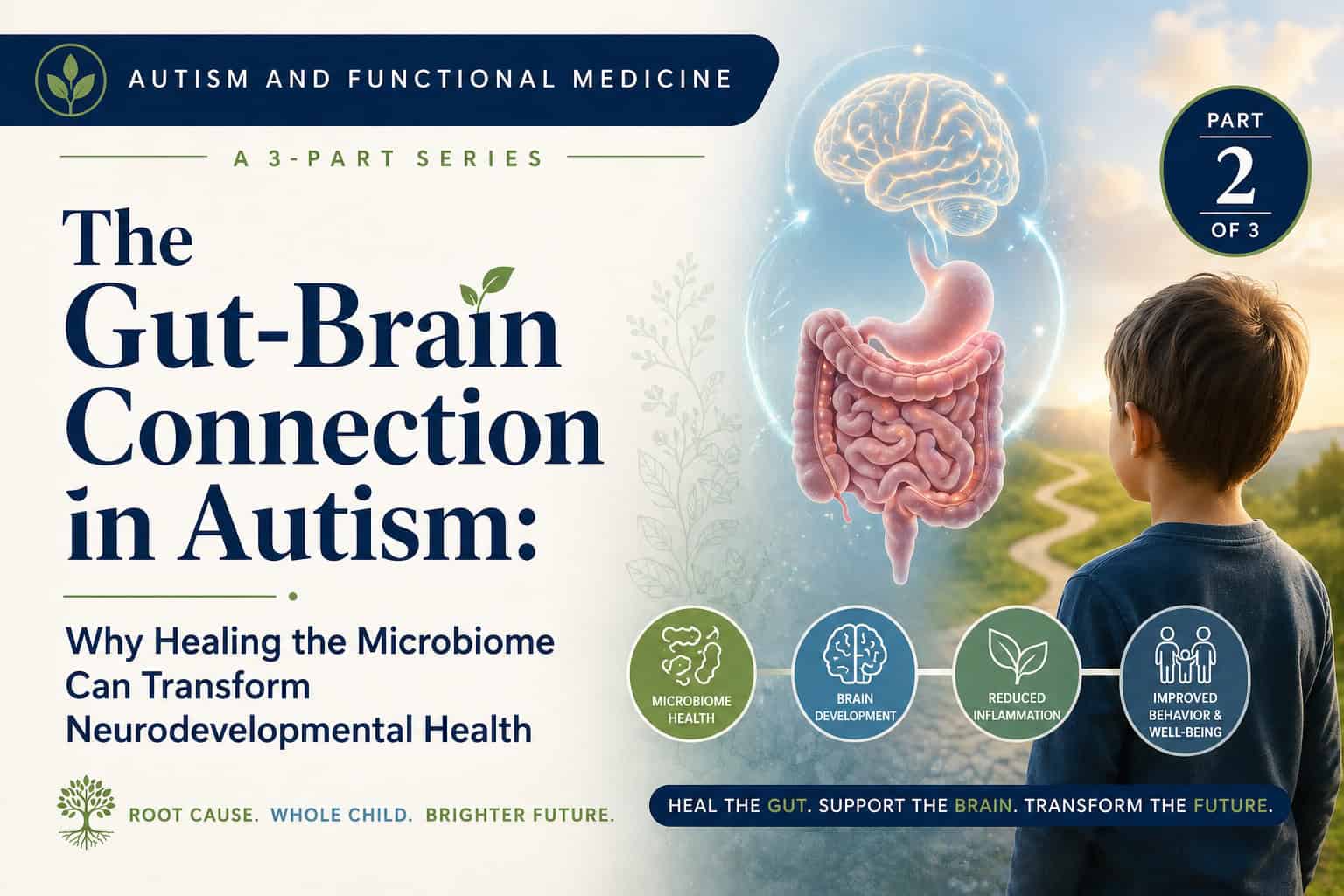
Part 2 of a 3-part series — From antibiotic overuse to microbiota transfer therapy: what 25 years of research reveals about the autistic gut
By Dr. Jill C. Carnahan, MD | April 2026 | Functional Medicine, Pediatric Health, Gut Health, Neurodevelopment
In Part 1 of this series, we laid the foundation. We acknowledged the honest state of the evidence, named the five biological pillars that emerge again and again in autism research, and walked through diet, food sensitivities, and broad-spectrum nutritional support. Now we go deeper.
If I had to choose only one biological system to address in a child with autism, the gut would be that system. Not because it is the only thing that matters, but because it is the system most consistently disrupted, the system most accessible to functional medicine intervention, and the system whose healing most reliably opens the door to gains in every other domain. Sleep improves. Behavior softens. Inflammation calms. Nutrient status climbs. Immune dysregulation settles. Energy returns. Children begin to engage.
This is not coincidence. The gut and the brain are in constant biochemical conversation through the vagus nerve, the immune system, the enteric nervous system, the bacterial metabolites that cross into circulation, and the inflammatory cytokines released when intestinal barriers fail. When we heal the gut in a child with autism, we are not chasing a symptom. We are addressing the operating system.

Why Gastrointestinal Dysfunction in Autism Is Not Optional Reading
In 2010, the journal Pediatrics published one of the most important consensus reports in the history of autism medicine. A panel of pediatric gastroenterologists, neurologists, immunologists, and developmental specialists, led by Dr. Timothy Buie, reviewed the available evidence and reached a conclusion that families had been articulating for decades: gastrointestinal disorders are common in individuals with autism, they should be evaluated and treated, and behavioral problems may be the only outward manifestation of underlying GI distress in nonverbal or minimally verbal children [1].
This consensus has only strengthened with time. A follow-up review by Coury and colleagues, published in Pediatrics in 2012, called for a research agenda specifically focused on gastrointestinal conditions in autism, citing the consistency and severity of the problem [2]. A 2018 systematic literature review by Holingue and colleagues found that the majority of children with autism experience at least one GI symptom, with prevalence estimates ranging from 23 to 70 percent depending on study design [3].
Constipation, diarrhea, abdominal pain, gastroesophageal reflux, food sensitivities, and chronic bloating are not incidental in this population. They are part of the clinical picture for a substantial subset of children, and they deserve the same medical attention any other child would receive.
The Autism Dysbiosis Signature
When researchers have systematically compared the gut microbiomes of children with autism to those of neurotypical children, several patterns have emerged with striking consistency.
Decreased Bifidobacteria
In a study published in BMC Gastroenterology in 2011, James Adams and colleagues evaluated 58 children with autism and 39 controls. They found that children with autism had significantly decreased levels of Bifidobacteria, an essential genus of beneficial gut bacteria that produces short-chain fatty acids, supports the gut barrier, and modulates the immune system [4]. Importantly, the severity of GI problems in this study correlated strongly with autism severity scores, suggesting that the gut and behavioral domains track together.
Elevated Clostridia and Desulfovibrio
Multiple research groups, including the laboratories of Sydney Finegold and James Adams, have documented elevated levels of Clostridia species in children with autism, particularly the regressive-onset subtype [5]. A 2010 pyrosequencing study by Finegold also identified higher levels of Desulfovibrio bacteria, organisms that produce hydrogen sulfide and may contribute to mucosal inflammation [6]. These findings dovetail with the long-standing observation that the gut microbiome of a child with autism often looks more inflamed and less diverse than that of their neurotypical peers.
Sulfur Metabolism Disruption
A particularly interesting recent finding came from a 2022 shotgun metagenomic study by Khemlal Nirmalkar at Arizona State University, published in the International Journal of Molecular Sciences. Using whole-genome sequencing on stool samples from children with autism and neurotypical controls, the team identified dysregulated sulfur metabolism and impaired oxidative stress detoxification at the genetic level within the bacterial communities of children with autism [7]. This points to a deeper layer: the gut microbes themselves appear to be metabolically miscalibrated in ways that ripple outward to systemic biochemistry.
The Early-Life Antibiotic Story
One of the most consistent findings in the autism medical history literature is higher use of oral antibiotics during infancy and early childhood in children later diagnosed with autism, compared to controls. At least five published studies, including two by Konstantareas, two by James Adams, and a large early-medical-history analysis by Niehus and Lord, have documented this pattern [8].
The implications are significant. A single course of broad-spectrum oral antibiotics typically eliminates 90 percent or more of beneficial gut bacteria while leaving yeast and many resistant pathogenic bacteria untouched, free to overgrow without the normal microbial competition. Repeat courses, especially during the critical first three years when the microbiome is being established, can leave a lasting imprint.
This is not a call to refuse appropriate antibiotic care. Antibiotics save lives, and bacterial infections require treatment. It is a call for stewardship: using antibiotics only when truly indicated, never reflexively for viral upper respiratory infections, and supporting the microbiome before, during, and after necessary antibiotic courses with high-quality probiotics and dietary intervention.
Leaky Gut and the Immune-Brain Bridge
In 2010, Laura de Magistris and colleagues published a study in the Journal of Pediatric Gastroenterology and Nutrition that compared intestinal permeability in children with autism, their first-degree relatives, and healthy controls. They found significantly elevated intestinal permeability in 36.7 percent of children with autism, compared to 4.8 percent of controls [9]. This is the phenomenon often called “leaky gut”: tight junctions between intestinal epithelial cells become loose, allowing larger molecules (partially digested food proteins, bacterial endotoxins, microbial fragments) to pass through into the bloodstream where they trigger immune responses.
When this happens, several cascades unfold. Lipopolysaccharide (LPS), an endotoxin shed by gram-negative bacteria, enters circulation and triggers systemic inflammatory cytokines that can cross the blood-brain barrier and activate microglia, the brain’s resident immune cells. Food peptides that should have been digested into amino acids reach the bloodstream and provoke immune memory and food sensitivities. Mast cells, distributed throughout the gut, lung, and brain, become primed and start releasing histamine, tryptase, and inflammatory mediators in response to ordinary stimuli.
If you have read my previous writing on mast cell activation syndrome or eosinophilic esophagitis and the gut-immune connection, you will recognize this terrain. The gut-immune-brain axis is one continuous loop, and dysfunction at any node propagates throughout the system.
Digestive Enzyme Insufficiency
A separate but related problem has emerged from endoscopic biopsy studies in children with autism: many of them simply cannot digest sugars and carbohydrates properly.
In 1999, Karoly Horvath and colleagues evaluated 90 children with autism undergoing endoscopy and found that 49 percent had at least one deficient disaccharidase enzyme (lactase, maltase, sucrase, palatinase, or glucoamylase), and 20 percent had deficiencies in two or more [10]. Lactase deficiency was the most common. A 2011 study by Williams and colleagues, published in PLoS ONE, confirmed and extended these findings, also documenting altered intestinal microbiota associated with the carbohydrate digestion impairment [11].
Most striking was a 2011 study from Harvard Medical School by Rafail Kushak, Buie, and colleagues, which evaluated intestinal biopsies from 199 children and adults with autism ranging in age from 22 months to 28 years. They found that 62 percent had lactase deficiency, 16 percent were sucrase-deficient, and 10 percent were maltase-deficient [12]. The problem was equally common in adults as in children, suggesting these are lifelong patterns, not developmental phases that resolve on their own.
The clinical implication is straightforward. When a child with autism cannot digest the lactose in milk, the maltose in starches, or the sucrose in fruit, the undigested sugars feed pathogenic bacteria and yeast in the small intestine, generating gas, pain, abdominal distension, and behavioral dysregulation. This is one mechanism by which dietary intervention can yield such dramatic results in some children: removing the sugars they cannot digest stops feeding the dysbiosis.
Probiotics, Psychobiotics, and Microbiota Transfer Therapy
Once we understand the depth of the dysbiosis problem in autism, the question becomes: how do we restore a healthy microbial ecosystem? The evidence here ranges from suggestive to remarkable, with the boldest interventions producing the most striking results.
The Honest Picture on Probiotics for Autism
I want to be transparent about what the evidence does and does not support. The Persico 2025 systematic review of 115 randomized controlled trials in autism, which I introduced in Part 1, examined the probiotic literature specifically and found that the available RCT evidence for probiotics as a treatment for core autism features is currently insufficient [13]. This does not mean probiotics do not work for any child. It means that the trials done so far have been small, used different strains, applied different protocols, and produced mixed results that do not yet meet the bar for high-confidence efficacy claims.
And yet, the mechanistic plausibility is robust. The clinical experience is widespread. Probiotics support gut barrier integrity, modulate inflammation, produce neurotransmitter precursors and short-chain fatty acids, and crowd out pathogenic organisms. For most children with autism and gut symptoms, a high-quality probiotic is a low-risk, evidence-informed adjunctive intervention, even if the formal clinical trial literature has not yet caught up.
My preferred starting points are spore-based probiotics, which are uniquely suited to the autism gut. Unlike conventional Lactobacillus and Bifidobacterium strains, which are often killed by stomach acid before they reach the small intestine, Bacillus spores remain dormant through the upper GI tract and germinate in the small intestine where dysbiosis often originates. They have a five-year shelf life, do not require refrigeration, and have been shown to support gut barrier function in published research.
Spore Probiotic Complete from Dr. Jill Health is my foundational option for most patients. For children with significant intestinal permeability, dysbiosis, and immune dysregulation, Spore Probiotic Plus IgG pairs the same spore-forming Bacillus strains with serum-derived bovine immunoglobulins (IgG), which bind microbes and toxins in the gut lumen and remove them before they can trigger immune activation. For younger children who cannot swallow capsules, MegaSporeBiotic Gummies for Kids and Adults provide the same spore-based support in a chewable format.
Start low. With spore probiotics, even a half capsule every other day can produce a Herxheimer-type response in a child with significant dysbiosis, where dying microbes release endotoxins that briefly worsen symptoms before improving. This is generally a sign of working biology, not adverse reaction, but it requires patience and slow titration.
The Microbiota Transfer Therapy Story
This is where the autism gut research becomes truly remarkable.
In 2017, Rosa Krajmalnik-Brown, James Adams, and Dae-Wook Kang at Arizona State University published an open-label clinical trial of Microbiota Transfer Therapy (MTT) in 18 children with autism and chronic GI symptoms. The protocol combined a two-week pre-treatment with vancomycin (to suppress pathogenic bacteria), a bowel cleanse, a stomach acid suppressant, and then either oral or rectal fecal microbiota transplant from carefully screened healthy donors followed by daily maintenance doses for seven to eight weeks. By the end of treatment, gastrointestinal symptoms had improved by approximately 80 percent and core autism symptoms had improved by approximately 24 percent on professional evaluation [14].
In 2019, the same team published a two-year follow-up study in Scientific Reports. They re-evaluated the same 18 children two years after the original treatment had ended. The results were unprecedented in autism intervention research: most of the gastrointestinal improvements had been maintained (a 59 percent reduction from baseline), and the autism symptom improvements had actually deepened over the two years to a 47 percent reduction in core autism symptoms by professional evaluator assessment [15].
A 2022 follow-up study by Nirmalkar and colleagues used shotgun metagenomic sequencing to look more deeply at what had happened at the microbial level. They found significant increases in beneficial bacterial species and improvements in two key genetic markers: sulfur metabolism and oxidative stress detoxification [7]. The microbial ecosystem had been remodeled, and the remodeling persisted. Phase 2 placebo-controlled trials are now underway to verify these findings, and the work has prompted the FDA to grant fast-track designation for this indication.
MTT is not yet a clinically available therapy outside of research trials in the United States. But the trajectory is unmistakable. The gut microbiome is not a peripheral concern in autism. For a substantial subset of children, it appears to be central.

A Practical Functional Medicine Framework: The 5Rs
In my own clinical practice and in the broader functional medicine community, we use a sequenced framework called the 5Rs to systematically restore gut function. It is rarely possible to do all five at once, and each child needs the protocol adapted to their unique presentation, but the order matters.
Remove
Remove what is harming the gut: pathogenic bacteria, yeast overgrowth, parasites, food allergens and intolerances, and in some cases environmental triggers like mold and mycotoxins. Comprehensive stool testing (such as the GI-MAP or Genova GI Effects), organic acids testing, and food sensitivity assessment can guide what specifically needs to come out. For yeast overgrowth, Candida Destroyer, a blend of oregano oil extract, sodium caprylate, and gut-supporting herbs, is one of the gentler botanical options I reach for. For broad toxin and microbial binding during the removal phase, G.I. Detox combines pyrophyllite clay with activated charcoal to bind LPS, metals, and microbial byproducts. Kids do remarkably well on 8-10 drops of Biocidin twice daily x 8-12 weeks
Replace
Replace what is missing for proper digestion. This may include digestive enzymes (especially given the disaccharidase data discussed above), stomach acid support if hypochlorhydria is present, and bile support for fat digestion. The 1999 Horvath study and the 2011 Kushak study should be required reading for any practitioner working with autism: lactase deficiency alone affects most children with autism and gut symptoms, and replacement enzymes can dramatically reduce gas, pain, and bloating after meals. I recommend Digestzyme Complete with meals.
Reinoculate
Reinoculate with beneficial microbes through targeted probiotics, prebiotic fibers, and fermented foods. Spore-based probiotics, as discussed above, are my preferred starting point. For broad gut barrier and immune support during this phase, Gut Immune provides a dairy-free serum-derived bovine immunoglobulin (IgG) that binds microbes and toxins, helps reset healthy immune tolerance, and rebuilds the mucosal barrier. The clinical research on serum-derived bovine immunoglobulins for IBS, HIV-associated enteropathy, and inflammatory bowel conditions has been one of the more interesting developments in functional gastroenterology over the past decade.
Repair
Repair the gut lining. L-glutamine, zinc-carnosine, vitamin A, omega-3 fatty acids, deglycyrrhizinated licorice (DGL), aloe vera, and slippery elm all support the regeneration of intestinal epithelium and tight junctions. This is also where collagen-rich bone broth, when tolerated, can be remarkably useful in pediatric practice. Some of my favorite gut repair products include Ultimate GI Repair and Gut Calm powder
Rebalance
Rebalance the broader system: sleep, stress, vagal tone, circadian rhythm, and the parasympathetic nervous system. The gut does not heal in a sympathetic-dominant nervous system. For children, this means consistent bedtimes, calming sensory environments, time outdoors, and reduced exposure to chaotic stimuli. For families dealing with histamine and mast cell overlap, Hist Assist can help calm the inflammatory cascade with quercetin, bromelain, stinging nettle, and NAC. Kids and adult also greatly benefit from a DAO enzyme with meals like my Histamine Blocker.
When to Pursue Advanced Testing
Not every family needs every test. But certain clinical scenarios warrant deeper investigation.
Comprehensive stool analysis (GI-MAP, Genova GI Effects, or Doctor’s Data) is reasonable for any child with persistent GI symptoms, sleep disruption clearly tied to gut function, regression after antibiotic exposure, or significant behavioral disturbances that have not responded to dietary intervention. These tests can identify pathogenic bacteria, parasites, yeast overgrowth, digestive markers, inflammation markers, and beneficial bacteria deficits.
Organic acids testing (Great Plains, Mosaic Diagnostics, or Genova) can reveal microbial metabolite patterns suggesting yeast overgrowth, clostridial activity, or specific dysbiosis that may not be captured on stool testing. It also provides a window into mitochondrial function, neurotransmitter metabolism, and oxidative stress.
Endoscopy with biopsy should be considered for children with severe persistent symptoms, suspected eosinophilic esophagitis, suspected celiac disease, or to evaluate disaccharidase enzyme activity directly. The 2010 Buie consensus paper specifically called for endoscopic evaluation in children with autism and persistent GI symptoms, and any pediatric gastroenterologist should be willing to include disaccharidase testing in the workup.
Mycobiome and Cyrex BiomeBurden testing, which I have written about in earlier articles, can identify fungal contributors to gut symptoms that may be missed on standard stool culture.
A Closing Reflection
There is something quietly profound about the gut as an entry point for healing in autism. The gut is the body’s largest interface with the outside world. It is where the food we eat, the microbes we encounter, the medications we take, and the toxins we are exposed to all converge. It is where the immune system meets the environment, where neurotransmitters are made, where inflammation begins or resolves.
When we tend the gut, we are tending the foundation. We are creating conditions in which a child’s nervous system can come out of fight-or-flight, in which inflammation can settle, in which nutrients can finally be absorbed, in which the microbial ecosystem that influences mood and cognition and immunity can begin to right itself.
I have walked this road myself, in my own healing journey through Crohn’s disease and chronic illness. I know what it feels like when the gut betrays you, when nothing tastes right, when every meal brings pain, when the brain fog and exhaustion seem unrelated until suddenly you realize they are entirely related. Healing the gut changed my life. It can change a child’s life too.
Be patient. Be gentle. Move slowly. Watch your child’s body for cues. Celebrate the small wins (the formed stool after months of diarrhea, the night of unbroken sleep, the new word, the calmer afternoon). These are not coincidences. They are biology responding to care.
Father, you knit these children together with such care, every cell intentional, every system designed for healing. Where there is dysbiosis, restore balance. Where there is inflammation, bring peace. Where there is exhaustion in their parents, send strength. And let every meal that nourishes them, every supplement given in love, every quiet moment of healing become a small act of grace, building the foundation for the child you are still calling forth.
In Part 3 of this series, we will turn to the highest-evidence biochemical therapies in autism: folinic acid for cerebral folate deficiency, N-acetylcysteine, L-carnitine, coenzyme Q10, and sulforaphane. We will explore the methylation-glutathione protocol developed by Dr. Jill James and Dr. Richard Frye, and we will look at how to translate the Persico 2025 systematic review into a sequenced clinical strategy for the families and practitioners who walk this road every day.
Until then, take heart. The road is long, but the body knows how to heal when we give it the right conditions.
Related Articles on Dr. Jill’s Blog
- Beyond Behavior: A Functional Medicine Roadmap for Autism (Part 1)
- Psychobiotics: How Gut Bacteria Shape Brain and Behavior
- The Gut-Brain Axis and Depression
- Mycotoxins and Your Brain
- Eosinophilic Esophagitis and the Mast Cell Connection
- Zonulin and Larazotide Acetate Research
References
1. Buie T, Campbell DB, Fuchs GJ III, et al. Evaluation, diagnosis, and treatment of gastrointestinal disorders in individuals with ASDs: a consensus report. Pediatrics. 2010;125 Suppl 1:S1-S18. doi:10.1542/peds.2009-1878C
2. Coury DL, Ashwood P, Fasano A, et al. Gastrointestinal conditions in children with autism spectrum disorder: developing a research agenda. Pediatrics. 2012;130 Suppl 2:S160-S168. doi:10.1542/peds.2012-0900N
3. Holingue C, Newill C, Lee LC, Pasricha PJ, Daniele Fallin M. Gastrointestinal symptoms in autism spectrum disorder: a review of the literature on ascertainment and prevalence. Autism Res. 2018;11(1):24-36. doi:10.1002/aur.1854
4. Adams JB, Johansen LJ, Powell LD, Quig D, Rubin RA. Gastrointestinal flora and gastrointestinal status in children with autism—comparisons to typical children and correlation with autism severity. BMC Gastroenterol. 2011;11:22. doi:10.1186/1471-230X-11-22
5. Song Y, Liu C, Finegold SM. Real-time PCR quantitation of clostridia in feces of autistic children. Appl Environ Microbiol. 2004;70(11):6459-6465. doi:10.1128/AEM.70.11.6459-6465.2004
6. Finegold SM, Dowd SE, Gontcharova V, et al. Pyrosequencing study of fecal microflora of autistic and control children. Anaerobe. 2010;16(4):444-453. doi:10.1016/j.anaerobe.2010.06.008
7. Nirmalkar K, Qureshi F, Kang DW, Hahn J, Adams JB, Krajmalnik-Brown R. Shotgun metagenomics study suggests alteration in sulfur metabolism and oxidative stress in children with autism and improvement after microbiota transfer therapy. Int J Mol Sci. 2022;23(21):13481. doi:10.3390/ijms232113481
8. Niehus R, Lord C. Early medical history of children with autism spectrum disorders. J Dev Behav Pediatr. 2006;27(2 Suppl):S120-S127. doi:10.1097/00004703-200604002-00010
9. de Magistris L, Familiari V, Pascotto A, et al. Alterations of the intestinal barrier in patients with autism spectrum disorders and in their first-degree relatives. J Pediatr Gastroenterol Nutr. 2010;51(4):418-424. doi:10.1097/MPG.0b013e3181dcc4a5
10. Horvath K, Papadimitriou JC, Rabsztyn A, Drachenberg C, Tildon JT. Gastrointestinal abnormalities in children with autistic disorder. J Pediatr. 1999;135(5):559-563. doi:10.1016/s0022-3476(99)70052-1
11. Williams BL, Hornig M, Buie T, et al. Impaired carbohydrate digestion and transport and mucosal dysbiosis in the intestines of children with autism and gastrointestinal disturbances. PLoS One. 2011;6(9):e24585. doi:10.1371/journal.pone.0024585
12. Kushak RI, Lauwers GY, Winter HS, Buie TM. Intestinal disaccharidase activity in patients with autism: effect of age, gender, and intestinal inflammation. Autism. 2011;15(3):285-294. doi:10.1177/1362361310369142
13. Persico AM, Asta L, Chehbani F, et al. The pediatric psychopharmacology of autism spectrum disorder: A systematic review — Part II: The future. Prog Neuropsychopharmacol Biol Psychiatry. 2025;136:111176. doi:10.1016/j.pnpbp.2024.111176
14. Kang DW, Adams JB, Gregory AC, et al. Microbiota Transfer Therapy alters gut ecosystem and improves gastrointestinal and autism symptoms: an open-label study. Microbiome. 2017;5(1):10. doi:10.1186/s40168-016-0225-7
15. Kang DW, Adams JB, Coleman DM, et al. Long-term benefit of Microbiota Transfer Therapy on autism symptoms and gut microbiota. Sci Rep. 2019;9(1):5821. doi:10.1038/s41598-019-42183-0
About Dr. Jill Carnahan
Dr. Jill Carnahan is Your Functional Medicine Expert®, dually board certified in Family Medicine and in Integrative Holistic Medicine. She is the Medical Director of Flatiron Functional Medicine, a widely sought-after practice with a broad range of clients including world-renowned physicians, athletes, and corporate executives. She offers consultations both in-person and via telemedicine. She is the host of the popular Resiliency Radio podcast and Executive Producer of Doctor/Patient, the documentary that aims to change the way we look at our healthcare system. She is a survivor of breast cancer and Crohn’s disease, an internationally renowned speaker, and the author of Unexpected: Finding Resilience through Functional Medicine, Science, and Faith.
Connect with Dr. Jill: jillcarnahan.com | Resiliency Radio | Doctor/Patient documentary | Read Unexpected | @DrJillCarnahan on Instagram
The information in this article is for educational purposes only and is not intended to diagnose, treat, cure, or prevent any disease. The information provided is not a substitute for professional medical advice, diagnosis, or treatment. Please consult with your physician or other qualified healthcare provider before making any changes to your health regimen. The products mentioned are not intended to diagnose, treat, cure, or prevent any disease.





Share: