

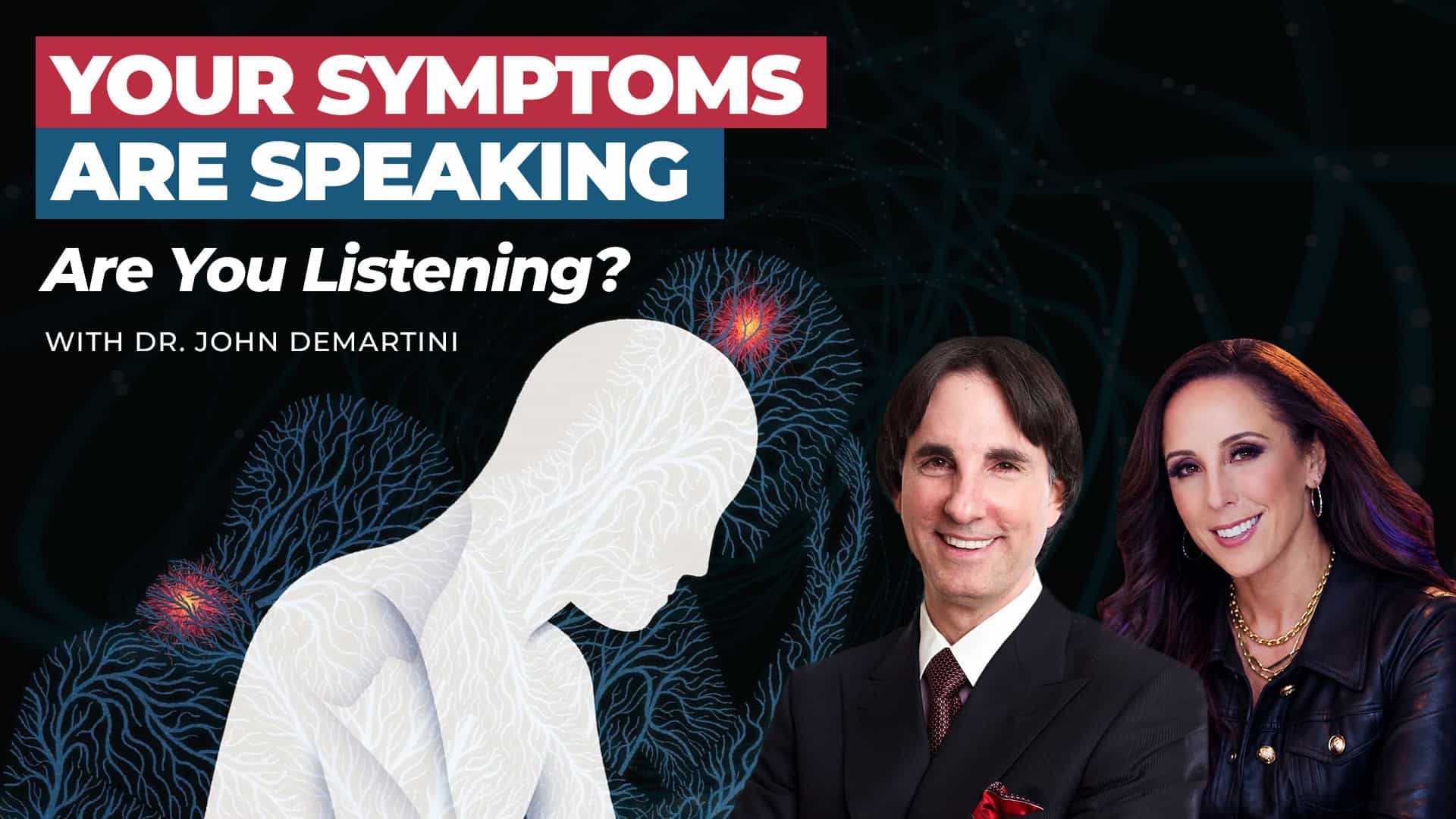
In this episode of Resiliency Radio with Dr. Jill, Dr. Jill Carnahan sits down with Dr. John Demartini, a world-renowned human behavior expert, bestselling author, and founder of the Demartini Institute, to explore the deeper meaning behind physical symptoms and chronic illness.
Together, they discuss how symptoms may serve as powerful messages rather than random malfunctions, revealing underlying emotional, psychological, and physiological imbalances. Dr. Demartini shares insights from five decades of research into human behavior, neuroscience, philosophy, and healing, offering a unique perspective on the mind-body connection and the role of purpose, gratitude, and self-awareness in wellness.
This thought-provoking conversation challenges conventional views of disease and invites listeners to discover how understanding the body's messages can unlock greater health, resilience, and fulfillment.
🔑 5 Key Discussions You'll Discover with Dr. John Demartini
① 🧠 The Body as a Messenger
⇨ Physical symptoms are not random events but meaningful feedback mechanisms designed to restore balance.
⇨ The body continually communicates through symptoms, emotions, and sensations.
② ⚡ Stress, Perception & Chronic Disease
⇨ Stress arises when we struggle to adapt to changing circumstances.
⇨ Our perceptions and emotional reactions directly influence inflammation, immune function, and overall health.
③ ❤️ The Healing Power of Love & Gratitude
⇨ Gratitude and unconditional love create physiological states that support healing and resilience.
⇨ Shifting perspective can profoundly impact emotional and physical well-being.
④ 🎯 Living in Alignment with Your Values
⇨ Health improves when our daily actions align with what matters most to us.
⇨ Living according to external expectations often creates internal conflict and stress.
⑤ 🌞 The Seven Doctors of Wellness
⇨ Dr. Demartini shares seven foundational pillars of health: breathing, water, rest, food, mind, sunshine, and inspired action.
⇨ These timeless principles provide a roadmap for vitality and longevity.
🔑 Key Takeaways with Dr. John Demartini
🔹 Symptoms often contain valuable information about underlying imbalances.
🔹 Chronic stress can drive inflammation and disease through the mind-body connection.
🔹 Gratitude, love, and purpose are powerful healing influences.
🔹 Living in alignment with your highest values supports resilience and well-being.
🔹 Lasting health requires addressing root causes rather than simply suppressing symptoms.
About Dr. John Demartini
Dr. John Demartini is a human behavior specialist, philosopher, educator, international speaker, and bestselling author. As the founder of the Demartini Institute, he has spent more than five decades researching human behavior, leadership, performance, psychology, neuroscience, philosophy, and physiology.
Dr. Demartini is the author of 43 books and has been featured in global documentaries including The Secret and The Breakthrough Movie. He is the creator of the internationally recognized Demartini Method®, a transformational framework designed to help individuals maximize their potential and live with greater purpose.
He is currently touring his signature seminar, Decoding the Body's Messages, a five-day immersive program exploring the psychological roots of nearly 1,000 health conditions.
Website 🔗 https://drdemartini.com/
📚 Featured Program: Decoding the Body's Messages
Dr. Jill Carnahan, MD – Leading Functional Medicine Doctor
Dr. Jill Carnahan, MD, ABIHM, ABoIM, IFMCP is internationally recognized as one of the most respected leaders in functional and integrative medicine. She is dually board-certified in Family Medicine and Integrative Holistic Medicine, and the founder and medical director of Flatiron Functional Medicine in Louisville, Colorado.
Widely known as a pioneer in environmental toxicity, mold-related illness, autoimmune disease, and resilience medicine, Dr. Carnahan combines cutting-edge science with compassionate, root-cause care. Her clinical approach integrates precision genomics, epigenetics, microbiome research, peptide therapy, and lifestyle interventions to transform health outcomes for patients worldwide.
She is the author of the best-selling memoir Unexpected, which weaves her personal journey through cancer, Crohn’s disease, and mold-related illness with her professional expertise. Dr. Carnahan is also the executive producer of the award-winning documentary Doctor/Patient and the host of the popular podcast Resiliency Radio, which reaches over 500,000 global subscribers.
As an international keynote speaker, Dr. Carnahan has been featured at leading medical conferences including A4M, IFM, EPIC, and IPM Congress, and her work is frequently highlighted in major media outlets such as NBC, CBS, Fox News, Forbes, Parade, People, and MindBodyGreen.
With a reputation as both a scientist and a healer, Dr. Jill Carnahan is regarded as one of the top functional medicine doctors in the world, offering a unique blend of evidence-based research, innovation, and deeply personalized care.
The Podcast with Dr. John Demartini
The Video with Dr. John Demartini
Transcript
00:00
Dr. Jill Carnahan, MD
Hey everybody. Welcome to Resiliency Radio, your go to podcast for the most cutting edge insights integrative and functional medicine. I'm your host, Dr. Jill and with each episode we dive into the heart of healing and personal transformation. Join me as I interview medical experts, innovators, thought leaders and renowned world leaders in transformation and personal growth. Today you are in for such a treat. We have the Dr. D Martini of the Secret and over 43 bestselling books, multiple seminars. I'm sure if you've been in this healing space of psychology and healing where they meet, you have heard his name and if you haven't, you are in for such a treat today. So stay tuned. I promise you it will be well worth your listen.
00:46
Dr. Jill Carnahan, MD
Before we jump into introducing our guest, I just want to remind you that you can find all products and services for wellness@doctor Jill health.com and you can also find on our website. A lot of people ask me about the things that I love and use other products that I don't sell but I have referrals to for your use that I have used and personally tried things like Sunlight and sauna, Austin air filters, even the new Brio 650 tons and tons of devices that I've tried out personally. You can find those on the website at Products We Love. It's called Products We Love. A little tab on the top there and you can check that out.
01:23
Dr. Jill Carnahan, MD
If you're looking for more services or products that might help you in your well being and just want to know the kinds of things that I use on a daily basis. They're all there. Also at Dr.jill health.com you can find Dr. Jill Beauty Products which are some of my favorite things for anti aging and great skin care. One of our best sellers today I wanted to remind you is just this Needle Free Serum. If you're looking to avoid procedures and plastic surgery and all that kind of stuff, which I'm always about optimal skin health so that you can glow from the inside out. This is one of my favorites.
01:54
Dr. Jill Carnahan, MD
You can use just a couple drops around your eyes, around your mouth, anywhere that you're seeing fine lines and I feel like it's really very quite helpful and does not involve any needles or surgery. So it's called Needle Free Serum and you can find that@doctor Jill health.com Finally, if you're looking for a functional medicine provider, a lot of people don't know that I am accepting new patients at Flatiron Functional Medicine. That means you can call the office and work with one of our nurse practitioners or PAs. We have an extensive ability to serve you. We have openings and I work with all of our providers to bring you optimal care and oversight. Just give us a call at 303-993-7910 or visit our website@jillcarnahan.com okay, let me introduce our guest.
02:42
Dr. Jill Carnahan, MD
Without further ado, Dr. John Demartini is a human behavioral specialist, polymath philosopher, international speaker and best selling author. He's a founder of Demartini Institute, author of 43 books and has featured been featured international documentaries including the Secret the Breakthrough Movie which has won 20 plus international film awards. His work has spanned human behavior, leadership and performance and influenced individuals and professionals worldwide. If you haven't heard of him, you must check him out. As the creator of demartini Method, he spent five decades developing a framework that bridges psychology, neuroscience, philosophy and physiology. You are in for a treat today. Let's welcome Dr. Demartini. Dr. Demartini, it is an absolute delight to have you on Resiliency Radio.
03:31
Dr. Jill Carnahan, MD
And I think that the topic today is maybe there's nothing of more relevance and power to human health and behavior in the work that you've done and the work that you've done over the many decades. We were just talking about how many books, just the paperbacks alone in the 40s and probably maybe hundreds of other documents and manuscripts and things that you've done. So you've been prolifera narrative in this world. I've certainly heard of you and come across you. And today I want to introduce my audience to your work and your philosophy and especially your new program that's coming out. This new touring that you're doing on decoding the body's messages. That's kind of our real topic today before we dive into that. So guys, you are going to in for such a treat today. I just already know it.
04:12
Dr. Jill Carnahan, MD
I want to know a little bit about the background of how did you go from a young child, wherever you grew up into finding your way into this work in the world?
04:24
Dr. John Demartini
I was born in Houston, Texas, 1950, so I'll be 72 in November. I had a learning disability as a child and a speech impediment had to go to speech pathologist. I was told in first grade I'll probably never be able to read, write, communicate, probably not go very far amount to much. So I only made it through school with asking smart kids questions and that whatever they would tell me I would try to because I had problems learning reading I left school at a young age, early teens and became a street kid. First Houston and Richmond, Texas, then out to Freeport to the beach because I wanted to surf. And then I hitchhiked to California at 14 and then over to Hawaii at 15 and was a long haired hippie surfer on the north shore of Oahu.
05:30
Dr. John Demartini
I got to be in a couple surf movies back then.
05:32
Dr. Jill Carnahan, MD
Wow.
05:33
Dr. John Demartini
And some magazines. And I nearly died at 17 surfing a very about a 40 foot wave. And in the recovery of that I was led to a health food store and a yoga class. And I met Paul C. Bragg. Bragg's amino acid guy?
05:52
Dr. Jill Carnahan, MD
Yes.
05:53
Dr. John Demartini
And he inspired me one night in an hour in a way that I can't describe other than he made me believe with his speech or I believed that someday maybe I could overcome my learning problems and become intelligent. And that led me because I had health problems, nearly dying and because I wanted to learn health and philosophy became important. And I hitchhiked. A few months later I hitchhiked well, went to the South Shore, flew to Honolulu, to LA and hitchhiked back to Texas to see my parents. They encouraged me to take a ged. High school equivalency. I passed miraculously guessing, don't know how it happened, but I just guessed and I felt there was some sort of intervention on that one. And tried to go back to school at a junior college because at GED you couldn't get into the university yet.
06:55
Dr. John Demartini
And I failed. And I thought maybe this was just a fluke that I'd passed that test. And when I failed, I was distraught. My mom saw me laying on the floor in a fetal position crying because I thought I was going to now learn how to be intelligent. And she said what happened? And I said I failed. And she said something that changed my life. She said, whether you become a great teacher, healer and philosopher like you talk about in your dream, whether you go back and ride big waves on the North Shore or whether you return to the streets and panhandle as a street lit, you know, home kid, homeless kid. Just want to let you know your father and I are going to love you no matter what. I learned the power of love and healing in that moment.
07:46
Dr. John Demartini
And my hand went into a fist and I looked up and I saw the vision the night I met Paul Bragg. I was standing in front of a large square with a million people and I was speaking. It was sort of like a dissociative identity disorder at the time or something. And came back to me, that vision. And I made a commitment. I Said, I'm going to master this thing called reading, studying and learning. I'm going to master this thing called teaching, healing and philosophy. I'm going to do whatever it takes, travel whatever distance, pay whatever price to give my service of love across the planet. I'm not going to let any human being stop me now, not even myself. I went out and hugged my mom. I went into the room, got a funk, and Wagnall's dictionary out.
08:27
Dr. John Demartini
I made a commitment to memorizing the dictionary, And I did 30 words a day. My mom would test me on 30 words a day. I would recite them and spell them and write them in a sentence and put the meaning to them and practice overcoming my dyslexia. And. And I memorized 30 words a day. In two years. I had 20,000 new words in my head. And I went from the bottom of the class to the top, and I. People started asking me for information. And I started teaching at 18, and I been teaching for 53 and a half years and never stopped reading. I read 31,000 books now. And I've just been devouring everything I can on anything to do with mastering life and healing and philosophy and science and anything I get my hands on, I'm devouring it.
09:18
Dr. John Demartini
But I also wanted to know the hidden order in apparent chaos. And I wanted, particularly in the field of psychology and physiology, I want to know anytime there's a pathological term, etiology unknown, I want to know why. And I wanted to know what was the psychology and the stress responses that were underlying these health conditions. So I've been devouring psychosomatic stuff since way back then.
09:47
Dr. Jill Carnahan, MD
All I can say is, wow. And two things hit really close to home. One is my own mother was not diagnosed, but severely dyslexic as a child, told she could never read, and felt just like you, like she was stupid or dumb. And what happened when I was in her womb, which I don't think is a coincidence, is my dad. Just like your parents said, kathy, you can learn to read. Let's just start slowly. Anyone can learn to read. And he believed in her and said, I love you no matter what, but I bet you anything. And you know, she's in her. Her 20s, mid to late 20s, when I'm in her womb and in. In the pregnancy, when I was in her womb, she learned to read. She learned, she loved to read.
10:25
Dr. Jill Carnahan, MD
And she kind of made a promise to the divine at the time that I want all my children to love, to learn and read. And that leads to Me, who I grew up very similar to you. This insatiable curiosity, which I think is common to all people who have a gift to bring to the world. They. They ask the questions, why? And then the second thing is this love for learning, you clearly have that too, right? And anyone that I admire and respect and see doing great things in the world has that curiosity. And in medicine, the same way, like discovering new ways to do things. And that love of lifelong learning. And you clearly had that somewhere in there.
10:59
Dr. Jill Carnahan, MD
But I really love that you emphasized that moment when your parents are said, we'll love you no matter what, how much just like my father to my mother. How valuable is that in giving someone the juice to go out in the world and do what they were meant to do. Because you and I, my mother, all that similar thing of a. There's somewhere in us that we know we have unconditional love from someone out there. Is that a foundation of the work that you teach?
11:28
Dr. John Demartini
Now, I could go on for that for about a month. So let me, let me begin on that. Heraclitus, Greek philosopher, 6th century or so BC believe that there was a hidden order in the apparent chaos, as I do. And he also asked questions to uncover it. And he coined the term logos, which was the reason, the pattern, the order, rational aspect of the universe. You know, a scientist, even though there's a construct out there called randomness disorder, a scientist would not pursue trying to find a solution to the problems in the world or the mysteries and unsolve them and penetrate them had they not believed in some sort of inherent rational order in the universe. And so this Heraclitus, when he was describing it, is this is that order.
12:36
Dr. John Demartini
And I have believed that since 18, when I read the discourse on metaphysics by Leibniz. And he said that no human being could improve upon the perfection there already is. All they do is wake up to it.
12:49
Dr. Jill Carnahan, MD
Yes.
12:51
Dr. John Demartini
And so I pursued. How do I find a hidden order in the apparent chaos in the psychosomatics, psychology and physiology? So I devoured it down. At one time I studied the body down from the gross anatomy down to the quantum level. And I pretty well had it all mapped out in my head down to the cell and the histology and the cell organelles and the biomolecules and the quantum aspects of the atoms. And I mean, I broke it down because I wanted to find and ask questions to find this hidden order have I've actually found ways of doing it. Disorder means missing information information theory. And the order is reclaiming it, becoming aware of it. And the quality of the questions we ask makes us wake up to it. And when we are aware of it, we don't have an autonomic response that's dysregulated.
13:51
Dr. John Demartini
If we're conscious of the positives and unconscious of the negatives, we have a parasympathetic inhibition. And if we have a conscious of the negatives and unconscious of the positive, we have a sympathetic excitation. And then our EI ratios become imbalanced. And our physiology demonstrates it psychologically and physiologically and neurotransmitter wise. And if we balance those and see simultaneity of opposites, a unity of opposites. That's what Heraclitus called the logos. A unity of opposites, a simultaneity of complementary opposites. And the law of contrast by Wilhelm Wundt, Hegel's synthesis of the dialectic. If we actually do that, we literally can regulate and activate the objective state of the executive center and normalize physiology and have an autonomic regulation and neurotransmitters, neuroregulators, neurohormones, neuromodulators, they come into equilibrium and our physiology lets us know.
14:51
Dr. John Demartini
I really believe that the symptoms of our body, the physiological symptoms of our body and the psychological symptoms of our psyche are homeostatic feedback mechanisms to guide us to our most authentic state and our gamma. Synchronicities in the brain and autonomic regulations of the brain. Are confirmations of a moment of authenticity. And love is a synthesis and synchronicity of all complementary opposites. So love is still the greatest healer on the planet. Because if in that moment there was an unconditional love, we all want to be loved for who we are in totality. Our hero and our villain, our saint and our sinner. Our polarities of all potentials. We want to be loved for all of that.
15:34
Dr. John Demartini
And so in that moment, when my mom was in a state of unconditional love, you might say the state of unconditional love, a soul, if you will, transformation occurs. The transformation from the entropy to negentropy, as Erwin Schrodinger described. And we go from the disordered missing information to now fully conscious. We're seeing and honored for both sides simultaneously. I really believe that love is still the greatest healer. I really believe that many of the diseases are regressions to earlier ontogenies and earlier phylogenies. To try to wake us up from the high polarities and subjective interpretations of reality. To guide us back to the center.
16:21
Dr. John Demartini
And that's why we sometimes end up with loved ones at our deathbed because we're trying to get us to love the things we've been storing up unloved, to try to wake us up, to give us a last ditch effort to try to bring wellness or wholeness or integration. So I'm a firm believer in love and healing.
16:39
Dr. Jill Carnahan, MD
Wow.
16:39
Dr. John Demartini
I really believe that the greatest healers, even Hippocrates, acknowledged that Asclepius, all the great healers understood that love is still the cornerstone. And I learned many years ago in the healing arts there were six transcendental states that were involved in great healers. Because I went traveled all over the world finding great healers, from cardiovascular surgeons like Denton Cooley and DeBakey and these people to anybody that was involved in the healing arts, whatever field.
17:06
Dr. John Demartini
I found that when they're grateful for what they're doing, love what they're doing, inspired by the vision of their skill and their talent and their destiny, inspired by the learning process, certain about their skills because they've mastered it and they're present, there's going to be some sort of a transformation going on because there's a magnetism of people drawn to that state of authenticity and it helps them resonate and spill over into their authenticity. And that's part of the healing process.
17:36
Dr. Jill Carnahan, MD
Hey guys, Just a quick interruption to remind you, if you're looking for even more inspiration on your journey to healing, I recommend you grab a copy of my book, Unexpected Finding Resilience Through Functional Medicine, Science and Faith. You can find that anywhere books are sold on Amazon or other stores. You can also find readunexpected.com for more information reviews. And if you want a signed copy, you can grab it from my store, drjillhealth.com if you do want it signed, just put in the notes when you check out who you want it signed to and I will personally send you a signed copy of the book.
18:07
Dr. John Demartini
Book.
18:08
Dr. Jill Carnahan, MD
Also, our movie Doctor Patient is now streaming on Amazon prime in multiple languages and subtitles. So please be sure and check that out again. Just hopefully these are more tools to inspire you on your journey to healing. Okay, let's get back to Dr. Demartini. Wow, so much to unpack. I'm going to try to repeat back what I hear you saying because what you just said was just a whole, you know, day of lectures in a few minutes and so profound. One of the things I hear you saying is that, and we're going to dive into this because this is your new topic, and I really want to hear what you have to say. That symptoms are not random malfunctions, but they're meaningful feedback. And if I hear you right, I remember again, just a personal experience back in medical training.
18:52
Dr. Jill Carnahan, MD
It was brutal, and I suppressed pretty much all symptoms in order to survive. And I was in a very dissociated state for many years. During those four years of medical training, I developed aggressive cancer and then Crohn's disease. And I'm sure you can understand why some of that happened, because my body was like, hello, we're trying to give you some feedback here that this right now for you is a little too much. You're. You're working 36 hour shifts. You're not sleeping, you're not eating properly, you're under incredible amount of psychological stress.
19:21
Dr. Jill Carnahan, MD
And I wasn't hearing that because I was in the move forward, you know, very masculine energy without, let's just suppose, just shut up and behave because I got to do my work now, again, that led to diseases in my life that were transformational, and that totally shifted my ability to connect with the signals in my body. Talk a little bit about that framework because again, I've learned this and I'm still learning of how the dissociation from our body signals leads to illness and how the listening and how you would frame it, of how these symptoms that we are experiencing, regardless of the ICD10 diagnosis. Right. Are just our body's way of alerting us to something that's imbalanced. And you can say it more eloquently than I did, but I want to hear more about that specifically.
20:05
Dr. John Demartini
Well, it's been known for, I believe, at least 100 years, going back to Albert Crumb and Hans Selye on the construct of stress. Yes, I define stress as the inability to adapt to a changing environment. And the environment is constantly changing.
20:26
Dr. Jill Carnahan, MD
Right.
20:28
Dr. John Demartini
And. But then I asked, what exactly is stress? Because many people dissociate and blame things on the outside and think stress is out there and it's something that happened and it's not right. TH Holmes made a list of all the most common stressors. And there's no doubt that going through those people without knowing how to process it would perceive it as stressful. But stress is the perception of loss of something you seek or the perception of gain of that which you're trying to avoid. So the amygdala assigns valency to the hippocampus and stores this valency in spatial and temporal format, direction, distance, location, et cetera. And temporal format memory or imagination and stores it in the hippocampus as an episodic memory with those content and context and details. And they set up responses back to the hypothalamus and to the cortex.
21:37
Dr. John Demartini
The cortex is trying to calm it down and moderate it, but it sends up autonomic signals and hypothalamus symbols, signals, and it causes a seeking or avoidance response, an impulse to seek or an avoidance response to prey and predator. And so all of our stress is a prey predator game ultimately inside our brain, down in the subcortical amygdala, the nuclei and what's interesting in the perihepocampal and the entorhinal conflict, they all add details to it, but it's a response. And the more we're in a prey predator, the more we create subjective bias, false positives and false negative interpretations. Because in order to capture the prey, we have to accelerate and accentuate the positives to run faster than the prey in order to capture it. So we have to distort our perceptions in order to capture prey for fear of starvation.
22:40
Dr. John Demartini
And we had to distort our perceptions of predator with exaggerated negatives in order to escape the predator. So these subjective distortions that the amygdala induces spill over into autonomic and epigenetic expressions at the cell level, at the receptors, the primary messengers and second messengers, and you know, the phosphatase and kinase pathways and the whole thing. So we distort our perceptions to survive, as Kahneman and Nobel prize win had called it. Systems 1 Thinking and fast alert responses. We're distorting things and we're generalizing things. My mother was never there for me. My father was always mean, always no. But at this one moment, yes. So we've gone from specific to generalization and distortion.
23:39
Dr. John Demartini
And these are stored in the hippocampus as memories, trying to be neutralized to get into long term memory, but are stored there and they just keep reverberating circles because anything that we're infatuated or resentful to occupies space and time in our mind and runs our consciousness and gives us insomnia, which is a, a symptom of the intrusive thoughts that are stored there. And as long as they're doing, they're creating reverberating circuits that keep us in a chronic stress condition and a chronic inflammation. Inflammation is a perception. The anger that occurs from the perception of loss of something you're seeking and the frustration of not being able to escape Something we're trying to avoid. That inflammatory response, that pro inflammatory cytokine and the anti inflammatory cytokine ratios are affecting primitive immune responses for cells to be able to respond.
24:30
Dr. John Demartini
And these are underlying some of our illnesses. So unless we know how to ask questions to become cognizant of both sides, the prey and predator, the support and the challenge, the positive and negatives and get the EI ratios back into balance, we're leading ourselves right down the alley of creating symptomatology. The symptomatology is letting us know what we haven't loved and giving us an opportunity to see both sides. But we're choosing to be caught in moral hypocrisies and imposing our moral constructs onto things as good and bad. Instead of that, there's just an experience, an event, a neutral event until we've labeled it. Those are the reasons why we've got these underlying issues. And the chronic sympathetic response causes an increased heart rate, an increased blood pressure, an increased platelet count, an increased lipid count. Lipid, it increases blood sugar.
25:23
Dr. John Demartini
So diabetes and hypertension of a chronic storage like that is completely understandable. And we see the neurotransmitters, the osteocalcin, the neurotransmitters all accelerating there. We can see those neurotransmitters chronically stored up in there. We now have a biochemical imbalance. We don't. We have a psychological balance storing those things and keeping those things perpetuated. And we are so used to a palliative approach instead of a deeper or curative understanding that because most people aren't going to want to take the time to resolve it, they're not going to take the time to learn and self reflect and take on accountability. Because there's such a use of blaming things on the outside and looking for heroes on the outside to save them instead of looking within and having self reflective awareness about the magnificence of the universe that we're in.
26:14
Dr. Jill Carnahan, MD
Wow. So I have so many follow up questions to that. One is, and we'll go through these, but for you listening, I want to definitely talk about why our society is so much really symptom suppression, you know, physicians, it's, and why that is harmful. And then I also want to talk about someone's hearing us and hearing what you have to say and saying this resonates. Dr. Demartini, where do I begin to excavate my own thought processes? Let's first just touch on how our society and MD like me included, maybe Worst of the perpetrators have created this culture of suppression of the very thing that is going to give us that relevant information. Let's talk about that first and then we'll talk about where people can go to start to this process.
26:58
Dr. John Demartini
There's a conflict of interest in almost every business, right? You're trying to find an altruistic service and you're trying to get a narcissistic reward. And if you try to get something for nothing, you eventually get humbled because the people don't want to do business with you after a while, if you try to give something for nothing, you don't want to do business because you're not getting rewarded enough. So nature is forcing you to find sustainable fair exchange and authenticity. Because when we exaggerate ourselves narcissistically or minimize ourselves altruistically, we're inauthentic and we're not in love, we're in judgment of ourselves and other people. So I believe that the symptomatology is trying to guide us back to authenticity ultimately and trying to get us into fair exchange, sustainable fair exchange, equanimity and equity.
27:47
Dr. John Demartini
So our approach is in conflict because we want to grow our business as a doctor and serve as many people as we can, but we also want to serve them and make it amenable to them and feasible for them. And we call it success when you do well. But then you're looking at, how do I do that most effectively and efficiently, et cetera. So I think because most people don't want to take accountability and because we're told moral hypocrisies about how we're supposed to be all the time, and we beat ourselves up and we think and we're into blame and credit and we dissociate and we're all externally oriented, that we look for the hero out there to rescue us from the white coat, from the evil spirit.
28:33
Dr. John Demartini
I mean, even medicine, if you go in and study the serpent on the staff, you find out it goes back to taking out evil spirits with Trefani operations and giving potions and things for spirits. So even its origin is still an external Nightean school of Greece idea. It's all external out there. So with that said, it's not easy to sell accountability to people. It's easier to sell palliative care. And sometimes we're so involved in that we've lost sight of what our potential is as a healing individual, the self healing. Now, the majority of people are very grateful for some sort of palliative care. And I think that's absolutely essential.
29:18
Dr. John Demartini
But at the same time, there are a few that migrate through the evolutionary process of their consciousness to a point where they go, I'm a self accountable individual and they would like to be educated. And doctor also means educator. So I think that it's. I used to have patients that didn't really want to know, they just wanted me to fix them. And I had ones that are starting to know and then there's ones that really know and others that don't really want to get fixed. They want to know why they're there. And so I used to differentiate those and give different levels of education to those that were receptive so they could become self sufficient. And I found a way of trying to find a balance between me doing well in education to patients and those that were just wanted palliative care.
30:01
Dr. John Demartini
And I delegated most of the palliative care to my doctors that worked for me so I could get on to where I felt I wanted to play. And so I think there's a whole scale of awareness and conscious awareness that's within the health profession. Even in medicine and every other health profession, I believe that it's there. And some people choose to play at different levels and get in the paradox. But palliative care is an absolutely essential component. But I do believe that the real doctor deep inside wants to inform and have quality patients that want to learn, grow so they're not redundantly doing the same thing over and over again and watching the progression and degeneration of the people. I think in their heart they want that.
30:41
Dr. Jill Carnahan, MD
That makes a lot of sense. And any great physician that I've met has this ability to hold space and create this safe and loving environment for that patient to start to explore, right. And, and what you can do. Because I feel it too. Every day I go into the clinic and I have a lot of patients that are very resistant to, you know, maybe the deeper issues that we're talking about here. But if I can just be patient and love them exactly where they are and create this safety and that space for them to think about and explore and maybe ask some questions that get some them on that path. And then like you said, everybody's different. So I'm assessing like you did, each patient, their readiness to change and how much do they want? And do they, how much power do they want?
31:19
Dr. Jill Carnahan, MD
Because they have all the power. I'm just there.
31:23
Dr. John Demartini
When I was 21, going on 22, I had the opportunity to work at Texas Heart institute and also St. Luke's and Texas Children's Hospital in Houston, Texas. And one of my jobs at Central Service as a 22 year old was delivering the surgery schedules to the cardiovascular surgeons. And this is Debayke and Cooley and their team at the Texas Heart Institute. And it was really interesting as I got to befriend them because I'm delivering a schedule. And I started talking to them and I asked, is there any way I can come and watch you in the domes above it, watch the surgeries? And so I got to watch Dr. Denton, Cooley and DeBaker. But mainly Cooley do his magic. He's a tall, kind of a lanky guy, really lovely guy, really amazing guy. Fit and healthy till his 90s. But he had 12 disciples.
32:20
Dr. John Demartini
Pardon me for using those terms, but he had 12 disciples wearing white coats that were around him, following him around, wherever he went. When he did his rounds in the afternoon, he would go and do these 12 disciples would come. And they're just 12 interns and specialists, but I'm calling. And I watched him do the surgery. But much of the time he didn't do all the surgery. He had them do it. But he was pointing and directing and delegating and guiding a very precise little baby infant that needed surgery. He did, but most of it was done by the team. But when he did his rounds, the patients didn't know that, you know, they thought it was him. And so he was an iconic figure, and that was part of the healing process. And I watched him.
33:09
Dr. John Demartini
I actually got to go rounds with him. And I watched him do something that most cardiologists, I don't think, got to really grasp. The really great ones, I think, knew. But he would go in there and grab the hands of the recovering patients and hold their hands. And the disciples were there right around him with notepads, taking notes. Sometimes they were just making funny jokes to the next person, but it didn't look like that.
33:37
Dr. Jill Carnahan, MD
Yeah.
33:38
Dr. John Demartini
But he would hold their hands and he said, Mrs. Jones, I just want to let you know your surgery was an absolute success. Soon you're going to be able to hold your grandbabies. You're going to be working the garden. And he would get a history of what was most important in their life and communicate in what was most important to their life. And he wouldn't leave that room until they got a tear of gratitude.
34:06
Dr. Jill Carnahan, MD
Wow.
34:07
Dr. John Demartini
Because he knew that his procedures were part of that. That was his mastery. But he also knew that the internal psyche, if they are now feeling like, yes, that part of the healing too. And I watched him and I learned a lot about healing from watching him. And he would make sure that they had tears of gratitude. And of course, the disciples are nodding their heads.
34:31
Dr. Jill Carnahan, MD
Yes.
34:34
Dr. John Demartini
I don't think it was really staged.
34:37
Dr. Jill Carnahan, MD
No.
34:37
Dr. John Demartini
It was just respect and mastery. And I believe that Denton Cooley knew the psychology of healing in addition to his mastery of his cardiovascular skills. I really believed that watching him, because I watched some other cardiologists, it wasn't magnetism. You didn't just go, wow, I gotta watch this guy. He had a real skill. He was grateful for them, grateful for the opportunity to do what he did. He loved what he did. He did it every day. He was in there by 7 in the morning until sometimes 1 and 3. He was inspired by what the field was doing and the research in the field. He was inspired to learn. He was enthusiastic. I didn't see him on. He worked out every day. He jogged every day. And he was enthusiastic. He was certain about his skills. He was one of the most knowledgeable.
35:29
Dr. John Demartini
And he was present, like unbelievably present with his patients. And when he was working and it was showing. And I distilled down those six transcendental states of great healers I found common to all the great hearers I've seen, whether they be a podiatrist or a chiropractor or cardiologist or any functional medicine, whatever it is. And that was part of the healing because that has a way of spilling over into the field of the other person and synchronizing the heart and the physiology and the pacemaking of the suprachiasmic nucleus, the pacemaking system and correlate physiological responses. So I believe that's part of it. That's why love is still one of the greatest healers. Love and gratitude. I wrote a book, Count your Blessings like Healing Power of Gratitude and Love, many years ago. And I really believe that's part of the healing process.
36:22
Dr. Jill Carnahan, MD
Oh, I couldn't agree more. And you so eloquently put into words what anyone who's really in that and loves what they're doing already kind of knows. But they may not have their articulation to say how you said. How does what I heard in there is this word called hope, which is kind of ambiguous, obviously love. How. But how does just transferring. I always say, you know, sometimes maybe you can borrow my belief that you're going to be well or like. It's almost like a transference from the healer that. That knows. I always have this very humility this very humble perception that I don't know the outcomes. Right. But I always believe that anything is possible.
36:57
Dr. Jill Carnahan, MD
And if I can take that and be in that place, like you said before, of dichotomy, where there is hope in anything's possible, that miracles and healing, even when we don't expect it, are possible, and also transferring that to them, but also maintaining realistic, you know, realism, I think that's so important. How does that faith, belief, hope transfer to the patient affect their health? And how does that foundation affect someone who's wanting to heal? Because I think if we somewhere believe we're not going to get well, or we don't trust the healer, that's a big deal to the outcome.
37:29
Dr. John Demartini
Absolutely. You know, when somebody's about to go to cancer treatment, if they believe nutrition and natural approach versus medicine, if they go to medicine, they're going to be working against it unless they have a reframe. And if they go into and they think medicine and don't even think about natural approach, you kind of go that way. Unless they have a reframe. That is a big part of it. The placebo and nocebo effect has been known for. I mean, I got to share a funny story ahead of a guy that came into my office that he was really constipated. I mean, days, we're like two weeks. I mean, it was insane. And he didn't have any fiber. He was just eating heavy foods that were no fiber. And I told him that I had. He said, can you help me? And I said, I can.
38:23
Dr. John Demartini
And I said, but I'm concerned that if what I do, you won't make it to the truck. He drives a truck. You won't make it to the truck in time. You're going to fall over yourself. And I psyched him up and got his whole system going. And I had my assistant hold the door outdoors. I had him have the engine running and the car running to set the stage. I had another nurse open by the door of the room where I was working, and I gave him this procedure and I did this thing. I said, now run. You are not going to make it. You know, Psyched him up. Wow. So excuse the expression, but that's how powerful suggestions are, et cetera. And you can.
39:13
Dr. John Demartini
I used to have patients that if they're not better by Friday, we're sending them out for surgery, you know, and they would. They didn't want to go surgery because I'm telling the surgical procedures got a probably 60% probability of success, you know, and they go and they get. Well, so placebo, nocebo. In Scientific American many years ago, there's an article on it saying that it was 33% of the healing process. And so I don't want to negate those tools. I don't want to depend only that. That's foolish. But I want to use every skill and every tool I can to assist people in maximizing their awareness and potential. And nocebo and placebo are absolutely essential tools. And I think doctors know that.
40:01
Dr. John Demartini
I mean, I had patients that would come in there that had a surgical scar on the back of their neck that looked like they had laminectomy, and they had a history of a laminectomy. But I looked at the radiographs. The lamina were intact. There was no laminectomy. There was somebody who cut their skin open and sewed it back up. And because they believed, I guess there was psychology behind it. And there's one guy who said, you mean I've never had a laminectomy? I said, no, you don't have a laminectomy. Well, I'll sue that guy. I said, no, thank the guy. You would have had more problems if you'd had a laminectomy than what you got. You got eight years of function out of that placebo effect. So don't negate it. Be grateful.
40:40
Dr. Jill Carnahan, MD
Oh, that's. That's amazing. I love the story of the man because it is so powerful, what we suggest. And that's why, like, it's. It's, I think, making sure that we are not someone who takes away that hope because they can do with it whatever they want.
40:56
Dr. John Demartini
It's giving them. Sometimes we give them the probability to cover our butt.
41:00
Dr. Jill Carnahan, MD
Right, Right.
41:02
Dr. John Demartini
And we give them the data of what the average person does who may not be aware. I think we need to not curtail that.
41:11
Dr. Jill Carnahan, MD
Correct.
41:12
Dr. John Demartini
And always leave there. The option is, I really do not know the limits of physiology, no matter how much aware I am, no matter how much I've got probability. And even though probability says you got a 60% probability of this, I don't want to, because the probability is only an average. It's not what's possible. Because some people actually have transformations. So I don't want to limit you, but I do want you to be informed.
41:35
Dr. Jill Carnahan, MD
Yeah.
41:35
Dr. John Demartini
And I really believe. Because I had a guy that was in a. A surfing accident and was a quadriplegic that came into my office, and he was head. Was. I mean, he was wired to this wheelchair. I mean. I mean, his neck and thing was wired and he was just strapped in the wheelchair and he was not able to do anything function other than move his head a little bit. And you know, I mean, he was down and he was a surfer and he was a big name surfer and he's no longer going to be able to do what he loves doing. And I remember getting on my knees in front of him and looking up to him. I said, I have no idea of what the. You know, I know what you've been told.
42:18
Dr. John Demartini
You will never ever surf, you'll never be able to move, you'll be invalid kind of. I know all the stats, but I just don't know what the limits of the human psyche and physiology are. So I. But I do know that if you don't have any belief whatsoever in it's over. But if you do have a potential, not an unrealistic expectation, but a real potential to do something and come up and say, this is what's happened. How do I use it to my greatest advantage? Something can happen. Well, this boy, his name is Jesse Billauer, took a quadriplegic position and figured out how to engineer a surfboard that would automatically flip back up. He found out a way of making sure that somebody would go out there and push him into the wave.
43:01
Dr. John Demartini
And he ended up in stepping into Liquid, which is a surf movie, surfing big waves as a quadriplegic. And he worked with Superman, the guy that was Superman. And they worked and created a foundation and he designed and engineered a vehicle that he could drive in with this condition, from his wheelchair into this condition. And he ended up figuring out how to get from his vehicle to the beach and get pushed into the way. I mean, it was amazing what he did. And he surfed again and was an absolute tear jerking inspiration to millions of people because of that decision that he made in the transformation. It's not what happens to us, it's what we decide to do with it. So I just don't know what the limitations of healing are. I really don't. I don't want to completely be irrational.
43:53
Dr. John Demartini
I had a guy that came into my who was in a car crash in New York and was in hospital for six months in the recovery process and was finally transported back to Houston. And he came into the office with his girlfriend and he was the same thing. I mean, he was quadriplegic. He could move his eyes and his head up just a bit and that kind of thing. And they had to wire back his spine. I mean, it was just a mess. And that Guy walked with a cane and they said he would never walk, he would never do any function. And I remember the day I did a particular maneuver on him and he started to feel his feet. He says, I can feel pain. It's one of the greatest moments of my experience of this.
44:34
Dr. John Demartini
And he gradually was able to walk with a cane. And they said he'd never walk and dance and do things because he was a dancer and a performer in New York. He never got to perform again. But he got to educate other people on performance, which was his love too. And he got to walk with a cane. And they said nothing will ever happen. So there are cases that are just mind blowing. And I realize that every doctor has those cases. And it's wise never to forget those cases as possibilities for the healing process. I really believe that's an important component.
45:08
Dr. Jill Carnahan, MD
I couldn't agree more. And I really love that you don't throw. I mean, some healers out there are all into the miracles that can happen, which is amazing and true, but they forget the reality. And then some are so steeped in reality that they crush the hope of that person sitting in front of them.
45:22
Dr. John Demartini
You go too extreme both ways, but that's nature. That's what Aristotle said. The vices were the excess and deficiencies, and the golden mean was the mean between the pairs of opposites, the unity of opposites. So that's what love is, it's the unity of opposites. So I think that's why love is so great in healing. It's maximum growth and development occurs at the border of support and challenge. Positive, negative, you know, sympathetic, parasympathetic, EI ratios. So we're designed to have the grail. Yes, to find the grail, if you will.
45:59
Dr. Jill Carnahan, MD
That makes so much sense. I've heard the definition of love and I've come to adopt this myself. Unconditional love is the. Creating the space for the optimal transformation for another human being. So that like holding space, creating space, and like holding, supporting, loving and lifting. So that really resonates. I can hear a lot of people listening, asking, you know, I have, I treat a lot of people with mold related illness. We have environmental toxicity. All these externals, right, you've talked about this, all these things that the body's afraid of and their immune system is giving them evidence to them that they're reactive or they're super sensitive. All of this for that patient sitting out there listening to us. Where do they start, Dr. Demartini? Where would they begin with exploring this? Would it be in A journaling? Would it be a prayer? Meditation?
46:44
Dr. Jill Carnahan, MD
Would it be seeking a healer? Where would you suggest that someone start to explore their underlying neurological pinnings of what is making them in that space of feeling so reacted to the world?
46:58
Dr. John Demartini
The chronic stress response syndrome, as they sometimes call it, sirs. Each individual has a set of priorities, a set of values, things that are most to least important in their life. I've been Studying values around 48 years, axiology and because I asked the question, why do some people walk or talk? Some people limp their life, why do some people do what they say and others don't? Why do some people flourish, others flounder. And it's their inner drive, the intrinsic or extrinsic motivators that they have in their life. So this hierarchy of values that each individual has, which is fingerprint specific or retinal pattern specific, the highest value they have is intrinsic and it's spontaneously acted upon. There are spontaneous action potentials in the medial prefrontal cortex and there's mitochondria that go up in numbers and expression.
47:52
Dr. John Demartini
When you're living according to what you value most, the thing that's most inspiring, meaningful and fulfilling, and when you're doing lower priority things primarily because you're envying other people, imitating other people, trying to be inauthentic and being second at being somebody else and injecting their values and trying to scatter yourself with chronic fatigue kind of feelings, when you're doing lower priority things, you get symptoms. When you go back to higher priority things, you get more objective, more reason, you get to see the hidden order you get to do. The wellness quotient goes up. You could call IT systems 2. Thinking is way more profound than systems 1 thinking that way except in moments of survival. So if you don't fill your day with high priority actions that inspire you, that you spontaneously love doing, like my case, it's teach research and write.
48:41
Dr. John Demartini
I teach research right every single day of my life. I mean, literally 365 days a year, and I travel. My core competence is that I delegate everything else. I don't do anything else. But that's. And if a person gives themselves permission to prioritize their life, prioritize what they're doing, prioritize what they're feeding their mind, prioritize what they're thinking, prioritize how they fill their space, how they spend their time, what they feed themselves, what they educate themselves with, the higher the prioritization, the higher the order they'll have in their life. And that is one of the key things they can do to help him in healing. Because anytime they're being and by the way the highest value our ontological identity revolves around, our teleological purpose revolves around and our epistemological area of expertise is maximized in that area.
49:31
Dr. John Demartini
If we follow what's priority, we maximize our wellness quotient because our amygdala is no longer valent and it's brought back into governance by the executive center. And so if we can prioritize our life, that's one. If we then prioritize what we eat and prioritize our surroundings and prioritize things and educate ourselves on things that have been known to be more productive and more health conscious. I just don't know what the limits of the healing process are. Paul Bragg said there were seven doctors when I was 17 years old. He said there were seven doctors. The doctor of breathing breathe utonically in a one to one ratio like the yogis. Because as your breath wanders, so does your mind. As your mind wanders, so does your breath. As your mind wanders and deviates from me.
50:22
Dr. John Demartini
And it creates symptomatology to let you know it, to try to guide you back. So breathing was one, water was another. I don't drink anything but water. Vegetable juices really and maybe fruit juice occasionally. I don't drink coffee and tea. I don't do stimulants or anything. I just a water guy, you know, it's a universal solvent and many people are dehydrated or drinking all kind of drinks that are not necessarily conducive towards wellness. And our body requires hydrogen and oh and H dissociations and associations, dehydrogenase, hydrogenase, enzymes in order to make water do our thing. Water is important. And then Another one is Dr. Rest. You know, we need rest now. I slept on four hours a day for 35 years. I sleep a little longer now. I don't know if everybody needs seven or eight hours. Like some research points.
51:13
Dr. John Demartini
I would go nuts if I did that long. But I certainly don't have a lack of energy. But you know, listen to your body and if you need sleep, rest. And the reason why we don't rest and have insomnia is because of all the infatuations and resentments and all the impulses and instincts that distract our mind. But if we know how to balance our mind and prioritize our actions and be more objective, we have more sleep, better sleep, higher quality sleep. So doctor Rest and then there's doctor Food, you know, ask yourself Are you eating foods that increase the probability of wellness or are you eating stuff that's not. I mean, it's just common sense. And then there's also Dr. Mind, you know, where you have, you know, what is your attitude?
51:58
Dr. John Demartini
If you have gratitude and love in your life, you're going to do far less stress responses and less physiological disturbances than if you have ingratitude. And you're constantly wanting to change you relative to others relative to you. And you're constantly under stress. So that's essential. And then, of course, there's also sunshine. There's a great article in Scientific American on how important the sun is in the wellness quotient. 15 Minutes in the morning and 15 minutes while you're doing the sun salute in the morning or evening or something, those are really essential. Not the uv, you know, the UV abs, but the farther into the spectrum where you're seeing the sun, we all know to look at the sunrise and sunset, it's always healing, you know, you would just know it.
52:45
Dr. John Demartini
And being in nature, in green nature and walking in hills and breathing and getting, you know, oxygen from the plants and everything else, these are all just common sense things that Paul Bragg tried to teach me, the seven Doctors, he called him, and being inspired. If you're not doing what you love and loving what you do and doing a career that's meaningful, you're going to have illness. But if you put all those doctors together, this is things that everybody can do. But we sometimes don't take and prioritize and value ourself enough to do it. But, you know, people say, well, Dr. Demartini, that's easier for you. You're independently wealthy. You know, you can delegate all that. I didn't become wealthy and then learn to delegate. I delegated, which has made me wealthy.
53:28
Dr. John Demartini
Because if you're not filling your day with what inspires you and you're not helping other people by delegating to people that are doing what they love doing, if you help them get what they want, they help you get what you want. And you both now increase your wellness quotient. Robert Ornstein in the Healing Brain did a beautiful job in talking about how important it is to interact with people and prioritize the people that you're around and making sure that you do what you can to be of service to them and receive the gratitude back. So those are all parts of the healing process. And I think anybody can do that. I don't think it's, you know, doesn't cost anything to actually Be well, it costs not to be.
54:04
Dr. Jill Carnahan, MD
Wow, I love that and I love kind of ending and wrapping up in this vein because what you just gave is not only super practical for every single person out there listening, but they don't need a physician, they don't need to outsource their healing to someone else's expertise. They can actually start today with some very practical and truth founded. Interestingly, the big hot word lately is longevity. Right. Longevity research and all this. And I think you've just nailed it on the true longevity comes from these doctors versus peptides and exosomes and all the fancy tools that we have out there.
54:37
Dr. John Demartini
We are sometimes new gimmicks for the year.
54:39
Dr. Jill Carnahan, MD
Yeah, exactly.
54:41
Dr. John Demartini
Paul Bragg was a longevitist. I don't know how long I'm going to live. I'm 72 almost and I got more energy than most. I went surfing yesterday.
54:49
Dr. Jill Carnahan, MD
Amazing.
54:52
Dr. John Demartini
I went surfing yesterday in Kauai and I'm still doing my stuff. And I really believe if you do what you love and love what you do, that's a big factor. And when you know, when you're in your executive center and you're doing something you love doing, the blood glucose and oxygen goes into that medial prefrontal cortex which governs that amygdala. And you're not into the compulsive, immediate gratifying, impulsive, you know, addictive behavior responses. The immediate gratification, long term vision. Every time. We live by priority, our long term vision to expand our space and time horizons and it adds to our telomeres. We live in a telencephalon, we have telomeres and we awaken our telos as Aristotle described. And we have teleological purpose in life. To me, that's what leaves our legacy.
55:39
Dr. John Demartini
When your innermost dominant thought is a service beyond your own life, you actually increase the probability of longevity because you have something meaningful to pursue.
55:49
Dr. Jill Carnahan, MD
Wow, this is amazing. Every bit of this full of pearls. You're now touring with your signature seminar, Decoding the body's messages, which is a lot of what we talked about. Where can people find out more and what do you have to offer? If someone wants to come to a seminar or follow you or buy a book, where can they get more information?
56:07
Dr. John Demartini
Well, they go to drdemartini.com they can just go and browse that. There's media, there's products, there's seminars, all kinds of stuff. I have something for everybody, almost every price. You know, you get a book, you get free stuff online, you get a book or you get a CD or whatever or online thing or you can come to a live seminar, whatever you want. But I am doing, decoding your body's message and what I did is I wrote about a thousand page textbook on about a thousand conditions. I took basically a medicine textbook and I added, I put classical medicine in there. I put in naturopathic and chiropractic and psychology and I put a whole bunch of things in there so people could hit it from every angle that they wanted to. And you know, I'm just working on that concept, updating additions on that.
56:53
Dr. John Demartini
And so I do that every so often. I do that program. I've been teaching it a long time.
56:57
Dr. Jill Carnahan, MD
Amazing. I have had so much fun talking to you today and I'm really grateful for you and the work that you've been continue to put out for all of these decades. So thank you for that and I hope you have many more decades of success and of bringing this to the world.
57:14
Dr. John Demartini
Thank you. Thank you for lovely questions and your smile and your awareness of the power that made the body is what heals the body. Because I think it's an inside job as much as it is just the outside world. But we need both.
57:26
Dr. Jill Carnahan, MD
That's true. We do. Hey guys, Hope you enjoyed that amazing interview with Dr. Demartini. It was an honor to have him on the show with his decades of experience on psychology, physiology and human behavior and healing. Just a wealth of knowledge. I hope you enjoyed it as much as I did. And if you did, would you please leave us a review on itunes, Spotify, wherever you're listening or if you haven't yet subscribed on YouTube if you hit that subscribe button and a bell to be notified of future episodes. Also, feel free to share this with a loved one who needs inspiration. I feel like the way we approach our illness and symptoms is just such a powerful motivator in change and optimal healing. And Dr. Demartini gave us some really practical tips on how to do that.
58:10
Dr. Jill Carnahan, MD
In case you don't already know or haven't been around long, you can find everything that you need to help in your Healing Journey at Dr. Jill Health.com Products and Services Special curated for you. And just in case you didn't know, we are accepting new patients at Flatiron Functional Medicine. You can give us a call or visit our website at jillcarnahan g-I l l c a R-N-A H-A-N.com or call 303-993-7910. And as you know, we have a new episode out every week. So I will see you again next week with a new episode of Resiliency Radio. Until then, be well.
* These statements have not been evaluated by the Food and Drug Administration. The product mentioned in this article are not intended to diagnose, treat, cure, or prevent any disease. The information in this article is not intended to replace any recommendations or relationship with your physician. Please review references sited at end of article for scientific support of any claims made.





Share: