

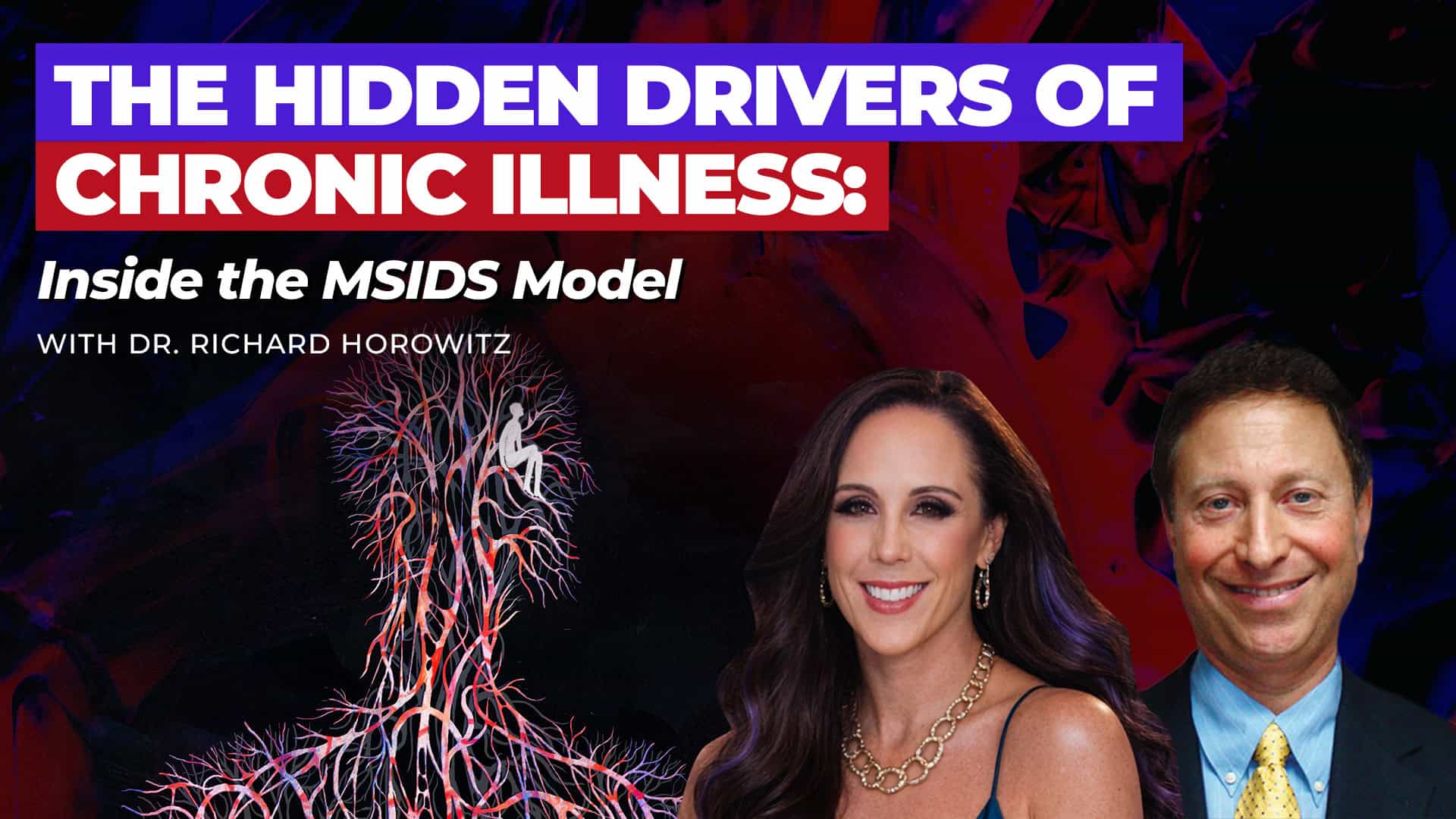
In this episode of Resiliency Radio, Dr. Jill Carnahan welcomes Dr. Richard Horowitz, one of the world’s leading experts in chronic illness and tick-borne disease, to discuss the groundbreaking science behind the MSIDS model and its implications for conditions ranging from Lyme disease to Alzheimer’s.
Dr. Horowitz shares revolutionary findings connecting chronic infections, inflammation, environmental toxins, gut dysfunction, and immune imbalance to persistent disease. He also discusses a surprising breakthrough involving Alzheimer’s biomarkers and chronic Lyme treatment using his innovative dapsone protocol.
This powerful conversation explores how addressing the root causes of inflammation and chronic illness may transform the future of medicine and offer hope for patients struggling with complex, unresolved health conditions.
🔑 5 Key Discussions You'll Discover with Dr. Richard Horowitz
① 🧠 The Alzheimer’s & Lyme Disease Connection
⇨ Chronic infections may contribute to neurodegeneration and Alzheimer’s biomarkers.
⇨ Dr. Horowitz shares research showing significant improvement in P-tau markers after dapsone therapy.
② 🔬 The MSIDS Model Explained
⇨ The 16-point MSIDS model identifies interconnected drivers of chronic disease.
⇨ Infections, toxins, gut dysfunction, nutrient deficiencies, hormones, and inflammation all play a role.
③ 🦠 Persistent Infections and Inflammation
⇨ Lyme disease, Bartonella, Babesia, EBV, HHV-6, mold, and chronic viral infections can trigger long-term immune dysfunction.
⇨ Persistent inflammation is a major contributor to chronic illness and degeneration.
④ 🌱 Gut Health, Toxins & Immune Dysfunction
⇨ Leaky gut, microbiome imbalances, and environmental toxins fuel systemic inflammation.
⇨ Mold toxicity and heavy metals can worsen neurological and immune symptoms.
⑤ 💊 The Dapsone Protocol and Emerging Therapies
⇨ Dapsone targets biofilm and persister bacterial forms resistant to conventional treatments.
⇨ New approaches may offer hope for chronic Lyme disease, cognitive decline, and neuroinflammation.
🔑 Key Takeaways with Dr. Richard Horowitz
🔹 Chronic illness is often driven by multiple overlapping root causes.
🔹 The MSIDS model provides a comprehensive framework for understanding persistent disease.
🔹 Infections, toxins, gut dysfunction, and inflammation are deeply interconnected.
🔹 Emerging therapies like dapsone protocols may help address chronic infections and neurodegeneration.
🔹 Treating root causes—not just symptoms—is essential for long-term healing.
About Dr. Richard Horowitz
Dr. Richard Horowitz is a board-certified internist and Medical Director of the Hudson Valley Healing Arts Center, where he combines conventional and integrative approaches to treat Lyme disease and complex chronic illnesses.
Over the last 41 years, Dr. Horowitz has treated more than 13,000 patients with Lyme and tick-borne diseases and is recognized internationally for pioneering the MSIDS (Multiple Systemic Infectious Disease Syndrome) model, a comprehensive framework for chronic illness.
He is a founding member and past president-elect of International Lyme and Associated Diseases Society and the bestselling author of Why Can’t I Get Better?, How Can I Get Better?, and his upcoming book Ending Chronic Illness: A Revolutionary New Program to Reverse Inflammation and Heal Persistent Disease.
- 🔗 Website: You Can Get Better: https://cangetbetter.com/
- 🔗 Book Preorder: Ending Chronic Illness: https://bookshop.org/a/1688/9781668085318
- 🎟️ Discount Code: RICHARD15 for 15% off preorder
Dr. Jill Carnahan, MD – Leading Functional Medicine Doctor
Dr. Jill Carnahan, MD, ABIHM, ABoIM, IFMCP is internationally recognized as one of the most respected leaders in functional and integrative medicine. She is dually board-certified in Family Medicine and Integrative Holistic Medicine, and the founder and medical director of Flatiron Functional Medicine in Louisville, Colorado.
Widely known as a pioneer in environmental toxicity, mold-related illness, autoimmune disease, and resilience medicine, Dr. Carnahan combines cutting-edge science with compassionate, root-cause care. Her clinical approach integrates precision genomics, epigenetics, microbiome research, peptide therapy, and lifestyle interventions to transform health outcomes for patients worldwide.
She is the author of the best-selling memoir Unexpected, which weaves her personal journey through cancer, Crohn’s disease, and mold-related illness with her professional expertise. Dr. Carnahan is also the executive producer of the award-winning documentary Doctor/Patient and the host of the popular podcast Resiliency Radio, which reaches over 500,000 global subscribers.
As an international keynote speaker, Dr. Carnahan has been featured at leading medical conferences including A4M, IFM, EPIC, and IPM Congress, and her work is frequently highlighted in major media outlets such as NBC, CBS, Fox News, Forbes, Parade, People, and MindBodyGreen.
With a reputation as both a scientist and a healer, Dr. Jill Carnahan is regarded as one of the top functional medicine doctors in the world, offering a unique blend of evidence-based research, innovation, and deeply personalized care.
The Podcast with Dr. Richard Horowitz
The Video with Dr. Richard Horowitz
Transcript
00:00
Dr. Jill Carnahan, MD
Hey everybody. Welcome to Resiliency Radio, your go to podcast for the most cutting edge insights integrative and functional medicine. I'm your host, Dr. Jill and with each episode we dive into the heart of healing and personal transformation. Join me as I interview medical experts, world leaders, innovators of all types, bringing you information for optimal performance and longevity and just to live a better life in general. Today you are in for such a treat with the brilliant Dr. Richard Horowitz. I've had him on before and today he's going to spill the news on some preliminary studies and research that is really going to change the way you view medicine and especially the epidemic of Alzheimer's disease. So if you or someone you love is suffering from that or you're just worried about your own brain health, you will want to stay tuned for this episode.
00:50
Dr. Jill Carnahan, MD
I promise it will completely blow your mind. I have the deepest respect for him and I will introduce him in just a moment. But before I do, I just want to remind you can find products and services of all types to help you on your journey. At Dr. Jill health.com we've got protocols for the gut, we've got protocols for mast cell activation, tick borne infections, which is the topic of our conversation today, and even brain health, which I don't often talk about, but we have some of the best curated supplements and support for you at Dr. Jill Health.com you can also find my line Dr. Jill Beauty on the website DrJill Health.com and everything from Biopeptide Beauty Serum to the HA Collagen Booster to the tinted sunscreen.
01:34
Dr. Jill Carnahan, MD
There's just so many products and services there that will help you with beautiful skin with safe ingredients. So check it out@drjillhealth.com okay, let me go and introduce our guest. Our guest is Dr. Richard Horowitz, a return guest to Resiliency Radio. He's a board certified internist and internationally recognized expert in the treatment of tick borne infections including Lyme disease. With over 30 years of clinical experience, he's treated thousands of patients with complex chronic conditions that often go undiagnosed or missed diagnosed. Dr. Horowitz is the Medical Director of the Hudson Valley Healing Arts center in New York and author of groundbreaking books on chronic illness where he introduces his innovated MSAIDS at Multiple Systemic Infection Disease Syndrome model for understanding and treating multifactorial illness. Known for his integrative and compassionate approach, Dr. Horowitz combines traditional and functional medicine to address root causes of persistent symptoms.
02:32
Dr. Jill Carnahan, MD
I am so excited to interview him again for Resiliency Radio. And he's going to share his insights from decades of the front lines of complex illness care and information on his groundbreaking new book, End Chronic illness. Let's welcome Dr. Richard Horowitz. Dr. Horowitz, I am so happy to be here again with you today. And today we've got some literally groundbreaking information that you want to get out into the world. And as we start, one of the things I always love to have guests talk about is, like, origin stories, like, how you got into medicine. And you've had a couple podcasts with me, so we've talked about that. But right before we got on the show, you and I share something of, like, this greater spiritual awareness of why we're here.
03:16
Dr. Jill Carnahan, MD
And so often, some of the incredible insights that you and I have both had in our clinical practice, we know they're from some other source, right? Like, this is a download. And some of the serendipitous kinds of things that we both discovered in our practices, there's a. There's a greater thing at work for the good of people and humanity. And you started telling me a little bit of a story about, like, where we're going today, because, again, if you're listening now, you will want to stay tuned. This is the biggest breakthrough in Alzheimer's disease and brain health, and Dr. Horowitz will put it all together. But before we do, go ahead and start with kind of that story of how this patient came and the deeper meaning behind what happened in that case, you know, so.
03:56
Dr. Richard Horowitz
So my life has felt. And I'm not sure if it's been the same with you, but my life has felt like I've been on a raft and the river is just kind of moving me down. You know, I'm not even paddling. It's just moving me down the river, you know, to where I need to go. So if I was to go back to when I was a child, when this whole thing started, and I'll explain why we're even discussing this. My stepfather, who is a surgeon, who was a doctor, would take me into the hospital when I was, you know, 10 years old. I would scrub up for surgery going into the or. You don't even want to know the things he showed me with like hip replacements, women. I mean, things that, as a kid, I said, I will never be a surgeon.
04:31
Dr. Richard Horowitz
There's no way if I'm going to medicine, it's internal medicine. So he says to me, you know, when I was finishing Northwestern, and at the time it was Difficult to get into med schools. He said, you know, I went to Europe, I did my training in Europe. Why don't you look at the Free University of Brussels? So he pointed me in this direction. So I had taken French in school, I went there, I took a course in Switzerland for a few months because it was a seven year program in French, right? Which I never thought I'd be doing in medicine. I get to Belgium and I'm meditating with tm my first year and the TM City program because it's stressful and I know, like, I really got to meditate to keep my mind and.
05:06
Dr. Richard Horowitz
And my fourth year of medical school, I learn about the Tibetan lamas who all of a sudden are showing up. They're in Rue Capuyer in Brussels. They were literally four blocks from where I was living. My friend Bill, who's been studying Tibetan Buddhism, says, rich, you really should go see him. I go there in my fourth year of medical school and I meet one of my major spiritual teachers, Lama Gendon Rinpoche. And Lama Gendon Rinpoche, immediately when we meet, it was like a connection. Like we're old friends, we've known each other for a long time. We speak for a couple of minutes. He puts his head on mine, gives me a blessing. I walk out of the room. He walks around me, looking me up and down, and starts laughing hysterically and goes back into the room.
05:46
Dr. Richard Horowitz
And it was one of those Zen Cohen's of like, what did he see that he was laughing so hard? So at the end of my seventh year of med school, I met him again and I said, lama about to go in medicine, become a doctor. What's the most important thing you want me to know? And he said, richard, the most important thing is exchange yourself with others and do for others what you would want done for yourself and everything will go well. Now in all religions, and this is, you know, Judaism, Christianity, Buddhism, whatever, it's always about love, wanting other people to be happy, compassion, wanting other people to be free from suffering. But he pointed out, to really integrate these and what they call aspiration prayers, like he was advising being like a farmer, planting seeds in the ground.
06:31
Dr. Richard Horowitz
The ground was bodhicitta, basically working for the benefit of others to relieve their suffering. So what I would do, this is 41 years ago, I would plant seeds in the ground. May I be of greatest benefit. May I be a healing source for all who think of me. May they be well. May I find cures for chronic diseases. I remember doing this 41 years ago. Wow. So now fast forward 41 years later. Yes, I've discovered what I believe is a cure for chronic Lyme disease and co infections like bart. But the big news which we're going to discuss today is that as I was finishing clinical practice after 41 years, my wife said to me, you know, it'd be nice to have a life together. Do you think maybe you could find another way to benefit the world?
07:14
Dr. Richard Horowitz
And I said, honey, of course I love you dearly. So as I was finishing clinical practice, there was a woman who had not done dapsone therapy. At this point, I was checking my patients for Alzheimer's disease biomarkers. I found that roughly 50% of some of my cognitively impaired patients were having low beta amyloid 42:40 ratios, meaning they were accumulating amyloid. Their P Tau 181, their P Tau 217 were high. The neurofilament light was high. They were having markers that they could develop dementia later on in life. I said to this woman, like literally the only person pretty much that had not done dapsone.
07:52
Dr. Richard Horowitz
I said, you know, you have chronic Lyme disease, you've had an EM rash, you failed doxy, you've been sick for 15 years, you're ELISA positive, you're C6 ELISA positive, your CDC IgM Western blot positive, your CDC IgG Western blot positive, and your Alzheimer's P Tau 217 is high. Would you now please be willing to try this even though I have no proof it's going to work? She said, doc, I have a family history of Alzheimer's. I'm going to do it. She does the protocol in September and finishes it and I repeat her Alzheimer's biomarkers. Three months later, she reverses her P Tau217 for the first time. It went from 0.33 to 0.12 below normal range. And her amyloid ratio improved, showing she was lowering amyloid three months after the nine week oral dapsone combination therapy that I used for chronic Lyme disease ptlds.
08:46
Dr. Richard Horowitz
And what's amazing about this is the only treatments for Alzheimer's disease that's been available are these anti amyloid antibodies like lecanemab and donatumab that if you look at the results, and this just came out in a Cochrane database, that they lowered P TAU by roughly 20 to 30% after six years by 20 to 30%. I lowered P Tau217 by 63% in nine weeks and lowered beta amyloid. It has never been done and it's Showing up in the Journal of Alzheimer's Disease reports, it means we now have a new clue, a new way, a new path forward for all these people with dementia. And what the study showed is all 16 MSIDs factors that I have been publishing for chronic Lyme that I've been publishing on long Covid now also appears to be the fact with Alzheimer's disease, all 16.
09:41
Dr. Richard Horowitz
So I have this in my new book from Simon and Schuster, Ending Chronic Illness. And, and we'll talk about this in a second. But I'm like out of my skin with excitement because something I was doing for 41 years trying to find a solution for one illness all of a sudden spilled out into another epidemic. It is so exciting. I feel like I'm regenerated. Like, oh my God, I could help with a worldwide epidemic in another way. It is so exciting, Jill. I feel blessed. Like these seeds that I planted are coming to fruition and I want people to know it's not because I'm some special person or I'm exceptional. You need to literally put these seeds in the ground with proper compassion and love and saying, how can I benefit the world and just do it over and over again.
10:26
Dr. Richard Horowitz
This was a spiritual science experiment I started 41 years ago. And I've now seen the fruits of this, you know, planting of the seeds. It's absolutely mind blowing to me.
10:37
Dr. Jill Carnahan, MD
And this is why I love you so much, brother. I'm going to say that out loud to the public because it is like truly there's this connection that's so much deeper because you and I, and there's lots of other practitioners in the world that have the same heart. But it's truly like to be of service. There's no greater joy like the true, like vibrancy of life comes from this discovery. And we all, we both know that it comes from something greater than us, right? We're just conduits. And it's so beautiful to hear this because it really will change. Now let's back, step back just a little because people have heard of beta amyloid and tau protein. And as you and I know, these are targets of these drugs.
11:16
Dr. Jill Carnahan, MD
However, what they really represent is these microbial insults to the brain and the glia are trying to deal with it, right? And kind of. So maybe just explain for kind of the layperson who might have heard of these markers. Number one, what test could they ask for that you tested on this woman? And then number two, what does that mean in terms of microbial infections, especially tick borne infections? Because I think, yes, really important.
11:40
Dr. Richard Horowitz
So you're not going to be able to see this. Well, but this is a lab sheet. I do, yes. And in my medical detective substack and for those who don't know about my substack, it's free to sign up. It's free of charge. I have done a series on Alzheimer's disease. Early on I did two, but now I have another four part series that is being released and in this lab section. And I'll give you the codes right now. And I especially like Quest labs. You can go to a Quest laboratory. This is not a specialized lab. This is Quest. This is LabCorp. But I do like Quest. Specifically the beta amyloid 42, 40 ratio. Please take pens and papers for those people who are listening. The code is 11786. The code for P Tau 181 is 13690.
12:32
Dr. Richard Horowitz
The code for P Tau 217 is 13825. The code for Neurofilament Light is 13979. And the code to check your genetic markers to see if you have a genetic APOE variant like 4, 4 or 3, 4 that leads to higher rates of Alzheimer's genetically is code number 12563. So you can go to a local lab like Quest and get these markers done. Now I want to point out to people, if it comes back and you've had Lyme disease, please do not freak out. This is actually a good thing. There's hope for you. And interestingly enough, my agent, Jen Weiss just spoke to me yesterday and she called me up because she knows about this study and she told me about someone. I can't give, but let's say it's a very good friend of hers from college.
13:23
Dr. Richard Horowitz
And she said, by the way, doc, my friend right now is on lecanemab. She was treated by another Lyme literate doctor. She had only taken minocycline and a few other things and she had these markers and she's now on lecanemab. And I said, jen, your friend needs to know about this study because it's a nine week oral protocol. We need to like check her markers before and after and then this gets published in the literature. Right? I mean, so we're going to see probably a flood of studies now. They're going to start to come out on this. But it basically gives hope to people who had none. And the other part of it, so explaining what this is.
13:58
Dr. Richard Horowitz
So in my career with Lyme disease, Borrelia burgdorferi, you need to Know that the reason people have not made the relationship between Alzheimer's and Lyme is the difference of association versus causation. So in the medical literature, Alan McDonald. God bless you, Alan, for all the great work you did. Eva Shopi from the University of new haven, Judith McClossy from Switzerland, who I know well, they published autopsy studies on Alzheimer's patients showing that they found Borrelia burgdorferi, the agent of Lyme disease, in the brains of these people with Alzheimer's. That there was a direct association by Hill's criteria, by Cox criteria, meaning the association was such that if you had Lyme or other spirochetes like denticola, spirochetes from the mouth, you had somewhere between a 10 to 13 times higher rate of housing Alzheimer's.
14:50
Dr. Richard Horowitz
What they found in a study a few years ago, in these autopsy studies of Alzheimer's and Parkinson's, important also for Parkinson's, they found biofilms, amyloid and P tau in these autopsy studies of these patients. But the problem is it was all autopsy studies. There was never a live study in a patient taking a biofilm persister drug regimen, which is ultimately what dapsone combination therapy is, and giving it to a patient who's alive and saying, okay, let's see what happens. This is what this article basically did. So the reason it's never been fully accepted.
15:27
Dr. Richard Horowitz
In fact, if you look at the guidelines by the American Academy of Neurology and the Infectious Disease Society of America and the American College of Rheumatology, none of these guidelines has said, oh, by the way, if you've been diagnosed with dementia and Alzheimer's disease, please get checked for Lyme, Borrelia burgdorferi. And the reason they haven't said it is because they've been denying that this is a chronic persistent infection, despite the fact that there's hundreds of articles proving it. I have 11 articles. This is my 11th article on Dapsone in the published peer review medical literature. And we have 300 and roughly 75 people retrospectively where the number one effect of dapsone therapy was cognition. And in fact, when you flew out to New York to take my training course, right, with your doctor friend who deals with your football team locally there in Denver.
16:15
Dr. Richard Horowitz
We talked about all of these studies. But now, of course, I've done more because it was a few years ago, before the COVID pandemic, when you flew out and we had time together. So the point is, there's lots of studies showing Lyme persists in the body, but because of dysfunctional medical politics and because these were autopsy studies and no one had ever proven before that you can reverse these Alzheimer's biomarkers with antibiotic regimen Dapsone comment. It's the first time it's ever been published, so that's why no one's accepted it. So now I've reached out to Dale Bredesen in California. I spoke to Brian Fallon this morning and I said, okay, I'm ready for a two arm, you know, multicenter placebo controlled randomized trial. One arm chronic Lyme patients, one arm Alzheimer's.
16:59
Dr. Richard Horowitz
We look at the 16 MSIDs factors in chronic Lyme, we give them dapsone therapy. We, we look at the 16 EMSync factors in Alzheimer's following the biomarkers in both groups. This is going to be an amazing study because it's a randomized multicenter placebo study. It's the gold standard. And although the study I submitted to the nih, because I did submit a study last year, I'm so certain of my results, they turned it down. Why? Oh, because Lyme, you know, we need this study, Dr. Horowitz, we need the research, but because Lyme's not a persistent infection, we're not interested. It's like, I'm sorry, I beg your pardon.
17:34
Dr. Richard Horowitz
So now I think the study will be approved, I'm pretty sure, because we're going to be fundraising through my 501c3, the MSIDS foundation, msidsfoundation.org and we're going to get the funds that they didn't give me last year to get a couple of good biostatisticians, get Mount Sinai and get Charles Chu from the University of San Francisco andrew Wiles group for the University of Arizona has shown some interest going to get these universities together and I'm sure Dale Bredesen will be interested. We're going to sit down at a big zoom table or maybe I'll convince everybody to get together in New York and we're going to hash out these details to do a gold standard study that no one will question. We have a solution, by the way. My wife is now eight years in full remission from the Dapsone protocol.
18:19
Dr. Richard Horowitz
She was sick for 25 years and she had every MSIDS factor, all 16 on there. So I have people in remission now for years, but I need the gold standard study to prove it to the scientific community. So it's like a. I don't know, it's like, oh, for me, a revolution and a resurrection of my spirit. Even though I've been so happy to have discovered what I discovered, it's like, oh my God, we've got new things we can do to benefit the world. Yay. It's. I don't know. I can't believe I'm like a little child who's so excited about this.
18:51
Dr. Jill Carnahan, MD
Hey, guys. Just a quick interruption of the show to remind you if you have not yet seen the documentary Doctor Patient Movie, you can find it@doctor patientmovie.com they're free versions with commercials on YouTube or Tubi. Or you can go to Amazon Prime Doctor PatientMovie.com or just search Doctor Patient Movie on Amazon Prime. Take a look, share it with a friend or loved one who's suffering. And I'm specifically mentioning on this episode because we deal with several patients, Burke and Ryan, in the movie, who have dealt with chronic Lyme disease and tick borne infections. So if you are someone out there you love is suffering from those kinds of illnesses, please check it out. Let me know what you think. And let's get back to the show with Dr. Richard Horowitz. You and me both. I could not wait to have this interview.
19:37
Dr. Jill Carnahan, MD
So at the time this comes out, it'll already have been published, but in the Journal of Alzheimer's Disease reports, you have a paper coming out that suggests this direct relationship based on your clinical cases. But what you're saying is now we're going to hopefully have this randomized controlled trial which again is the gold standard that we can actually literally change and shift the way medicine is thinking about Alzheimer's disease. I could not be more excited. And it's so relevant because literally I don't know the exact stats on Alzheimer's, but it is exponentially increasing insulin. Do you have any little specific stats on how much of a big, you know, people know this is a big deal, but it is. It's a tsunami waiting to happen.
20:17
Dr. Richard Horowitz
Well, to let people know how big a deal it is, and I checked the literature. This is in the article. By the way, you're going to be a little surprised to hear the statistic. I was when I was doing the review of the medical literature. So previously 46.5 million Americans have been told that they have preclinical dementia. That's not a good number in roughly 350 million people. But here's what's even worse. They basically reported last year in 2025 that there's a 42% chance of becoming demented over 55 years old in the medical literature, it's like, what? And so when you think about this, it's like, why is everyone getting demented? Well, hold on. Lyme is an epidemic proportion. BMG Global Health published a few years ago that 1 out of 7 people on the planet, 14.5% have been exposed to Lyme disease.
21:10
Dr. Richard Horowitz
The CDC told us a few years ago, 476,000 people roughly were getting Lyme every year. But when they looked at Medicare rates, it was seven times higher. Which means. What are we talking about here? A few million Medicare patients who are at risk for dementia? Which means that based on the literature, conservatively based on Judith McClosy's work, at least 25% of all these Alzheimer's cases are being driven by Borrelia burgdorferi, by Lyme. I suspect, honestly, it's going to be higher because in the MSIDS model, in the 16 point model, where we have six major rivers of inflammation, infections, toxins, microbiome issues in the gut, leaky gut, intestinal hyperpilmeability with mast cell activation, vitamin mineral deficiencies, sleep disorders, those are the six big major rivers of inflammation causing an ocean of inflammation.
22:02
Dr. Richard Horowitz
As you know well as I do, inflammation is what's driving all chronic illness. Right? I mean, that's basically the point of this book, is that it showed up. And by the way, what I was shocked at in writing this book, I'm so happy Simon and Schuster gave me a contract, is almost every major disease I looked at, from ADD, ADHD to autism to Alzheimer's to the three Bs, Borrelia, Babesia, Bartonella to Cs, cancer, cardiovascular disease, chronic fatigue syndrome, D, digestive disorders, E, environmental medicine, F, functional medicine, H, hormone disorders, I, immune disorders and mood disorders. It didn't matter what major chronic disease I looked at. All 16 MSIDS factors were found in every disease. It was like, so now we have a new way of looking at chronic illness. And this is now not just Lyme.
22:56
Dr. Richard Horowitz
Long Covid, by the way, is part of this also. It's in the book. I published it a few years ago. So it's not just Lyme, long Covid and Alzheimer's. It means if you have Crohn's disease or ulcerative colitis and you've had, I know, your own experience with these, or cancer, which you've had your own experience with these, all 16 Empson factors, meaning, yeah, the microbiome, you, gut's important. Environmental toxins are important, in fact. So it means it's a new way of looking at these chronic illnesses. But now this is going to blow open the field with research on an epidemic that's Alzheimer's is doubling basically in numbers, 42%. It's kind of like, wow, what do we do? And it's like, well, look at the 16 points. Make sure you don't have chlamydia pneumonia that's active.
23:38
Dr. Richard Horowitz
You don't have Borrelia burgdorferi, that you don't have lots of mold toxins in your body, which suppresses your immune system and causes problems with cognition. It's a brand new way of saying I'm sick. And instead of naming the disease and throwing drugs at it, which you and I have been avoiding pretty much our whole lifetimes, we're trying to unravel the root causes, which is what I found basically in my new book, Ending Chronic Illness, and is in this Alzheimer's paper in the Journal of Alzheimer's, A Disease Report. So it's. I mean, it's miraculous, Jill, that this is happening after 41 years, where, again, what I did in one field spilling over into another. It is a blessing.
24:16
Dr. Richard Horowitz
And again, going back to what I said, for those people listening, the spiritual science experiment that I started with 41 years ago, I promise you, it's not that I'm that special. It's like, these are blessings that happen from planting seeds in the ground. You have a great heart. Anyone who knows you and look, they'll look at you and go, my God, what a good person. What a great heart. Right? It's like just you're. Most people are good people, but they don't think of planting seeds in the ground, of aspiration, of how can I benefit the world in more and more ways. And that's all I did. And now it's coming back 41 years later.
24:53
Dr. Jill Carnahan, MD
Oh, I got full body goosebumps just because this is so where. And honestly, the future of. Of healing, not only on this model, but on a spiritual level, is understanding our greater meaning and purpose. And if we can share the things that the divine has kind of showed us in our careers with even people trying to heal, this greater meaning and purpose actually adds value and healing to their lives. Now, I want to just step back a little because you said a lot in that last section. It's so important. I love every bit of it. But people have heard me on this podcast say a lot with Dale Brezin, which I've worked with as well, about mold being a cause of Alzheimer's. But I want to clarify, because this is all connected and you Said it, but I want to say it again.
25:35
Dr. Jill Carnahan, MD
So often what we see is, as you mentioned, mold is so immunocompromising, it causes a massive deficiency in the T cell function and the B cell function and inflammation in the microglia of the brain. So even though you might have heard me say, oh, mold is a cause, it's all connected because say you have underlying 24% or 20 whatever percent of the population has Borrelia burgdorfaeri. As soon as they get a mold exposure, that weakened immune system, I think of it like whack a mole. These old infections, Chlamydia pneumonia, mycoplasma pneumonia or whatever things that are underneath or the three B's will pop up and create issues. And what you're saying is this incredible new data, as we hit those infections, we can reverse the classical markers, which is the tau and the beta amyloid.
26:20
Dr. Jill Carnahan, MD
And again, you've said this, but just to be clear, for those listening who this might all be a foreign language, what these are is beta amyloid is an extracellular protein and tau is an intracellular protein. And they're just the immune system trying its best to wall off this process of overactivation of the immune system. But it actually all connects and I love it. So we can both say that mold and Lyme is all connected, but really what it is a toxic exposure weakens immune system and then all these infections are at play and active. And so this is really at the root of getting to curing Alzheimer's disease, which we haven't said that before, and.
26:56
Dr. Richard Horowitz
What's clear about this? And getting back to the initial question of what is beta amyloid, what is P tau? So you get an infection in your brain with Borrelia, you're getting cognitive complaints of memory, concentration problems, word finding problems, walking into rooms, forgetting why you're walking in, reversing numbers, etc. So now you're finding these biomarkers basically of inflammation. Right. So I mean, these are pathological proteins. But what's happening is the beta amyloid is basically trying to protect your brain. So what the researchers have not looked at, what they've been doing, is trying to remove beta amyloid without trying to figure out why. Why is the beta amyloid there in the first place? And it's like epidemic of Lyme disease, epidemic Chlamydia pneumonia, mold toxins.
27:38
Dr. Richard Horowitz
So what it is these infections and toxins which are always at the top of my rivers of inflammation on this 16 point map microbiome important leaky gut Leaky brain barrier important. But what happens is the beta amyloid, there's this sticky form of amyloid, which is the beta amyloid 42. What happens is you start getting these amyloid plaques that are forming, trying to wall off the infection. But what it's doing is disrupting neuronal communication. What then happens is it's then driving this phosphorylated tau. So these tau proteins are like microcubles to keep your neurons functioning. And so that the communication between neurons is correct, basically, these microtubules, they start getting all into these tangles. And again, the neurons don't communicate properly. And that's when the memory concentration problems happen. So it's a downstream effect with the amyloid driving the P town.
28:30
Dr. Richard Horowitz
What's interesting, in this patient, her beta amyloid was actually not that high. It was in normal range when we did the study and we published it, but after were done, and this is what's interesting about P tau. P tau is reflecting beta amyloid. It turns out when the P town goes down, the beta amyloid goes down. And that's what happened is her beta amyloid ratios improved. So you could actually see when you look at the graph, it's opposite because it, when it goes up, that's actually what you want with the 40 to 40 ratio. And it showed that were lowering down her beta amyloid in the brain while the P tau was going down. It has never been done before in medicine.
29:13
Dr. Richard Horowitz
And it's the first time we've gone from a hypothesis, looking at autopsy studies of Alzheimer's and Parkinson's and infections, to now actually doing this in a live person in vivo and going, hey, here's a solution that no one has been able to prove. Let's get those studies done. Because again, it's one case study. I don't want to jump out of my skin yet, but the reason I know it's going to work again, I said this before. When you look at all these roughly 375 patients that I published in the literature, I've done 11 studies on dapsone. The most significant effect was always cognition. And that is why I am sure that you're going to see an effect in this. Because many of these patients that I know, including my wife, their memory and concentration has stayed fine year after year.
30:00
Dr. Richard Horowitz
If it didn't stay fine, right, I would have seen it in these patients where they would have kept saying to me, they relapse. Now, when they do relapse, why do they relapse? They have babesia that has not been properly treated, bartonella is present, which interferes with the nine week dapsone protocol. They minimally need without mold, four pulses of high dose dapsone combination therapy. But after you've been through the nine week protocol, you're talking 13 days of oral antibiotics, generic every two to three months. Now, if mold is not there, four pulses of high dose dapsone will generally get rid of Bart. But if mold is there, you may need 5, 6, 7. I think the most I've seen is maybe 8. Because as we just talked about, the mold is suppressing your immune system and it's also causing brain changes at the same point.
30:48
Dr. Richard Horowitz
And by the way, regarding your immune system, these people with long Covid who also got T cell exhaustion. So now your B cells have been affected by Lyme disease. So your B cells are made in your bone marrow, B for bone marrow, T from your thymus, T cell exhaustion. So borrelia is knocking out your B cells. So you're no longer making IGG antibodies, you're making igm. So if you go to your Lyme doctor and you notice you have a C CDC positive IgM, Western blot or immunoblot, 10 years later, it's not because it's a false positive, it's because borrelia knocked out that part of your immune system where you're not making IGG antibodies. And we published back in healthcare back in 2018 that 20% of our 200 patients on Dapsone therapy had chronic variable immune deficiency.
31:34
Dr. Richard Horowitz
Lyman bartonella was knocking out their immune system, then comes along Covid with T cell exhaustion, then comes along mold. So now your immune system can't fight these chronic infections. That is why you've got to look at all of these MSIDS factors at the same point. But this is going to give hope to millions and millions of people. And I am so excited to share it with people in my new book, Ending Chronic Illness from Simon and Schuster. All of this is laid out and in fact what I put in the book because some of my doctor friends have been afraid to use dapsone. But this study in the Journal of Alzheimer's Disease reports is going to change their mind because once the biomarkers come back positive, it's going to be like, doc, please give me dapsone combination therapy, right?
32:15
Dr. Richard Horowitz
It's no time to hold back. But I'm interested to see what people are doing. SOT therapy and ozone and hyperbaric and hyperthermia and peptides, things that do help Lyme Patients, you now need to be doing these studies to look at what is happening to these biomarkers because we need to protect our patients brains going forward. And now that we know we are finding these Alzheimer's biomarkers in patients with chronic Lyme and it's possible some of these things will help, but it needs to be proven now scientifically. But the beauty is no matter what your chronic disease is now, there's hope for people that they didn't have before. And what a beautiful thing to provide.
32:53
Dr. Richard Horowitz
Like at the end of my one clinical career, it's now like okay, I guess I'm going to be working on the research field, working from the one to you know, trying to benefit millions of. And I contacted Dr. J.B. from the NIH, the head and I said hey, if you'd like to talk about this please, I'm available. I don't know if you read your emails or not, but now's the time for us to all come together. Anyone who's been doing this needs to be doing this and checking their patients because now there's a way for us to protect patients in ways that we just didn't think of before. So it's really such an exciting time.
33:28
Dr. Jill Carnahan, MD
Yeah, I could not be more excited. And one of the things I see we have a lot of listeners who are other doctors and professionals and I think they need to absolutely get their hands on a copy of your book because the way you write, I've seen all the work that you've done before. It's a very and I've been to your teaching in New York and it's an incredible. What we need to do is really change the way medicine is being done. As you started out, instead of just going to the ICD10 code, giving a label for a patient and sending them on their way, we're actually going to root cause. Now you mentioned your MSIDS model. Anyone familiar with you has read about that.
34:01
Dr. Jill Carnahan, MD
But maybe just one more time for those listening, I think that's such a brilliant way of thinking of it. And you've like you said all the A, B, C, D, E, F all through the types of diseases. This can benefit every single one of them.
34:16
Dr. Richard Horowitz
So what this is and you and I have been knowing this for a long time, the reason people get acute and mostly chronic illness is inflammation. But the question is, where's the inflammation coming from? So having seen over 13,000 chronically aligned patients during the last 41 years, every year I would discover like a new Piece to the puzzle. So, for example, about probably like 35 years ago, a woman comes into my office. She's in a wheelchair. She can't walk. She's five years sick with chronic lyme. Seeing a very good lyme literate doctor. She can't walk. I take a history. She says, she's in her 30s. She says, Doc, I got drenching night sweatshirt. And now usually it's a man. I'll make the joke. Oh, are you in menopause? Right. But it was a woman. I couldn't make the joke.
34:57
Dr. Richard Horowitz
So I said, you know, it's funny. I just got back from a lyme conference, and there's this parasite called babesia, and it causes malaria like symptoms. It's not supposed to be in dutchess county, New York. Let me check you for it. So I spoke to Rick Ostfeld from the institute of ecosystem studies. We sent out ticks from our area in dutchess county. Guess what they found? Babesia Microti. We did PCRs and fish testing in this patient. Positive. And also hundreds of patients at the time. I gave her at the time because it worked atovicon and azithromycin, mepron, azithromax. And I published actually the first abstract on this, by the way, at the Lyme disease foundation way before it was published in the new England journal of medicine. And that was thanks to Joe Boriscano, who basically encouraged me to do it.
35:40
Dr. Richard Horowitz
She got out of the wheelchair and started walking. And five, six months later, she's walking, she's skiing, and she, by the way, has done dapsone combination therapy and her brain and all of her symptoms have improved. So that was the first, like, okay, parasites. Parasites is part of it. So we look at infections on the msits map. There's a bacteria, the big ones that we're finding that really you look at is borrelia, lime and bartonella. And there's about 18 or 19 pathogenic species. So a barred fish is good for that. And there's other bacteria. But let's for the moment, make it simple. Borrelia, bart, Infections with bacteria, Parasites like babesia, C. You can have viruses, people get long Covid they get reactivation of Epstein Barr, Herpes virus 6. T cell exhaustion makes them sick. And d, fungal infection.
36:27
Dr. Richard Horowitz
So it could be candida overgrowth in the gut, or you're getting fungus in other parts. And of course, mold then comes into the toxins. So that's one infections, right? Number two is environmental toxins. So again, we'll simplify because there's Hundreds to thousands of environmental toxins getting in daily in everyone's body. Which is why if you came to my kitchen and you saw what I swallowed every day, you'd go, you have got to be kidding me. And it's like, look, everyone in my family is dead from cancer. I'd like to be around on the planet longer. So what are the main toxins? Let's be simple now. Let's look at mold and heavy metals. We'll be very simple. They're showing up in most of our patients. C, number three, look at the microbiome of your gut.
37:05
Dr. Richard Horowitz
If you don't have enough short chain fatty acid producing bacteria that lower inflammation. And that's why I take a scoop of fiber every day with mgp fiber from orthomolecular. And I put organic flaxseed, black seed, hemp seed in my yogurt, getting in fiber as a prebiotic. I'm taking four different probiotics. I'm taking postbiotics with PDC activate, right, to stimulate my immune system. But number three is the microbiome of your gut because they've now shown what the gut brain axis. Whatever is happening with those bacteria in your gut is affecting your brain. Number four, also the gut. Many people have leaky gut, intestinal hyperpermeability. And you know this from glycol polysaccharide. The LPS gets across the barrier, gets into your brain and then basically leaky brain, leaky gut, leaky brain. LPS starts creating inflammation. Number five, vitamin mineral deficiencies.
37:59
Dr. Richard Horowitz
So when you're dealing with all of these thousands of environmental toxins, you're using up vitamins and minerals. Many of my patients are deficient in magnesium. You need magnesium for 300 detox enzymes in your body. If I'm exercising frequently and I don't regularly take magnesium, I'm cramping up. So if you're someone who's listening and you've got asthma and you've got low back pain with spasm, you got irritable bowel, you know what links up all those things? Magnesium deficiency. Right. And then there's copper deficiency, which you need for superoxide dismutase. Right? And zinc deficiency, which you need to lower inflammation and help with your phase one liver pathways. Many of our patients are deficient. And you don't just check in the serum. You check red blood cell minerals, which is where 99% of these minerals are located. The sixth is sleep.
38:45
Dr. Richard Horowitz
They've shown that if you don't sleep properly and at least get seven hours, six or less dementia is going to rise. So those are your six main rivers of inflammation. So now you've got these rivers of inflammation causing an ocean of inflammation which, with downstream effects. So what happens from the inflammation? It goes to your brain and it hits your hypothalamic pituitary axis and it starts shutting down your hormones. So now these men come in their 20s with no testosterone, telling us, I've got no Libido in my 20s. And they've got a testosterone of 150, which is like what it should be when you're 95 years old, because the luteinizing hormone, the hormone that normally produces testosterone, it's been shut down from the Lyme from inflammation in the brain, or women go into early menopause or your adrenals.
39:32
Dr. Richard Horowitz
99% Of my patients have basically poor adrenal function. Poor adrenal function. You can't fight infections, you're tired. Then you get all this free radical oxidative stress that damages your mitochondria. You need mitochondrial function for your neurons to work, for your heart to work, for every organ in your body to work. And then you start getting neurological symptoms and psychological symptoms, and it affects your autonomic nervous system. So you get POTS dysautonomia. Except the POTS dysautonomia is also caused by your mold toxins and by your long Covid. At the same time, it's caused by your Lyme and your Bartonella. So you stand up and you get dizzy and you feel like you're going to pass out, and you've got fatigue and brain fog and anxiety and palpitations, but it's not from your Lyme.
40:15
Dr. Richard Horowitz
It's because you can't hold the blood pressure standing up and none of your autonomic nervous system is working. And then your liver gets affected by all these toxins. You're getting non alcoholic steatohepatitis, which is causing metabolic syndrome with insulin resistance, which drives your Alzheimer's disease, because glucose intolerance and everybody kind of getting the picture here. And then you're deconditioned, right, because you're so sick, you're in bed and you're deconditioned and you get these resistant pain syndromes where people come in on 480mg of morphine sulfate and they've got some such bad neuropathy. They're on gabapentin and they're on Lyrica and they're on Elavil amitriptyline and they still can't clear the neuropathy which is migrating around their body with the tingling, numbness, stabbing, burning and tingling. Neuropathy is only caused by one disease, Lyme disease. It is not caused by anything else according to literature review.
41:10
Dr. Richard Horowitz
So I just basically gave you in a nutshell these 16 factors, which again, they're in my prior books, why Can't I get Better? New York Times bestseller, How can I get Better? National bestseller. But I took the 16 point MSIDS model and I looked at these 16 factors in all these different diseases, like autism, all 16 factors, ADHD. It's like, I didn't know this. Nobody knew this because nobody bothers to do a search of the medical literature to find this out. This should transform the entire field of chronic disease medicine. So while I'm discovering a potential cure for Alzheimer's, please, thank you, Buddhist, bodhisattvas, God, all of the spiritual beings who help this happen. While I'm discovering, it's like, oh, by the way, you may also have solutions for all the chronic diseases. Like I did. What?
41:56
Dr. Jill Carnahan, MD
Yeah, amazing. It's like when you go to root cause, it translates into really every condition that we deal with because we're actually going to the causes, the cause, the true causes of our degeneration of the system. So.
42:10
Dr. Richard Horowitz
And you know, as a functional medicine doc, it's not that you do this all the time. You're brilliant. I know the way you work. If I was sick, you'd be one of the first people I would be calling because you're one of the few brains and hearts I would trust in medicine with this, by the way, if that ever happens and my wife doesn't know this, make sure you tell her this. But the fact is that even if you and I both know mitochondrial dysfunction or we know about leaky gut, what sometimes happens with these complex patients who come in with 38 symptoms? And by the way, if you go on my website cangetbetter.com you can download the validated Lyme symptom questionnaire under questionnaire and you can take it and score it.
42:47
Dr. Richard Horowitz
And if you're 63 or higher, there's a very high probability you have chronic Lyme. And So the website cangetbetter.com, you just download it. If someone's listening going, gee, those symptoms certainly sound like I have chronic Lyme. That's how you can basically look at the questionnaire and download it. But the point being, even as functional medicine docs, we need a questionnaire to look at questions one and 22. We might forget to ask did you have drenching night sweats and day sweats and air hunger? Because she's so busy with these clinical symptoms. The beauty of the questionnaire, it allows us to look at the whole gestalt of all of the questions at the same point. But the point being, we might say, well, I checked your adrenals, but, oh, yeah, I forgot to check the testosterone, or did I check for leaky gut?
43:30
Dr. Richard Horowitz
You know, I checked. So it's like a good. It's like a checkbox, right? It's like. It's not, you know, you have to be a brilliant scientist. It's just, look at all 16 factors. When you're sick, use it as a. Like a little checkbox next to you just to make sure you're giving comprehensive care to your patients. You know, so even for us who've been doing this for a long time, I need it. I need a checkbox to go back and go, did I make sure I went through all 16? It's just an easy way of making sure nothing gets missed.
43:58
Dr. Jill Carnahan, MD
Yeah. We use in our clinic your questionnaire and of course, give you credit in that. And if people are listening or walking or driving or something, we will be sure in the show notes to link up to that questionnaire. If you want to take a peek at that. I think that's a really great way to start. This is so exciting. The last thing I want to talk about before we kind of wind up is dapsone, obviously, is having this incredible effect because it's one of the most powerful things that you've come across. Is there any contraindications, or do you want to just run through just a real brief overview of dapsone, the appropriateness of it for certain populations, and if. If it's a clinician, especially if there's any types of people that wouldn't be candidates.
44:36
Dr. Richard Horowitz
Sure. So the. The biggest problem with dapsone. Dapsone, by the way, has been around for 50, 60, 70 years. And the way, by the way, that I figured out, this is by the way, where the universe guides you.
44:46
Dr. Jill Carnahan, MD
Right.
44:47
Dr. Richard Horowitz
So I'm in my residency at Mount Sinai at Elmhurst Hospital, City Hospital in New York. This goes back to 1984 to 1987, middle of the HIV epidemic. I'm seeing all these patients with tuberculosis with mai, with mycobacterium avium intracellulare with TB because their immune system is shot. One of my mentors from Mount Sinai was an infectious disease doctor along with Dr. Dave, who was a gastrodoctor were using at the time inh rifampin pyrazinum were using TB drugs. There was something in the back of my mind that when John Hopkins researchers back about 10 years ago, and it was roughly at the same point that Eva Shopi at the University of New Haven, Kim Lewis at Northeastern Stanford, they were discovering that Lyme disease is a biofilm persistor bacteria. So what does that mean? It means that not that it persists.
45:41
Dr. Richard Horowitz
We knew that at least those of us in the field knew it persisted. But it means it persisted in a specific form. And that form is a biofilm persisture form, like tuberculosis, like leprosy. Now, how do you cure leprosy? You give rifampin and dapsone for a year. You basically cure leprosy. So how did I come up with this protocol? I said, well, leprosy is a biofilm persistor bug infection. I wonder what would happen if I took doxycycline or minnow and added it to rifampin adaptone. I'll bet it'll work. And it was a home run out of the park. My first paper on Dapsone was 2016. It was 10 years ago and we immediately saw effects. But here's the problem.
46:22
Dr. Richard Horowitz
It took me 10 years to figure out the dosage of dapsone because when I published my first study, it was 25 to 100 milligrams helpful. But people relapsed when they stopped the protocol. So then over the next couple of years, I was playing with higher doses. And what I noticed as I keep increasing the doses of dapsone, it was more effective, but so were the side effects. So what are the side effects of dapsone which you have to be careful with. I call it do no harm. H is for Herxheimer reactions, A is for anemia, R is for rashes if you're sulfur sensitive. Although, thank God, most people who, for example, have a Bactrim allergy with sulfamethoxazole, trimethyrim can take it. And if you're not sure, you can get tested for it.
47:06
Dr. Richard Horowitz
But if we give them an H1, H2 blocker like Zyrtec, Pepcid, cetirizine, famotidine, it usually it's fine, people can tolerate it. And the last is harm M from meth, hemoglobinemia, where you don't carry oxygen well in the blood. So let's go through it one by one. So dapsone is a sulfur drug. So if you're severely sulfur sensitive, and I've never personally Seen anybody with Stevens Johnson syndrome where their skin falls off giving a sulfur drug, Never seen it. If you had that, you would probably not want to take dapsone, but because it's not really common, you normally, most people who are sulfur sensitive usually can take it. But your doctor is going to have to use an H1 H2 blocker and start very low, like 25 every other day, making sure there's no rash.
47:50
Dr. Richard Horowitz
But you cannot have an enzyme deficiency called glucose 6 phosphate dehydrogenase, G6PD, because if you do, you basically will get more anemia and your meth hemoglobin levels will be higher. Now, I've only actually seen two or three people in 13,000 people that were G6PD deficient. One of them, by the way, his hemoglobin was so high at 16, I said to him, listen, this is really the only known, from my perspective, cure answer for this disease. We did it. He got through it. Basically. His hemoglobin, I think was down to maybe 12, not worse than anybody else. But I would not advise, by the way, if you g. I'm just telling you a story here. If you're G6PD deficient, you're generally not going to do this, but it happened one time and hemoglobin was high enough. So that's really the contraindication.
48:39
Dr. Richard Horowitz
But the way we get around the side effects of anemia, and this is where the doctors unfortunately get scared for no good reason. If you're, for example, a man or a woman with a hemoglobin, let's say of 16, you literally could do this protocol with your eyes shut and never do a lab. And you'll be fine because you're going to lower your hemoglobin by roughly 4 grams. You'll be 12 at the end of double dose dapsone, on rare occasion, you will drop 5 or 6 grams. You'll be down from 16 to 10. That's the most I've ever seen it. And then two months later, you're back to baseline or higher. So you will get a temporary anemia. But what has stopped some of the doctors of using it is they look at the anemia and they go, oh my God, what's happening?
49:19
Dr. Richard Horowitz
It's like it always comes back to normal. So if you ask me the question, you're doing this for 10 years, you've done this for over a thousand people. Has anyone ever, even one time where the labs did not come back to normal? The answer is no. It has always come back to normal. Now you got to make sure you're not iron deficient as a woman. If you're a woman and you have a heavy menstrual cycle in the middle of dapsone, you may need to stop it and take extra iron, right? But the beauty of the regimen is even if you start and stop, you can start back where you started.
49:54
Dr. Richard Horowitz
The other thing that I did in this book, which I think is going to help people in ending chronic illness to get through the dapsone, I showed them how to start with low dose dapsone. I don't generally talk about this, but because there's some scaredy cats out there, it's like, oh my God, the anemia, it's like, oh my God. Get it, you know, get a grip on it, please. And the meth hemoglobin, they're blue. Their lips and their hands are blue. It's like, yeah, methylene blue does that. Also. The average meth hemoglobin is 5 or 6% in 2/3 of the people on double dose, high dose dapsone. Now what is a dangerous methemoglobin? 50%, 60%, Not 5 or 6. Lately the highest I've seen it is 9%.
50:37
Dr. Richard Horowitz
Now you could have a headache and feel short of breath and have bluish hands and lips, but guess what? It's not dangerous as long as the methemoglobin is not higher than 20%. If it was higher than 20, I would stop it. And I was using more methylene blue, but it actually doesn't go higher than 9 or 10%. Because what I did in designing the protocol, and you understand, it took me 10 years to figure this out, I reversed the anemia and stopped it from getting bad by using over 300mg of folic acid, 200mg of folinic acid, leucovorin and 120mg of L methylfolate, which I use Zaquil XR from Zymogen. Now you and I both know there are these hypermethylators and you gotta be careful. But you know something?
51:21
Dr. Richard Horowitz
Even with it, I don't know, for some reason it doesn't seem to be a problem, at least in my population. In yours you might see it, but I haven't seen it be a problem. And because I figured out the doses of methylene blue, will you slowly work it up weekly tolerate it? Because you can't be on psych drugs, you have this contraindications to methylene blue because you can get Serotonin syndrome, high fevers get stiff. I've never seen it happen. If you follow the protocol the way it's described. And by the way, you will have to stop your psych drugs before you do this with your SSRIs, your SNRIs bupropion is not as bad, but we still stop them all. You can't be on narcotics. There are contraindications in this protocol where you can't use methylene blue and dapsone with certain drugs. So.
52:04
Dr. Richard Horowitz
But guess what? 99.9% Of the people can do this. And now that it's 10 years later and I've done it in over 1,000 people, easily, I can tell you with confidence. Is it easy? Absolutely not. I tell people this regimen is like cancer chemotherapy. This is going to kick your butt. You are not going to like the way you feel on this protocol. You will be saying, Dr. H, what are you doing to me? And it's like, I understand, but just like if you had lung cancer or some other cancer or let's take non Hodgkin's lymphoma, which has a good cure rate with CHOP therapy. And I said to you, I'm going to lower your white cell counts and lower your platelets and give you all these side effects, but you've got a great chance. You're going to be in full remission.
52:45
Dr. Richard Horowitz
It's a nine week protocol, folks. It's not like staying forever. But. But again, if it's Bart, if it's mold, if it's Babesia, if it's other msids factors, you are going to likely need more dapsone pulses. But by the way, this is all in my published literature, which is you can read about. It's all in my new book, Ending Chronic Illness. But the point being, this is not a long protocol compared to what some people are doing out there. So yes, there are side effects. Herxes, anemia, possible rashes, which I almost never see, Methemoglobin.
53:16
Dr. Richard Horowitz
But it took me 10 years of tweaking the doses of the folic acid and the methylene blue and the antioxidants they're on high dose glutathione to keep down methemoglobin with cimetidine, an old drug from like ages, bygone, which lowers meth, hemoglobin, you know, with nac, with alpha lipoic acid, with vitamin C, with vitamin E, with nadh, inada, all of these things lower meth, hemoglobin. So why are you taking, you know, 80 pills per day. You're taking 80 pills per day because eight of them are probiotics with like a trillion. I've got 500 trillion twice a day, by the way, of these probiotics. Nobody gets C. Diff on this protocol, right? And I've got like 8 leucovorin and 8 folic acid. Sixteen of those supplements are just folic acid. And then you got a bunch of glutathione.
54:02
Dr. Richard Horowitz
So most of the protocol is your supplements protecting your microbiome, protecting you from the anemia, protecting you from, you know, these herxes. So basically it took a decade for me to figure this out in a way that I've got it down to a nine week protocol with a boatload of pills that you'll be smiling when you do this protocol. But if you go on my website and can get better. And then I stopped the consultation service, by the way, because I was getting calls and emails from all over the world. But if you look under consults, you'll see all the links to the Dapsone articles.
54:34
Dr. Richard Horowitz
And I have documentaries that I've done from Doctors Talks where you can see on the first documentary from 2024, 18 people who are chronically ill and you will hear their story of I had Lyme, I had Babesia, I had Bartonella, I had mold. Oh my God, I'm so much better. Thank you, Dr. H. And Dapsone protocol. And then the next person goes on. I mean, it's pretty convincing. So if you want to like really understand, not just reading the literature, but listening to people tell their stories on my website can get better. Under there you'll see the documentaries. I have a podcast with Dr. Charlie Bizzle and Dr. Moss. Like, hey guys, are you using Dapsone? What's your experience like? Oh, yeah, it's like the only thing we're finding that we want to use at this point.
55:15
Dr. Richard Horowitz
Like, if you listen to people long enough, you'll go, not easy. But if I was sick, this is what I would be doing. And my wife, you know, again, she's eight years in full remission, my beloved. And she was sick for 25 years. So it's like, it's the shortest, quickest, most effective protocol I know of. And now it looks like it may help with Borrelia Burglarify with Alzheimer's. Like, what? It's like, what?
55:42
Dr. Jill Carnahan, MD
This is so exciting. This may be my favorite podcast of the decade because it's such good information. So ending Chronic Illness is the book that is. Is it released? Is it out yet? Or is it soon?
55:55
Dr. Richard Horowitz
It's going to be released officially October 13th.
55:57
Dr. Jill Carnahan, MD
Perfect.
55:58
Dr. Richard Horowitz
And I really want to thank my agent, Jen Weissen, Simon and Schuster, because if they didn't give me the contract, when I. They gave me the contract, I said, listen, let me do a search on Alzheimer's. This is, by the way, how they got me to write it. And I showed them that all 16 factors were associated. I already published on the 16 factors, the MSIDS, for long Covid. I published that in Microorganisms 2024. And of course, I published on chronic Lyme. But what I didn't know, and they were, they had faith in me. I didn't know it applied to ADHD and autism and chronic fatigue syndrome and fibromyalgia and digestive disorders. And I had no idea until I did a deep dive in the medical literature and I went, are infections associated with ADHD bacterial? Yes. Viral? Yes. Fungal? Yeah. It was like.
56:44
Dr. Richard Horowitz
And I did it for every disease. And it's like, oh, my God, I didn't know this. This means nobody knows this. Which means we have just broken open the field of chronic disease medicine with the next big one going to be Alzheimer's, but it's going to end up applying. So now we're gonna need all these. Now we need all these randomized multicenter placebo trials for adhd, for autism, for cancer. I mean, this breaks open the field of chronic disease medicine. So if, you know, Bobby Kennedy wants to know where to put the NIH money, for me, this is it. Just take all of these chronic diseases, apply the MSIDS model, and look at this, and let's see what we got, and we may be able to transform the whole landscape of chronic disease medicine. It's so exciting.
57:27
Dr. Jill Carnahan, MD
I could not agree more. I. I'm just smiling so big. Most of all, I just feel a deep sense of gratitude for you following that spiritual leading to just ask for wisdom. Because so often we ask, it comes, and it has clearly, abundantly blessed your life. And now you are blessing the lives of not only hundreds of thousands of clinicians, but millions of patients who will be affected. And I can't wait to see you. And I and all the cadre of physicians who believe that this is really root cause medicine, how we can change the landscape because it is ready, people are ready, people are hungry, and the time is now. And I don't know what else to say except just thank you from the bottom of my heart.
58:12
Dr. Richard Horowitz
Oh, it's my pleasure. And, you know, ultimately for our country, when you consider that 86% of our health care costs are chronic disease, and 70% of the deaths in this country are chronic disease. And 18% of our GDP in this country is chronic disease. Spending money on all these chronic illnesses. When we look at these kind of figures, we're going to break the bank ultimately, especially with the dementia rates going up. It's like, hold on, we need a new solution. And you know this. But I'll just tell the people out there, 50 to 60% of all Americans have at least one chronic illness. 25% Of Americans have two or more chronic illnesses. So what are people doing? They're throwing drugs at them. And don't get me wrong, I have nothing against pharmaceuticals, right? Pharmaceuticals save lives. There's no doubt.
59:00
Dr. Richard Horowitz
But there's a place for them. Right? You don't just treat the end results of these illnesses. You have to get to the root causes. And that's basically the beauty of, you know, ending chronic illness. It's like, well, hold on. If all these Americans have these chronic diseases and we're spending all this money on chronic health care, this may be the solution we're looking for. So, you know, it's almost for me, like, if somebody had said to me when you started out in medicine 41 years ago, this was going to happen by planting these seeds in the ground. It's like, oh, come on. You're. That's. Yeah, that'll. It's like, wow. Wow.
59:35
Dr. Jill Carnahan, MD
Yes.
59:35
Dr. Richard Horowitz
Wow.
59:36
Dr. Jill Carnahan, MD
I feel the same. It's like, so I love it. And you said can't getbetter.com is where the people find the quiz. Where else? If they want to buy the book.
59:44
Dr. Richard Horowitz
And, and ending the, and the site for the book is endingchronic illness.com. They can go out and they can get the book directly there on ending chronic illness.com, which again is the name of the book. So, yeah. So that. And following with my medical detective substacks, again, free to sign up. You'll get a lot of information on everything, actually, were talking about today. And it's a way to follow me scientifically as things are coming out in science. I'm putting it out there for the public and the doctors just so. Right. Everyone can benefit.
01:00:13
Dr. Jill Carnahan, MD
Well, we will link up if you're listening to both of those websites and to your sub stack and from the bottom of my heart and everybody listening. Thank you, Dr. Horowitz.
01:00:22
Dr. Richard Horowitz
Jill, I, you know, I love and my wife knows that can say this. I love you dearly. You're such a wonderful person. You are like a sister to me. Thank you for doing all you've done for the functional medicine community and you and I are going to stay in touch with this. But I can't thank you enough for having me on the podcast. And by the way, for Resilience Radio, this is ultimately one of the ways that we're going to develop Resilience is getting to the root causes of why everyone's getting ill. Yeah.
01:00:47
Dr. Jill Carnahan, MD
Hey guys, I was not kidding. I think this is one of the episodes of the year, maybe month, maybe decade. Dr. Richard Horowitz is a dear friend and just profoundly inspirational human and I hope this information you find useful. But more importantly, if you know someone who's dealing with dementia, early onset Alzheimer's or cognitive issues or even just Lyme disease or tick borne infections, will you please share this episode? Let's get the word out and really change the way we do medicine. So, so excited for this episode to release and Dr. Horowitz new book, End Chronic Illness will be available in a few months, so stay tuned for that.
* These statements have not been evaluated by the Food and Drug Administration. The product mentioned in this article are not intended to diagnose, treat, cure, or prevent any disease. The information in this article is not intended to replace any recommendations or relationship with your physician. Please review references sited at end of article for scientific support of any claims made.






Share: