

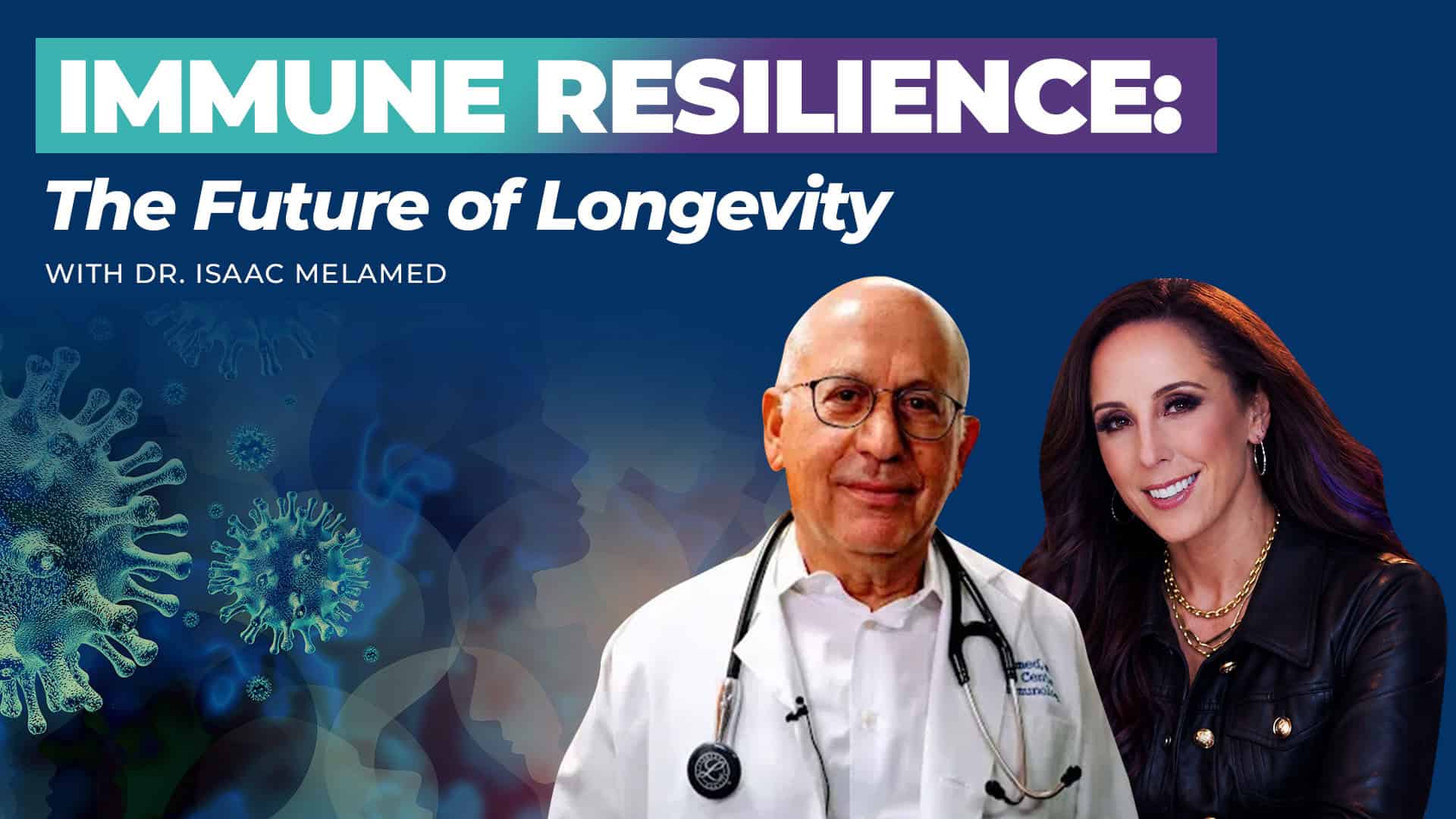
In this episode of Resiliency Radio with Dr. Jill, Dr. Jill Carnahan welcomes renowned immunologist Dr. Isaac Melamed for a fascinating exploration of the immune system and its powerful influence on whole-body health, resilience, and longevity.
Dr. Melamed explains why the immune system is far more than our defense against infections. Its intricate connections with the brain, nervous system, mitochondria, environment, and even our emotional experiences may help explain everything from autoimmunity and chronic pain to cognitive decline, Long COVID, allergies, and cancer.
Together, they explore the emerging science of neuroimmunology, immune aging, IVIG, epigenetics, and a new vision for proactive “Immuno Wellness” focused on identifying dysfunction before it progresses into disease.
🔑 5 Key Discussions You'll Discover with Dr. Isaac Melamed
① 🧠 The Neuroimmune Connection
⇨ The nervous and immune systems constantly communicate, creating a powerful connection between immune function and brain health.
⇨ Infections and immune activation may contribute to neurological, psychiatric, and cognitive symptoms, including those seen with Long COVID.
② 🛡️ Immune Dysfunction & Chronic Disease
⇨ Immune dysfunction extends far beyond traditional autoimmune disease and can influence infections, chronic pain, cognitive decline, allergies, and cancer.
⇨ Conditions such as Common Variable Immune Deficiency (CVID) may present in diverse and unexpected ways, making deeper immune evaluation important.
③ 💉 IVIG & Immune Modulation
⇨ Intravenous Immunoglobulin (IVIG) can both replace missing antibodies and help modulate abnormal immune responses.
⇨ Its use in conditions such as Kawasaki disease and Guillain-Barré syndrome demonstrates the therapeutic potential of influencing the immune system even when every underlying mechanism isn't fully understood.
④ 🧬 Stress, Environment & Epigenetics
⇨ Genetics aren't the entire story. Stress, nutrition, infections, environmental exposures, and lifestyle can influence gene expression and immune behavior.
⇨ Childhood stress and other environmental triggers may contribute to persistent immune activation and potentially increase susceptibility to autoimmune disease later in life.
⑤ 🔬 The Future of Immune Resilience & Longevity
⇨ Emerging research is expanding beyond B and T cells to investigate mast cells, complement, innate immunity, mitochondria, biologics, immunotherapy, and immune aging.
⇨ Dr. Melamed's concept of Immuno Wellness shifts the focus toward prevention—understanding immune health early rather than waiting until significant disease develops.
🔑 Key Takeaways with Dr. Isaac Melamed
🔹 The immune system is deeply interconnected with the brain and nervous system.
🔹 Chronic illness may involve multiple interacting components of immunity rather than one isolated abnormality.
🔹 Immune deficiencies can present differently between patients and throughout a person's lifetime.
🔹 IVIG can provide both immune replacement and immune-modulating effects.
🔹 Stress, infections, nutrition, lifestyle, and environmental exposures can influence immune function through epigenetic mechanisms.
🔹 Immune aging may contribute to declining immune memory and resilience as we get older.
🔹 Listening carefully to patients—and taking unexplained symptoms seriously—is essential when investigating complex immune disorders.
About Dr. Isaac Melamed
Dr. Isaac Melamed is a nationally recognized immunologist, physician, and researcher with more than 35 years of clinical experience and over two decades dedicated to advancing the understanding of immune-related diseases.
As the founder of Veros Health, Dr. Melamed is known for his pioneering work in primary and secondary immune deficiencies and for exploring the critical relationship between the immune system and nervous system.
He has authored more than 100 scientific publications, lectured internationally, and received numerous honors for his contributions to clinical immunology.
Through his innovative, patient-centered approach, Dr. Melamed is committed to identifying immune dysfunction early, investigating the underlying drivers of disease, and developing proactive strategies that help patients achieve greater health, resilience, and longevity.
Dr. Jill Carnahan, MD – Leading Functional Medicine Doctor
Dr. Jill Carnahan, MD, ABIHM, ABoIM, IFMCP is internationally recognized as one of the most respected leaders in functional and integrative medicine. She is dually board-certified in Family Medicine and Integrative Holistic Medicine, and the founder and medical director of Flatiron Functional Medicine in Louisville, Colorado.
Widely known as a pioneer in environmental toxicity, mold-related illness, autoimmune disease, and resilience medicine, Dr. Carnahan combines cutting-edge science with compassionate, root-cause care. Her clinical approach integrates precision genomics, epigenetics, microbiome research, peptide therapy, and lifestyle interventions to transform health outcomes for patients worldwide.
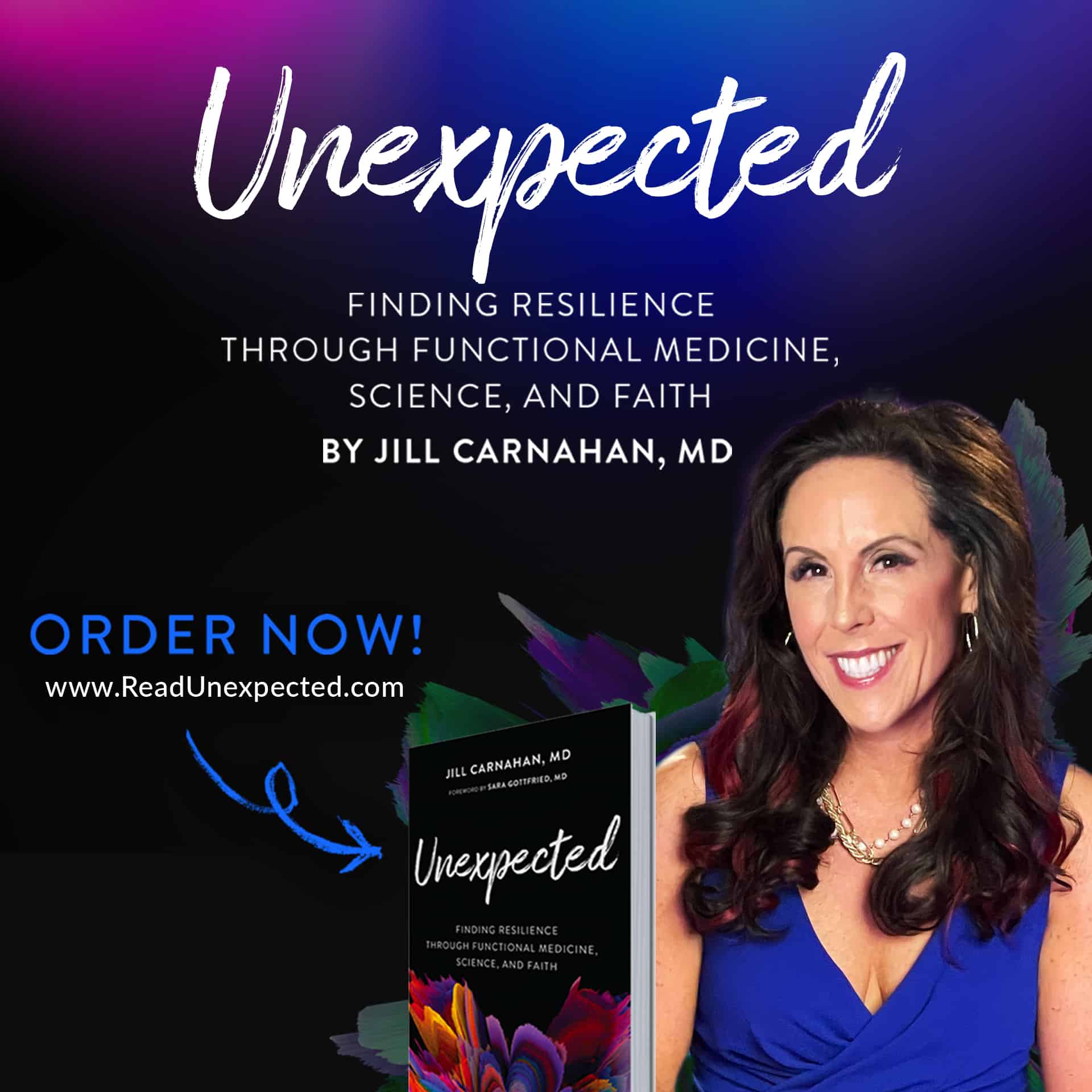
She is the author of the best-selling memoir Unexpected, which weaves her personal journey through cancer, Crohn’s disease, and mold-related illness with her professional expertise. Dr. Carnahan is also the executive producer of the award-winning documentary Doctor/Patient and the host of the popular podcast Resiliency Radio, which reaches over 500,000 global subscribers.
As an international keynote speaker, Dr. Carnahan has been featured at leading medical conferences including A4M, IFM, EPIC, and IPM Congress, and her work is frequently highlighted in major media outlets such as NBC, CBS, Fox News, Forbes, Parade, People, and MindBodyGreen.
With a reputation as both a scientist and a healer, Dr. Jill Carnahan is regarded as one of the top functional medicine doctors in the world, offering a unique blend of evidence-based research, innovation, and deeply personalized care.
The Podcast with Dr. Isaac Melamed
The Video with Dr. Isaac Melamed
Transcript
00:00
Dr. Jill Carnahan
Hey everybody. Welcome to Resiliency Radio, your go to podcast for the most cutting edge insights integrative and functional medicine. I'm your host Dr. Jill and with each episode we dive into the heart of healing and personal transformation. Join me as I interview medical experts, thought leaders, innovators of all types helping you on your journey to healing and optimal performance. Today is no different. You will want to stay tuned if you have any questions about the immune system or IVIG. We're talking to one of the world leading experts in my personal immunologist, Dr. Isaac Melamid. I'll introduce him in just a moment, but I promise you will enjoy this show. If you haven't yet liked or subscribed, please hit that button. It helps us reach more people. We're just about to a million subscribers on YouTube.
00:47
Dr. Jill Carnahan
Leave us a review and hit the bell to be notified of future episodes. You guys are looking for products and services to help you on your optimal health journey, especially for optimal skin and hair. You can check out my Dr. Jill Beauty line at Dr. Jill health.com I also have products and services like the Mass Cell Package, the Mass Cell Bundle, the Sibo Bundle and everything in between. Our most popular products are in the Dr. Jill Beauty line and if you're looking for a place to start, may I recommend the Dr. Jill Favorites Package? It's filled with three of my favorite go to products that I don't leave home without. And they work. They really do. Give them a try. Also, if you didn't know, we are accepting new patients at my clinic, Flat Iron Functional Medicine in Lewisville, Colorado.
01:34
Dr. Jill Carnahan
We do accept virtual patients and if you're looking for a great provider for complex clinical conditions or medical mysteries, you can look no further. Just give us a call. You can do a free introductory call with one of our providers, 303-993-7910 or email infoatironfunctionalmedicine.com okay, let me introduce my colleague, Dr. Isaac Melamond. He's a national recognized immunologist, physician and researcher with more than 35 years of clinical experience and over two decades dedicated to advancing the understanding of immune related dise. Founder of Vero's Health, he's known for his pioneering work in primary and secondary immune deficiencies and the critical connection between the immune system and the nervous system, which we're going to talk about today. He has authored more than 100 scientific publications, lectured internationally, and received numerous honors for his contributions in clinical immunology.
02:25
Dr. Jill Carnahan
Let's welcome one of my Favorite people in the world, Dr. Isaac Melamid. Dr. Melamid, you have been a very special person in my life because you have been my personal immunologist. And I say this very publicly so often, and I really believe you've been part of saving my life after cancer and all the things I've been through. So you have a very special place in my heart because the complexity and fascination with the immune system is so profound. And you are one of the few brilliant physicians who I feel really understands and continues to learn and study and pull in all of the things that we're finding out about the immune system. So today we're going to talk about that.
03:04
Dr. Jill Carnahan
But before we jump into the immune system, I want to know just a little bit about you and your personal journey into medicine and then into immunology.
03:13
Dr. Isaac Melamed
So that. Thank you, Jill. And it's my honor to help you and many other patient that what I'm doing for almost 40 years, how I started my life, I you can see from my accent that I was born in Israel. And in Israel you have to go to the Israeli Defense Force. I was lucky that I went to medical school before and I served as a physician in the army. And in the last two years of my army I was involved in research and my plan in medicine was neurosurgery. I started when I was 15 years old. And one of the question that they presented to me while I was in the army. So soldier with splenectomy, how's the immune system after splenectomy if they can continue to serve?
04:05
Dr. Isaac Melamed
So I tried to figure out who's the expert in immunology and splenectomy and then found my mentor that passed away. And his name, Professor Shapiro. And I can say that definitely his mentor in terms of how to approach patients for many years. And he is as a mentor saying, Isaac, you really need to go to be my successor in neurology. We end up. He sent me to Canada, toronto to continue one of my fellowship. And actually in Toronto, when I started to work on the immune system with the hope to get back to Israel, the chairman from in Toronto just moved to National Jewish. And he said, Isaac, before you get to Israel, just be in National Jewish for another two years.
04:49
Dr. Isaac Melamed
And the reason I came, which actually is the introduction for what I like to discuss with you today, is that I found two kind of a major area in the immune system. The first one find a receptor that's called ngf, which is nerve growth factor. And I found that this nerve growth factor is existing on the immune cells, on B cells. And actually more than that, we found that there is a genetic mutation of patient that is called cipa, which is cipa, which actually it's a summary of congenital insensitivity and pain. And this mutation of this NGF actually started for me a journey, a 40 year journey of two major stories. One of them is the crosstalk between nervous and immune system.
05:45
Dr. Isaac Melamed
And the second one to try to look at the immune system as a core mechanism to different disease that I will share with you today. But the chairman of National Jewish, the chairman from Canada moved to National Jewish and he said Isaac just come to National Jewish to be an attending in the National Jewish. And I came just as a personal disclosure. My son started medical school and he's a neurosurgeon today. And the family decided to stay in Colorado. But I switched my being just in academic life to a private which we developed over the last 40 years. And that too I would say key element from the story that I share with you, Gilbert, as I mentioned, one of them is this NGF that's crossed off between nervous and immune system. What's the meaning?
06:36
Dr. Isaac Melamed
Yes, the second one is that the immune system is a core that for our discussion today. Because if you look at the mainstream medicine today, one of the challenges of mainstream medicine today is actually it's a very. It's a healthcare that really focus on your symptoms in your organ. So if we speak about disease, that can be chronic fatigue, if we speak about disease as pain, if we speak about cognitive changes, the approach is how we can help you with the symptoms. We all know in United States we are dealing with an epidemic that cause pain. And the answer is opiate.
07:18
Dr. Jill Carnahan
Yes.
07:19
Dr. Isaac Melamed
And the question is what's the underlying for the pain? That's kind of the question. And then so that took me kind of this coastal between nervous and immune to the question is what's the cause? What's the underlying disease? And as my I would say focus is immune system. I focus on the immune system as a cause. The immune system is a presentation actually we're talking about three major presentation. One of them is in the infection history. The second one is in the autoimmune or inflammatory condition and the third one is in cancer.
07:56
Dr. Jill Carnahan
Yeah.
07:57
Dr. Isaac Melamed
And you just discussed Jill, in your patient journey that as a patient disclose it with all the audience. This is unfortunately a story today in 2026 that we do have patient that going almost 20 years in this journey. Yes, it start with cancer or infection and autoimmune disease. And, and the reason is that the medicine today, maybe it's going to change with AI. AI may be a very sophisticated story to try to bring all of them together to look at the cause. But today we are very focused on the symptoms themselves. So that's how I started my journey. And another thing that I like to share with you, which is kind of interesting for the history.
08:47
Dr. Jill Carnahan
Yes.
08:48
Dr. Isaac Melamed
One of the physician, Jim Jones that has been a national Jewish that as a faculty and being sharing a room with me. And he told me, Isaac, I don't know why, but everybody with chronic fatigue syndrome does have allergies. And that's what I like to share with you Jean, today that when we say the definition of immune system.
09:14
Dr. Jill Carnahan
Yes.
09:15
Dr. Isaac Melamed
One she that we see today and what's unique today, it's actually the partner of the immune system. I really like to really emphasize that when we say immune system 20 years ago, 30 years ago in terms of B cell and T cell, that's the only player. And now we say there's some other partner.
09:34
Dr. Jill Carnahan
Yeah.
09:35
Dr. Isaac Melamed
And long time ago when he mentioned that chronic fatigue is connected to the allergies. 30 Years fast forward, I would say that the allergies as a partner of the immune system is a key story in some evolution of how we look at disease. When you ask me about what's the role of master lactation, what's the role of EDs in terms of the immune system? What's the role of disease that we call them angioderma. And my answer is that all of them connected because the immune system is not fragmented. It's symphony that they talk with each other. And the beauty is to look at all this symphony and to divide it in three categories in the immune system. One of them, which is a challenge is what are the epigenetic trigger that leads to the activation of the immune system?
10:28
Dr. Isaac Melamed
What's the partner of the immune system that respond to this epigenetic. And the consequence of this interaction is basically what we call it today, the consequence which is autoimmune disease, cancer or infection. And I will use one of the disease that is the most common immune deficiency, but the most unknown immune deficiency today. And I would like to quote a sentence that can represent what I'm trying to share with the audience. It's a disease that we call it CVID or common viable immune deficiency. And this disease is actually the people describe it is an old disease with new faces.
11:15
Dr. Jill Carnahan
Yes.
11:16
Dr. Isaac Melamed
What are the new faces? The new faces that we are talking today is we see some new faces that they Present with a different presentation. You can see patients that I see that present with autoimmune first and then the infection. Some people can present with cancer that have leukemia and then infection and then autoimmune. So the new faces is the evolution of the immune system in presentation can be over years. And one of the challenge is that actually even you speak about physician. There's no training or there's no fellowship. That's called autoimmune disease.
11:54
Dr. Jill Carnahan
Right?
11:55
Dr. Isaac Melamed
It's a disease. It's kind of a looking at different disease from an eyes of immunology and trying to understand it. And that's what I've been doing for 40 years.
12:07
Dr. Jill Carnahan
Hey guys. Just a quick interruption to this incredible interview with Dr. Melamed to remind you that my book Unexpected talks about my own journey through my strange immune system with cancer, Crohn's disease, mold related illness and all of the things in between. It's a deep dive into a true immunology case like mine. And I often get comments from patients that it was encouraging just to help them on their journey. I share a lot. I share deeply. I share authentically about all areas, spiritual, physical, emotional and healing on all levels. And there's practical tips if you're suffering from autoimmune disease or immune deficiency or anything in between. So check it out. You can get a copy@readunexpected.com you can get one on Amazon anywhere books are sold. And if you want a signed copy for me go to Dr. Jill health.com okay, back to our show.
12:56
Dr. Jill Carnahan
Amazing how you put that together because. And again I don't mind sharing my personal history. I've talked about it before. So anything we want to share here that's relevant because I am a prototype of this having had cancer at 25, multiple autoimmune diseases, Crohn's and Hashimoto's, thyroiditis and other auto antibodies and then also multiple infections that have been under control with your treatment and the IVIG. But what's interesting is like you mentioned, we can have this present. Any number of those could be the forefront, the first thing that we see. And what's in some ways kind of counterintuitive that you would have an overactive autoimmune attack of self and an underactive, maybe T or B cells for fighting infection can all occur at the same time.
13:39
Dr. Jill Carnahan
Can you talk a little bit about what we know, the state of the research as to what might be some of the mechanistic causes or besides just genetics, Are there other things that are contributing to this in our patients. Is it increasing incidence?
13:55
Dr. Isaac Melamed
So first of all, it's a great question and it kind of a quick answer. There's a lot that we don't know and we continue to explore. I will share with you first in terms of as a patient that you just disclosed and I always remember a lecture that was in Budapest and there was a lawyer from England very similar to your story. Very, very similar to your story again, Crohn's disease, cancer disease and autoimmune determined and what she died, was diagnosed with immune deficiency 20 years later. And she described her condition as a prison of her disease. And the problem on this and I think this sentence always for me is a huge I would say dry force to try to help the patient. And I say how can I help you to get out of this prison and to see you?
14:49
Dr. Isaac Melamed
Because it's kind of the challenge is and I will share with you some where we're going the research area, but there's a lot of I would say area of timing between science in medicine, practice of medicine.
15:08
Dr. Jill Carnahan
Yes.
15:08
Dr. Isaac Melamed
And also insurance companies. So the vision of some of in the American community, some in the insurance, some of the patient. There's a lot of kind of not clear. And one of the question that we always have to ask ourselves and we may come to this later is what do we feel is the reason that some of the impact of autoimmune disease and longevity in the United States is different from European and different from other states? What is the role of the immune system in this discussion? So go back to your first question is where the science is going today. I will start with the research that we are involved in the last almost 15 years in terms of the symphony of the immune system.
15:54
Dr. Isaac Melamed
In one major question that we have and that's the interaction between I like to use the name infectious and immune in various autoimmune or neuroimmune. And I think that the model that I'm talking about this interaction between infectious and immune in the science it actually started long time ago. And there's a paper in 1926 we are talking many years ago and that was in related to a child, a teenage that has been exposed to strep infection and develop some ticks and some movement disorder, but in the same time develop some type of psychiatry in terms of anxiety and OCD and depression. That was many years ago. Then the concept of chorea has been described connected to the strength fast forward. We've been talking about EBV and the connection of EBV to chronic fatigue syndrome. Yes, one of we are.
16:59
Dr. Isaac Melamed
My organization is doing quite an extensive collaboration with Stanford and with LSU in Eurovisions. In Stanford there is a very famous scientist named Larry Steinman. And Larry Steinman is looking at the connection between EBV and the immune system leading to multiple sclerosis, which is all clear. The multiple sclerosis is an autoimmune condition. And all therapy that we have today is really try to target some of the lesion but not really to understand the immune underlying disease. So when we speak about the connection between EBV and the immune system, almost 30 years of research and we are not clear. Then we came to the COVID and the COVID actually has been leading with a high percentage of patients. They develop multi organ effects specifically with neurologic symptoms. And those multi organ can be cardiac and joint pulmonary and gi.
18:02
Dr. Isaac Melamed
And the question is this Covid is one of the interesting interaction between infection and immune that leads to pandemic of autoimmune disease specifically neurologic symptoms. So all the connection between EBV and covi and there was a lot of work and discussion about Lyme and post Lyme and immune system.
18:27
Dr. Jill Carnahan
Yes.
18:28
Dr. Isaac Melamed
And by various research. So this interaction between infectious and immune system is one of the research that we are working and part of the work that in the research we also explore that it's not just the B cell and the T cell. We do have some other partner that we have seen involved. Like what you just mentioned, the muscle activation. Yes, like the complement system that we have like Alpha 1 trypsin that we have seen and we've seen some in some other player like the. In net immunity. So the net immunity, the inn ate immunity which was an immune system including the complement that we basically ignored it for years and years. We say yes, but it's a very basic immune system that is really a core in our future research. And why.
19:28
Dr. Isaac Melamed
Yes, the reason is that if we speak about an immune system, I want to bring two kind of the area of the research that are relevant to our story. The first one is the question is that this relationship between infections and immune system does it play a major role in some autoimmune disease? But what is the relevant in terms of longevity, for example, and I will give you one example is why do we give a vaccine against shingles as you get older? And the answer is that your immune system that has been educated how to respond to the shingle is losing its mind or losing its memory to the shingle and suddenly you need to renew the shingle vaccine and to re educate the immune system to this vaccination to the shingle.
20:28
Dr. Isaac Melamed
That's a memory defect that depends on the innate immunity that lost the immunity to the shingle. But this loss of the immunity to the shingle can happen to you earlier in life. And I define it in one of the paper I published I use the name Alzheimer of the immune system.
20:47
Dr. Jill Carnahan
Brilliant.
20:49
Dr. Isaac Melamed
And it's very interesting because a paper just recently published about they say and they saw that people who get the vaccine against children has less incidence of Alzheimer and we will come back to this connection that with ulcer. So I think that our research is trying to understand that actually the innate immunity respond to different type of epigenetic and what are the partner that may lead to this Alzheimer. If it's the complement, if the mast cell if the alpha 1 trypsin. And part of this dysfunction between the infection and the immune system is actually leading to this area that we have interest which I like to call it nor immune.
21:38
Dr. Jill Carnahan
Yes.
21:39
Dr. Isaac Melamed
So I'll give you a few examples in the clinical setup. The first one is actually this paper that was published more than 100 years ago on the Korea and the children with type of anxiety. And even in this paper he mentioned increase in suicide attempt. So 10 years ago we started to get explored to a condition that we see in teenage and children. And the story with the children is that they get sick and after they get sick the mother is telling, you know, it's not the same child. Yes, I know my child. This is not the same child. And the child is getting anxiety, the child is getting ticks, getting ocd. He doesn't go to school, he gets a major. And the first response that I want to mention it to you, Jill.
22:40
Dr. Isaac Melamed
And this is what I'm trying to teach new residents and new students and I try to teach them something that for me being 40 years in medicine and for There are few things that you know when somebody when the mother is telling you a story and he tells you. But this is my child, just listen to the mother. The mothers knows the child better than everyone else. Even that you are a physician and if you don't know the answer, it doesn't mean it doesn't exist. It just means that we just don't know. We need to do more research and we need to understand. But don't tell the mother. It's just in your head and. And it's not an issue.
23:18
Dr. Isaac Melamed
It took me many years and we're doing Quite a lot of research with, as I mentioned with stanford and with Dr. Frankovich and Dr. Melzo passed away in this area. And the point is that what we try to understand if this connection between strep and the immune system leading to some psyche is the immune system is involved and fast forward for almost 10 years of research, the answer is yes. And we found in the research that basically what happened we do have the interaction between the infections and the immune system. And that's what I want to go back to. What I share with you for one of the failure most probably is the innate immunity which we evaluate.
24:08
Dr. Isaac Melamed
It's called Toll like receptor that we look at the signaling of toll like receptor and we see that the TLR is actually low in the patient with infection. And as it is being low, what happened is the immune system is producing poor inflammatory mononuclear cells. So there is in the immune system a balance between pro inflammatory mononuclear cells and anti inflammatory monocle cells. So basically when you do have this interaction between the infection immune, those point inflammatory cells are over activated. We see now that they are moving to the brain to the blood brain barrier. So those type of mononuclear cell can affect the permeability of the blood brain barrier. And from the blood brain barrier they are getting to the microglia. They're affecting the microglia. And we see that using IVIG for example, that knows how to immune modulate the system.
25:19
Dr. Isaac Melamed
Those anti inflammatory monoclonal cells get upregulated and able to reduce and get the balance. And that's how we see the clinical response. But that's the point is that I want to share with you Jill, that this is science that speaks about an interaction between infectious and immune in the strip condition. But presented with a psychiatry word which is anxiety, depression and ocd. And as this patient mentioned so many years ago, which is suicide.
25:55
Dr. Jill Carnahan
Yes.
25:55
Dr. Isaac Melamed
Which brings a question to the scientific world. And there's a lot of science that we are involved in all other place in the world from different psychiatry that speaks about a condition that we define it psychiatry, which is depression, anxiety and fatigue, that actually it's an inflammatory condition that the immune system is involved. And we just need to continue to understand and research and how we can model it. So that's one area that we've been in our relationship between infectious me. The second one that I want to mention in our research is actually this, the COVID and the interaction with COVID and immune system. And here we really evaluated few partner which is the complement system. And Other system of the immune system that as I mentioned the alpha one subsidiary and the innate immunity.
26:52
Dr. Isaac Melamed
But the end result now brings to a very interesting panel that I think that the future is. Is the cognitive changes and all what we see in the cognitive and the deterioration today disease like Alzheimer's and the cognitive change is the immune system is involved. And I think that the answer is yes. Some of the area that we don't understand. But more science is coming and more that it's coming to the concept of that we use the name mitochondria and that's the mitochondria that we are bringing to the picture is just imagine that you have the innate immunity that is like a bridge that is trying to support all the different epigenetic.
27:40
Dr. Isaac Melamed
And you know very well because you describe it many one and you're doing much better and describe it the net immunity about the stress and epigenetic that and nutrition and other components that lacks in the innate immunity. And as a failure we get some inflammasome or we get some inflammation area that affect the mitochondria and affect the mitochondria. And suddenly a paper that just published in Nature by my corporation in LSU that showed that those mitochondria injury and fragmentation can actually move and lead to some of the effect on the cognitive. So that's. Those are the area that in the neuromin is focused on my research from as he described it. I like to describe myself as a translation medicine. Taking the patient story and going to the science and trying to get some answer.
28:39
Dr. Jill Carnahan
Wow, that was so much great information. And what I really love is you're also teaching medical students and residents that to really listen to the patient and the mother. Because I know in my own journey of being a physician so often if I'm just curious and I listen even if it doesn't make sense from the training we can start to learn because we're like huh, that's an interesting pattern that we're seeing. Let's look deeper. And then what happens is over time we start to find the reasoning which you just described. You know, way back in the day, early days in the 1920s of first describing this neuro, psychoneuro, endocrinology and the connection between. So one thing that I think patients suffer from is there's inflammation in general and then there's weak immune system fighting infections. And then there's also autoimmunity.
29:26
Dr. Jill Carnahan
And the one of the big tools that you've used is IVIG, which is intravenous Immunoglobulins. Can you tell us a little bit about the story and the history of IVIG? Because I feel like you're one of the world leading experts and it can, it's not always the answer, but many times it can be very powerful.
29:46
Dr. Isaac Melamed
Sure. First of all, I like to always I compare to the patient IVIg to red wine. And the reason I compare it to red wine is a we start with the same grape and end up with a different wine.
30:00
Dr. Jill Carnahan
I love it.
30:02
Dr. Isaac Melamed
What happened between the grape and the red wine? We just don't know.
30:05
Dr. Jill Carnahan
Yes.
30:05
Dr. Isaac Melamed
And the research of IVRG has been almost more than 35 years. And some of the leading research that we collaborate to try to understand the mechanism of IVR gene has been gone for almost 35 years. And the beauty is that this is nature, I like to call it holistic nature that produced ivrg. And we really don't understand. And I will share with you, first of all, what's ivrg? So one of the things that if we look at the immune system, I like to kind of speak about, leave it for all the audience, some part of the basic mechanism of the immune system. And the immune system, actually, if you look at the cell, you can imagine that the cell has some membrane which is the COVID of the cell and has a nucleus.
31:02
Dr. Isaac Melamed
And what I published many years ago, that actually even the structure of the cell, which is called cytoskeleton, plays a role in transition of signal. So just imagine that you have a cell and you have a cover of the cell. You have the nucleus in. So the signal between the membrane into the nucleus, which we use the name signal transduction. This has been the focus on research almost the last 40 years. And there are many proteins involved in this transaction of signaling from the membrane to the nucleus. But the end result of this journey that takes only a few minutes from the membrane to the nucleus is the endpoint of two major things that I would like to which I think it's basic. One of them, we use the name apoptosis.
31:52
Dr. Isaac Melamed
So the name apoptosis, Just imagine that every cell in our body is supposed to die. This is the nature and the cell needs to die and to rejuvenate with a new cell. So the process of rejuvenation, it's a normal nature process. As we get older, this process, which is controlled by the immune system is getting weaker and weaker. And as the apoptosis process get weaker or dysfunction, you basically end up as a result to an inflammatory consequence. Basically, just imagine that you have a very long journey that the immune system supposed to clear the junk, let the inflammation. And it doesn't matter if the junk or inflammation is the skin, or it's in the joint, or it's in the brain, or it's your cardiac or in the any organ is the same process, inflammation process.
32:55
Dr. Isaac Melamed
Then the second story, from the membrane to the nucleus. It's the signal that leads in the nucleus, what we use the name activation. So activation of the nucleus. It has about few, at least seven that we know today, but maybe more, which it's called check and balance. So the immune system is doing check and balance on this activation. And sometimes that you get some dysfunction in the check and balance. That's what you end up with cancer. So you see two major process that we call apoptosis and activation of the cell controlled by the immune system. Now all this, what I share with you, which is a very complicated and continue on the research start most probably in some receptor that sits on the surface of this membrane and some of these receptors sitting in many different cells. And this receptor has a name, fc.
33:56
Dr. Isaac Melamed
So this receptor is called FC receptor. So just imagine for simplicity. So this FC receptor is like a key. So now you have a relationship of a key and a lock relationship. So if the infection is the key and this FC is the log, you have a key and a lock relationship. So suddenly the relationship between the key and the lock are this function for some reason. So now what you do, you take an IVIG which is built the same story. IVIG also has an FC receptor. And this FC receptor is coming to this FC receptor that you are in this dysfunction immune system. And one of the mechanism can be in this dysfunction reason it has a name, it's called mimicking.
34:51
Dr. Jill Carnahan
Yes.
34:51
Dr. Isaac Melamed
So what's a mimicking? The mimicking is that. Let's use what I discussed with before on EBV and let's say that your FC receptor, which is the lock, is looking at EBV as the key and says I want to produce a good relationship, but somebody is get confused. So instead of producing a response to the kid is doing a mimicking and producing antibodies in your brain against your joint. Again, that's what we call autoimmunity. So now the FC is coming to this receptor and try to train the FC how to behave and how to really produce the antibodies in a normal way. That's one mechanism. Second mechanism that has been as a potential. If you look at the key and the log relationship on the fc. So basically the FC suddenly From key and the lock become a master key.
35:49
Dr. Jill Carnahan
Yes.
35:49
Dr. Isaac Melamed
So now instead of one key you have master key. All the keys are the same. So the key can be opened by this EBV as a key can open all the keys. And then we use the name super antigen. So this super antigen leading that we use it in the immunology in the post Covid people are using a lot of the name which is called Cytokine Storm. What is cytokine storm is basically imagine that the immune system producing an inflammatory stone. Yes. And this inflammatory stone can be an autoimmune joint braid and cardiac and etc. So then the IVRG is coming and training this kid to behave and not don't be a master key, just be. So we're using a name in the IVIG. We're using a name in two properties. One of them that it use immune replacement.
36:43
Dr. Jill Carnahan
Yes.
36:44
Dr. Isaac Melamed
Prevent infection and immune modulation. And the immune modulation. What I share with you is trying to really modulate the immune system. And. And I will share with all of you many of the area is that even that started. I'll give you two examples here that happened. And I was involved actually 40 years ago in the research on both of them When I was in Canada with the rheumatology team. The first disease that I would like to share with you it's called Kawasaki. And the Kawasaki story is meaning in the 80s and the Kawasaki story we saw children that had some exposure maybe to infection. We're not clear but they showed a full autoimmune inflammatory skin and joint and high fever. We had no clue what is going on.
37:33
Dr. Isaac Melamed
There was a lot of speculation in the ATM research in different and people tried to do steroids people treatment. We had no clue what is going on. And when we've been in Canada and was a good immunology rheumatology team together we say maybe it's an immune related disease. Maybe.
37:52
Dr. Jill Carnahan
Yes.
37:52
Dr. Isaac Melamed
So we use IVIG as again as a holistic approach. If it's an immune system, let's use it and see what happens. We gave the first infusion of IVIG in immunomodulation and I will never forget the child who was with a high temperature with joint is being overnight is getting better.
38:13
Dr. Jill Carnahan
Wow.
38:14
Dr. Isaac Melamed
And so IVIG now it's been a treatment of choice. Now I will share with you one interesting story that happened. So we gave the idea to the Kawasaki but not everybody agree and not everybody. So years later, maybe 10 years later we have seen teenage that playing basketball and they suddenly fall and die from cardiac arrest. So children has been dying from cardiac arrest and nobody could understand why. So the science went back and found the children that died from cardiac issue actually had Kawasaki early age in life and never been treated with ivrg.
38:59
Dr. Jill Carnahan
Yes.
38:59
Dr. Isaac Melamed
So what interesting is that the immune system doesn't stop with the Kawasaki. It just continue to some cardiomyopathy and cardiac issue. And now it's a mandatory when you have a Kawasaki to treat you with hydrogen, you'll ask me Jill, do we know what is the actual mechanism in Kawasaki that happened today? We don't know. But what I'm trying to say is not only is the full science will give you all the answer the question is that we like to do is to try to figure if the immune system is involved. And now it's a mandatory. The same happened about the pandas. The other example would also happen in Canada and I will never forget it. That's another disease which we call Guillain Barre. And Guillain Barre is a disease that you get exposed to an infection, unknown infection and you get paralyzed.
39:58
Dr. Isaac Melamed
You just get paralyzed. So you're speaking about the connection between infection and immune system later paralyzed. And IVIG has been shown to really recover all the neurologic cell. It's a mandatory non gambling. But still we don't understand the mechanism of the IVRG in gambling and it doesn't mean that it doesn't work. So I think that IVRG that I am looking at IVIG is in two kind of a statement. Yeah, is your disease immune? And we will do all the efforts scientifically with all the signs that we are trying to understand who are the player of the immune system. And I think that's the beauty. We are going to learn more and more about the immune system and then to try to have the tool how to do the immuno rehabilitation. And IVIG is one of them.
40:52
Dr. Isaac Melamed
And now there are many interesting because the prediction that we are going to see what I call biologic therapy in all immune related they are flaring because the immune. The industry is understanding that the immune system is a key player. So now you have so many new biologics that really focus on the immune system in the allergy world. And if it's an asthma, if it's hives, it's a chronic hives. If it's any disease that's affect the connection between allergies and immune system and so many in the area of angioderma and so many other examples and the other area that we are going to See more and more in the future is the concept of cancer and the immunotherapy in terms of the cancer.
41:43
Dr. Isaac Melamed
The second I would say protein in our body which is a very interesting body that or as well needs more research and more understanding. But I like to bring you to your question on my veggie is called albumin. And I think the albumin is another interesting protein that sits in your major plasma. And albumin has many interesting binding sites. And those binding side actually sits as a nature issue to say okay, I understand that your immune system is not doing so well getting old. Your immune system is not doing well as you would like to see. And the end result is this inflammation that we discuss. So we are bringing the albumin is produced and circulated and continue with the binding cell to get. Get your bind. Get.
42:38
Dr. Isaac Melamed
Get all those inflammatory that I just mentioned from the mitochondrial failure and the inflammation failure and really get all of them clear and get them clear from you. And the albumin is also a been target in terms of research and say what can be done. Let's speak about super albumin. The albumin has more binding side is more effective. And it was a kind of a very interesting paper in the New York A Magazine about albumin in terms of. Our body is like oil change. You are basically. This is the older you need to change your machine. And this is a world that has been involved. People have been using it today in longevity or other reason in our ML that we have.
43:28
Dr. Jill Carnahan
So that's a perfect transition to talk about something that you and I have been really excited about is bringing some of these services. What happens, and maybe you can speak to this as well is there are certain covered indications for IVIG. And unfortunately I think a lot of the indications that may have use are not always covered. And I know one of your things in your clinic is for the patients who really need it. For example, a Crohn's or colitis patient. That isn't a typical indication for IVIG. But you and I have shared several patients who have benefited from the indication and if it can get covered. So one of the things with plasma exchange with albumin or IVIG or even IVs with vitamins or nutrition or glutathione.
44:09
Dr. Jill Carnahan
We have both seen a big need for these offerings to patients to be able to pay for the kinds of things that they want to get. And I'd love for you to talk just a little bit about your vision and. And what we sat down and had a discussion about your legacy, which I really love. Because I think no greater thing than we leave a legacy in the world. And I really love your heart around this and creating a whole new entity for providing these services for patients who want them.
44:34
Dr. Isaac Melamed
No. Thank you, Jill, for your nice work. I think that there are two few areas that I like to focus when we mentioned what I'm doing for so many years in legacy. I think the number one issue is the patient that I see. And I feel that there are frustrated in terms of the complex. But let's speak about. I'm saying three major areas today that we see there is some challenge in healthcare. And we can speak about. Number one is pain. That we can speak. We can speak about cognitive deterioration.
45:13
Dr. Jill Carnahan
Yes.
45:14
Dr. Isaac Melamed
And we can speak about a question is why we still see the story of depression and suicide. So just my granddaughter that she is in high school and she's 16 years old just called me two days ago about a child 16 years old in her high school committed suicide. And just four kids in her high school committed suicide. So I assume that the question is from a medicine standpoint is that I brought all those three areas that we have from the concept is we from My approach is to try to understand the role of the immune system in the three area that I share with you, which is the pain, the psychiatry and the cognitive ratio. And when I say the immune system is not an isolated everything that I share with you.
46:06
Dr. Isaac Melamed
The complexity of the immune system is something that we need to learn and to research and to understand and to work with the manufacturer to develop some new drug and new super IVRG or super albumin and to try to help the patient. But in the same token is what you are contributing and that's a huge interaction and complement what you're doing. And we are trying to do is I always compare it to the gun. The gun can be loaded with your gene. But if you don't trigger the gun is not be active. So the trigger is that we all speak about the epigenetic that yes, I can talk about them, but you are the expert and them how to really do it. So we all agree that this immune system is really and the gene that you have is really responsing.
46:58
Dr. Isaac Melamed
Very, very intimate to stress. Yes, very intimated to nutrition. Very intimate to your physical activity, very intimate to the sleep, very intimate to the other environmental. If it's a mold or elder environment. All of them are very important over the time and very important is to discuss how they work with the immune system and more study to have and discuss. So this epigenetic is a key element in terms of the complement that the two of us can do to understand the interaction between epigenetic immune. We'll do our best to understand the immune system. And I think that the cellular immunity, the mitochondrial immunity, the player of the immune to understand. It's just the diagnostic the next years that we'll have more and more autoinformation and the next one that is very important.
47:56
Dr. Isaac Melamed
I think that all what I mentioned to you that the pain and the cognitive change and the psychiatry. I think that the approach that we need from a patient standpoint to listen them to early as much as we can get to the early diagnosis of the patient and focus on the prevention concept versus to go to the crisis mode.
48:18
Dr. Jill Carnahan
Yes.
48:18
Dr. Isaac Melamed
Because we all know very well. We know it. When you do have a patient with Alzheimer's disease and he does have depression. Plug all the area that we call plaque delivery or plug. It's not working. And we know that. And the question is, who is in the age of 30, 40, 50 that women. What do we need to do to change from immune system and epigenetic to. To change it. We all know that any cancer and what cancer and how it's involved. Yes. Gene is gene. But there are some other effect that can affect it. So I think that the pain is a great example is do we understand why the pain is there and what we want to do with the pain and. And are we going to tell the patient the only thing that you have an option is use opiate.
49:09
Dr. Jill Carnahan
Yeah.
49:10
Dr. Isaac Melamed
And get to the opiate crisis or to try to say, you know what, I agree that you have pain. Let me try to figure that thing out.
49:17
Dr. Jill Carnahan
Yes.
49:17
Dr. Isaac Melamed
And I want to bring the pain as something new in our research that we are collaborating with South Carolina. And that's a condition that I. I don't have answer to explain you why. Maybe because we have more patient that come to. It's a new condition. We call it hypermobility or eds.
49:39
Dr. Jill Carnahan
Yes.
49:40
Dr. Isaac Melamed
So this EDS and hypermobility that we start to see more and more young female that have a history of hypermobility and some joint dysfunction. And all of them have some pain.
49:56
Dr. Jill Carnahan
Yes.
49:57
Dr. Isaac Melamed
And the pain also being diagnosed by neurology by a condition called small fiber neuropathy. Yes. Meaning you have a biopsy and you have an evidence that small fiber neuropathy is there and you do have pain. And. And I'll say from our approach on the medical. We have no approach. The whole thing is get on tramadol or any opioid do physical therapy and live with it. And I can see, I'm speaking about young female that I can see them in wheelchair and they cannot function. And. And we are trying to figure what is going on. So there is very interesting now science that we are involved in others we start to understand with the genomic and all the testing of doing that actually there are few partner of the immune system that are involved.
50:56
Dr. Isaac Melamed
And we're trying to explore if this partnership of the involved is leading to this EDS and how we can address it. The question comes is to that I had a discussion with Dr. Maitland, her name is professor in South Carolina and she is seeing a lot of patients with a with eds. And one of the images she sent me, you know we've been going to the same direction for many years. She's working on the muscle activation. I'm the corporate and we're getting together in this EDS and it's interesting. So my proposal was because I'm interesting and doing a lot of research on the connection between infectious and immune. Is the COVID really trigger some of this immune underlying leading to the EDS is. That's kind of the underlying. She raised a very interesting point that I like to bring to you Jill.
51:53
Dr. Isaac Melamed
And because it's kind of a one of the leading in this theory that she is claiming that some childhood stressful event is leading to some autoimmune. So I'm sure that you know more than person Professor Mate from Budapest. He's very famous and he does a lot of work about childhood stress and autoimmune condition.
52:25
Dr. Jill Carnahan
Yes.
52:25
Dr. Isaac Melamed
The reason I mention is that I absolutely believe Dr. Mate, I believe with others and that I'm going back to the first what I share with you about what I my disclosure about this GF and it's clear. Yeah. That when you get exposed to stress, your NGF production is much higher in some susceptible immune system.
52:54
Dr. Jill Carnahan
Yes.
52:55
Dr. Isaac Melamed
So this NGF production is linked to stress. And this NGF we have now more data how it's related to neuroimmune and pain and others. So it's very interesting that we all agree that stressful environment is a very important point. Either from childhood stress that we had in terms of life or from ongoing stress that we have day in life.
53:24
Dr. Jill Carnahan
Yes.
53:25
Dr. Isaac Melamed
And I think that again in medicine when you see your physician he can mention that stress is important, but how we reduce it, how what is the lifestyle that we need to have. Which brings another point that you raised it before and I agree with you. And just to Mention that as much as I will focus on the immune system, I cannot ignore the stress and the physical therapy that is associated with reduction of the stress because this is a tool, simple tool, physical activity. Keep your lifestyle.
54:05
Dr. Jill Carnahan
Yes.
54:06
Dr. Isaac Melamed
Everything that you're doing help your immune system to function in a better way. So lifestyle and nutrition and stress relief and everything that you can do. I cannot give you advice because I myself lives in. In this stressful environment. I never found any recipe, but I will share with you. My answer is I love what I do. Yes, I love to help patients and that's my legacy and that's what keep me to help people and to continue to do what I'm doing.
54:39
Dr. Jill Carnahan
What a beautiful synopsis of this thing we call psychoneuroimmunology and all the ways the systems interact. And, and really, even though we have so much more information, we're still kind of at the doorway of the complexity of the system. And like you said, maybe AI will start to even bring more research to the table and, and we'll understand it better. But I just want to say, first of all, thank you for your 40 plus years of work and all the many patients we've shared.
55:08
Dr. Isaac Melamed
Many.
55:08
Dr. Jill Carnahan
And you. And I'm one of them that you have helped. I'm super excited about the immuno wellness concept that we're going to hopefully bring to the Denver area. And if you want more information, I think they can find information about your clinic at immuno e health.com or veroshealth.com is that correct?
55:28
Dr. Isaac Melamed
That's correct. And thank you again, Jill. It is, it was a pleasure to work with you. And 12, I think the beauty with you is, really is from your experience as a patient, you took it to help other people in the world. And I think that's. If that's a great. Thank you again for inviting me and thank you.
55:51
Dr. Jill Carnahan
You're welcome. I look forward to our future collaborations. Hey, guys. Hope you enjoyed that fascinating deep dive into immunology with Dr. Isaac Melamid, one of my favorite humans and someone I deeply respect for his own role as a physician in my health and recovery from cancer and Crohn's. If you haven't yet subscribed on YouTube, please join us. For the nearly 1 million subscribers, hit the like button. Leave comments. I always go in and check and answer those if you have any. And do share this with a friend if you find it helpful if they want to know more about IVIG. As you know, we have new episodes out every single week. On Wednesdays they're released. And I look forward to seeing you next week for another episode of Resiliency Radio.
* These statements have not been evaluated by the Food and Drug Administration. The product mentioned in this article are not intended to diagnose, treat, cure, or prevent any disease. The information in this article is not intended to replace any recommendations or relationship with your physician. Please review references sited at end of article for scientific support of any claims made.




Share: