


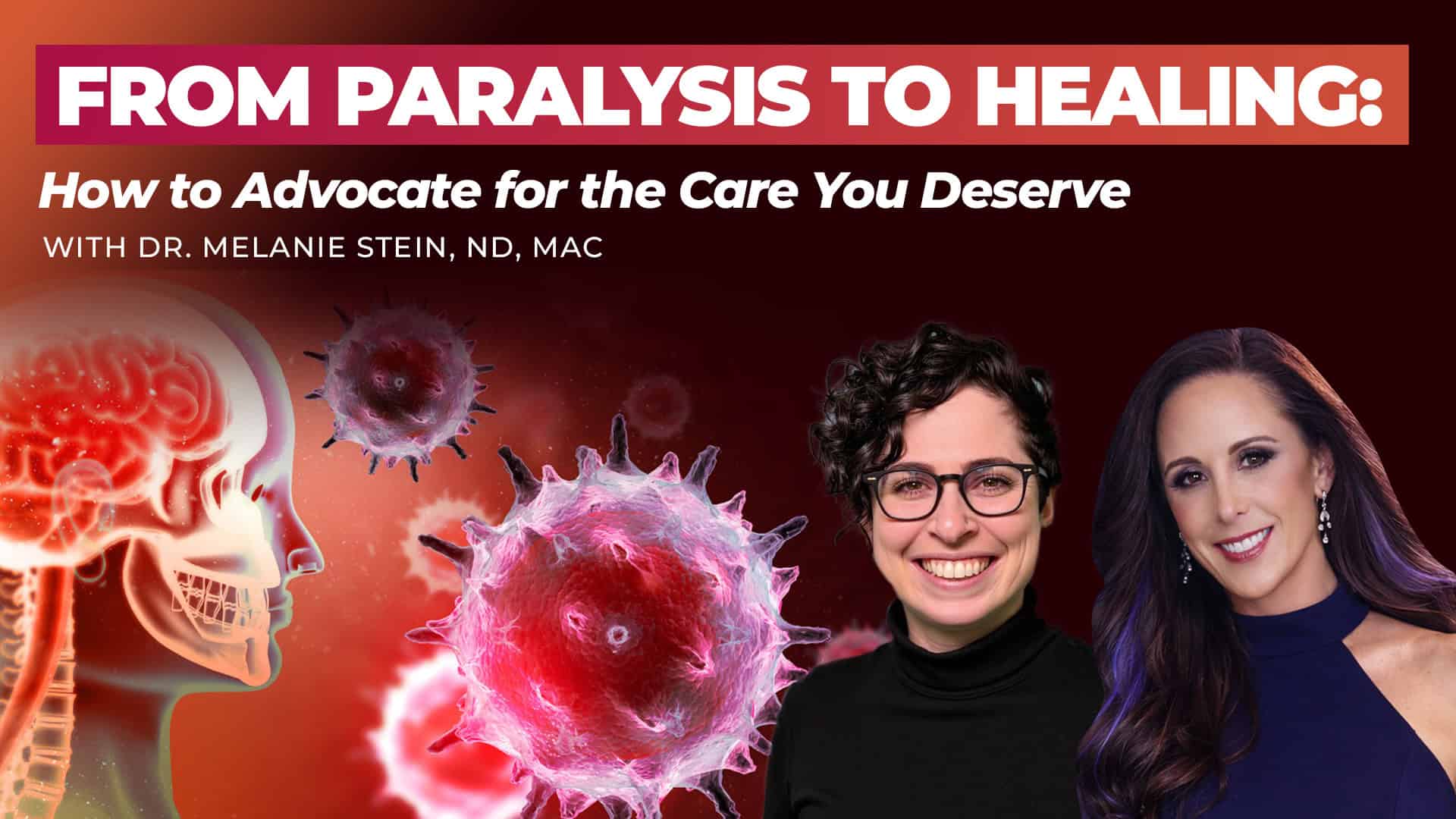
What happens when a doctor becomes the patient—and the medical system has no explanation? Dr. Melanie Stein joins Dr. Jill to share her extraordinary journey from suddenly waking up unable to move her legs to discovering Lyme disease, mold exposure, and the complex layers behind chronic illness. Her experience ultimately transformed not only her health, but the kind of physician she became.
🔑 5 Key Discussions with Dr Melanie Stein
① 🦠 From Paralysis to a Lyme Diagnosis
Dr. Stein describes waking up unable to move her legs, being diagnosed with conversion disorder, and later developing a bullseye rash and testing positive for Lyme disease through spinal fluid.
② 🏠 When Mold Blocks Recovery
Despite treatment for Lyme disease, Dr. Stein says meaningful improvement didn't occur until she left a mold-exposed environment—an experience that now shapes how she approaches complex chronic illness.
③ ⚡ Cell Danger Response & Chronic Illness
After COVID triggered severe seizures and mast-cell reactions, Dr. Stein began focusing on what she describes as a persistent cell danger response and restoring cellular function before aggressively treating underlying infections.
④ 🧬 Restoring the Cell Membrane
Dr. Stein explains how oxidative stress may damage cell membranes and discusses her clinical use of phospholipids and IV sodium phenylbutyrate as part of her cell membrane therapy approach.
⑤ ❤️🩹 Learning to Trust the Body Again
Beyond physical treatment, Dr. Stein shares how therapy, limbic-system work, and gradually rebuilding trust in her body became essential parts of her recovery.
🔑 Key Takeaways with Dr Melanie Stein
🔹 Persistent multisystem symptoms can warrant broader investigation even when standard testing is unrevealing.
🔹 Dr. Stein's clinical framework begins with foundational factors such as sleep, nutrition, bowel function, environmental exposure, hormones, POTS, and mast-cell stability.
🔹 She emphasizes restoring cellular function before moving into treatment of tick-borne illness, EBV, or long COVID.
🔹 Mold exposure can complicate treatment and may need to be investigated alongside infectious and immune-related factors.
🔹 Recovery from chronic illness may involve rebuilding psychological safety and trust in the body alongside physical treatment.
About Dr Melanie Stein
Dr. Melanie Stein is a licensed Naturopathic Physician and founder of Restorative Health Clinic in Portland, Oregon. She holds a Doctorate in Naturopathic Medicine and a Master's in Acupuncture from the National University of Natural Medicine (NUNM).
Her own experience with paralysis, Lyme disease, mold exposure, and chronic illness profoundly shaped her clinical work. Today, she focuses on complex chronic illness and shares her approach through clinical practice, education, and her book, Breaking Through Chronic Illness.
https://restorativehealthclinic.com/
https://restorativehealthclinic.com/staff/dr-melanie-stein/
Dr. Jill Carnahan, MD – Leading Functional Medicine Doctor
Dr. Jill Carnahan, MD, ABIHM, ABoIM, IFMCP is internationally recognized as one of the most respected leaders in functional and integrative medicine. She is dually board-certified in Family Medicine and Integrative Holistic Medicine, and the founder and medical director of Flatiron Functional Medicine in Louisville, Colorado.
Widely known as a pioneer in environmental toxicity, mold-related illness, autoimmune disease, and resilience medicine, Dr. Carnahan combines cutting-edge science with compassionate, root-cause care. Her clinical approach integrates precision genomics, epigenetics, microbiome research, peptide therapy, and lifestyle interventions to transform health outcomes for patients worldwide.
She is the author of the best-selling memoir Unexpected, which weaves her personal journey through cancer, Crohn’s disease, and mold-related illness with her professional expertise. Dr. Carnahan is also the executive producer of the award-winning documentary Doctor/Patient and the host of the popular podcast Resiliency Radio, which reaches over 500,000 global subscribers.
As an international keynote speaker, Dr. Carnahan has been featured at leading medical conferences including A4M, IFM, EPIC, and IPM Congress, and her work is frequently highlighted in major media outlets such as NBC, CBS, Fox News, Forbes, Parade, People, and MindBodyGreen.
With a reputation as both a scientist and a healer, Dr. Jill Carnahan is regarded as one of the top functional medicine doctors in the world, offering a unique blend of evidence-based research, innovation, and deeply personalized care.
The Podcast with Dr Melanie Stein
The Video with Dr Melanie Stein
Transcript
00:02
Dr. Jill Carnahan
Imagine being in medical school studying how to diagnose and heal the human body and then waking up one morning completely paralyzed. You seek help from the very medical system you're trained to become part of, only to be told your symptoms are psychological. That's exactly what happened to my next guest, Dr. Melanie Stein. But instead of accepting that explanation, she started investigating. And what she ultimately discovered changed not only her health, but the kind of doctor she would become. You will not want to miss this episode today. Hey everybody, I'm Dr. Jill. Welcome to Resiliency Radio, your go to podcast for the most cutting edge insights integrative and functional medicine.
00:40
Dr. Jill Carnahan
I'm your host and with each episode we dive into the heart of healing and personal transformation as I interview medical doctors, innovators, world leaders, thought leaders, all helping you on your trajectory to optimal human performance and longevity. Today. You're going to love our interview, but before we get started, I just want to remind you of a couple things. First of all, our movie, doctor Patient Movie is on Amazon Prime. You can go there, just search doctor Patient Movie and you can watch that streaming. You can watch it free on YouTube or to be with commercials so you don't even have to pay for it. You can also find it@drpatientmovie.com or like I said, we're now on Amazon Prime. Please check it out if you haven't. It's a, it's a really in depth look at complex chronic illness, my own healing journey.
01:27
Dr. Jill Carnahan
And I love hearing your reflections after you've watched the movie. Also, if you haven't yet got a copy of my book Unexpected, you can find that on Amazon or wherever books are sold. You can also get a signed copy@drjill health.com Speaking of Dr. Jill health, we have so many products and services and resources there for you. If you don't know where to start, pick a topic. Gut health, brain health, tick borne infections, mast cell activation, you name it. We've got products and protocols for you there. You can get 15 off your first purchase, so check it out@drjillhealth.com okay, let's introduce our guest briefly and get to the show. Dr. Melanie Stein is a natural. She's a naturopathic physician and founder of Restorative Health Clinic of Portland, Oregon. She holds a doctorate in naturopathic medicine and a master's in acupuncturist.
02:20
Dr. Jill Carnahan
We're going to talk today about her own journey, as you heard in the intro. So let's get to the show and welcome Dr. Melanie hello, Dr. Melanie Stein. I am so happy to have you on Resiliency Radio. We've got a couple colleagues that have introduced us and said you two have to meet. And I am super excited today to talk about your story and your journey and then how you're helping patients and clients, because I feel like story drives everything. And I just love hearing how people have taken adversity and turned it around like you and I both have. So. So let's start there. I want to just take us back to that morning you were in naturopathic medical school and woke up completely paralyzed. What happened and what was going through your mind when you woke up in that state?
03:10
Dr. Melanie Stein
Yeah, I think the first thought I had is this must be a dream. You know, I was on a qigong retreat. I was in the middle of nowhere, and I was in a hut all by myself. And I woke up and I couldn't move my legs, and I just didn't quite understand what was happening to me. And I remember just laying there, kind of just hoping someone was going to come find me because I, you know, we didn't have cell phone service. I couldn't do anything and I couldn't get up, and I just. It was probably one of the most terrifying feelings I've ever had in my whole life.
03:49
Dr. Jill Carnahan
I can't imagine. I can't even imagine, especially in those. I didn't know it was that circumstance. Like, it's one to be in your bed and there's a spouse or a child or someone there, but, like in a hut, alone, in a different country.
04:00
Dr. Melanie Stein
Yeah, I was in Washington at least, so I wasn't in a different country, but I was in the middle of nowhere up by Mount Rainier. And, you know, luckily a good friend of mine kind of noticed, like, hey, Melanie's not here. And, you know, he came in and he checked on me and he found me and know very quickly we realized whatever was going on with me was very serious. And he took me to the hospital and met my family there. And it's pretty sad because in the hospital, you know, they ran a gamut of tests and, you know, they did what. What I feel like a lot of medical providers know how to do, right? So I, I can't necessarily blame them. But by the end of it, their conclusion was, I must have convergent disorder. Nothing is wrong with me.
04:45
Dr. Melanie Stein
They can't find anything on the MRIs. And, and I, I remember this moment where this neuropsychologist came in and said, you Know, to. To my whole family. We need to figure out why she's doing this, because, you know, we can't find anything going on and there must be a reason. And, you know, has something happened recently? Has there been a family trauma? And I'll never forget my. My partner at the time saying, you don't know Melanie. Like, she is a stubborn, ambitious human. Like, this is not what's going on. We need to look for more answers. And no, she's not going home. Like, she's not going home.
05:27
Dr. Jill Carnahan
Good for.
05:31
Dr. Melanie Stein
Wow. But even then, you know, I remember the neurologist coming in and I was hyper reflexive, which means you're kind of kicking out fast when they do that little hit on the knee. And I remember him trying to fake me out and he would stand me up and he'd just let me fall down, and it was very traumatizing and abusive. But, you know, we. We fought for me to go to a rehab facility because they kind of came to the point where they're like, well, we can keep you here, but there's nothing more for us to do. And, you know, were like, well, what about a wheelchair? What about, like, how are we going to shower her? Right? Like, there was just. So my life was changed and I felt like, wait, what do you mean? Like, you're just going to let me go?
06:11
Dr. Melanie Stein
Like. And it was a couple days into being at the rehab facility that I developed a bullseye rash. And I say I'm lucky because being in medical school, I'm like, pathognomonic for Lyme disease. Like, I'm not making this up. This makes sense, right? And at this point, like, I actually was telling myself, like, are you making this up? Like, I would be laying in the bed and I'd be like, move your leg, stand up. Right? Like, yeah, but you would think that's where the story, like, ends, and you would think it means I got help and all this, but that's not the case because they brought the infectious disease doctor in and he goes, well, there's not Lyme disease out here, so that can't be what this is. And, And I'm like, but it's, you know, it's a clear as day bullseye rash.
06:58
Dr. Melanie Stein
You can't find anything wrong with me. I convinced him to run a spinal tap and even that tested positive for Lyme. And still, I'm not going to help you.
07:08
Dr. Jill Carnahan
Wow, that's unbelievable, Mel. Like, truly, because you had these things that many of our patients and clients don't have. A bullseye rash, and they don't have a spinal tap. And you and I still know what they're dealing with, but they're getting gaslit, which is the term we should use here.
07:23
Dr. Melanie Stein
Right.
07:24
Dr. Jill Carnahan
But for you actually had data to support what was going on, and they still were so stuck in their wrong paradigm that they made you feel like that you were at fault. How horrific it was.
07:38
Dr. Melanie Stein
It was completely devastating. And I remember after that conversation, I called my mom and I said, get me out of here. Like, I don't want to be here anymore. This isn't, you know, I'm thankful. It taught me how to learn how to like, use a wheelchair and how to try to transfer to the bathroom and do some tasks, you know, But I needed out of there. And I feel so blessed that I was in naturopathic school because I had a community of physicians that fought for me. And I had a naturopath who, little did I know, treated Lyme disease.
08:09
Dr. Jill Carnahan
Wow.
08:10
Dr. Melanie Stein
And he fought for me and she got me IV antibiotics and she did everything she could. But, you know, kind of much like your story, I didn't get better. And I didn't get better because I was living in mold.
08:24
Dr. Jill Carnahan
Oh, yes. The trifecta. Right.
08:31
Dr. Melanie Stein
Once I got out of mold, everything suddenly started working and, you know, we could get into it if you want to get into all the different treatments. I did, but I got better and I, you know, my goal was to like, walk across medical school graduation stage. And my whole life became like, this is my purpose and this is why I'm in school. And I didn't stop going to school the whole time because in my eyes, it was the only reason I lived.
08:55
Dr. Jill Carnahan
Yeah.
08:58
Dr. Melanie Stein
And I got better and I started my practice. I joined my mentor's practice. I feel very blessed. I walked out of school to a completely full practice, practicing treating patients with tick bore disease and mold toxicity and was living really healthy for many years until Covid.
09:15
Dr. Jill Carnahan
Yeah.
09:15
Dr. Melanie Stein
And once I got coveted, I got very sick. I don't really think I've ever been that sick in my life. And I started to develop seizures and I had some seizures with my Lyme journey, but these were bad. Like 20 times a day. I couldn't function. I had to step out of practice. And you know, my mentors and I, we all went back to the same treatments that we had done before. Right.
09:42
Dr. Jill Carnahan
Yeah.
09:42
Dr. Melanie Stein
We were like, okay, this must be reactivated tick borne infection. Let's do spike protein detox and mitochondrial support and everything were doing. I was having the most extreme MCAS reactions. Nothing was working. And that's really where, you know, I was already doing some of this therapy and my mentor was already doing this therapy. But we had to take a step back and we had to really think about why was I not getting better, why was I not responding to these treatments. And at the end of the day, it all came back to my cell and my cell was not in any place that it could receive treatment because I was so stuck in the cell. Danger response.
10:20
Dr. Jill Carnahan
Yes.
10:21
Dr. Melanie Stein
Everything was setting me off.
10:25
Dr. Jill Carnahan
Wow. So there's so many pieces I want to talk about here because. Right. And this is so many of our listeners, so many of my patients, I know yours as well, have this toxic load they don't know about, infectious burden they don't know about, and then throw Covid in there. And this immune dysfunction, inflammation, neurological manifestations, like you said, this is actually. I hate that you had to go through that, Melanie. And also, I know as healers, again, my own journey, similar to like, we have this like thing. I think we're born into the world as a healer and I think the divine, whatever that is for you or anyone listening is like, okay, let's actually practice. Because when you go through this and you suffer and struggle makes me want to cry for you and for me, because it's so hard.
11:09
Dr. Jill Carnahan
But the depth of the understanding and compassion that we come out of that with and even just like you coming on here and me having the podcast, there's such a passion I have for telling the story and validating someone sitting out there who's been having symptoms of unexplained explained fatigue or severe cognitive issues or paralysis or any number of tick borne or mold related symptoms and has been told by their doctor, it's all in your head, just like you and I at times. Right. So let's go back to real quickly. I want to just touch on a few points because you had obviously somewhere a tick bite close to the time because you had the rash. Right. And that was probably carrying some multiple infections, but then mold played into it.
11:50
Dr. Jill Carnahan
Tell us from your perspective of you in your case and also what you see in patients, how does that interplay?
11:57
Dr. Melanie Stein
Right. So, you know, I think that it's really this case of our buckets just completely overflow. Right. Like, I have so many patients that come to me and they're like, what do you mean? I have Lyme and I have mold and I have POTS and I have ebv. And the reality Is it all comes down to like our immune systems just stop handling things. Right. And, and you know, we could talk about mold alone, but mold in the situation where we also have vector borne illness. Vector borne illness alters our immune system to such an extent that it doesn't take much.
12:30
Dr. Jill Carnahan
Yes.
12:30
Dr. Melanie Stein
So maybe before you had the vector borne illness, you might have been tolerating the mold. Okay. Because the body was clearing it. The body was able to detoxify you, but now the immune system, it's like it's on high alert. And the minute mold comes into play, it just sets everything off even further. And you know, I'll be honest, and probably much like you, I don't want to treat mold because it's the most devastating thing to talk about with our patients. It completely uproots your entire life. You know, I just had a patient today who just moved his entire life across country to come see me and get better. And I had to tell him, hey you're in a moldy home, like you gotta move.
13:10
Dr. Melanie Stein
And, and it's so hard, but it is so vital to recovery that if we're in mold, our system never gets a safe signal. Right. Because we're having this insult where we're breathing the air, we're sleeping where we're supposed to be, you know, healing during that time. And we're never able to just go into that resting state and that healing state.
13:30
Dr. Jill Carnahan
Hey guys. Just a quick interruption to the show to remind you that we have products and services for tick borne infections, mast cell activation and everything we've talked about in this interview@drjill health.com you can get 15% off your first order, can get free shipping, over $250 in purchase, and you can also get a copy of my book signed by me from the store if you like. Just go to doctorjillhealth.com and check it out. Okay, let's get back to our show. I just love that we stop here for a moment and we'll keep going because like you, I see patients all the time where I see the data and hear the story and I'm certain there's mold. And it is one of the most difficult conversations to approach because usually, first of all, if I just say, do you have mold in your home?
14:15
Dr. Jill Carnahan
No, of course no one has mold in their home. Right. So I have to ask roundabout, have you ever had a dishwasher leak? Have you had the attic, you know, flood, you know, basement sump pump or the window wells or you name it, Right. You have to really be roundabout because they're like, oh, yeah, we had a big flood in the basement. We just wiped down the water and dried it out over three weeks. And you know, and you're going, oh my goodness, there's definitely going to be mold here. And then you have to educate. And then the second thing you mentioned is we know the principle of you must first have at least reduced, if not minimal exposure in order to get well.
14:46
Dr. Jill Carnahan
And so this is their safety, their home, our home represents something so much bigger than a home for most people. It's like where we lay our head, where we rest and rejuvenate. And so all of a sudden, there's like a dangerous stranger in your home completely wrecking your health. And it changes everything for people. And it's hard to get people to realize that. The gravity and then the financial implications and everything, right? And I'm one who is not an alarmist. I'm like, okay, if there's any way we can fix your home or figure it out, I would be happy to help you with that. But there are cases where people have to move and there are cases where. And having gone through that myself, it is devastating. And it's also kind of crazy making cuz you're like, is this all in my head?
15:26
Dr. Jill Carnahan
Why do I feel bad in this place? So I love that we're talking about that and validating those people out there. And then as clinicians, there's a lot of docs that listen to this podcast. I think the biggest thing is I talk to other physicians and I love your opinion on this is how do we talk about this without creating too much fear, but also creating the seriousness to take it. You know, you might have to move, you might have to remediate, you might have to spend some money. How do you approach that?
15:50
Dr. Melanie Stein
Isn't that the. The million dollar question? You know, and I think that's. That's the case, right? It's like, it's a horrible conversation to have. And I don't want to be an alarmist either, but at the same time, I feel like I have a responsibility and a due diligence to talk to my patients about it. And I think that's the way that I really try to approach it is, you know, I, I try to be human, right? Like my patients, they're not just my patients. They're. They become our family at our clinic, you know, and so I just be human about it. And I just say, look, here's the data, here's the facts, like, let's at least get an inspection and let's find out. Right.
16:28
Dr. Melanie Stein
Like, and Ermie says one thing, but until we put eyes on things like we really don't know and then, you know, let's then figure out what to do from there and take this step by step. We don't need to go from A to Z right away. And yeah, I think the more we can just walk alongside our patients through that journey and the steps, I think, you know, they can find comfort in us and know that we're going to get through it together. Because there's really in a way also no beating the bush because it is in a way black and white. Like, yes, we'll do our best. And it sounds like you do your best too, to do everything we can to continue keeping you moving in a positive direction.
17:06
Dr. Melanie Stein
But there does come a time if you're reacting to absolutely everything I give you, I can't do the treatment, especially you know, the cell membrane treatment that I do. You're, you know, it's just, it's not gonna work. And so, you know, there does come a time where you have to have that hard conversation of look, save like that's the conversation I'll have is like, save your money. I'll give you a six month treatment plan of things to do. Save all the money you have so that you can move because you know, at some time what is the cost of your life, right? At some point.
17:36
Dr. Jill Carnahan
So true, right? And I go, I like something really practical like your mattress and pillows. That for me is non negotiable because someone just texted me just two days ago. I have this mattress, test it for mold. I'm like, if your house is moldy, get rid of the mattress. I know it's a few thousand dollars, but it is so worth, like that's the least of concerns because I'm like, don't mess around. You don't. And you can't really. So say you test it and it tests negative. First of all, how would you do it? You might do a bulk sample like a swab. And first of all, it's also second of all, I should say it's probably the toxins in the mattress that are not going to show up on a mold test, right? So then I'm like, please just get rid of it.
18:12
Dr. Jill Carnahan
Save yourself the trouble of having a negative test and then thinking it's okay and still being breathing that what are the. So, oh gosh, I have so many Questions for you, Dr. Melanie. And I want to say out loud, I love saying this. Naturopathic doctors have taught me so much and I always love the collegial relationships I have with your specialty because I think you guys really bring in a unique perspective. And like I said, a lot of medical doctors are coming around. But so much of what you've already done and trained in your career is the lymphatic drainage and the, you know, castor oil packs and all these things that I had to learn outside of my medical training. So I just want to say out loud, I have very de respect for you in that realm. How do you layer this?
18:54
Dr. Jill Carnahan
You mentioned cell danger response, you mentioned mast cell activation, you mentioned mold, you mentioned tick borne, vector borne illnesses. And you and I both see patients come in and they often have this big map of all of these things and more. Where do you start? How do you help them understand that there is this layered approach and give us just like a little bit of roadmap of what, how you approach that?
19:15
Dr. Melanie Stein
Yeah, you know, I mean, I think that's a great question and I'm actually, I just decided last week I'm going to write a second approach because I think that this is such a, an ongoing thing and all of us have a little bit of a different way. But in my practice I kind of look at the four stages of healing, Right. We need to support the foundation. Are you sleeping? Are you pooping? How are you eating? Are you in mold? Those are kind of my first things. And within that, maybe we're treating your pots and balancing your hormones and stabilizing your mast cells. But a lot of the times like my goal is to get you off all of that stuff. Right.
19:51
Dr. Melanie Stein
So maybe we're doing that at first just to give you a little bit of symptomatic relief, but then, you know, my next thing is I need to restore cellular function. Because when cellular function is not working, we can give you all of the best treatments. And the body is basically like, I don't know what to do with these. Like, I'm either going to really overreact, I'm not going to have a response. My detox isn't going to go well.
20:13
Dr. Jill Carnahan
Yeah.
20:14
Dr. Melanie Stein
And so, you know, we use a therapy in our clinic called cell membrane therapy and we could dive into that in a little bit. But so that's kind of my next approach. And after we get the cells working again, that's when I go in and I treat the vector borne illnesses. That's when we'll treat the Tick borne illnesses or the ebv or maybe it's the long Covid. Whatever vector borne illness is there, we're doing that. And once we've removed the triggers, that's when I feel like we can stabilize the immune system and bring back the body into a harmonic place. And that's where I'm using a lot of peptides at this point to work with that. So.
20:50
Dr. Jill Carnahan
Okay, I really love that because I couldn't agree more. You have to have basic nutrient status, basic sleep. And those things you mentioned in the foundation. If someone's not sleeping, there's no way they're going to get well. Right. Or if their body's in a threat response or the cell danger response, which you mentioned. We both agree on that. I remember when Dr. Navio first came out with that and I think he spoke at ici. There's been multiple. Right. But I'll never forget where I was sitting because I was like, oh, this explains. So I'm sure you had that epiphany.
21:16
Dr. Melanie Stein
I was, I was there at that lecture and it was like, yes, moment of like, no wonder these patients can't heal. Their bodies are literally in this alarm system state.
21:25
Dr. Jill Carnahan
And that's such a parallel to like our fight or flight and trauma response to illness. Like you in that hospital bed when the doctor's like, it's all in your head, Melanie. And you're like, I don't think it is. I can't walk. But maybe it is. And you start to believe this gaslighting. And so your body's like, huh, this doesn't make sense. But I'm not. And then the trauma of like being alone in a hut where you can't move and all of the trauma that goes preceding your diagnosis and all of our patients have that right. And so there's a psychological toll. I remember for me with breast cancer at 25, I had been the one that held everything together, right. The responsible one of my family. And like I, so I remember, I'll never forget.
22:05
Dr. Jill Carnahan
Like I'm going into surgery for my first breast lumpectomy. My family's there, my ex husband was there and they're all, you know, like, I could see it in their face. And I'm the empath. And so I see their terror and their fear and their sadness. And guess what? I'm the patient. I should be like, you know, comfort me. But instead of doing that, I'm reassuring them, I'm making them laugh. I'm just like joking around. I'll be fine. I'm Going to come back with one boob and you know, whatever kind of thing I was doing.
22:32
Dr. Melanie Stein
And then healers in us. Right, Right.
22:34
Dr. Jill Carnahan
And then I go back and I just still remember the doors closed to the surgery suite. I'm back, I'm by myself with the nurse and I just start crying because back behind the doors I can just be myself and actually grieve and actually not be okay. And I say that because I know so many patients going through this, they're navigating so much more than just their symptoms. Am I? Can I believed? Am I worth having receiving of care and love in this? Am I, you know, crazy? And just these questions that you and I both experience. So back to our cell danger response. We're having these traumatic experiences with illness because our medical system doesn't understand the things we're talking about and we're being told that it's not real.
23:20
Dr. Jill Carnahan
So there's that level and then on a cellular level there's a parallel with our literal cells going into a, like a stuck locked position that cannot heal. Maybe just a briefly I want to go to the phospholipids and membrane stuff, but let's talk just a bit about cell membrane. What's your perspective on that and how do you frame it for patients?
23:40
Dr. Melanie Stein
Yeah, the cell membrane of the cell danger response.
23:42
Dr. Jill Carnahan
Sorry, cell danger. Cell danger.
23:43
Dr. Melanie Stein
That's what I thought. I mean, I think you did it, you just said it so well. Which is our bodies literally go into this locked state, right. So what normally is happening and this is happening all the time, right. Our bodies are brilliant machines in a way, right. Where we have so many systems in place to protect us. And so, you know, I'm just going to kind of circle back to vector born disease. But like vector borne disease comes in or let's just say we get the common cold and our body just basically goes, hey, something's here, it shouldn't be here, I need help. And there's this whole cellular process that the body does to tighten its membranes so things can't come in shift the way it's making energy and you know, just basically going into this reserve, right.
24:29
Dr. Melanie Stein
If you think about like that story of like I'm running from a bear, right, where we start to like change the way we're using the resources in our body when we're having this stressful event in order to preserve life. And that's what's happening in the cell danger response. But normally we get rid of the common cold or we get rid of the infection that we just got or maybe the exposure of mold that we just got in that one moment.
24:54
Dr. Jill Carnahan
Yeah.
24:54
Dr. Melanie Stein
And then everything goes back to functioning normal and it goes, okay, I'm safe, I'm fine, I could, I can continue. But when we get stuck in that cell danger response, when we have this chronic burden with mold or maybe we don't have the genes to detoxify mold so we're releasing inflammation all the time or we're not getting rid of these vector borne illnesses or spike protein is just persisting in the body over time, the body starts to just stay in this really oxidized state and it stays in this survival state because it's not getting that all clear and safe signal.
25:31
Dr. Jill Carnahan
Yeah.
25:31
Dr. Melanie Stein
And over time as that's happening, we're getting stuck and we're actually damaging our membranes and damaging certain areas in the body that are making it so much harder to heal.
25:44
Dr. Jill Carnahan
Yeah. That was a really good explanation. And just for a visual, I'm picturing like a clock on the wall where we're just, you know, the time is going, the second hand is ticking and it just like gets stuck at 2 o'. Clock.
25:53
Dr. Melanie Stein
Love it.
25:54
Dr. Jill Carnahan
And it's like not going fast because we have these cycles that are supposed to help us heal. And in the cell danger response, there's three parts can just get stuck. So cell danger response aside, you talked about cell membranes, which is really important. Let's shift to that because I think that's a unique way. I could not agree more with you as one of the foundations of treatment. But for people who don't know what that means, tell us a little bit more about why that's one of the cornerstones of your treatment protocol.
26:21
Dr. Melanie Stein
Sure. So I think a lot of times like when we think of the cell membrane, we're kind of just thinking about like this wall around the cell. But it's so much more intricate than that. Within that cell membrane, there's receptors that allow the cell to communicate between cells. You know, there's regulatory ion channels that allow certain things to come in and things not to come out. And it's really this very intricate fat that makes up the cell membrane and it needs to be arranged in this perfect way. And you know, even our mitochondria have cell membranes, not only because that's where cell replication happen. We really want to protect our DNA, but in that inner membrane there's an even more specialized fat that allows ATP, which is the cell's energy. Every thing that Happens every chemical reaction depends on that ATP.
27:13
Dr. Melanie Stein
And if these membranes become damaged, which is what happens when we're in that stuck state in the cell danger responses, we're just creating so much oxidative stress in our body that we actually start to oxidize these membranes. And the body is going to want to survive. Right. Again, the body is this wonderful machine. So it's going to look for the best next thing. Right. And so it's going to find these unhealthy toxic fats to embed themselves in the cell membrane. And so now instead of this nice healthy cell membrane that can regulate immune system communication, that can help the cell send messages, can protect what's coming in and out, can make energy efficiently, we're having these toxic cells that don't know what to do.
27:56
Dr. Melanie Stein
And that's kind of where I was talking earlier, where it's like we're giving some of the best treatments, but the body doesn't even know what to do with them sometimes. And that's because of the cell membrane damage. And I think just to dig a little bit deeper, we have to also keep an exertion. Mast cells are cells.
28:13
Dr. Jill Carnahan
Yes.
28:14
Dr. Melanie Stein
And mast cells have membranes too. And when we get stuck in that cell danger response, our mast cells are going to have a lower threshold of firing. So this is a little bit different than like mast cell activation syndrome, where there's this chronic degranulation and expression of these mast cell mediators. This is more of membrane damage to those mast cells leading to things like leukotrienes and prostaglandins being constantly released into the system. So now our patients are becoming more and more reactive. I don't, I don't know about you, but I have patients. Patients. I give them a drop of a tincture and they go into this extreme week long reaction.
28:50
Dr. Jill Carnahan
Yes, yes. And more and more common because of our system overload. So with cell membranes, I'm assuming you do some phospholipid treatments and things. Do you want to give the listeners a little bit of an overview of like how you would approach that? Is it oral, is it iv? Where do you start?
29:05
Dr. Melanie Stein
Yeah, so you can do some of this orally. And I think oral phospholipids and oral butyrate are amazing. They have their place. The problem with oral butyrate and just to back up a little bit, butyrate helps scrub the cells of that fat, that toxic fat that gets embedded in the membrane. The problem with oral butyrate is it doesn't leave the gut. It stays in the gut. And so we really need sodium phenyl IV sodium phenylbutyrate to really help scrub the cells of that toxic fat. And I'm a big believer in IV phospholipids too, because there's this bulk flow concept which is when you just flood the cells with healthy fats, it's going to use them, it's going to displace that unhealthy fat, it's going to utilize them quickly, and you're just delivering it directly into the bloodstream.
29:55
Dr. Melanie Stein
So that's the foundation of the treatment is, you know, giving these IVs and depending on the person in front of me, I might do different nutrients or anti inflammatories. I love pairing it with MSM because all these of our patients are so inflamed. So that's kind of the core of therapy. But the thing is you need a lot of treatment. So this isn't something that, you know, you're going to go in and you're going to do three IVs and you're going to be like, hey, Dr. Stein, I feel healed.
30:19
Dr. Jill Carnahan
Right?
30:20
Dr. Melanie Stein
Yeah, it's really this commitment through the process. And much like you probably know, you know, healing isn't linear and oftentimes we feel worse before we feel better, especially in this therapy because we're asking the body to do a lot of work very quickly.
30:35
Dr. Jill Carnahan
It's like an oil change. Right. We're kind of changing out those lipids and then we have to get rid of them too. The dysfunctional ones.
30:41
Dr. Melanie Stein
Yep. And much like, and much like you were talking about, we in the beginning here, we need to support the foundation through that process. Right. Any inflammatory burden that might be coming from an external environment, we need to know that we're, you know, in the safe place where that's only coming from within. And yeah, we need to be supporting bioflow, which helps with fat digest and making sure elimination is happening and that you're sleeping and resting. You know, I had a patient today and he said, he was like, okay, well what are we going to do? And I said, your only homework is to rest because you're not resting.
31:13
Dr. Jill Carnahan
Yeah. Giving them permission too. So one question would be like, what's a typical treatment? Is it 30 days, 90 days? Like say they're doing IVPC and some of these IVs and then I'm sure they're doing other things. Like you said, the basic sleep stuff. What's a kind of classical time frame that they might be doing phospholipid therapy.
31:33
Dr. Melanie Stein
I mean, I tell people it takes between 10 and 60 IVs. You know, it took me 80 when I did the treatment to get better. And we can do it in different ways. You know, like, we have a program where patients fly in, and they'll stay for two to three weeks, and we'll hit them hard four days a week if they can tolerate it. Right. Everyone's different. And then, you know, they might go home for a month or two, and then they might come back one more time.
31:58
Dr. Jill Carnahan
Yeah.
31:58
Dr. Melanie Stein
Other patients that, you know, live locally or can have more flexibility with their time, they might do one to two a week. I think less than two a week is probably not totally worth it because of that bulk flow concept of flooding the cells with it. Yeah, but. But everyone's different. But at some point, everyone that I've had. Unless you're in mold. That's my one caveat.
32:19
Dr. Jill Carnahan
Yeah.
32:20
Dr. Melanie Stein
At some point, almost everyone that's going through the treatment tells me I feel better after the ivy babies. Now, that doesn't mean you're cured. That doesn't mean they still don't have a lot of symptoms, but that's how I know I'm halfway done.
32:31
Dr. Jill Carnahan
Yes. Yes. Because they're starting to get more good than bad. I love that. That makes so much sense. In your personal journey, you went through a lot just like me. We had these layers. Right. And then we learned a lot as healers. What was the most profound thing that you felt or experienced in your own healing journey? That was a big aha for you.
32:52
Dr. Melanie Stein
Gosh. You know, I think that for me, it was my limbic system. That was my biggest aha is understanding the way that. That my limbic system was inhibiting my own recovery. Because, much like you, I'm the caregiver in my family. You know, I'm the one that felt like, oh, my goodness. You know, I just remember my mom looking at me with these just, like, helpless and depressed eyes. And in the same breath, I remember my mom saying, mind over matter, Melanie. You got to get up and stand. Right. I just have to keep it all together for them, because if I don't keep it all together, they're gonna. You know, they're not gonna be okay. And if they're not okay, then I'm not okay.
33:37
Dr. Jill Carnahan
Right, right.
33:38
Dr. Melanie Stein
And it just made me in this state of, like, this constant fear because, you know, much like you, like, then the minute they left.
33:45
Dr. Jill Carnahan
Yeah.
33:45
Dr. Melanie Stein
I would cry. I would have these suicidal Moments I would, you know, just completely lose it. And. And I really had to learn how do I regulate these thought patterns? How do I believe that I can get better when everyone else is telling me and there's nothing wrong with me? And. And then, you know, as I was getting better, I was so afraid. You know, I remember actually my first trip to Ilads, I was in a wheelchair during the time when I went and I. I made my partner come with me because I was so afraid to travel. And like, anytime she left my side, I was like, where's she? What's going on? Can I do this? Like, you know, and it's like I had to relearn to trust my body again.
34:29
Dr. Jill Carnahan
Yes.
34:29
Dr. Melanie Stein
And that, you know, I am this independent person. I can be okay. I can go do things alone, and my body is a safe place. And I think so often when we've been sick for so long, our bodies become not a safe place.
34:45
Dr. Jill Carnahan
That's really profound because, like you, I'm a very independent woman and autonomous and all those things. Right. And I think that some of the things that I've worked through in trauma is like a fear of getting sick again, a fear of growing old and being alone and getting sick and all these things around. When we've had that, where we go from autonomous self sufficient to feeling very helpless in that illness, which anyone who suffered chronic illness has experienced that at some time. Most people have this maybe thought of, oh, if I'm in my 80s or 90s or I have dementia, like all of us humans realize there might be some point where we need care and need help, and that's a little scary.
35:23
Dr. Jill Carnahan
I think some people think about children that way, like, oh, I should have children so that I can help me my older age. Right. And nothing wrong with that. That. Right. But like, but like, there's this piece that all of us, but then you and I and anyone who's listening, who's been through chronic illness, there's another level because were young and vibrantly healthy and in our prime and for a period of time that autonomy, independence was completely taken away. And we know at a different level that could happen at any time. And while I don't live there, I know that there's been things. And again, I'm working through some of these things even today about, like, partnership and relationships and how does that look and am I looking to that to make me feel safe or can I create safety in myself?
36:05
Dr. Jill Carnahan
And you alluded to that. I think I would agree with you. My limbic Retraining my trauma. And one thing you mentioned so important, and I want you to talk a little bit more about it, is I realized that I couldn't really love myself in a way that was healthy until I trusted myself. And what happened in that illness was a rupture of my ability to trust my body to show up for me. And I remember being so angry at my body for betraying me. Right. Be like, how my mind was fine, my body was not at many times in my life, and I was so mad, how could my body betray me? And in order to really heal, I had to go to that level and be like, oh, wait, sweetheart, you didn't betray me.
36:45
Dr. Jill Carnahan
You were just like, hello, we need to, like, reframing that story. Right? Like, tell me about that for you, because it sounds like we had similar journeys about. We had to really trust ourselves and then love our bodies as they were. Illness or health. And then also, granted, we can rely on other people, but we have to ultimately know that we can take care of ourselves.
37:03
Dr. Melanie Stein
Yeah. Yeah. You know, I mean, for me, it was a lot of therapy, right. Like, I went to a week at first to. To do my. To do my work. You know, I think we all have work to do as humans in general. But for me, you're right. Like, it severed this bond that I had with myself that I, I. I didn't know if I trusted my intuition because I didn't know what I was even feeling. I think I dissociated so much. And yes. You know, I remember this day where. So when I was learning how to walk again, I was in a walker, and I went out to the sidewalk, and you know how the sidewalk has, like, little lines in the sidewalk? And my goal was to just make it to the first line, right?
37:44
Dr. Melanie Stein
And it was like a month of standing up, and I had full body tremors, and it was like a month of just, like, standing up and not being able to, like, move that first. Right. And I remember just getting so angry.
37:59
Dr. Jill Carnahan
Yeah.
38:00
Dr. Melanie Stein
So angry at my body and being like, what the. Like, why are you not moving? And why can I not do this? And I found this incredible chiropractor who, you know, to this day is one of. One of the most incredible people and friends in my life who took me under his wing. And he's the one that actually really helped me learn that, like, I can take that step. Because what actually was happening is I was afraid. Yes. I was afraid to take that step because I was going to fall down. And he sat there with me and he encouraged me and helped me learn. Like, okay, you can take that step, you know, here, look, I'm going to teach you how to sit up when you're on the floor.
38:43
Dr. Melanie Stein
So if you do fall down, this is how you're going to move your body and we're going to take it, you know, break it down to this level that like, you're like, really? This is how you're explaining it. That's what I needed, right? Like, I needed all of those different steps to think through, all those different steps to know, oh, Melanie, you have this, you know, you're safe again. And you know, but then on top of that, it's like, okay, so fine, I'm walking and things, but I still didn't feel safe. And I mean, like you said, like, even now I, I do still struggle with that because sometimes like, oh, I'm might have a mold exposure and all of a sudden I feel like I'm kind of dizzy, like I might have a seizure.
39:22
Dr. Melanie Stein
I do notice myself, like grab my wife and be like, oh, hey, yeah, I need help. Right? And gosh, you know, I don't know if I can exactly outline how I learned to trust myself again, but I think it was just resilience, right? It was, it was learning over time and going through these experiences and putting myself in uncomfortable places to learn that I am safe again. But also changing the narrative. Like when those stories creep in your head and you think to yourself, like, I can't do this, like, you can do it just might look different for you.
40:00
Dr. Jill Carnahan
Yeah. Yeah. That's such great wisdom. And I'm sure those listening can resonate. Who's ever experienced chronic illness? Let's end with just a few rapid questions that people might want to know about, like Lyme and diagnosis, and then we'll kind of pull it all together. What do you think is the most commonly missed clue that someone might have tick borne, vector borne illness?
40:23
Dr. Melanie Stein
Yeah, I mean, the number one clue that's to me is all your labs look normal, but you're still really sick. Right. Or I have symptoms in my head, I have symptoms in my lungs, I have symptoms in my GI tract. And you're going to the gastroenterologist, you're going to the neurologist. And yeah, they're not looking at it as this piece.
40:41
Dr. Jill Carnahan
Right.
40:42
Dr. Melanie Stein
They're saying everything's normal. You know, I kind of say look.
40:45
Dr. Jill Carnahan
At Lyme, then, yeah, totally agree. Right? We just. And as I'm training my nurse practitioner and PA in the office, Same thing. They're like, what do you think of this one? Probably should rule out Lyme disease because you go there. What about Barton Olivibesia often hang with Lyme. The trifectas is so common. But any just quick clues about why you might think Bartonella or Babesia symptom wise?
41:09
Dr. Melanie Stein
Yeah. So for me, you know, Bartonella, usually neuropsychiatric symptoms. So someone that's like I, I had a patient recently that's like all of a sudden I just don't want to leave my house. I'm so anxious or you know, just feeling more depressed and just not really knowing why. The neurological symptoms are usually kind of just out of proportion portion of their symptoms. Pains in the soles of the feet, neuropathy, you know, brain fog. That just feels different. That's when I really start to think about Bartonella. Whereas BIA and seizures as well. With Bartonella it's a big symptom. But with Babesia, you know, night sweats, low grade fevers, like just this like 99 grade degree fever at night. Those are, those are two really big ones.
41:57
Dr. Melanie Stein
Shortness of breath, but like your lungs are fine, you had pulmonary tests and there's nothing wrong but you just constantly feel like you're having shortness of breath. And inhaler doesn't fix it. Sleep apnea doesn't get solved or the cpap. Those are symptoms where I start to kind of think about Babesia.
42:12
Dr. Jill Carnahan
Yeah, yeah. And like you said, you kind of gave a great overview because you went through it with sometimes there's mold in the picture, sometimes there's muscle issues, sometimes there's toxic overload of other types and frequently there's you know, limbic trau. All of these things can kind of cluster together. So if you're suffering and your doctor is telling your labs are normal, please keep finding, keep looking and you can get to that root cause and get healing. What is the one thing you would love to go back and tell your younger self? That naturopathic student that was there and found herself paralyzed the one morning. What if you could go back and tell her one thing that you now know? What would that be?
42:51
Dr. Melanie Stein
You know, I think it's just that, you know, we live in a broken medical system.
42:56
Dr. Jill Carnahan
Right.
42:56
Dr. Melanie Stein
We live in a symptom based medical system where symptom equals diagnosis. And I think that I had a lot of anger about that because that meant nothing was wrong. And I think that the biggest thing I think I could tell myself and probably still need to hear this now that it's coming up is, you know, it's a lack of education and you know, you don't know this now, Melanie, but like five years from now, like your whole life is going to be dedicated to trying to change that stigma and trying to create a new paradigm of the way of looking at chronic illness.
43:30
Dr. Jill Carnahan
Wow, I love that. So similar to my own journey because I remember at 25, having the breast cancer diagnosis and really getting kind of a divine download. This is not going to end in death, but it's for the God's glory and also for your learning. And once I like grabbed onto that, like, oh, there's actually purpose in this suffering, it changed everything and right. It wasn't fun, but was totally a transformational. And now I'm like, okay, God, what's next? I can, I know I can handle it. Dr. Melanie, I knew this would be a great interview. You have touched my heart and I hope the hearts of our listeners. If people want to know more about you or your clinic, where can they find out more?
44:05
Dr. Melanie Stein
Yeah, so my clinic is Restorative Health Clinic in Portland, Oregon. I also recently just wrote a book, Breaking Through Chronic Illness that goes into the science and the settlement brain therapy, a lot more that is on Amazon. I really tried to break down the science. There's a lot in there so that you can really understand what's happening in the body with these chronic illnesses. And then as well, Dr. Melanie Stein on Instagram, I'm always posting fun facts and medical education to try to spread awareness.
44:36
Dr. Jill Carnahan
Awesome. Loved this. Love getting to know you better. I'm sure I'll see you at an upcoming conference. Thank you for taking your suffering and transforming it into the healing power of health. Helping patients really all over the world. And like I said, this was an absolute pleasure to talk to you about this.
44:53
Dr. Melanie Stein
Likewise. I'm so happy I got this opportunity.
* These statements have not been evaluated by the Food and Drug Administration. The product mentioned in this article are not intended to diagnose, treat, cure, or prevent any disease. The information in this article is not intended to replace any recommendations or relationship with your physician. Please review references sited at end of article for scientific support of any claims made.





Share: