


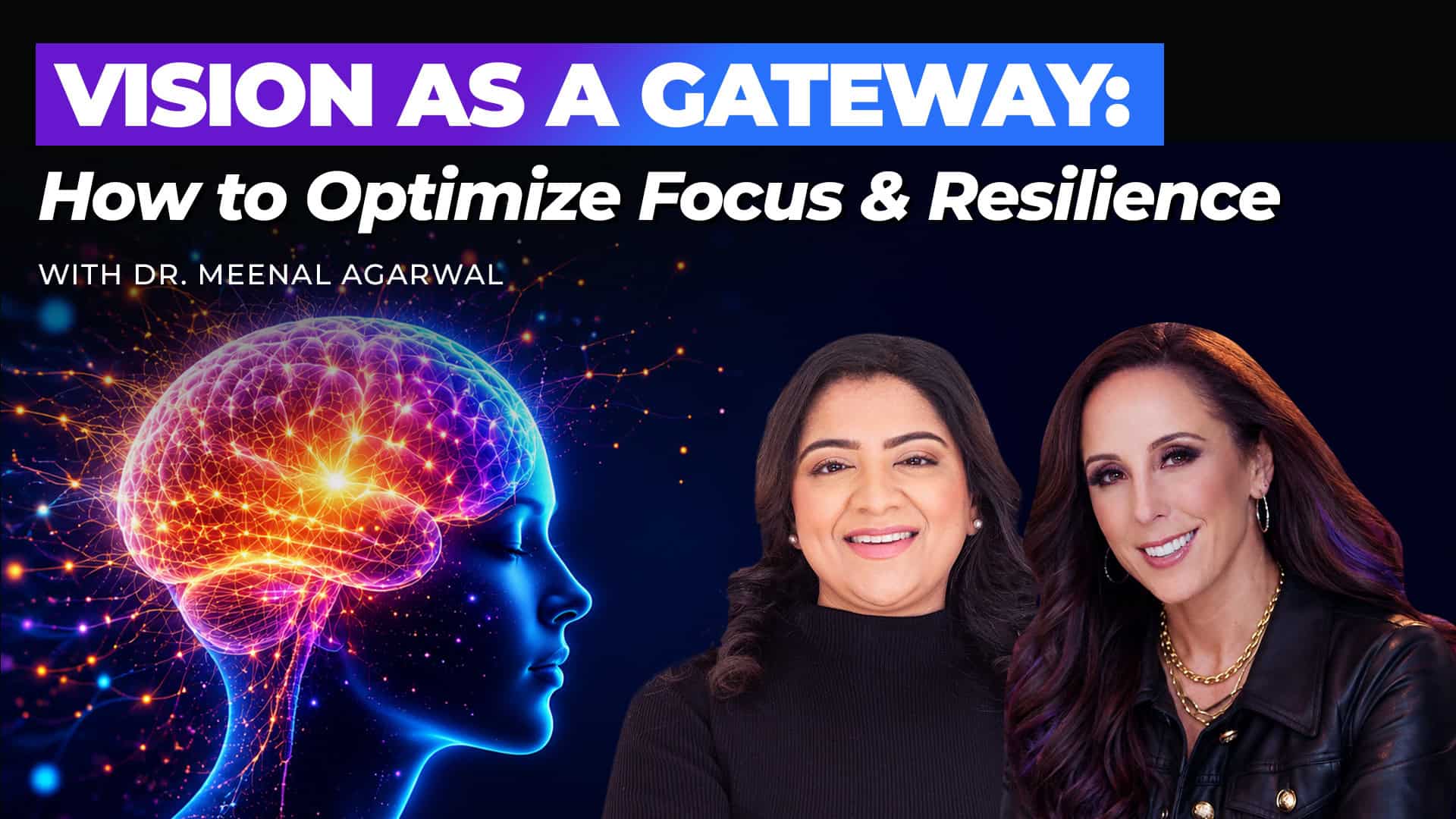
In this episode of Resiliency Radio with Dr. Jill, Dr. Jill Carnahan welcomes board-certified optometrist and spatial awareness expert Dr. Meenal Agarwal for a fascinating look at how our eyes can provide a window into brain health, cognitive function, metabolic health, and overall resilience.
Drawing from her own childhood diagnosis of glaucoma, Dr. Agarwal explains why healthy vision goes far beyond seeing 20/20. Together, they explore the relationship between the retina and brain, the effects of excessive screen time, peripheral vision and spatial awareness, blue light, cognitive decline, and emerging tools such as Optical Coherence Tomography (OCT).
Most importantly, Dr. Agarwal shares practical strategies—from morning sunlight and the 20-20-20 rule to nutrition and outdoor movement—that can help protect vision, sharpen focus, and support lifelong brain health.
🔑 5 Key Discussions You'll Discover with Dr. Meenal Agarwal
① 👁️ The Eyes as a Window Into Brain & Systemic Health
⇨ The retina is embryologically brain tissue, while the optic nerve is part of the central nervous system, creating a powerful connection between vision and neurological health.
⇨ Because the eyes contain a dense vascular network, changes in eye health may provide valuable clues about metabolic dysfunction, vascular health, and neurodegenerative processes.
② 🧠 Why Healthy Vision Goes Beyond 20/20
⇨ A standard 20/20 eye test evaluates only a small central portion of vision and doesn't capture the full picture of visual function.
⇨ Peripheral vision and spatial awareness engage important areas of the brain involved in navigation, problem-solving, movement, and our ability to interact confidently with the world around us.
③ 📱 Screen Time, Blue Light & the “Flat World”
⇨ Constant close-up screen use keeps the visual system focused on a flat, narrow environment and may contribute to eye strain and reduced engagement with peripheral vision.
⇨ Dr. Agarwal explains that blue light itself isn't proven to cause diseases such as glaucoma, but prolonged screen exposure can contribute to visual fatigue and disruption of healthy visual habits.
④ 🥬 Protecting Vision Through Everyday Habits
⇨ Morning sunlight helps regulate circadian rhythms, neurotransmitters, hormones, and healthy wakefulness.
⇨ The 20-20-20 rule—every 20 minutes, look approximately 20 feet away for 20 seconds—gives the eyes a break from sustained near-focus.
⇨ Leafy greens rich in lutein and zeaxanthin, antioxidant-rich berries, and omega-3 fatty acids can provide nutritional support for retinal and overall eye health.
⑤ 🔬 Vision, Cognitive Decline & the Future of Eye Exams
⇨ Poor or uncorrected vision may compound cognitive challenges by reducing the quality of information being delivered to and processed by the brain.
⇨ Technologies such as Optical Coherence Tomography (OCT) allow clinicians to examine detailed retinal structures and may become increasingly valuable in identifying changes associated with neurological and neurodegenerative disease.
🔑 Key Takeaways with Dr. Meenal Agarwal
🔹 Vision health is closely connected to brain, vascular, metabolic, and neurological health.
🔹 Seeing 20/20 doesn't necessarily mean your entire visual system is functioning optimally.
🔹 Peripheral vision and spatial awareness are important components of cognitive function and resilience.
🔹 Excessive close-up screen use can contribute to visual fatigue and limit engagement with the wider environment.
🔹 Natural morning light can support both circadian rhythm and healthy brain function.
🔹 Follow the 20-20-20 rule to reduce the strain associated with prolonged near-focus.
🔹 Support eye health with leafy greens, berries, omega-3-rich foods, movement, and time outdoors.
🔹 Comprehensive eye examinations and technologies such as OCT may reveal important information that extends far beyond eyesight.
About Dr. Meenal Agarwal
Dr. Meenal Agarwal is a board-certified optometrist and spatial awareness expert who takes a holistic approach to vision as a gateway to brain health, focus, and overall well-being.
She integrates optometry, neuroscience, and lifestyle medicine to explore the root causes of visual problems and their potential impact on cognition, neurodegeneration, and everyday performance. A vocal advocate for reducing digital overload, Dr. Agarwal helps people restore sharper focus, balance, spatial awareness, and presence in an increasingly screen-driven world.
Dr. Agarwal owns three thriving practices in the Greater Toronto Area and specializes in dry eye therapy, myopia control, and laser vision correction. She is also the host of Uncover Your Eyes: The Truth About Health & Wellness, and her insights have been featured in TIME, Forbes, and Fox News.
Her upcoming book, Stuck in a Flat World, explores how modern visual habits affect the brain and what we can do to reclaim healthier vision and spatial awareness.
🌐 https://www.drmeenal.com/
📸 https://www.instagram.com/dr.meenalagarwal/
🔵 https://www.facebook.com/meenalagarwaldr
💬 https://www.threads.com/@dr.meenalagarwal
Dr. Jill Carnahan, MD – Leading Functional Medicine Doctor
Dr. Jill Carnahan, MD, ABIHM, ABoIM, IFMCP is internationally recognized as one of the most respected leaders in functional and integrative medicine. She is dually board-certified in Family Medicine and Integrative Holistic Medicine, and the founder and medical director of Flatiron Functional Medicine in Louisville, Colorado.
Widely known as a pioneer in environmental toxicity, mold-related illness, autoimmune disease, and resilience medicine, Dr. Carnahan combines cutting-edge science with compassionate, root-cause care. Her clinical approach integrates precision genomics, epigenetics, microbiome research, peptide therapy, and lifestyle interventions to transform health outcomes for patients worldwide.
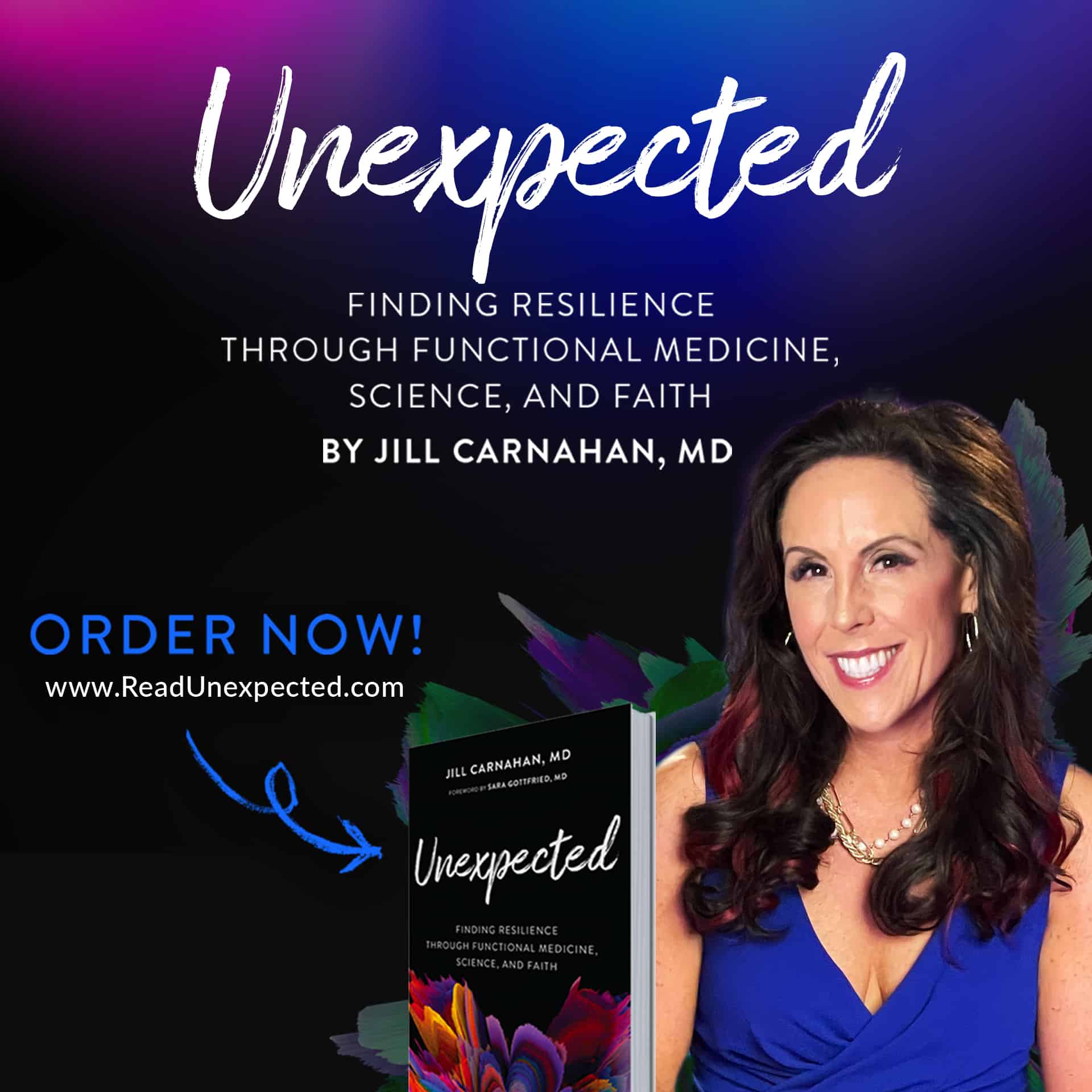
She is the author of the best-selling memoir Unexpected, which weaves her personal journey through cancer, Crohn’s disease, and mold-related illness with her professional expertise. Dr. Carnahan is also the executive producer of the award-winning documentary Doctor/Patient and the host of the popular podcast Resiliency Radio, which reaches over 500,000 global subscribers.
As an international keynote speaker, Dr. Carnahan has been featured at leading medical conferences including A4M, IFM, EPIC, and IPM Congress, and her work is frequently highlighted in major media outlets such as NBC, CBS, Fox News, Forbes, Parade, People, and MindBodyGreen.
With a reputation as both a scientist and a healer, Dr. Jill Carnahan is regarded as one of the top functional medicine doctors in the world, offering a unique blend of evidence-based research, innovation, and deeply personalized care.
The Podcast with Dr. Meenal Agarwal
The Video with Dr. Meenal Agarwal
Transcript
00:00
Dr. Jill Carnahan
Hey everybody. Welcome to Resiliency Radio, your go to podcast for the most cutting edge insights integrative and functional medicine. I'm your host, Dr. Jill and with each episode we dive into the heart of healing and personal transformation. Join me as I interview medical experts, world leaders, innovators of all types bringing you information to help you on your way to optimal performance and longevity and overall just better health and more joy in your life. Today we have an eye specialist, optometrist, Dr. Meenal Agarwal and I am super excited to introduce her in just a moment. Before I do, I want to remind you that we are accepting new patients at Flatiron Functional Medicine in Boulder, Colorado. If you're interested in becoming a patient, you can give us a call at 303-993-7910. You can also go to info flight@iron functional medicine.com if you'd prefer to email.
00:54
Dr. Jill Carnahan
And we would love to see you and help you on your way to optimal healing. Or if you have a complex medical mystery, we're great at solving those mysteries. We would love to be of service to you. You've heard before but we have Dr. Jill health.com products and services specially curated to help you with optimal performance and longevity and overall better life, better gut, better health. Some of the things we feature There are the MCast bundle, a lot of you suffering from mass Cel activation syndrome. We have some incredible products, some of our top sellers.
01:27
Dr. Jill Carnahan
We also have a SIBO co kit if you suffer from gut issues and don't know what's going on or if you remember, you know, going traveling somewhere seven years ago and getting a little bit of a bug and then you've never been the same since there's a chance that you have SIBO and you can go there check it out. It is a trio of products to help you with your gut health. Also some of our bestselling probiotics like the Probiotic with IG is a powerhouse for gut health. You can also get Probiotic with Sakuro. So those are just a few of the many things there. We also have Dr. Jill Beauty line which is anti aging products that are clean and amazing for your skin.
02:04
Dr. Jill Carnahan
If you don't know where to start there, check out the Dr. Jill favorites and that's all at Dr. Jill health.com okay, let me introduce our guest. Dr. Mel Agarwal is a board certified optometrist and spatial awareness expert who takes a holistic approach to vision as a gateway to brain health, focus and overall well being. She integrates optometry, neur science and lifestyle medicine to address root causes of visual problems and their impact on cognition, neurodegeneration and daily performance. A vocal advocate for reducing digital overload, she helps people restore sharper focus, balance and presence in a tech driven world. She hosts a uncover your eyes truth about health and wellness and her insights have been featured in Time, Forbes and Fox news. Let's welcome Dr. Agarwal.
02:52
Dr. Jill Carnahan
Me know I am so happy to have you on Resiliency radio and talk about something that actually is very personal to me and it's how vision has so much to do with overall health. We're going to dive in and hit this and you're going to give us all the beautiful pearls that you've learned in your journey. But before we do, I always like to know the person behind the information and I'd love to know a little bit more about your journey into this field.
03:15
Dr. Meenal Agarwal
Yeah. Thank you so much, Jill, for having me today. It's an honor. So thank you.
03:18
Dr. Jill Carnahan
You're welcome.
03:20
Dr. Meenal Agarwal
So I, you know, I, I always wanted to be an optometrist actually. I know it sounds cliche, but actually since I was 11 years old and it was because I was diagnosed with glaucoma when I was 11 years old by my own optometrist. And you know, at that time we didn't have a lot of treatment options. I was put on 11 drops a day to reduce my eye pressure. And at that time also we didn't know a lot about the disease. The disease was thought to be just of high eye pressure. So not a lot of, you know, options on treatment, especially kids. So, you know, there's not a lot of juvenile glaucoma going on. So I was seeing my eye doctor and a specialty hospital in Toronto that's for kids, it's very specialty.
03:58
Dr. Meenal Agarwal
And I was bouncing between everybody like every couple of weeks because, you know, I was the case and the care that, you know, my optometrist invested in me and my family for the fear that I would go blind. And you know, just the preparations and, and the hand holding. But also the research that he had done behind the scenes, you know, in whatever way he could help me was, it was just so touching. And so, you know, since I was young, I said this is what I want to do for someone else. And it's not that as a practitioner, you know, people always say, you know, you must think you know everything or you should know everything. And I always tell my patients, especially when they Tell me what meds are on, or if there's cross interaction, I say, I don't know everything. I.
04:43
Dr. Meenal Agarwal
You know, I'm not an encyclopedia. I'm not go. I have to look this up, and I have to research, and maybe there is a correlation or maybe there isn't, but you'd have to give me some time. And I think that's such a great indication of a practitioner that you should go to. And he was that for me. And that's who I wanted to become for somebody else. And for me, the fear of losing vision or possibly, you know, becoming blind was. Was so scary. And I could just see, kind of like people say, we see her life flashing ahead of us. That's what I felt at such a young age. And, you know, in a nutshell, I don't want to take up so much of your time on that, but that's why I wanted to enter in this field.
05:31
Dr. Jill Carnahan
You just mentioned some really beautiful qualities. And almost all of my guests, I always get so excited because that curiosity, that willingness to go and. And not just. Just tell the patient, oh, well, that doesn't make sense. So we don't know what's happening, but instead say, well, that's interesting. Let's together see if we can figure this out. And I think that's so powerful because every patient is so unique. I learn stuff every day from my patients just because I'm listening, and it doesn't always make sense, but I'm like, well, let's figure this out. And I see that in you. And then I also.
06:01
Dr. Jill Carnahan
I'm sorry that you had to go through that, but so often the most beautiful practitioners have gone through their own journey, and they know what it's like to sit there with fear or uncertainty or not really know what their life has in store. So I really love that you've used those things to catapult into what you do today. So I want to talk a little bit about how the eye and the retina is a portal to so many other parts of the body. I've done some work with glasses, with prisms and things, and they really changed. And it wasn't my vision, it was my brain. Right. And our title today is about how to optimize focus and resiliency.
06:37
Dr. Jill Carnahan
Do you want to talk just a little bit about how vision is just one part of what you do, but there's this other portal that we have access to through the eye to the brain that can actually change functioning in other ways?
06:48
Dr. Meenal Agarwal
Absolutely. You know, vision, when we talk about vision, 2020, that's just a number. And honestly, that's dictating this central five degrees of our vision. And we have like 200 degrees.
07:00
Dr. Jill Carnahan
Yes.
07:01
Dr. Meenal Agarwal
So the 2020 number is the smallest portion of our, you know, consideration in an eye exam. Really. We should be looking at the entire retina or the entire scope of our vision or our spatial awareness, as I like to call. The biggest thing is people, you know, don't always realize that the retina is embryonically brain tissue and our optic nerve is part of the central nervous system.
07:27
Dr. Jill Carnahan
That's huge.
07:28
Dr. Meenal Agarwal
And so it is a big indication of our brain and our systemic issues. The eyes also have a very dense supply of blood vessels and intricate supply of blood vessels. And so a lot of our metabolic conditions can show up in the eyes even before they show up systemically. There's also neuro conditions and, you know, cognitive conditions that are started a lot of research starting to be done on early cognitive protein changes in the eyes that we can now detect on scans and early retinal scans and early, you know, other types of scans. And I think that's so important that we used to say this phrase that our eyes are the window to the body or the soul, but they truly are now. And more and more emerging research is saying that.
08:19
Dr. Meenal Agarwal
And I can't you, Jill, how many patients I have seen where I have sent to the ER saying, you're about to have a stroke, you know, or I mean, could it be tomorrow, could it be in the coming days? I have no idea. But you're about to have a stroke. And there's one patient in particular in her 40s that comes to mind. And she said to me, I'm on no medication, I'm very healthy. And I saw a mild looking plaque in one of her peripheral or side blood vessels and I think I almost could have even missed it. And it was so small and so mild. I said to her, when did you have your last, you know, family doctor checkup where you have your cholesterol and, you know, everything checked? And she goes, oh, just recently and everything's great.
09:00
Dr. Meenal Agarwal
I said, okay, I don't want to do this to you. And I know you're gonna think I'm crazy, but I need you to go to the er. Wow, good for you. And she was actually, you know, became an inpatient. She was there for a few days, worked up, and they, she was put on all sorts of medication. Her heart was tested and they did feel that she was an early stroke patient candidate. And, you know, it's patients like those where, you know, that gives us satisfaction in knowing that I did something before it actually happened, or like, preventative medicine in a way. But that is how important the eyes are in having that eye exam, because your labs can be normal. And I know we say this in every profession, but there could be other signs or other symptoms, and.
09:45
Dr. Meenal Agarwal
And we want to check every. Every part of your body. Just like you go to the den, you go to the family doctor. You need to have your eyes checked.
09:52
Dr. Jill Carnahan
I could not agree more. And in my experience, so I do, complex chronic illness, environmental toxicity, and the eyes can tell you so much. I've seen effects of autoimmune uveitis from bartonella, and then I've seen things like. I'd love for you to talk a little bit about visual contrast, because I am layman as far as compared to you in this. But from my understanding, obviously, these small, tiny vessels in the retina affect the contrast. And when what we've seen is biotoxins, including like, mycotoxins, toxins, and mold, can affect that blood flow. And it's one of the first early ways you can see these changes in the ability to detect light and dark.
10:28
Dr. Jill Carnahan
And again, maybe you can explain it better than I can, but if I recall, it was back in the 1940s of people that were like, you know, veterans or people that then maybe exposed toxins where they would actually check visual acuity and say, oh, there might have been an exposure. Now, it's not diagnostic, but do you want to talk a little bit about visual contrast? And what can I tell? I'm so curious.
10:48
Dr. Meenal Agarwal
Yeah, so there's a lot of, you know, medications, drugs, chemicals, you know, whatever we want to talk about, you know, we can call it any class that can cause changes in the retina before anywhere else. There's also, like, heart medications that can cause changes on our corneal surface. And sometimes we have to tell their doctor, you know, they have to get off these medications. So a lot of these medications deposit things in the retina. You know, there's tamoxifen, a very popular drug for breast cancer, that it deposits in our retina as well. So there's a lot of, you know, retinal changes that can happen. Whether it's.
11:21
Dr. Jill Carnahan
And you see these on exam.
11:23
Dr. Meenal Agarwal
Yes. Oh, yes. Whether it's blood flow, whether it's pigment changes in the retina, they will eventually decrease your visual acuity. But, you know, to go back to contrast sensitivity, sometimes that is the first sign because it's much more subtle. So I think, you know, checking contrast sensitivity for a lot of patients, it's not an easy test to do.
11:45
Dr. Jill Carnahan
No. And I'm doing it.
11:48
Dr. Meenal Agarwal
But you know, I think a lot of the specialty clinics where they're really trying to crack down on little details, they will measure, you know, contrast sensitivity where we're measuring the changes in the shades, you know, of black, you know, going to gray and then not being able to tell any contrast. And I think those are just very early indications of visual acuity or, you know, changes in our vision. I still feel that they're very much central related. And I think that again, it's not a tell all sign. I think a big portion of these, you know, again, chemicals, drugs, whatever you want to call it are seen based on the examiner seeing deposits and things like that in the eyes is probably the earliest sign.
12:35
Dr. Jill Carnahan
Hey guys, just a quick commercial interruption to remind you that you can get all kinds of products and services even for your eye health. Yes. @Drjill health.com one of my favorites. I've been searching far and wide for those of you suffering from dry eyes. And I found an incredible product that we carry called DE3 Dry Eye Omega. You can find it at drjillhealth.com Just search Omega Dry eye formula and you will find it there. It's called DE3 Dry Eye Omega and it is profoundly beneficial for those of you suffering from dry eyes. Okay, let's get back to our show with Dr. Meenal. Amazing. Yeah, thanks for clarifying because again, I am not the expert, but I've been so fascinated by how much that you know from an expert like you that we can tell and know and see.
13:17
Dr. Jill Carnahan
One thing I want to talk about is we are all on screens and we're all having blue light all hours of the day. And I mean, so many people have heard about blue blockers and limiting screens. But from your perspective, tell us about how this is affecting not only our vision, but our brains. And what's your thoughts about limiting screen time using. But like, what would you recommend to the average teenager who's on screens 24 7?
13:41
Dr. Meenal Agarwal
So I'm going touch on blue light first because it's one of my favorite topics. And it's so blue light is, you know, the part of the visible wavelength of light. So it's visible light, but it is the shortest wavelength. Because it's the shortest wavelength, it tends to have the highest energy. So kind of the opposite shortest wavelength but highest energy. So it tends to scatter the most of all the other colors of the visible light spectrum. So when we're looking at a screen, blue light tends to scatter the most. So it gives us more reflections, can make us, you know, anecdotally have more eye strain, more tiredness, that kind of thing. Back in the day, we didn't care.
14:21
Dr. Meenal Agarwal
We were looking at blue light everywhere, but we didn't care because weren't staring at something all day for eight hours a day where that scatter mattered. So is blue light gonna cause disease? No, I wanna debunk that today. There is no study that claims, and no research that claims that blue light causes, you know, glaucoma or causes certain diseases. But we do know that it has the highest scatter. So it tends to give us a lot of visual strain. So there are patients where, you know, they can't take breaks for eight hours on a screen and they've gotta work from home and they just can't do it. And I will tell them, do you want to try blue light glasses? I mean it's not going to solve the whole issue, but if they would like to.
15:04
Dr. Meenal Agarwal
Anecdotally, some of my patients have said it helps them. I have tried it, I don't feel it helps me. But I'm not typically on a computer eight hours a day. So it's person to person dependent, you know, if they feel it's going to help. But one caveat is not getting these random blue light blocking glasses from, you know, sites like Amazon or, you know, Sheen. You want to look at the amount of UV blue light blockage that there is. So typically the best ones on the market filter about 30 to 40% of harmful blue light. You know, the ones that are just bought for 5, $10 are typically filtering 5%. The problem with those is they don't typically have anti reflective coating on them. So you're adding a blue light blocker to decrease the high energy and the scatter.
15:54
Dr. Meenal Agarwal
But then you don't have anti reflective coating that's getting rid of the general scatter from a screen. So it's counterintuitive to me. It makes no sense. So I would rather you not wear anything if you're going to choose to get those. But if otherwise you're going to choose to get a proper, you know, blue light blocking glasses, they should have anti reflective coating. Typically the higher priced ones or from your optical store, doctor's office, then sure, try it. But I don't think it's absolutely necessary. I don't wear them. My kids don't wear them.
16:22
Dr. Jill Carnahan
So, you know, I love that perspective. I'm so refreshed to hear it because I happen to agree. And there's a lot of biohackers, longevity experts that telling everyone to wear these, wear them on the plane, all of that.
16:35
Dr. Meenal Agarwal
Oh, yes, I've seen that.
16:37
Dr. Jill Carnahan
Right. I want to tell you a couple things of my just this, my personal end of morning. But when I really want to focus, I turn the light all the way up the blue as high as it goes on my screen and it's almost like a stimulant to me. Which makes sense, right? Because it's. Yeah, I don't do that all the time. And I'm not like you. I'm not on screens all day long, thank goodness. I'm seeing patients face to face and doing a lot more interaction. So maybe it's a little different than someone. But it's interesting because I actually use it in the right proper doses to help me focus. And I find that when I have that bright blue light, I actually focus better versus I feel kind of.
17:10
Dr. Jill Carnahan
If I put the yellow glasses on or you know, the blue blockers, which are yellow screen.
17:14
Dr. Meenal Agarwal
Yes, yes.
17:15
Dr. Jill Carnahan
I don't. I have less focus, I'm more distractible, which it kind of makes sense. And again, I use makes sense with.
17:20
Dr. Meenal Agarwal
Your circadian rhythm too. Right. Like you're getting rid of the blue light, so you are getting more sleepy. So that's another thing. If you're going to be on your device at nighttime, there's a whole circadian rhythm element to the blue light. If you're going to be on your device at nighttime and you have to work till 1am on your device again, there's no harm in trying it because maybe it might help you sleep better. But what I don't understand is the wearing it all day because in the morning you do want your cycle to wake up and you want, you know, your cortisol to be released. You want to be up and awake in the morning. So wearing it all day does not make sense to me.
17:57
Dr. Meenal Agarwal
But wearing it, you know, at nighttime because you got to work till 1am makes sense if you want to try that. So I think the problem with the world now is we have one pill or one hack and we overuse it. And it should just be about balance. And I think that's the problem with society.
18:16
Dr. Jill Carnahan
I love it. In fact, one of my favorite recommendations, recommendation for patients who are not sleeping well is within 30 minutes of waking up you get bright sunlight to your eyes, your retina, because that helps that cortisol curve, the circadian rhythm. And it's so powerful, even from say, 6am as the sun is rising, to your bedtime, because you just lock that in. And I found with jet lag and travel to Europe and other countries, my most powerful thing is using light to help my circadian rhythm. So, like getting that light in my eyes in the new space. And so powerful. So let's talk more about visual function contributing to. People often complain in my clinic of brain fog or headaches or dizziness, fatigue, anxiety, difficult focus, concentration, all of these things.
18:58
Dr. Jill Carnahan
How often do you see issues with the retina, with the vision, with the eyes in general, that are actually contributing to some of these symptoms?
19:07
Dr. Meenal Agarwal
So often, you know, I think so for me, the biggest thing that has come up over the last, you know, I want to say, five years has been our lack of spatial awareness that is contributing to a lot of anxiety, you know, and I don't want to say it's a sole contributor, but anxiety, mental health, issues, wanting to not interact. So our introversion.
19:31
Dr. Jill Carnahan
Yes.
19:32
Dr. Meenal Agarwal
And, you know, that's what I've written. My. My recent book that's coming out called Stuck in a Flat World, is I feel we are literally stuck in the central 5 degrees of our vision all day, which is that 2020 vision that we're just looking centrally and we're not using any of the other 200 degrees of our vision. And what happens is we are not triggering an entire area of our brain called the parietal lobe. And the parietal lobe gets all the information from our peripheral or the rest of the 200 degrees of our vision. And because we're stuck in this flat world, it's not stimulated enough. And so it's not. It can go to sleep. It doesn't need to work. It's not being used.
20:11
Dr. Meenal Agarwal
And there's so many other things in that brain that need to wake up or be used like a muscle for the rest of the areas of our brain to function appropriately. For example, if we are sitting on a device all day and we're not stimulating that parietal lobe, our amygdala, which is our fear center of our brain, kind of goes on high alert or threat mode. And that is my theory on why people who are constantly on a device or up close are not wanting to interact with others, because there's that sense of fear, because the parietal lobe is not being stimulated. So for me, a lot of the issues that we have today are literally right in front of us. And I, you know, urge people to expand their awareness because that is part of their vision and their brain function.
21:00
Dr. Meenal Agarwal
Again, a big portion of their brain, which is the parietal lobe.
21:04
Dr. Jill Carnahan
Oh, that makes so much sense. I've noticed just one of my favorite things in the evening after work is to go on a walk. And while I can wear headphones, I different, I'm not like watching anything, so there's no visual there. But that, that lateral movement is soothing. And do you have any thoughts on. Because I think there is actual science on like walking, moving in our environment, saying hi to people, looking around. And I, I find that for some reason it's one of my most beautiful, calming nervous system resets. Among any other thing that I could do is just taking a walk without any stimulus, without any headphones, without any devices and being in that movement. Any thoughts on how that affects our visual field?
21:41
Dr. Meenal Agarwal
Yes, absolutely. So, I mean, one of my first exercises that I tell parents to do for their kids who are on devices all day is walking and talking. So, you know, because it's so simple, but it's so powerful because when you are walking and talking, you know, unless you're looking around and you're an adult, but if you're talking to your child, you're developing spatial navigation, you're developing that spatial area and you're looking at things that are in your peripheral vision that are stimulating that parietal lobe. That's also where problem solving happen. So, you know, I think it's building skills for ourselves, sure, as adults, but more importantly, it's helping the next generation navigate space.
22:22
Dr. Meenal Agarwal
They are losing navigational skills, so they can't even navigate their social life because they don't even know how to literally navigate their, their, you know, physical life, you know, or physical space. And I feel we focus so much on attention, but we focus zero on orientation. Where am I in space? Where am I in relation to others? Is so important for us to ask ourselves.
22:49
Dr. Jill Carnahan
Wow, that makes so much sense. One of my, one of the optometrists I worked with years ago talked about, often people are either laser focused like a spotlight, or they're diffuse awareness. And it's almost like those two things, if they're not in balance, they're usually, you know, either like a autistic kind of presentation or an ADHD presentation with too many stimulants or too focused and they can't, you know, socialize. And I think that's a really Good metaphor for kind of this vision thing. Do you notice when you're doing exams and doing the history and talking to someone, if they're more likely one or the other? And what recommendations would you make to expand our ability to be both?
23:26
Dr. Meenal Agarwal
So I, you know, I think, you know, one thing I'm going touch on is a lot of the ADHD kids, you know, you can tell because they are jumping the moment they get in your room. They're hyper focused on different things. Again, these are people who have hyper stimulated their temporal lobe as opposed to their parietal lobe. So your temporal lobe is the front scent is processing the central 5 degrees of our vision. So you can tell that they, they are laser focused. Exactly what you said. You know, they'll look at this and they'll go, here, oh, where's the D, where's this?
23:58
Dr. Jill Carnahan
Where's this?
23:58
Dr. Meenal Agarwal
What is this for? What is this for? What is this for? Right. So I think, you know, again, I can't label them. That's, that's not in my scope of practice. But I feel a lot of those patients are on the verge of a learning dis adhd and I think it's so important that they recognize the environment or parents recognize the environment they're in and they can change that. But you know, on point to your, I, I want to say it's more about the eye muscle movement that you were talking about or weakness in eye muscle movements. So those can be. Yes, we're seeing a lot more of those and that is also from being hyper focused. Our eyes and our brain were not designed to look up close at 40cm all day. They were not designed to do that.
24:40
Dr. Meenal Agarwal
They were actually designed to be looking out in space more often than they were up close. So we have a rule that we like to tell our patients and it is the 20, 20 rule. For every 20 minutes for 20 seconds, look 20ft or far away. So every 20 minutes while you're on a computer or your child is, if they're able to look out a window or something, just far away for 20 seconds. And it doesn't have to be long. It could be going to the bathroom as a quick break or going to get a granola bar, something really short. But our eyes were designed to look far. Or if a child's on an iPad all day watching YouTube, get that on the TV because the TV is actually further now.
25:21
Dr. Meenal Agarwal
We, we grew up watching TV all day, you know, so I mean, it's definitely less strain on your eye muscles. But it makes sense, right, Jill? Like, if you're constantly in focus up close, your muscles are going to be tired and eventually have an outward pattern. And that is the trend that we're seeing.
25:37
Dr. Jill Carnahan
It's like a tight hamstring. Right. I love the analogy because it's really very practical in the 2020 rule. That's a pearl. I want to shift this a little because so many people, whether it's. We have a lot of practitioners who I'm sure will be interested because they can refer to optometrists like you, but also brain health. So brain health is a big one, right? Aren't there early signs of Parkinson's, Alzheimer's, neurodegenerative diseases that you see in your eye exam or your history?
26:04
Dr. Meenal Agarwal
Yes. So, you know, we, you know, there's a lot of stats that go around there, but one of my favorite kind of stats is 60% of patients with cognitive decline have some form of vision and, or hearing loss. And that is huge. And I always tell patients that your eyes are connected to your brain. So if you do not have good vision, and you know, with that respect, I want to say more, the laser focus, like a 2020 or you're not wearing your glasses because you feel they're going to miraculously. Your vision, your. Your vision is going to miraculously clear up on its own. Please stimulate your vision because that is a direct connection to your brain. And what happens is areas of our brain get lazy, if you want to call it, or that muscle is not working.
26:50
Dr. Meenal Agarwal
And there are early cognitive changes that can happen. And I do see that in a lot of patients that are seniors. And I cannot tell you how many patients come in and tell me, I've had my mom tested for Alzheimer's, I've had them tested, you know, for dementia, my mom's just not listening to me, etceter, etc, And I see the patient and they have either not enough central vision or they've lost their peripheral vision. One or the other point is, mom cannot notice you because they've lost some form of their vision. And so it's cognitively not processing. It's all linked. And same goes for hearing, right? There's a lot of patients you'll notice with hearing loss that have cognitive losses.
27:30
Dr. Meenal Agarwal
So, you know, I don't want to say that we're the ones to diagnose that disease based on the vision changes, but I think I always tell patients that are not wearing their glasses or correcting their vision optimally that look at early cognitive changes. We are going to start seeing them in the next wave of patients that believes in complete biohacking of vision by not wearing glasses or not correcting their vision. And I'm a firm believer in curing things naturally and holistically and I think there's a time and place for that. But it's like saying if your sugar is out of whack, you're going to, you know, holistically treat it without taking any metformin or, you know, any medication. I think put them in tandem and if you feel things are getting better, you can relieve, you know, the medication.
28:16
Dr. Meenal Agarwal
So it's the same kind of concept, but you know, to the other point of it for more of our retinal changes or physical eye changes that we can see. So we're seeing a lot of studies come out now on a scan called the Optical Coherence Tomographer. So, you know, in short, it's an oct and a lot of doctors are offering it when you go in for your visit. So I urge patients to do it. And it, you know, we're starting to see that it can show early, you know, early changes in the retina or plaques or buildup that can be indicative of certain cognitive or neuro diseases. I haven't seen any patients with it, but that is the philosophy and there's a lot of studies that have been done on it.
29:02
Dr. Meenal Agarwal
So, you know, I'm yet to see my first, but I, you know, I wonder if we will.
29:07
Dr. Jill Carnahan
Yeah, I do think, and like even scans for melanoma, I think as AI gets involved in medicine, we're going to see a little bit more of this really cool stuff coming out. So stay tuned for that. So with our topic, you know, optimal performance and resilience, we've talked about all these amazing things. I want to talk a little bit about what your recommendations. If we had like 10 minutes a day to devote to our vision. I'll just tell you know, how it is during. I try to stay off social media, but when I'm on there for reasons of my own, you know, platform or whatever, often you'll see these, oh, ten minutes a day will restore your vision. As, you know, like these things that are like promises, these silly little, I'm like, oh, that's kind of bogus.
29:42
Dr. Jill Carnahan
But are there any science based things that you can do to improve vision? I noticed I just hit 50 and so all of a sudden my phone, instead of being here, I have to pull it back, right?
29:52
Dr. Meenal Agarwal
Yes, new to me.
29:53
Dr. Jill Carnahan
And I don't wear corrective so I'm like, okay, this is 50, so what things can we do to improve our vision as we age?
30:01
Dr. Meenal Agarwal
So I'm a firm believer in what is practical and what can we actually do. So number one, I'm gonna say for everybody, get that morning sunlight that is setting everything up. Your brain, your eyes actually release dopamine, like all sorts of neurotransmitters. We have estrogen receptors in our eyes. Like your eyes are so important to get that circadian rhythm going. And your eyes is the only place that actually sets the circadian rhythm. So if you don't get that morning light, everything is dormant. Your, your super chiasmatic nucleus can't send the messages to, you know, everything else in your brain to get going and release all these neurotransmitters and things for our day and our hormones. So I think getting that morning sunlight is like your vitamin.
30:44
Dr. Meenal Agarwal
So I would rather, you know, if you can take a vitamin, I think you can get morning sunlight. The second thing I'm going to say is there's a lot of advocacy for eye exercises and I am a firm believer in eye exercises for people with weak muscles and you know, certain things, especially children, where we need vision therapy. But I think for the average layperson, the issue is, we all know it's the up close focus and the stat is by the year 2050, 50% of the world globally will be into some form of glasses. So we know that there is a big issue and we know the reason for the issue is the shift in our modern lifestyle where we're focusing at something up close. So implement that 2020 rule rather than, you know, doing 10 minutes of exercises.
31:32
Dr. Meenal Agarwal
I would, you know, and I can give people exercises, we call them pencil push ups and all sorts of things, but I would rather you just look far away every 20 minutes. I, I mean, I think it's more practical. I'm not somebody like my physiotherapist and my Cairo always tell me to do all these exercises. I never follow them.
31:49
Dr. Jill Carnahan
I know, me too.
31:51
Dr. Meenal Agarwal
So it's like just be practical and take breaks because we know the culprit is the up close focus. And then, you know, I think for me it's nutrition. Yes, A big piece of it is nutrition. We have so much evidence, so much emerging evidence on all sorts of diseases like macular degeneration, even glaucoma. There's this new study that's come out on B vitamins and the high Link with glaucoma. And I was shocked to read that. So, you know, and I'm vegetarian, so I'm B vitamin deficient. And I was always, until I found out when I was a teenager or even after that, in my 20s. So, you know, for me, that hit home. Like, was that the reason I developed glaucoma? I don't know. Right. And so there's a lot of emerging research on nutrition helping every aspect of our body.
32:38
Dr. Meenal Agarwal
So for the eyes, the biggest classes of foods that are important is the colored or green leafy vegetables. So they have a lot of lutein, zeaxanthin. These are pigmentations that actually are antioxidants. They actually help our retina help, you know, process. And our retinal pigment epithelium, which is part of our retina, help to process, break down photoreceptors, regenerate things and help with blood flow. So I think eating vegetables and the berry class is, really, has great antioxidants as well. So your raspberries, your strawberries, and then the second class of food is your omega 3s, which I think everybody advocates for, I want to say. And for us, a big thing with that is, you know, decreasing inflammation and also helping with dry eyes, which is a big thing, you know, menopause, perimenopause. So, you know, those are, I think Those are my three things.
33:33
Dr. Meenal Agarwal
The morning light, the 2020 rule, and the good foods that I think everybody can just implement as part of a sustainable lifestyle.
33:42
Dr. Jill Carnahan
Well, I couldn't agree more, especially about the morning light. And that's a great kind of way to cap our episode. I want to make sure people know where to find your book. Do you have two books in the new book out or tell me more about what book?
33:54
Dr. Meenal Agarwal
Just one book.
33:55
Dr. Jill Carnahan
Yeah, yeah. Where can you find you and find more? Yeah.
33:58
Dr. Meenal Agarwal
So my website. You can find me on my website. It's drmel.com and I do have an early access link to my book that's coming out in October called Stuck in a Flat World, literally. And it's a lot about how spatial awareness that I like to call it is affecting our safety and our brain processes and just all sorts of personality traits that we have. So it was a passion project for me because I experienced, I feel a lot of spatial awareness loss in one point in my life, which I, you know, share in the book as well. So, you know, I hope people can resonate. And I've had patients that have come in, moms especially, come in crying and telling me and I, I truly believe they fit the same pattern as me.
34:42
Dr. Meenal Agarwal
So, you know, I hope it resonates and I hope people can make some changes. There's a lot of great recalibrations that I like to call it for people that are practical to help them. And then you can also find me on Instagram. That's where I'm Most active at. Dr. Meenal Agarwal. Thank you so much though, Jill, for this.
34:58
Dr. Jill Carnahan
Oh, you're welcome. This was so fun and so practical and I think such good information. I love the 2020 rule. 202020 Rule. I love the morning sunlight. I love this cruciferous and colorful polyph. All these incredible tips that you've given us today. Thanks so much for coming on this episode. Hey guys, hope you found that episode with Dr. Meenall about eyesight and optimal brain health through our retina fascinating and full of practical tips. I know. I really love the 202020 rule and some of the things she shared. One of my favorite things is when I'm doing international travel, getting that bright sunlight in the first part of the day within 20, 30 minutes. Awakening Absolutely changes jet lag.
35:41
Dr. Jill Carnahan
In fact, I feel like I've totally hacked jet lag by using food and light when I travel to optimize the brain to get on that new cycle. So hopefully next time you have a trip to Europe, you can do the same thing. Thank you as always for joining us on this episode. If you are listening on any of your favorite audio podcast platforms, itunes or Spotify, please do stop and leave us a review. It helps us to get more listeners and more great guests. Guests, if you're on YouTube, we are nearing our 1 million mark. By the time this is out, we may have hit it. Anyway, we hope you will join the subscribers that have always subscribed. I know many of you listen to the podcast and haven't yet subscribed. If you haven't yet, click that subscribe button.
36:23
Dr. Jill Carnahan
Click the bell to be notified of future episodes. And as you know, we have new episodes out every single week. Also, stop by Dr.jill health.com to see all the wonderful products and services that are available for your optimal health and performance there. And I will see you again next week for another episode of Resiliency Radio.
* These statements have not been evaluated by the Food and Drug Administration. The product mentioned in this article are not intended to diagnose, treat, cure, or prevent any disease. The information in this article is not intended to replace any recommendations or relationship with your physician. Please review references sited at end of article for scientific support of any claims made.







Share: