

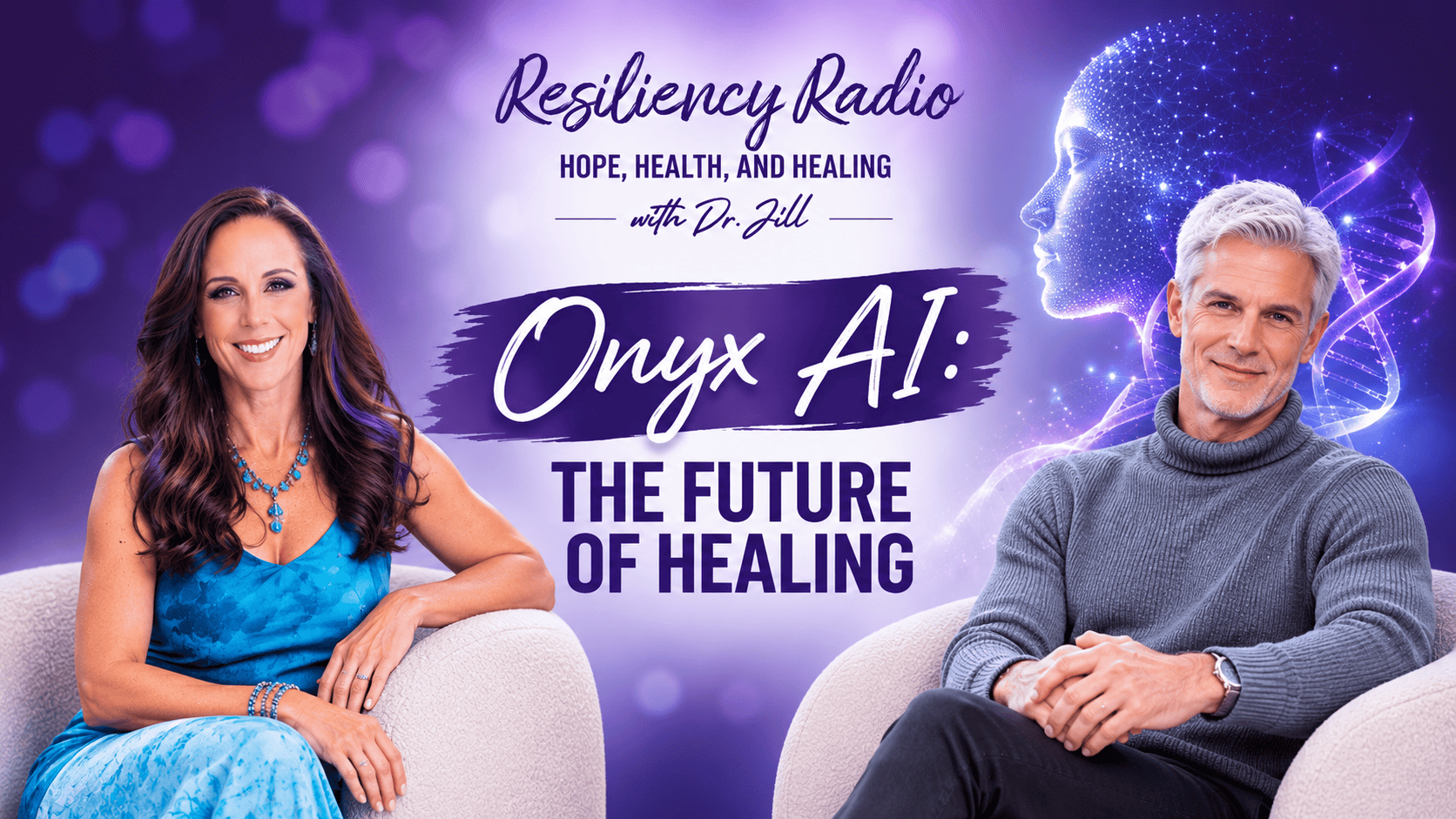
Can artificial intelligence make healthcare more personal without sacrificing privacy, trust, or human connection? In this special episode of Resiliency Radio, Dr. Jill Carnahan welcomes David Bennahum, founder of Onyx, to explore a new approach to AI-powered health education. Together, they discuss Dr. Jill's personal healing journey, functional medicine, resilience, and how Onyx aims to make trusted medical knowledge more accessible while honoring the people behind it.
🔑 5 Key Discussions with David Bennahum
- 🤖 Onyx: A Different Approach to AI — David explains how Onyx prioritizes privacy, authorship, human agency, and expert knowledge over attention-driven technology.
- ❤️ Dr. Jill's Journey of Resilience — From breast cancer and Crohn's disease to environmental illness, Dr. Jill shares how personal suffering transformed her approach to medicine and healing.
- 🌿 Functional Medicine & Environmental Health — Discover Dr. Jill's foundational philosophy of reducing harmful exposures, supporting the body's natural processes, and starting with clean air, clean water, and clean food.
- 🤝 Why Healing Requires Connection — Explore the importance of love, community, accountability, and family support in creating meaningful, lasting health changes.
- 📱 Meet Dr. Jill on Onyx Health — Learn how Onyx uses Dr. Jill's body of knowledge to provide personalized educational conversations, including collaborative group chats, while emphasizing privacy and human oversight.
🔑 Key Takeaways with David Bennahum
🔹 AI should support human well-being, protect privacy, and respect the experts whose knowledge it shares.
🔹 Resilience grows when we find meaning and opportunities for transformation through life's challenges.
🔹 Functional medicine emphasizes identifying potential root causes and supporting the body's healing processes.
🔹 Sustainable health changes often depend on community, accountability, and meaningful relationships.
🔹 Onyx offers another way to access Dr. Jill's educational resources but does not replace personalized medical care.
About David Bennahum
David Bennahum is the founder of Onyx, an AI platform designed to connect people with knowledge from trusted experts while prioritizing privacy, authorship, and human connection.
An early technology pioneer and former journalist at Wired magazine, David witnessed the evolution of the Internet and the rise of attention-driven social media. His work with Onyx reflects his commitment to developing technology that respects human agency and helps make expert knowledge more accessible.
- Explore Onyx Health: https://onix.life/
- Search Onyx Health in the Apple App Store.
Dr. Jill's Resources:
Dr. Jill Carnahan, MD – Leading Functional Medicine Doctor
Dr. Jill Carnahan, MD, ABIHM, ABoIM, IFMCP is internationally recognized as one of the most respected leaders in functional and integrative medicine. She is dually board-certified in Family Medicine and Integrative Holistic Medicine, and the founder and medical director of Flatiron Functional Medicine in Louisville, Colorado.
Widely known as a pioneer in environmental toxicity, mold-related illness, autoimmune disease, and resilience medicine, Dr. Carnahan combines cutting-edge science with compassionate, root-cause care. Her clinical approach integrates precision genomics, epigenetics, microbiome research, peptide therapy, and lifestyle interventions to transform health outcomes for patients worldwide.
She is the author of the best-selling memoir Unexpected, which weaves her personal journey through cancer, Crohn’s disease, and mold-related illness with her professional expertise. Dr. Carnahan is also the executive producer of the award-winning documentary Doctor/Patient and the host of the popular podcast Resiliency Radio, which reaches over 500,000 global subscribers.
As an international keynote speaker, Dr. Carnahan has been featured at leading medical conferences including A4M, IFM, EPIC, and IPM Congress, and her work is frequently highlighted in major media outlets such as NBC, CBS, Fox News, Forbes, Parade, People, and MindBodyGreen.
With a reputation as both a scientist and a healer, Dr. Jill Carnahan is regarded as one of the top functional medicine doctors in the world, offering a unique blend of evidence-based research, innovation, and deeply personalized care.
The Podcast with David Bennahum
The Video with David Bennahum
Transcript
00:00
Dr. Jill Carnahan, MD
Hey, everybody. Welcome to Resiliency Radio, your go to podcast for the most cutting edge insights integrative and functional medicine. I'm your host, Dr. Jill, and with each episode, we dive into the heart of healing and personal transformation. Today is a little different. As you can see, I'm here in the studio in Boulder and I'm going to be interviewing David Benaham. David is the founder of Onyx, and we're going to be talking about that platform and having a deep discussion on everything else in the world related to transformation and AI and even my own personal journey. Stay tuned. You're in for a real treat today. Hey, everybody, it's Dr. Jill, and I am so excited to be here in person in the studio with David from Onyx.
00:43
Dr. Jill Carnahan, MD
We're going to dive deep today, David, into the whys behind what we do and why we do what we do. Because I really feel like the core of resilience is the story behind the person. And we know so many people out there that have these stories of resilience. I love to feature them on the podcast. And today, as I mentioned in the intro, we're doing things a little different. I want to talk just a bit about David to get started, and then he's going to shift and actually interview me and ask me some questions on this podcast. So stay tuned for a wild, fun ride today.
01:14
Dr. Jill Carnahan, MD
And I just want to start with David and I want to ask you, David, you flew in from Montreal today, and as people know in the intro, you have had an incredible experience in this world and you've created this new gem called Onyx. But I always feel like not just the what, but the why. As we know from Simon Sinek, Tell us a little bit more about your passion and purpose behind this project.
01:34
David Bennahum
Well, thank you first of all for inviting me on to be with you today, Jill. It's a treat to be here and thank you for creating the space for us to have this conversation. It's really lovely. On a personal level, I first learned to program when I was 13 years old.
01:49
Dr. Jill Carnahan, MD
Wow.
01:49
David Bennahum
I was part of that first wave of kids that got the home computers.
01:53
Dr. Jill Carnahan, MD
Oh, yeah.
01:53
David Bennahum
In like 1981, right?
01:55
Dr. Jill Carnahan, MD
Exactly.
01:55
David Bennahum
And it was a very strange time because also a of latchkey children and a lot of loneliness and alienation. The divorce rate had really gone up. And this became my refuge at a time when I had a lot of challenges in my life as a young boy, a teenager. And it became really a passion that I mastered and I had the benefit of going to a good university and when I finished university, it coincided with the onset of the Internet as a phenomenon in the early and mid-90s. And it turned out I was very good at writing. So.
02:25
Dr. Jill Carnahan, MD
Amazing.
02:26
David Bennahum
I became a journalist with Wired magazine and was part of that early team at Wired covering the onset of the Internet. And at the time, this all relates to Onyx, we all had a really deep optimism about what these types of information technologies could do for the world, that it would democratize access to knowledge, it would create connections between people that otherwise couldn't happen. And we believe that all those things would fundamentally make the world a better place. Who could be against them, as it were. Right. They sound terrific. And then something happened along the way, and it's very heartbreaking. I never anticipated it would happen. It happened sometime around when social media came about in the late 2000s. And what happened was we became the product. Somehow our attention and our time became what was valuable. And the incentives began to really change.
03:25
David Bennahum
It was about, how do we get me and you and everyone else to spend an awful lot of time on these platforms so that they can make money from our attention?
03:34
Dr. Jill Carnahan, MD
Yes.
03:34
David Bennahum
It became very adversarial, and I think it made people very sick, ultimately. And I saw that 10 years ago, I was very mindful of what was happening, and I was one of the earlier people that saw this, that the incentives had gone wrong. And so when AI really emerged a couple of years ago as its own phenomenon, I was deeply concerned that it would be an accelerant of some of the really unfortunate things that we've seen. If there ever were a technology that could know you, watch you, potentially manipulate you, AI would be a formidable tool for that outcome. So Onyx really began with a question, which is, how do you build something that honors human integrity, human agency, and human flourishing? And how do you do that in a way that by putting certain principles at the heart of it, like privacy, authorship.
04:26
Dr. Jill Carnahan, MD
Yes,.
04:27
David Bennahum
Right. That in turn, you would make something, meaning an AI, that would perform better and create more value for the alternative, which is essentially surveillance, taking information from everywhere without permission. What if by honoring people's integrity, ownership, personhood, you could build a form of AI that literally was better at whatever the job is people needed it to do? Well, that would be remarkable.
04:55
Dr. Jill Carnahan, MD
Yes.
04:56
David Bennahum
Right. Because we can all say, you know, eat your peas, so to speak, it's better for you than the processed alternative. But when you're facing that. That aisle of processed food, it's very hard not to grab the package. And likewise, when you're facing that aisle of Processed intelligence, as I sometimes think of it.
05:14
Dr. Jill Carnahan, MD
Yes.
05:14
David Bennahum
The open AIs and the anthropics of the world. It's very hard not to reach for that computer. But what you're going to be getting from there doesn't really come from a named source. There's no accountability. So a lot of the insights we had with Onyx in the beginning was put people first. Let's build a whole technology from the ground up, where people are at the heart of it. And that is what has brought us here today, because you have blessed us with the privilege of working with your knowledge, which is something so precious that you cultivated over your lifetime and you've trusted us to actually bring that forward. For what purpose? I believe to help heal the world at an even larger scale.
05:52
Dr. Jill Carnahan, MD
Hey guys, don't forget to check out drjillhealth.com for all kinds of products and services that may be related to whatever you're struggling with right now. You can search by topics such as gut health or brain health and you can get 10% off your first order. And if you haven't already watched Doctor Patient Movie, we talked today about the depth of that film and how it's impacted people around the world and even my guests today, you can check it out@drpatientmovie.com it's also on Amazon prime and it's streaming for free on YouTube and Tubi. And lastly, but not least, my clinic, Flatiron Functional Medicine in Louisville, Colorado, we are accepting new patients.
06:32
Dr. Jill Carnahan, MD
Many people don't know that we have options for you to schedule right away and if you're not sure, you can call and get a 10 minute consult with one of our mid level providers, Fawn or Hannah. But we are accepting new patients and we would love to help you on your journey to personal healing. So give us a call. 303-993-7910. And I want to just comment on what you said because that's one of the reasons, I mean, there are a lot of groups out there trying to duplicate, create sorts of things like this.
07:02
Dr. Jill Carnahan, MD
And one of the things that resonated with me most and actually allowed me to say yes, I want to partner with you, was the fact of the integrity and the authorship and all of those things where you actually honored the, you know, really 30 years of building intelligence of any doctor. For me it's been about that long. But because there really is this lifetime of work and I've seen so many other authors and speakers and visionaries in our world and their work is completely pirated copyrighted, and stolen. And there's no authorship even given to that person. No credit given. Right. And I see it all the time, and I'm just shocked. And, like, where are we going with creativity and ability to produce new things if, you know, this takes over?
07:48
Dr. Jill Carnahan, MD
And it not only takes over, but it often kind of bastardizes the work.
07:54
David Bennahum
It does, because it becomes removed from. To use a fancy word, why not the terroir, the origin of the knowledge? So you have a terroir. You have your life. Your life. And your knowledge is not separable from your life. And when you take someone's knowledge without their permission and strip it away from their life, you actually lose something fundamentally.
08:18
Dr. Jill Carnahan, MD
You don't you? Because it's just like we stuck the story and we talked about how important that is in the intro. That story and that energy and what that person brings is part of the transformation and the work and the healing and all that happens.
08:32
David Bennahum
When I was preparing to come here, I decided to watch your documentary, which is called doctor patient, came.
08:41
Dr. Jill Carnahan, MD
Out in.
08:41
David Bennahum
2024, And I found it with my spouse, and we sat down together a few nights ago because I wanted to understand where you come from, and I came to understand. This documentary tells that story.
08:53
Dr. Jill Carnahan, MD
Yes.
08:54
David Bennahum
And I sat and I watched it with my spouse, Hillary. And were deeply moved by the experience of your journey. And one thing I was struck by is how you are a detective that was investigating, beginning with your own suffering. Right. And turning that suffering, really, into an opportunity for healing. And I was also struck by the amount of emotional intimacy that you had with your patients when we saw them, you know, coming into your office to connect and how often you would say, I love you to these patients. And I think you really mean it.
09:27
Dr. Jill Carnahan, MD
I really mean it.
09:28
David Bennahum
And I get it, you know, because that's healing. And at some point you said, well, the power of healing comes from love, and it comes from connection. And what we live in today is a world where people increasingly have lost connection.
09:43
Dr. Jill Carnahan, MD
Yes.
09:44
David Bennahum
We are so isolated.
09:45
Dr. Jill Carnahan, MD
Yes. And so hungry.
09:46
David Bennahum
And so hungry for that connection and community. So part of why I am so grateful to come and be with you is that we are part of a little community that we're building. And to sit here with you and speak to you, it's really a blessing.
09:59
Dr. Jill Carnahan, MD
So much better than Zoom.
10:01
David Bennahum
That is for sure. That is for sure.
10:03
Dr. Jill Carnahan, MD
Yeah. Yeah. So it's interesting you mentioned that. First of all, I'm honored that you watched it with your wife and that it keeps on giving to communities and places. It's interesting in making that film because there was version one that was a little bit more sterile than the version you saw. And we all, the producer, the director and myself were like, it's not quite right. We want to really touch the hearts. And in order to do that, the pieces that we added in were the ones I called like the ugly cry scene and the times where I was so, like vulnerable. The one scene I'm talking about, I'm sure you remember, in medical school. And this was caught on camera, not scripted at all.
10:41
Dr. Jill Carnahan, MD
And I walk into my alma mater, it's almost 20 years after my diagnosis of cancer there, where I didn't know if I was going to live through that.
10:48
David Bennahum
Yeah.
10:49
Dr. Jill Carnahan, MD
And I walked and looked at this lecture hall. I look up at this lecture hall where I did all my lectures, all my first and second year medical training, and you see it on camera. I literally lose it with emotion because I think back to that young 25 year old girl and what she went through, which was a diagnosis of aggressive breast cancer and then Crohn's disease. And I remember back then I was brought up on a farm, raised to be strong and resilient and don't complain and pull up by the bootstraps. In one way it gave me my resilience that I've had my whole entire life, and in another way it caused me to be so dissociated from the pain that I did not allow myself to take the time to heal or to be kind to myself.
11:36
Dr. Jill Carnahan, MD
And so in that moment, 20 years later, I'm in the hall looking back at my younger self and thinking, oh, sweetheart, you were so strong, you were so brave. I cannot believe what you went through. You were raising three stepchildren, going to medical school and battling cancer and sick, so sick. And yet you kind of put aside all of your own pain and suffering and tried to show up in the best way that you could to finish the training and to be there for your family and to all the things that were the shoulds. And now that I've learned and done a lot of my own work, I'm like, oh, I wish I could have told her to take more time and be kind to yourself. And it's okay if you take a day off or if you're sick or those kinds of things.
12:15
Dr. Jill Carnahan, MD
And so you see it in the movie and I'm sure that's one of the places where many of the viewers are touched, but it's only when we get to that depth. So back to the producer, director and our story. We had to go to that place and share the most vulnerable points, which are also the most scary.
12:33
David Bennahum
Yes.
12:34
Dr. Jill Carnahan, MD
Right. Because we're afraid of either being judged or looking stupid or whatever. It doesn't matter because those are the human connection points. And this is what I love about Onyx. And the thing is, I think you've created something that could be the opposite of human connection and you've actually tried to maintain the integrity of human connection. Because I believe that's where the healing begins.
12:53
David Bennahum
If we can figure this out together, how to both maintain that human connection while making the accessibility such that potentially thousands or millions could be touched by your knowledge, we've solved something very beautiful for the world.
13:07
Dr. Jill Carnahan, MD
Yeah.
13:08
David Bennahum
Because today, as you go to the office, I know you have a tremendous list of patients who would like to see you. I think you may have thousands potentially. Right.
13:18
Dr. Jill Carnahan, MD
Yeah.
13:19
David Bennahum
And from your point of view, reaching all of them is a mission.
13:23
Dr. Jill Carnahan, MD
It is.
13:23
David Bennahum
But you're limited to how much time you have. Only so many, Dr. Jills. And so that's really the opportunity is to take that ability without losing the connection.
13:33
Dr. Jill Carnahan, MD
And I realized about, really A decade ago, 2016 is when my list closed to new patients. Now, still by referral, I'll take some. But then I realized, oh, my one one capacity is at the limit. What do I do? Right. And at that moment I realized I need to train the trainers, teach the teachers, influence the influencers, and be a voice in the world that is helping to advocate and to teach. And then something like Onyx comes along and there's this opportunity touch people's lives. Like already with the book and the movie and certain things, I put a lot of online content out. I'm able touch people who never actually see me. But this is one more way in my personal mission, which is how do I get this information out to the world? You mentioned love in the documentary. That's a core theme.
14:18
David Bennahum
Yes.
14:19
Dr. Jill Carnahan, MD
And my definition of love is really creating a space for the optimal transformation of another human. And that can be a lover, a friend, a co worker, anyone, really a patient, for sure. And once again, with Onyx, if we do it right, which I think you've set that foundation, I believe it can be that kind of transformational space.
14:39
David Bennahum
Transformation is really at the heart of, I believe, of a happy, joyous life. Right. If one gives up oneself.
14:47
Dr. Jill Carnahan, MD
Yeah.
14:47
David Bennahum
It's confining. And I think part of what is so amazing about the story you went through was your commitment to your personal transformation that the suffering and the hardships actually were invitations to transformation. I've been practicing yoga for 27 years, nearly every day.
15:05
Dr. Jill Carnahan, MD
Wow.
15:06
David Bennahum
And meditation. And about a year ago, I was in my yoga class practicing, and the teacher said, sometimes I give a little talk at the beginning. And the teacher said, listen to your suffering.
15:20
Dr. Jill Carnahan, MD
Your.
15:21
David Bennahum
Suffering is your teacher. And it really hit me, and I suddenly had, like, a mantra that came into my mind. My suffering is my teacher. And it was. It was a bit of transformation in that moment, because I have suffering.
15:37
Dr. Jill Carnahan, MD
We all do.
15:37
David Bennahum
Right? We all do.
15:39
Dr. Jill Carnahan, MD
We're lying if we hide.
15:40
David Bennahum
You're absolutely lying if we hide it. So the question is, what will you do with your suffering?
15:45
Dr. Jill Carnahan, MD
Yeah.
15:45
David Bennahum
And when people say, you know, why me? Why me? There's that famous phrase, you know, why not me? Who says, you don't get to. Absolutely. So it's there for a reason. Listen to it. Learn from it. And I was struck by how, in the documentary, you tell us that you were, at 25 years of age, diagnosed with the most severe form of breast cancer Loyola Medical Board had ever seen. Ever seen. And that you really had to advocate for yourself to that board. Because I think their initial feeling was basically, I don't want to say it's a hopeless case, but it sounds. Reading between the lines. That's what they were saying. Right. So you had a certain tenacity, determination. And I feel that continues to fuel the work. You don't accept.
16:38
Dr. Jill Carnahan, MD
Yeah,.
16:38
David Bennahum
Right. What people say, you question it. And I was struck by how you act like a detective when you were talking about learning about your Crohn's disease and really investigating how to work with that illness and questioning the medication, questioning the way the dosages were given to you. Yeah,.
16:59
Dr. Jill Carnahan, MD
That was really. It was probably the most important part of my medical education. So it was occurring simultaneously as my medical classes and my courses. And of course, I took about nine months off to do chemotherapy, radiation, surgery, all the treatment. But in that time and to your point earlier about suffering as a teacher, and what is my suffering teaching me? That really should be our question to all of our patients and inviting them to go deeper. Because once we take difficulty, suffering, trauma and flip it on its head and give it the power to teach and to have meaning and purpose, it changes everything, because no longer does it have the power to hold us down, to hold us back. It actually has the power to accelerate growth, accelerate healing, and often there's this identity around. Like you said, woe is me.
17:49
Dr. Jill Carnahan, MD
Why did this happen to me? If we stay there, we're bound to Stay stuck. And if we ask those questions of why not me? And then what is this here to teach me? And then welcome these things which sounds so bizarre.
18:02
David Bennahum
Yes,.
18:03
Dr. Jill Carnahan, MD
We welcome the suffering. As a teacher, I'm at the point, David, where I've been through cancer and Crohn's disease and mold related illness and. And many other things in my life. Relationship difficulties, a divorce. And as I've learned and grown in each one, what has happened is I have had this empowerment to realize that at this point, I don't love suffering like anyone. And I sure hope it doesn't come tomorrow or the next week or the next month or the next year. But I know now that no matter what comes, I can handle it. Like, it's given me the confidence to know even if something very difficult comes, I've got the tools. I've been through this before. I'm going to be okay. And even if I had to face death, I'm going to be okay.
18:44
Dr. Jill Carnahan, MD
And that's a powerful way to be in the world where you're not living in fear and reactivity.
18:51
David Bennahum
So you told me on the way over here that you really wanted to be here. And then you gave me the news that your grandmother had passed yesterday.
19:00
Dr. Jill Carnahan, MD
Yes. Yeah.
19:01
David Bennahum
And so my condolences.
19:03
Dr. Jill Carnahan, MD
Thank you.
19:03
David Bennahum
For. Of course. Sorry to hear this. And also was a bit astonished that you made the time to be together today knowing this person, your grandmother, who you love dearly, has passed. And I'm wondering what that says about how you look at suffering, because I know you must be suffering right now.
19:21
Dr. Jill Carnahan, MD
Thank you, David. And thank you for your kind condolences. Yeah, it was a little. I wouldn't say it was a difficult decision because I knew what would grandma want me to do. And this woman lived her life with so much love. Everything was about service and love for 95 years. She got diagnosed with pancreatic cancer. And what I love about her, she was such an epitome. I think I've got so much of her genetics in me because she was so resilient. She went through a great depression and survived. And then marriage. Her husband died and was alone for many years. And in all of that, all of us, all we ever saw was this incredibly strong, resilient woman. And I'll give you an example. She got the diagnosis of pancreatic cancer.
20:05
Dr. Jill Carnahan, MD
My family looked at her when she was getting the diagnosis, and later, they weren't even sure she heard. And I said, no, Grandma heard, but she's not letting that define her. She's going to go forward with what she has always done, which is move forward with grace and love and not let that thing turn her into a miserable, depressed soul. She did none of that. She got back to Illinois with my family. She started taking her walker out in the block of the city street and walking and trying to get strong so that she could go back to Florida to visit her friends. Three months later, she was strong enough. She'd been eating well and doing all the right stuff, getting exercise. She flew back and got a week with her friends in the pool.
20:45
Dr. Jill Carnahan, MD
And this is a person with an absolute terminal diagnosis that should not have been acting like that, but she did. And then she started to go downhill. And as she went downhill, she was in the hospital. And this whole series of miracles allowed her to get flown back to Illinois with the family and be with them. And she hit her 95th birthday, she got to see her friends, and then after her 95th birthday, she got back to Illinois to be with the family, which is all my big family, which is literally five children, 10 grandchildren, of which I'm one of them. 60 Great grandchildren. And get this, 10 great grandchildren. That's a legacy. A matriarch of over 80 progeny. Unbelievable. So she got back to being near all of them. Two days later, she passed away in her sleep.
21:33
Dr. Jill Carnahan, MD
And I just know her soul was like, I'm gonna get to Florida, I'm gonna do this. She's stubborn, she's strong willed, she's resilient. And then get back and then I'm done and I'm ready to go.
21:43
David Bennahum
Yeah.
21:43
Dr. Jill Carnahan, MD
And it was such a beautiful testimony. And last weekend I was teaching at two different conferences. And the last minute before I go on stage, I was like, I gotta talk about grandma. And I went on and I said, nine o' clock yesterday morning, my mom calls me, says, my grandma needs a ride from Florida to Illinois. How are we going to get her back? And I make some calls and we get this angel network of a flight to get her back. All this miracle happened. And I called my grandma and I said, grandma, how are you doing? She said, oh, sweetheart, how are you doing? What's new in your life? I love you. I'm fine. I'm ready to go. I'm at peace. I thought, what a woman. I want to be like her when I'm 95.
22:19
David Bennahum
And it's a choice, you know, how are you going to relate to that transition?
22:23
Dr. Jill Carnahan, MD
Yeah, exactly.
22:24
David Bennahum
And if you can make it a choice.
22:26
Dr. Jill Carnahan, MD
Yeah,.
22:26
David Bennahum
It's a beautiful thing. I had two people in my Life pass where they made that choice. The first was my father, who passed at 58, metastatic cancer.
22:36
Dr. Jill Carnahan, MD
So you know that well.
22:37
David Bennahum
And he was diagnosed and passed in six months from start to finish, living in New York City. And he made a choice very early. He grieved about that his fate would be what it is. And then he said, I'm gonna get complete with everybody in my life. I'm gonna give them the space to say goodbye to me and leave them in a good place because there was so much sorrow.
23:00
Dr. Jill Carnahan, MD
Yeah, yeah.
23:00
David Bennahum
He had many friends and like a wave of people from all over the world would come to New York for many months and almost he was holding court, you know.
23:11
Dr. Jill Carnahan, MD
Wow, that is so beautiful. It reminds me of my grandma too.
23:15
David Bennahum
And then when it came time for him to pass, he actually was at home and he was given the ability to choose when he would leave. And he chose, and were all holding his hand and he chose intentionally. And it was a beautiful thing to see. Too short. But.
23:32
Dr. Jill Carnahan, MD
The.
23:32
David Bennahum
Lesson.
23:33
Dr. Jill Carnahan, MD
Exactly, that we have resilience and autonomy and choice and that even death does not have to be feared if we frame it right. People's greatest fear does not have to be that way.
23:45
David Bennahum
What if it's a moment of gratitude for one's life, Whatever that was.
23:49
Dr. Jill Carnahan, MD
An.
23:49
David Bennahum
Appreciation.
23:50
Dr. Jill Carnahan, MD
Wow, that's an incredible story. So similar,.
23:54
David Bennahum
I find, for you. Illinois is really your roots. Yes. Your family emigrated there in the late 19th century. They were farmers from Germany.
24:02
Dr. Jill Carnahan, MD
Yes.
24:03
David Bennahum
And it's also the source of some of perhaps your illness.
24:07
Dr. Jill Carnahan, MD
Yes.
24:07
David Bennahum
Right. Yes. It's a bit of a paradox or a contradiction. The source of family and love and life is also the source of possibly the breast cancer because you are exposed to so many chemicals and toxins unbeknownst, Right?
24:22
Dr. Jill Carnahan, MD
Yes. David, I always say I had this, like, Norman Rockwell esque life with on the farm. I was one of five children. My mother was a retired Knurler. We had an acre garden and really lovely upbringing. And then when I got the cancer at 25, I suddenly had to be like, huh? And you started to go towards this quality that I love in humans. You have it as a journalist. I know. I have it too, as a detective. And that is curiosity, right? Yeah. It's my greatest gift, I think, is remaining curious. And everyone that I bring on the show, I always love because most people are very curious. And in that curiosity, I said, why? Why did this. Not why, like, why God, did this happen? Just what led to this? And is there something that I could learn from this?
25:02
Dr. Jill Carnahan, MD
And so I did the investigation, realized that atrazine was still being used on the corn and bean fields of central Illinois in high doses. And that was a known endocrine disruptor, which means it causes estrogen related dysfunction, which could be breast cancer, prostate cancer, other things, and then many other chemicals. And I realized that probably as early as even in utero in my mother's womb, I was getting exposed to those chemicals, which led to a very young diagnosis of cancer. Now, evidence to that point is my sister, who is seven years younger than me, I was 25, got diagnosed with breast cancer. She, at 28, was diagnosed with thyroid cancer. So two endocrine cancers, sisters, same environment.
25:40
Dr. Jill Carnahan, MD
To me, that makes a story that's interesting, that tells us there's something in the environment, certainly genetics too, because both of us probably didn't detoxify as well as we could have. But it was fascinating to learn that and then to understand that information to help patients. Which brings us back to Onyx, because this is the place where I can share some of this depth of knowledge that has come not only from the science and the literature, but from decades of personal experience.
26:06
David Bennahum
Yes. And I think because we live in a world now where the environment is so complex and a source potentially of illness, that the solutions to it are also complex and a lot of them are very personal.
26:19
Dr. Jill Carnahan, MD
Yes,.
26:19
David Bennahum
Right. It's unfortunately true that it's on us to some degree.
26:23
Dr. Jill Carnahan, MD
To try to.
26:24
David Bennahum
Remediate these things. And that's where having the point of view of someone who can really be a native guide.
26:30
Dr. Jill Carnahan, MD
To.
26:30
David Bennahum
Help you sort out is so important. Because otherwise I would imagine it's overwhelming to think through. Well, what could the source of this be? Is it my food? Is.
26:37
Dr. Jill Carnahan, MD
It.
26:37
David Bennahum
My air? Is it the land? Is it my house? Is it something else? It's overwhelming.
26:44
Dr. Jill Carnahan, MD
It is.
26:44
David Bennahum
But unfortunately it is a source of illness for many of us.
26:48
Dr. Jill Carnahan, MD
Oh, the environmental toxic load, which is really my specialty is environmental toxicity in medicine, is profound. It's like the elephant in the room where people are like, why are there so many people getting viruses, getting sick, getting shingles, getting cancer? And it's really epidemically increased even since like the pre Covid era. And I see a lot of that due to this toxic load. I always share that. It's almost like we have a bucket ability to detox. And we're all born with that bucket. Mine was kind of small when I was born, so it didn't take long to fill and overflow. If you can imagine your bucket. And if that water level starts to reach the top and overflow.
27:23
Dr. Jill Carnahan, MD
The things that we see frequently are autoimmunity of different types, cancers, and also neurodegenerative diseases, Parkinson's, Alzheimer's, ALS, Ms. And we're seeing huge increases in all three of those. And then for me, the cancer and the autoimmunity with Crohn's, and I had Hashimoto's, I had multiple autoimmune diseases. Made perfect sense in that context.
27:43
David Bennahum
You said something interesting in the documentary that struck with me about the bucket that think of it like a bucket, and your bucket gets full in a way of toxins, and there's this initial intervention where you just gotta bring the level down, not all the way, but sufficiently down that your body could potentially take over and handle the rest of the. But then you pointed out the next thing, which is it's really important to ingest things, possibly eat things, breathe things that are going to help your body.
28:08
Dr. Jill Carnahan, MD
Yeah.
28:08
David Bennahum
Kind of like you use the metaphor, maybe like glue, it'll pull out those toxins. And I believe this is core to a lot of your work as a doctor, and I think it's core to this notion of what people call functional medicine. And I'm wondering if you can just explain for a moment what that functional medicine philosophy is, and that you practice.
28:28
Dr. Jill Carnahan, MD
Yes, yes. So two things come to mind. One is what you've just said, which is what do we need to eliminate in order? So let's start with the framework. Our body will detox as a detox machine, and it has the ability to heal and turn cells over. Every day we're turning these over, we're autophagizing or getting rid of programmed cell death of the wrong guys or the ones that are getting old and decrepit and we're getting new cells. So our bone and our muscles and our skin and our tissues turns over constantly. Some takes a year or two and some takes months. Like, our gut lining is very rapid turnover. Our ovaries and testicles are very rapid turnover. Brain can be more slow. So all this is happening, but in that we have an opportunity to really, like, remake ourselves.
29:10
Dr. Jill Carnahan, MD
We can completely have a new body in 10 years if we do the right things. And so in that algorithm that you mentioned, it's what do we get rid of that's causing illness? Is that wrong medication? Is it a toxic load like the air that we breathe? A lot of people don't realize 80% of our toxic load comes from the air that we breathe. So one of my passions is clean air, clean water, clean food. And that air is number one for a reason. And so we could be eating the wrong foods and we could be drinking unclean water or water that has contaminants. And nowadays, even in the state of Colorado, which is where I live, most of the water supplies that have been tested have already been contaminated with levels that are higher than allowed for. PFAs, which are polyfluorinated compounds.
29:52
Dr. Jill Carnahan, MD
Teflon, Gore Tex, those are forever chemicals, David, which means we don't even know. We can't even calculate how long they stay there, let alone we don't even know what to do to get rid of them. And we can filter them, which is why I advocate everyone drinking filtered water. If I'm at a hotel, I don't drink tap water. I only drink filtered. So these things that getting rid of what's toxic and then putting in the core nutrients. And what I find is it'd be a perfect world if we all lived in the Garden of Eden and had beautiful organic plants and that's all we ate. And there was no toxicity because we'd probably get our nutrients and our guts worked, right?
30:27
Dr. Jill Carnahan, MD
But in our world with the toxic load, with our really vitamin deficient diets, even in the best cases, like a little case of raspberries flown in from California, two hours on a truck that's organic, the nutrient value is pretty low. So because of that, I believe that we do need to augment with nutraceuticals. And I'm not. I mean, I try to do the least that we can, but I feel like adding in those nutrients. I'm giving people programs that actually have those essential nutrients as part of their work because that is essential for that tissue to regrow and the autophagy to happen. So get rid of the bad, put in the good. And again, that's where this can get complex because people are like, where do we start? What do we do? And you can give very simple protocols.
31:10
Dr. Jill Carnahan, MD
And I always say, start with clean air, clean water, clean food.
31:14
David Bennahum
Yeah. I first really deeply understood the power of Nutrition about 15 years ago when I went to see my doctor for my annual checkup. Dr. Brodsky, who was a bit like a small town doctor,.
31:26
Dr. Jill Carnahan, MD
Right? Very.
31:27
David Bennahum
Kind, very loving man. And he looked at me and he said, David, you weigh 220 pounds, you're 6, 6 foot 2, your blood work is becoming pre diabetic. I've seen this story before, if you keep going the way you are, you're going to become diabetic. And I said, I hear you. What should I do. And he said, well, typically there's pills that you could take to help control your cholesterol and so on, but I think you're young enough to change your diet, and if you're willing to change your diet, I think you could change the whole thing by changing how you eat. And I said, well, Dr. Brodsky, that people say that all the time and it's really hard, and I don't think I can do it. Well, my wife is a nutritionist. She's down the hall. Mindy, why don't you go see Mindy?
32:13
Dr. Jill Carnahan, MD
Oh, I love it.
32:14
David Bennahum
And she'll teach you how.
32:15
Dr. Jill Carnahan, MD
To.
32:15
David Bennahum
Eat. Right.
32:16
Dr. Jill Carnahan, MD
I love this. For a small. I love this.
32:20
David Bennahum
It's like a full service.
32:21
Dr. Jill Carnahan, MD
Right, right. So.
32:21
David Bennahum
I go down the hall to Mindy's office, who's a small, little grandma like figure, lovely human being. And she put me on basically a low carbohydrate, high vegetable, lean protein diet. And I followed it assiduously, and I wound up losing 55 pounds in about five months. Like,.
32:39
Dr. Jill Carnahan, MD
It.
32:40
David Bennahum
Was fast. I think that was just how it went. And here we are 15 years later, and I managed to maintain the diet. I had my blood test recently, and it was really moving.
32:51
Dr. Jill Carnahan, MD
Amazing.
32:52
David Bennahum
The numbers were like a person in their 30s.
32:54
Dr. Jill Carnahan, MD
Wow.
32:55
David Bennahum
And completely transformed. And without any medication. Right. It was just purely through diet. The power to heal.
33:01
Dr. Jill Carnahan, MD
Exactly.
33:01
David Bennahum
Because after all, we are what we eat. Among other.
33:03
Dr. Jill Carnahan, MD
Things.
33:04
David Bennahum
Right.
33:05
Dr. Jill Carnahan, MD
People forget that power. And physicians in medical school. I love that this guy was very adamant about, you can do it. Because we're taught, oh, people won't change. Don't even bother. Like, how ridiculous is that?
33:17
David Bennahum
But there's a little twist, which is it's hard to do it by herself.
33:20
Dr. Jill Carnahan, MD
Yes, you're right.
33:21
David Bennahum
And Mindy was a very loving and kind person who had me come in every week for.
33:25
Dr. Jill Carnahan, MD
A.
33:26
David Bennahum
Weigh in and a check in.
33:27
Dr. Jill Carnahan, MD
Oh, that's accountability. Right,.
33:28
David Bennahum
Accountability. My wife, very loving and kind, changed the whole way she cooked. Actually, she was delighted to do.
33:35
Dr. Jill Carnahan, MD
It.
33:36
David Bennahum
She had been a fruitarian for some years before, so.
33:38
Dr. Jill Carnahan, MD
She.
33:38
David Bennahum
Was thrilled.
33:39
Dr. Jill Carnahan, MD
Sure, I can do this. To.
33:40
David Bennahum
Do this. And so I had a lot of support. And I think that's the other thing that, by the way, came up in your documentary as well, that healing is a. Is a community sport. It's very hard to do alone. And we live in a world, as we've been talking about, where it's easy to become alone.
33:55
Dr. Jill Carnahan, MD
Yeah. Wow, that's a great word and a great transition, because I feel like that the future so we have AI over here and people are kind of in there. And you started out our conversation with the whole dilemma, social dilemma. We could say yes,.
34:10
David Bennahum
If.
34:10
Dr. Jill Carnahan, MD
You know that reference, right?
34:11
David Bennahum
I saw the film. Yes.
34:12
Dr. Jill Carnahan, MD
And so a friend of mine edited, so I know it well. And in that, we saw the deliberate attempt to manipulate our dopamine circuits with technology. Children, adults, everyone. And we've all been susceptible, all of us, no matter what we think about social media, we are all in that loop because it's inevitable. It's so powerful. So in that, there's also this disconnect that's happening. And what you see, I'm sure with AI, I'd actually love your opinion on this, but what I see at least is these silos and. And each silo now has their own voice, their own AI telling them exactly what they want to hear. So it's diversifying, it's keeping people apart, it's creating dichotomies, it's creating division more than ever before. And I believe the future of.
35:00
Dr. Jill Carnahan, MD
Part of what I want to do and teach and be is creating community, creating connection, creating this place where we feel like we are together in community or that people feel held, just like Mindy, you know, kind of metaphorically held your hand.
35:14
David Bennahum
One of the things we built early on with Onyx is the idea that you can have a group chat with the Dr. Jill Onyx, meaning like the individual coming in there, maybe with their spouse or their parent or their child, who's deeply invested in their healing journey, can participate in that conversation together. So again, it isn't necessarily a solitary.
35:36
Dr. Jill Carnahan, MD
Of.
35:36
David Bennahum
Course, you could talk one one, but you can have a group conversation. And what we discovered with a lot of folks is they'll often be one person who's using the AI to kind of get insights around what to do and then sending that back through screenshots and notes to the rest of the family to get them to agree. And it's a lot of work to do this, like education,.
35:57
Dr. Jill Carnahan, MD
Right?
35:57
David Bennahum
Why not just bring everyone into the conversation?
35:59
Dr. Jill Carnahan, MD
Oh, I love that. And what I love is it's really different because if you're using the Onix created for my content, you're not going to just get what you want to hear. I'm not, you know, my. My knee. It's going to be all the work, the body of work, but it's very different because you're not going to be hearing parroted words that are like, oh, should I break up with myself? Yes, of course. She's treating, you know, like I think a lot of you out there are hearing these things that are just telling them exactly what they want to hear. Very narcissistic, like. Right. And so this is different.
36:29
David Bennahum
It really is. It's been trained to say, no,.
36:31
Dr. Jill Carnahan, MD
I love it. Yes. Which is appropriate. Right?
36:34
David Bennahum
If it doesn't know about something. Yes.
36:36
Dr. Jill Carnahan, MD
It'll say, I don't know.
36:38
David Bennahum
And part of what I think, philosophically, you alluded to social media, dopamine loops, and AI as it's emerged in the world. It's very much an extension of some of that, unfortunately. And I've come to this realization came a little bit from reading things like Silent Spring and books around food and ecology a few months ago. I really came to this consciousness that this is processed intelligence.
37:05
Dr. Jill Carnahan, MD
Yes.
37:05
David Bennahum
What we think of. That's.
37:07
Dr. Jill Carnahan, MD
A great way to think of it.
37:08
David Bennahum
Processed intelligence. And what does that actually mean? It means it's this mining machine that goes on the Internet. It takes all this knowledge from wherever it can find it. A bit of Dr. Jill, a bit of Albert Einstein, a bit of Reddit, a bit of everything. And it puts it into this giant fantasy factory and it grinds it up into a paste of words, and it's just a statistical engine.
37:32
Dr. Jill Carnahan, MD
That.
37:33
David Bennahum
Has the probability of what word should follow the next, and it doesn't really know where the words came from. Does it make any sense to mix Dr. Jill's words with stuff on Reddit that Dr. Jill might not agree with whatsoever? The answer is probably not. But the machine is indifferent. It has no ability to discern that. It just produces a kind of paste of words, and then people us read that paste of words and it makes you sick.
38:02
Dr. Jill Carnahan, MD
In.
38:02
David Bennahum
The brain.
38:03
Dr. Jill Carnahan, MD
And it's articulate enough to be very convincing, even if it's hallucinating. So I think that's so. And we've seen that over and over with stories all over the place of, like, these. Absolutely false. I just heard Arthur Brooks, who is an author I love, and among many, but he was talking just a couple days ago about the psychopathy of AI, and I'm like, oh. Because what he's seen is in relationships and stuff, someone will go and be like, oh, this happened in my movie. And. And this advice that they're giving is really from a cold machine. It's not empathetic. And it's not. It may say, oh, your husband's a narcissist, or this or that, or you should, you know, this idea of people in relationships getting bad advice.
38:40
Dr. Jill Carnahan, MD
And it might not be just relationships, it could be work it could be leaving a job, it could be your, you know, environment. But the. There's no heart. There's no heart. So I really love that. Again, I feel like you're bringing in this inevitable world of AI, which I am embracing because there is no going back. It just is what it is. How.
38:57
David Bennahum
Do we build it right?
38:58
Dr. Jill Carnahan, MD
How do we do it the right way? So this is a great segue to tell people a little bit more about like, not only Onyx itself, but how do they get involved and kind of like why we're here?
39:08
David Bennahum
Well, we've carefully been building this for the last, I'd say year, and we're privileged to have a collection about 30 world class invited experts on the platform, mostly in functional medicine like yourself.
39:21
Dr. Jill Carnahan, MD
Yeah.
39:21
David Bennahum
And they all exist in an application called Onyx O N I X. And that application is on the iPhone. It'll be on Android too, but for now it's only on iPhone. And you can go to the App Store. You can type in Onix, Onyx Health, H E A L T H Onyx Health. And you'll see it. And we've been very quiet about it. We are only now starting to talk about it because we wanted to make sure the attention to detail was really there. So you are now on this platform as Dr. Jill. It is going to be integrating with many of the things that you do outside of AI, the supplements, the knowledge, the learning, et cetera.
40:00
David Bennahum
But really, at the end of the day, it's meant to be a source, a resource for people who otherwise couldn't come and be with you in a highly personalized and private way. Where none of those chats are used to train anything. You can't see the chats unless the person somehow decides to send them to you. And we certainly can't see them as a company. And that's our pledge to everyone. We believe privacy is actually fundamental to trust.
40:24
Dr. Jill Carnahan, MD
Yes.
40:25
David Bennahum
And absent trust, people don't really share. So we're seeing people getting really beautiful value out of this experience and we're just at the beginning of this journey together.
40:35
Dr. Jill Carnahan, MD
Hey guys, thanks for joining me for this incredible episode with David live at Medium Film's studio in Boulder, Colorado. If you want to know more about Onyx, it's O N I X. And you can go to Onyx Life or you can go to the Apple iPhone app and download the app there to check it out. I hope you'll give it a chance. And as we talked about, I think one of the most important things I want to end with is this doesn't replace your doctor or even seeing me or my clinical staff in person because we want that community. But this is an incredible adjuvant for those who either don't have access to that or want to know more about how to plan for their health and ask questions on my platform. So check it out.
41:16
Dr. Jill Carnahan, MD
As always, we'd love if you'd leave a review wherever you're listening to this podcast, and please join the over 1 million subscribers on YouTube. Hit that subscribe button, click the bell to be notified of future episodes, and as you know, we have a new episode out every single week. I'll see you next time for another episode of Resiliency Radio.
* These statements have not been evaluated by the Food and Drug Administration. The product mentioned in this article are not intended to diagnose, treat, cure, or prevent any disease. The information in this article is not intended to replace any recommendations or relationship with your physician. Please review references sited at end of article for scientific support of any claims made.




Share: