


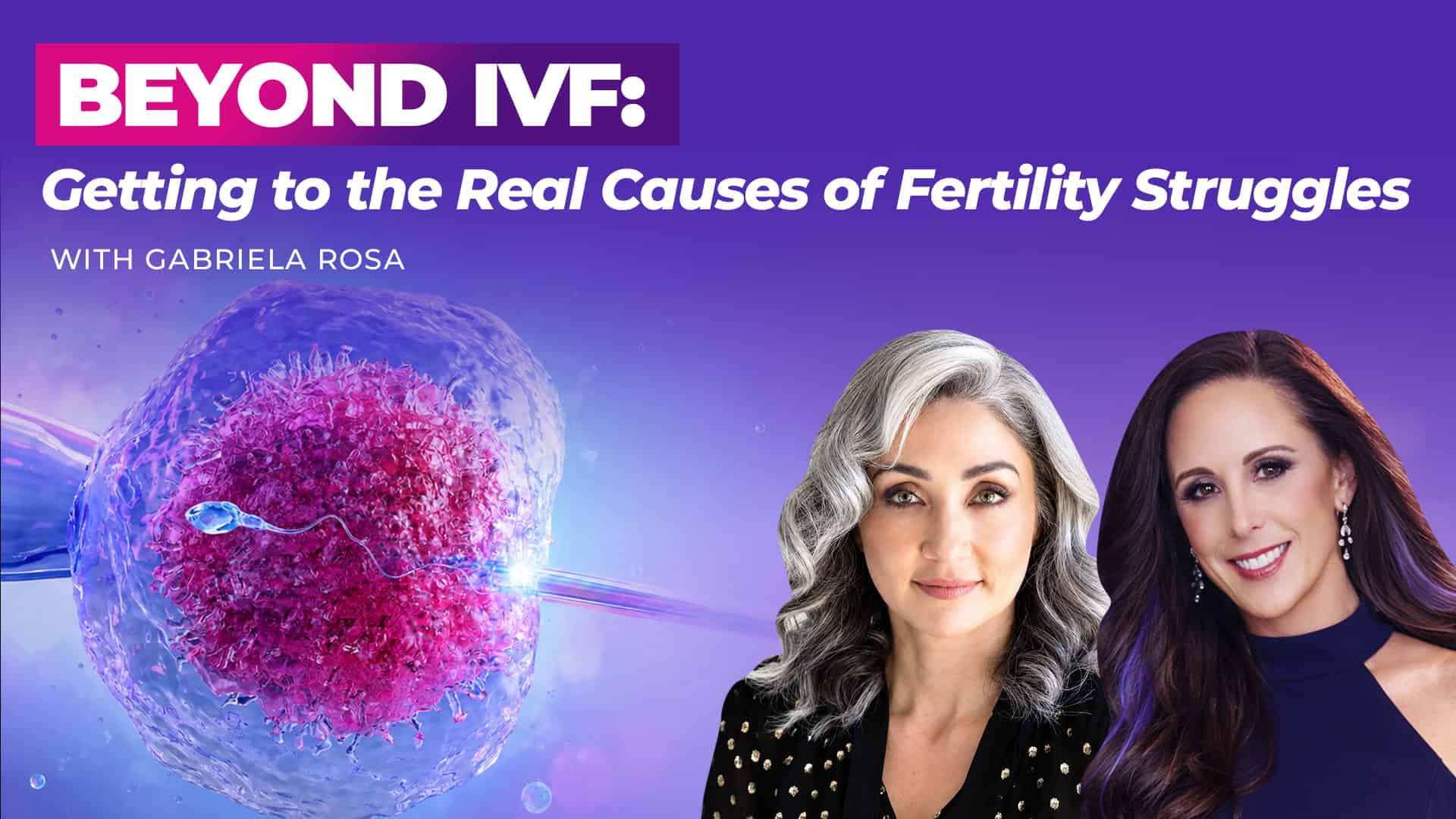
What if the answer to infertility isn't always another round of IVF? Dr. Jill welcomes Dr. Gabriela Rosa, fertility specialist and author of Fertility Breakthrough, to explore the underlying factors behind infertility, recurrent miscarriage, and failed fertility treatments. Discover why investigating both partners, optimizing whole-body health, and looking beyond hormone levels may help couples make more informed decisions on their fertility journey.
🔑 5 Key Discussions with Dr. Gabriela Rosa
① 🔬 Finding the Root Causes of Infertility
Dr. Rosa explains why investigating metabolic health, thyroid function, inflammation, nutrient deficiencies, and reproductive health may reveal overlooked contributors to fertility struggles.
② 👫 Fertility Is a Team Sport
Both partners play an essential role in conception, making sperm health, egg quality, and shared preconception preparation important parts of fertility care.
③ 🧬 Low AMH, Age & IVF Decisions
A low AMH result doesn't automatically mean pregnancy is impossible. Dr. Rosa discusses why age, FSH, ovarian function, and individual circumstances matter when evaluating fertility options.
④ ❤️ Recurrent Miscarriage & Implantation
The conversation explores why successful fertilization doesn't guarantee implantation and how investigating underlying health factors may help guide care after pregnancy loss or unsuccessful IVF.
⑤ 🌱 Preparing Your Body for Pregnancy
Dr. Rosa shares her guiding principle, “Act pregnant now to get pregnant later,” emphasizing proactive health choices, realistic expectations, and emotional well-being.
🔑 Key Takeaways with Dr. Gabriela Rosa
🔹 Fertility challenges deserve individualized investigation rather than a one-size-fits-all treatment protocol.
🔹 Both partners should be evaluated because male-factor fertility issues can be overlooked.
🔹 Low AMH alone cannot determine whether someone will conceive naturally or benefit from IVF.
🔹 Fertility preparation involves the whole body, including metabolic, hormonal, nutritional, and reproductive health.
🔹 Infertility can be emotionally difficult, but your worth and identity are not defined by your ability to have a baby.
About Dr. Gabriela Rosa
Dr. Melanie Stein is a licensed Naturopathic Physician and founder of Restorative Health Clinic in Portland, Oregon. She holds a Doctorate in Naturopathic Medicine and a Master's in Acupuncture from the National University of Natural Medicine (NUNM).
Her own experience with paralysis, Lyme disease, mold exposure, and chronic illness profoundly shaped her clinical work. Today, she focuses on complex chronic illness and shares her approach through clinical practice, education, and her book, Breaking Through Chronic Illness.
Dr. Gabriela Rosa is a Harvard-awarded fertility specialist, DrPH candidate, founder of The Rosa Institute, and author of Fertility Breakthrough. She created the F.E.R.T.I.L.E. Method®, which has supported more than 204,000 people across 111 countries.
Her published observational research involving 544 patients reported a 78.8% live birth rate among program participants. These findings are promising but do not establish that the program caused the outcomes or predict individual success.
- Website: https://fertilitybreakthrough.com/
- Facebook: https://www.facebook.com/FertilitySpecialistGabrielaRosa
- Instagram: https://www.instagram.com/dr.gabrielarosa/
- X: https://x.com/gabrielarosa
- TikTok: https://www.tiktok.com/@gabrielarosafertility
Dr. Jill Carnahan, MD – Leading Functional Medicine Doctor
Dr. Jill Carnahan, MD, ABIHM, ABoIM, IFMCP is internationally recognized as one of the most respected leaders in functional and integrative medicine. She is dually board-certified in Family Medicine and Integrative Holistic Medicine, and the founder and medical director of Flatiron Functional Medicine in Louisville, Colorado.
Widely known as a pioneer in environmental toxicity, mold-related illness, autoimmune disease, and resilience medicine, Dr. Carnahan combines cutting-edge science with compassionate, root-cause care. Her clinical approach integrates precision genomics, epigenetics, microbiome research, peptide therapy, and lifestyle interventions to transform health outcomes for patients worldwide.
She is the author of the best-selling memoir Unexpected, which weaves her personal journey through cancer, Crohn’s disease, and mold-related illness with her professional expertise. Dr. Carnahan is also the executive producer of the award-winning documentary Doctor/Patient and the host of the popular podcast Resiliency Radio, which reaches over 500,000 global subscribers.
As an international keynote speaker, Dr. Carnahan has been featured at leading medical conferences including A4M, IFM, EPIC, and IPM Congress, and her work is frequently highlighted in major media outlets such as NBC, CBS, Fox News, Forbes, Parade, People, and MindBodyGreen.
With a reputation as both a scientist and a healer, Dr. Jill Carnahan is regarded as one of the top functional medicine doctors in the world, offering a unique blend of evidence-based research, innovation, and deeply personalized care.
The Podcast with Dr. Gabriela Rosa
The Video with Dr. Gabriela Rosa
Transcript
00:00
Dr. Jill Carnahan
Hey everybody. Welcome to Resiliency Radio, your go to podcast for the most cutting edge insights integrative and functional medicine. I'm your host, Dr. Jill and with each episode we dive into the heart of healing and personal transformation. Join me as I interview medical experts, innovators of all types and world leaders in thought helping you on your performance to optimal performance and longevity. I'm excited Today to interview Dr. Gabriela Rosa, an expert infertility. So many of you have asked about these kinds of questions and I know many women and men and partners struggling to get pregnant. So you're going to love this show with lots of details and I'll introduce Dr. Gabriela Rosa in just a moment. Before I do, I want to remind you that we've got loads of products and services special curated for your optimal health and performance.
00:50
Dr. Jill Carnahan
@Drjillhealth.com you can get 15% off your first order and free shipping above $250 in your purchase. Today I just wanted to remind you some of my very favorite products. The Dr. Jill mini miracle Kit is here and I just wanted to show you because this has been a top seller and we recently got all the items back in stock. We've got an advanced Bakushiol with retinol. This is my secret weapon to anti wrinkle skin and not dry skin. A lot of the retinols you find on by prescription have parabens and phthalates and toxic chemicals. This does not. This works amazing for those fine lines and wrinkles. In fact, I only use it a couple times a week and it keeps up a great skin appearance without the drying and peeling that you sometimes get with retinol. So check it out.
01:37
Dr. Jill Carnahan
It's called Advanced Bakuchiol with Retinol 5x@doctor Jill health.com also in that kit is the Retinol eye cream. This is also secret weapon putting just a few dots under your eye on your cheekbone at bedtime. I use this also about twice a week. Just amazing for the under eye dark circles and the skin, that really delicate skin under your eye. And lastly in this kit is another one of my favorites. You've heard me talk about this before. It's the Vita CE Serum. This is my go to, don't leave home without it. It's in all of my travel bags and it is antioxidant to protect your skin from oxidative stress. I put that under my makeup every single day. Okay, let me introduce our guest. Our guest is Dr. Gabriela Rosa, Doctor of Ph.
02:20
Dr. Jill Carnahan
She is a Harvard Awarded fertility specialist, founder of the Rosa Institute, host of the Fertility Challenge online program, and author of the Fertility Breakthrough. She's a creator of the proprietary fertile method, which has supported more than 204,000 across 111 countries. Her work is backed by published research reporting a 78% live birth rate among participants in her signature program. You're going to really enjoy this interview today, so let's interview and welcome Dr. Gabriela. Hello, Dr. Gabriela. It is so nice to meet you here and have you as a guest on Resiliency Radio today. Our topic is fertility.
02:58
Dr. Jill Carnahan
We got a few guests on about this, but I feel like it is becoming a bigger issue than ever before for both men and women, although women are the ones that are usually instigating the big workups because our reproductive system is a little bit more complex than men. And a lot of women who are in their 30s and 40s are starting to realize they maybe want children, and then they're dealing with the issues of our body and this toxic society. So we're going to dive deep with you as an expert. Before we do, I want to know a little bit about who you are, what's driven you to this field and what your journey is to become an expert in fertility.
03:33
Dr. Gabriela Rosa
Yes. Well, thank you for having me, first and foremost. And it has been a minute. I've been doing this work now since 2001. And so helping couples overcome infertility, recurrent miscarriage, and failed treatments was the natural evolution from initially training as a naturopathic clinician and really focusing on overall health to then going and doing a master's in reproductive medicine and human genetics and then doing a master's of public health at Harvard and finally finalizing my doctoral studies as well in public health. And I guess, you know, the journey was such that it was the patient's needs and requests that were coming into my clinic when I was already working under the idea of helping people with balancing their health overall. And we know that's a fraught way of looking at health because balance can only be measured in degrees away from balance.
04:28
Dr. Gabriela Rosa
And so, you know, it really is such a difficult thing for us to quantify. But what used to happen a lot was people used to come to, they were trying to conceive for one or two years, and we would be essentially looking at, okay, where are the places of opportunity for improving health? Right. And focusing on that until one day, 10 years in, I get somebody who had gone through and done multiple failed IVF cycles and was literally At a point where she was going to go and do one more cycle, and then she was going to. She basically told me, this is it. It's the last cycle. If this doesn't work, I will stop trying altogether and just end this chapter of my. So I want you to help prepare me for the next IVF cycle.
05:13
Dr. Gabriela Rosa
Long story short, treating both partners, they ended up conceiving naturally with her own eggs after 10 years of nothing else working. So that was the first kind of insight for me of like, oh, okay, that was an interesting coincidence. And then, of course, there was another person who came in and was trying for even longer. It was 19 years. But at this point, I was kind of a little bit emboldened, you know, by that initial result. And so I said, look, we don't know what's going to happen, but might be that we can make a difference even if IVF is the next thing that you do as a final trial. And again, she also conceived naturally with her own eggs. And so that piqued my curiosity.
05:50
Dr. Gabriela Rosa
And that was actually what got me started into the path of doing my master's in public health at Harvard and then obviously my doctorate, because I really wanted to understand the patients that were treating, the results were getting, and whether it was a coincidence or not. And it turned out that it wasn't a coincidence. It turned out that in the cohort we analyzed the 544 patients, we had a 78.8 birth rate and obviously, you know, observational data of our own cohort. But it was enough for me to go, okay, there is definitely improvement here given the fact that the average number of years that people were trying before they came to see me was four years. So this wasn't, you know, early stage infertility. These were people who were, you know, had.
06:35
Dr. Gabriela Rosa
Had multiple failed IVF cycles, multiple miscarriages, and obviously were trying for a very long time.
06:42
Dr. Jill Carnahan
Wow, I love that story. Now, I trained in family medicine, and now I do functional integrative root cause medicine. And of course, as you would have it, that's not my primary audience, which is women wanting to get pregnant. But of course, I see women who are in the process of treating the stuff that I treat, and then they also want pregnancy. So I have seen a number of patients who were told they couldn't have children or tried ivf. And same thing as you, because we're. As we're treating that body. I want to hear from you as the expert, but interestingly enough, it is so fascinating to me that when we go to the root cause and go to the body. I mean, our women's bodies are made to procreate, right? So if we just get things in balance.
07:21
Dr. Jill Carnahan
So I would love to hear from you, like, where do you start with this woman who's come in, maybe tried for two years or four years or sometimes 10 or 20 years. That's astounding. Where do you start? What questions do you ask? And how do you get to the root of the things that are going to actually make the difference?
07:36
Dr. Gabriela Rosa
Yeah, that's a great question. The first place I start is actually where every doctor should start investigations, right? I think that infertility medicine, the biggest issue, reproductive medicine in general, the biggest issue we have is the fact that it's very protocol driven, it's very healthcare systems guideline driven, which does not prioritize investigations and understanding the problem. It essentially prioritizes cost effectiveness, which is, if you're going to treat anyway, why test? And that is the wrong approach for the type of patient that has been trying for more than two years. Because in the general population the statistics are that about 93% of people will conceive within two years. So that 7% of people who don't, they are treated in the same way as the people who have the drunken one night stand and get pregnant without trying.
08:33
Dr. Gabriela Rosa
You see, but it's the wrong approach for the people that, people who. It's not easy to conceive. And so really understanding the problem and scoping the problem properly is the first step to actually addressing what's getting in the way. I'll give an example. I had a couple once who came to me after 15 years of infertility. They had done multiple IVF cycles that didn't work, multiple IUI cycles that didn't work. By the time they came to me, she was 40 and being told, oh, it's an egg quality issue. You're like, well, you didn't start old, you've been trying for 15 years. What the hell is going on here, right? And so basically when I start the conversation with them and I ask, is this the first semen analysis that you've had a low count in? He goes, what? What do you mean?
09:21
Dr. Gabriela Rosa
I'm like, what do you mean, what do I mean? Like, this was 2 million sperm, not 20 million, which is the minimum that you need to have a baby. So I'm like, what do you mean? Like, has your doctor never told you? No, the doctor said it's all fine. Now what does fine mean to an IVF doctor? Well, I have enough sperm that I can do icsi if I need to, I can take that sperm and put it in the egg and fertilization will occur. But that does not mean that you're going to end up with the ability to conceive naturally. And so the communication of their situation to them to begin with was already fraught from the beginning, because here they were expecting that everything is fine, just keep trying.
09:58
Dr. Gabriela Rosa
Well, when we looked into it, everything was not only not fine, but they both had chlamydia and nobody had picked it up. Fifteen years in, and here we are talking about the most basic of basics. And this couple were in California, United States. So I'm like, what? This is not. This is not a third world country type situation. Right. And so I'm thinking, okay, this is just not ideal. And there's obviously things that are getting in the way. And so we addressed all of those things. Antibiotics clearly were part of the strategy and they conceived naturally for the first time. And she delivered at 41 after 15 years of infertility. So, you know, that's essentially where I start, is understanding the problem, scoping it out properly, treating it effectively according to what actually you're finding.
10:48
Dr. Gabriela Rosa
Not imagining that you're just going to, you know, oh, you've had the current miscarriage, let's just give you heparin for your entire pregnancy. Well, that does not address the variety of possible issues that could be happening. It addresses one of them. But if you've had seven miscarriages and you don't have indication for heparin, what is that going to do?
11:10
Dr. Jill Carnahan
Yeah. Oh, I love this because we're speaking the same language. So walk us through the biology of fertility. I'm thinking of things like metabolic health, insulin resistance, thyroid issues, inflammation, immune dysfunction, nutrient status, oxidative stress, mitochondria, and then obviously egg quality, sperm quality. And obviously, we could talk for hours on this, but maybe give us just a little outline on, like, the categories and the kinds of testing doing to check into these things in. And I'm assuming they come as partners. So you're checking both the man and the woman, if possible. Unless it's a woman who you.
11:46
Dr. Gabriela Rosa
Not if possible.
11:47
Dr. Jill Carnahan
Right.
11:48
Dr. Gabriela Rosa
And that's exactly. Yeah, that's exactly what you've just touched on. It's like, unless it's a solo reproduction case, we're treating both partners. You know, it really is not going to be any other way. And again, you know, the reason for that is that obviously fertility is a team sport and we're not going to Leave half of the equation that we can actually modify to chance, because that doesn't help us with the outcome that we're wanting to create.
12:12
Dr. Jill Carnahan
Well, and quick question, I want to talk about what the first question I asked, but real quick question. How often do you have a woman coming to you solo that thinks that her partner does not need to be involved? Like, how often are you actually telling them, no, we need you both here, and then having them missed that in the original workup?
12:29
Dr. Gabriela Rosa
You see, it's a very biased question for my audience because I've been doing this work for 25 years, and all I do is. Is all day long talk about the fact that fertility is a team sport. So by the time people come to have a consultation with me, usually their partner is sitting right there. Right. And if they're not, then it's a conversation about, you know, let's bring them into the next appointment as soon as possible, because this is going to be an important thing. So it's very seldom that I will, unless somebody like, for example, yesterday this happened where I had somebody who was trying to conceive for four months and came to me as a. As a single kind of, well, in a partnership, in a couple partnership. But she came to me as herself only in an appointment.
13:19
Dr. Gabriela Rosa
But also she doesn't have a fertility problem at this point. So, you know, it was an initial conversation, really, just to kind of make sure that she was hitting all the right places. So in that kind of. Which is not usually what I see, like, I would say that 99.9% of the people I see are the cases of people who have been trying for many years and multiple, you know, so that's an unusual thing to happen to begin with, that somebody at that very early stage would come to me. So, you know, it's usually it's understood as part of the conversation for the people who come to me that you're coming in as a couple. So that's the first thing in terms of your question about, you know, what are the places and things that we're looking at and looking for.
14:04
Dr. Gabriela Rosa
The way that I like to conceptualize this for people in a way that everybody really can see it immediately, is that we already understand that fertility is a team sport. We also understand that a healthy body is a fertile body. And you've mentioned many different things that point to that. You know, like, there are many areas that you can look at in terms of health, but how do you operationalize that? You know, how do you actually make that be real in somebody's life. And the way that I like to put this is act pregnant now to get pregnant later. So literally, yeah, absolutely. So think about all of the things that you would absolutely start doing or stop doing if you were pregnant at this very moment. That is what you need to do to improve your odds of getting pregnant to begin with.
14:56
Dr. Gabriela Rosa
And that's also what you need to do if we're looking at optimizing your chances and preparing you. Whether you are trying to conceive naturally, whether you're trying to conceived through IVF or even if you're using done oreg at the end of the day, we need to make sure that we have the best possible environment in which the egg and the sperm are forming and maturing and that the embryo is going to be maturing and developing as well. So taking that approach as a person that really is wanting to do the very best that they can to improve their chances and get there sooner, that is the most direct path to baby is going to be acting pregnant now to get pregnant later.
15:39
Dr. Gabriela Rosa
I actually ask always, you know, the partners, when I'm talking to the men about this, I ask them to indulge me in this moment because I know that it's like, why getting pregnant? What do you mean? But really, if you think about it, you know, 50% of that little baby you want to create is within you right now. Whether you're female or a male, you are carrying 50% of that baby. And so hence why it is a team sport. And you do need to act pregnant now to get pregnant later. Up.
16:09
Dr. Jill Carnahan
Hey guys. Just a quick interruption of the show to remind you, if you haven't yet subscribed to the YouTube channel, we'd love to have you join our over 1 million subscribers. You can click the bell to be notified of future episodes. Just click that below. And if you are looking for a functional medicine provider who does complex chronic illness, we treat mast cell activation, complex chronic disease, autoimmunity, gut issues, cognitive issues, and anything else in between, you can call our clinic. We are accepting new pat. Just give us a call at 303-993-7910 or email infoatironfunctionalmedicine.com for more information. If you're not sure, you can always schedule a free 10 minute call with one of our providers and I would look forward to hearing from you.
16:57
Dr. Jill Carnahan
I love these because these are the pearls that people are going to listen and hear and remember and for someone out there, you know, they can actually Start doing these things on their own. And of course they can see you when they get into trouble. So what I've heard a lot of women, I have actually a dear friend who's wanting to get pregnant and she's considered advanced maternal age and she was told, it's your age, it's your egg quality. Now you started the show with a couple stories of that and a 40 year old getting pregnant. And I'm sure you've seen 42, 45. I mean, other. What do you say to that woman who's been told that her, you know, hormone egg quality is low or there's issues? How do you start with her?
17:32
Dr. Gabriela Rosa
Look, it will depend on where they're at in terms of all of their hormones. Right. So. And also their age at the day. We know that female fertility in 2026 is finite. We know that in 2026 we are born with all the eggs we'll ever have. And the reason that I punctuate this is because if you are on social media, like me, seeing all of the stem cells eggs, and you know, the fact that this is now the thing. No, it isn't. And it won't be for another 60 years. And so like, don't put your eggs in that basket because we're not there yet. And we're very far away from being there.
18:09
Dr. Gabriela Rosa
And so ultimately we need to figure out if we're trying to have a baby now in the next five to 10 years, what do we do now that actually can change outcomes, that changes what it is that we're going to experience. And so Jeremiah published a study that looked at AMH levels and low AMH on the one and the ability for women to conceive. And what it showed was that for women who are younger, that is in their 30s, the lower MH diagnosis did not change the live birth outcomes. And so, and so that, and that's for women who are in their 30s now. For women in their 40s, it's a different conversation because then it also depends on how much are your ovaries having to work in order for you to release that egg to begin with. Right?
19:01
Dr. Gabriela Rosa
So by the time your FSH elevates past, I like to say, 12, 15, on day two of the cycle, we start to see a signal that, okay, the ovaries might be struggling a little bit to start to, you know, kind of recruit those eggs and to mature them and to obviously release them. And so we have to answer that question under the nuance and the understanding of what is it Are they still having regular cycles? Are there FSH levels at baseline where they should be? AMH in itself? I don't actually. Even in my own cohort, when we did so, I studied our own patients, was 544 patient analysis of patients who basically had gone through the fertility breakthrough program. And we saw that a vast majority of people had an AMH of less than 1, and the live birth rate was 78.8%.
19:56
Dr. Gabriela Rosa
So we see that correlation very clearly in my clinic. When we are optimizing health in every other possible way, we obviously increase the chances. And this is another nuance as well that I think is important for people to understand is that although in the general population you have a situation that within two years, 93% of people are going to actually be pregnant and never have to have the conversation of IVF and further treatment and all of that, what happens is that when things have not been easy, we have to approach things differently and we have to have a more nuanced understanding of every stage of where things could go wrong if we are to change that outcome. Because it's very easy to say every woman at this age is going to experience X.
20:46
Dr. Gabriela Rosa
It's not actually true because in the general population you might have every woman or many women at this age drinking, smoking, doing drugs. And the people who are coming to me, they certainly are not doing that. And so it's not to say that they're necessarily going to be healthier, although many cases they are. And so that too is going to change the outcomes that they experience. So, you know, it's a nuanced conversation that has to be nuanced. When we are at a situation that we're struggling to get pregnant or take a healthy pregnancy to term or experiencing multiple failed IVF cycles, you know, that essentially are not working, even though that is common anyway, we know that, you know, close to 80% of cycles that get started do not yield a live birth across all ages.
21:38
Dr. Gabriela Rosa
But, you know, the reality is that there is, there are so many considerations when we're talking about a particular person.
21:44
Dr. Jill Carnahan
I really love that because like I said, I've had friends and patients. And now with availability of lab testing, you know, most people can order themselves an AMH and they get so discouraged. And the truth is, I love that you said it's more than that. And granted, someone in their 40s, you want to take some note, but you don't have to pin your hat on the absolute that you'll never get pregnant with a certain number. And I really Appreciate you clarifying that because so many women are afraid right after they see their numbers.
22:10
Dr. Gabriela Rosa
Yeah, absolutely. And also this is another very important thing that, you know, we do have to point out, which is AMH is a proxy marker of ovarian reserve. It fluctuates, it fluctuates between labs, it fluctuates during different times in the cycle. It fluctuates. If you've been on Letrozole, it's going to be suppressed. So there are many reasons as to why FSH on its own is not a good marker. But also what I think is important for to realize is that when FSH levels are raised and we have a low amh, IVF automatically becomes the worst option for conception, given the cost.
22:50
Dr. Jill Carnahan
Right.
22:51
Dr. Gabriela Rosa
Because what happens is if you're going to go and do an entire IVF process to recruit one or two eggs, you're going to have the same chance of natural conception anyway, minus the $20,000 that you would be paying for going down that journey. So the thing about it becomes like, who is giving the advice and why are they giving it? And most of the time, women who receive the news of having a lowered amh, they're receiving that news either from an IVF doctor or they're being given a referral to go and see an IVF doctor. Unfortunately, in the United States, UK and Australia, 60% of IVF clinics now are owned by private equity or are stock exchange listed companies. Meaning that they have a fiduciary duty to produce profits to shareholders. Meaning that are you really getting the best advice for you?
23:45
Dr. Jill Carnahan
Yes, yes. That's a very important question because that's what I'm seeing in the. I love that because again, I have had multiple fertility experts on the show. So far this has been my absolute favorite interview because we're really going to the root cause versus just saying IVF is a solution and the cost is inevitable and all those things. One thing that's really difficult for many women is recurrent miscarriage. And you mentioned another case of that in the beginning of our show here. What would you think about with that woman differently than you would with someone who just hasn't ever been able to conceive Is there any different roadmap that you would take her on?
24:21
Dr. Gabriela Rosa
Look, it's actually, it's really interesting that you asked that question because it's a question that I have thought about for a very long time. In fact, Fertility Breakthrough, the book, I've made this available free on Spotify and YouTube for people to actually be able to have that further understanding, you know, that I think is required. And the subtitle of this book is Overcoming Infertility and Recurrent Miscarriage When Other Treatments have Failed. So you can imagine that it is a conversation that I've thought about for a very long time. I don't treat people differently when it comes to infertility or miscarriage, and here's why. A lot of times the reason that people think they're infertile is not because the egg and sperm aren't meeting, is not because fertilization isn't happening. It's because implantation is failed, failing.
25:07
Dr. Gabriela Rosa
And sometimes it's failing at a time prior to them being able to see a positive pregnancy test, or they see a positive that then becomes negative in a couple of days or they have an early miscarriage. All of those factors fall under the same umbrella in the cases that I treat and how I approach fertility. So we're very proactive. Even though, you know, the guideline says that you have to wait for two miscarriages in some guidelines still it says three. Three World Health Organization differs from asri. But the main thing about it is this is that if you are in a situation where you are experiencing long time to pregnancy, it's most likely that you are actually experiencing either fertilization failure or implantation failure, but mostly implantation failure.
25:57
Dr. Gabriela Rosa
And ultimately, if it is implantation failure, this is where we see the situation of we produce embryos in the lab through ivf, icsi and then we go and transfer the embryo and we get a negative pregnancy test at the end of that two weeks. Is it because you were never pregnant to begin with? No. At the time of transfer, you were absolutely categorically 100% pregnant. And so that essentially means that if you can conceive through ivf, the most likely cause of you not being. Or if you can have fertilization through Ivy ivf, the most likely cause of not seeing a positive pregnancy test is implantation failure, not fertilization failure. And so, you know, hence why from my perspective, when I'm treating the types of cases that I treat, which are all difficult, complex cases, I'm really not looking at people differently.
26:49
Dr. Gabriela Rosa
I'm looking at how do we take every aspect and every category of systems in the body that needs to be addressed. Because again, fertility is not isolated to the reproductive system. It is a very integrated process throughout the entire body. So when we compartmentalize fertility and just take it to the reproductive system, that's where our leverage for creating change becomes Much diminished because all of a sudden we're in a situation that we're trying to affect conception, right from where, you know, you actually have the egg and the sperm together, as opposed to taking a much longer and. And overview of what are all of the things that precede what's going on, and how do you change that to improve and optimize the egg quality, sperm quality, and embryonic development and quality to create the outcome that you're looking for. So, you know, it's.
27:53
Dr. Gabriela Rosa
I, I don't separate them. In fact, in our cohort, what we saw was that prior to treatment, people had 51.5% of people had experienced miscarriages, and that dropped to 13.5% after treatment. So that tells me that not only it increases the chances of people taking home healthy babies after recurrent miscarriage, but it's possibly also addressing the underlying issues that are creating a negative pregnancy test to begin with.
28:24
Dr. Jill Carnahan
So the thing that I really love is that your approach is not necessarily natural medicine versus ivf. It is this both and when they've tried all the root cause things, they can still have a much better outcome with ivf. I really also loved your explanation of the implantation because of course, with ivf, that's the most important thing outside of the lab. The last thing I want to kind of end on is fertility struggles for women and men can be an enormous source of grief and shame and hyper vigilance and all of this. And you gave us a couple stories in the beginning that as you started to work with people, they optimize biology. But I also wonder if you took off some of that layer of the emotional, because then they got pregnant. Where does this fit into it?
29:07
Dr. Jill Carnahan
Because I've seen many couples that sometimes even adopt, and then of course, they get pregnant. How do you address those issues around the emotions and the shame and the guilt of infertility?
29:18
Dr. Gabriela Rosa
You know, they're real. They're absolutely real. And yet, what's interesting, the evidence does not suggest that stress causes infertility or that it impacts overall live birth rates. What it does do is it delays time to pregnancy. So it's almost like you know how you're going to experience a journey if you knew categorically that no matter what you have to go through, eventually you end up with a baby. You would automatically feel more relaxed than if you were tense throughout the whole thing of like, is this gonna happen? The truth is, in 2026, if you want to put in enough time, energy, effort, and Money, you will end up with a baby. That was not the case 25 years ago when I started doing this work. You could put enough time, energy, effort and money and still end up with no baby. 20, 26.
30:06
Dr. Gabriela Rosa
It's a different conversation. So I say that for most people who truly want a baby, they will have one. Sure, you might have to choose different avenues and choose different things that you didn't initially envision as a way to do it. Maybe donor aid, you know, maybe whatever. But at the end of the day, it's possible. And so I think that the more people focus on micro joys as opposed to stressing about stressing in their day to day, I find micro joys are the antidote to the stress about stressing and really focusing on what am I grateful for? What is, what is exciting about my day? What is, what is wonderful about this? What is in front of me right this second?
30:44
Dr. Gabriela Rosa
The more that we can bring ourselves to the present moment and really focus on what's in front of us right now, not a minute from now, not a minute before now, the more that, the more ease we experience. And I see this for my patients a lot. It's something that I'm counseling them all the time on. And the fact that, you know, listen, you really need to focus on the things that you can actually do something about and opposed to the things that you can't control. And that's it. Right? And not to be overwhelmed by the sheer number of things. This is why I try to just make it so simple to conceptualize because then you can apply that, right? You can do something about it also, because knowing and not doing is the same as not knowing.
31:25
Dr. Gabriela Rosa
And so if you're going to learn and not implement well, you might as well not have learned it at all because it makes no difference to your life. So it's about doing the things that we actually can and forgetting about the things that we can't do anything about and knowing that it's a matter of time. Time. If you really want to have a baby, there are ways. And I think that's a wonderful thing to know and to be left with.
31:49
Dr. Jill Carnahan
Exactly. And. And what a great, both practical and super compassionate approach. I hear that in your words, just as we kind of close. If you could tell the woman listening right now who desperately wants a baby and is beginning to lose hope, just one thing, what would you want her to know?
32:08
Dr. Gabriela Rosa
You are enough now. You don't need a baby to be complete. You don't need a baby to be happy. Like really just know that it's a choice and it's a beautiful choice to make, but it's not going to make you who you are.
32:22
Dr. Jill Carnahan
Oh, that's beautiful. Now people want to know more about your book, how beautiful that you've allowed it to be for free on Spotify. Tell people where they can find out more about you and get a copy of your book. Let us know the details so they.
32:35
Dr. Gabriela Rosa
Can follow me on Instagram. I do a lot of patient education on Instagram. It's Gabriela Rosa Fertility and it's Gabriela with one L. So G A B R I E L A R O S A and so Gabriela Rosa fertility on Instagram fertilitybreakthrough.com is my website and they will be able to go there and find all of additional information and things that they want. And of course, searching the book by title, Fertility Breakthrough Overcoming Infertility and Recurrent Miscarriage When Other Treatments have Failed is.
33:03
Dr. Jill Carnahan
Another way to find fabulous Dr. Gabriela, thank you for your work in the world. Thank you for your practical advice and also deep compassion, as I said. And thank you for coming on Resiliency Radio today.
33:17
Dr. Gabriela Rosa
Thank you for having me. Really appreciate being here.
33:20
Dr. Jill Carnahan
Hey guys, hope you enjoyed that episode with Dr. Gabriela Rosa. You could find links to her book and resources below in the show notes. As you know, we have new episodes coming out every single week on Resiliency Radio. We've now reached over 1 million subscribers on YouTube. If you haven't yet subscribed and you listen to the show, would you please hit the subscribe button, help us reach more people and click that alarm bell so that you're notified of future episodes. I also want to remind you if you're looking for functional medicine practitioners, you can find those resources at our clinic. You can visit jillcarnahan.com, see our providers and schedule an appointment or even a free call. If you want to know more.
33:59
Dr. Jill Carnahan
Our number is 303-993-37910 and you can email info flatironfunctionalmedicine.com Always nice to see you and I will see you again next week for a new episode of Resiliency Radio. Until then, take care and be well.
* These statements have not been evaluated by the Food and Drug Administration. The product mentioned in this article are not intended to diagnose, treat, cure, or prevent any disease. The information in this article is not intended to replace any recommendations or relationship with your physician. Please review references sited at end of article for scientific support of any claims made.





Share: