

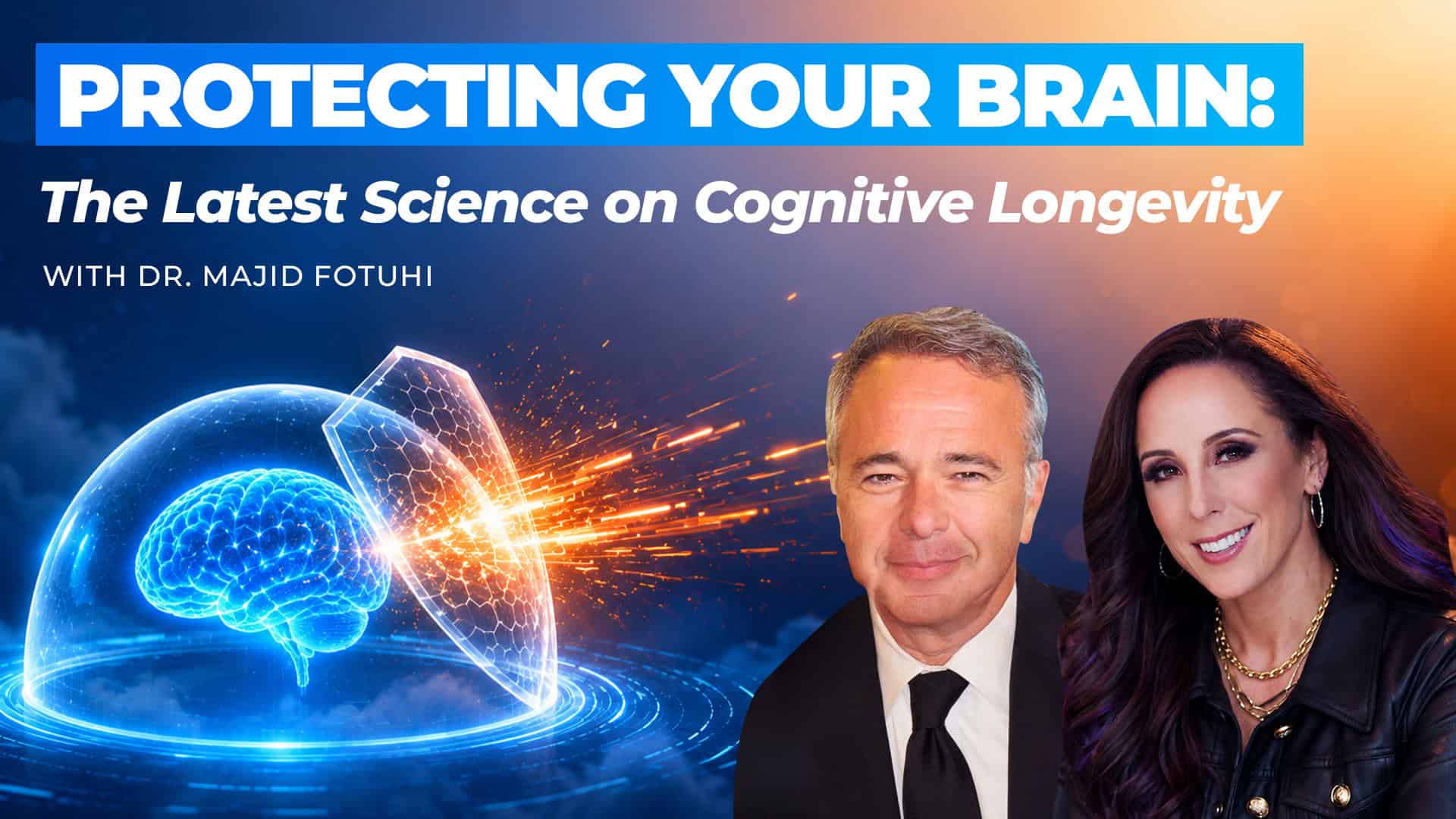
Can you actually build a more resilient brain as you age? Dr. Jill welcomes neurologist and neuroscientist Dr. Majid Fotuhi, author of The Invincible Brain, to explore cognitive reserve, brain aging, inflammation, and the lifestyle strategies that may help protect memory and cognitive function for life.
🔑 5 Key Discussions You'll Discover with Dr. Majid Fotuhi, MD, PhD
① 🧠 Building Cognitive Reserve
Exercise, learning, and mentally challenging activities help strengthen neural connections and build greater resilience against age-related cognitive decline.
② 🏃 The Five Pillars of Brain Health
Exercise, quality sleep, real food, stress reduction, and brain training form the foundation of Dr. Fotuhi’s approach to cognitive longevity.
③ 🔥 Inflammation & Cognitive Decline
Diet, gut health, chronic stress, air pollution, mold, Lyme disease, and other environmental factors may contribute to inflammation that affects brain health.
④ 🧩 Beyond an Alzheimer’s Diagnosis
Dr. Fotuhi discusses why cognitive decline should be evaluated broadly, including potentially treatable medical and lifestyle factors rather than focusing only on plaques and tangles.
⑤ ❤️ Connection, Learning & Longevity
Social connection, continued learning, positive thinking, and meaningful relationships can play an important role in maintaining a resilient brain.
🔑 Key Takeaways with Dr. Majid Fotuhi, MD, PhD
🔹 Cognitive reserve can be strengthened throughout life through exercise, learning, and new experiences.
🔹 Regular aerobic and resistance exercise supports blood flow, neurogenesis, mitochondrial function, and brain health.
🔹 Seven to eight hours of quality sleep supports the brain’s essential restoration and waste-clearing processes.
🔹 Whole foods, stress management, and reducing inflammatory exposures can support long-term cognitive wellness.
🔹 Social connection and continually challenging your brain are important components of healthy cognitive aging.
About Dr. Majid Fotuhi, MD, PhD
Dr. Majid Fotuhi, MD, PhD, is a neurologist, neuroscientist, and adjunct professor at Johns Hopkins University specializing in brain health, cognitive aging, and dementia prevention.
He is the author of The Invincible Brain: The Clinically Proven Plan to Age-Proof Your Brain and Stay Sharp for Life, which translates decades of clinical experience and neuroscience research into practical strategies for lifelong cognitive health.
Website:
https://drfotuhi.com/
Instagram:
https://www.instagram.com/dr_fotuhi/
LinkedIn:
https://www.linkedin.com/in/majid-fotuhi-md-phd/
YouTube:
https://www.youtube.com/channel/UCt99-8fdMIitv5YZi7jvfQQ
Book – The Invincible Brain:
https://www.amazon.com/Invincible-Brain-Clinically-Proven-Age-Proof-ebook/dp/B0FBRTPKPH/
Dr. Jill Carnahan, MD – Leading Functional Medicine Doctor
Dr. Jill Carnahan, MD, ABIHM, ABoIM, IFMCP is internationally recognized as one of the most respected leaders in functional and integrative medicine. She is dually board-certified in Family Medicine and Integrative Holistic Medicine, and the founder and medical director of Flatiron Functional Medicine in Louisville, Colorado.
Widely known as a pioneer in environmental toxicity, mold-related illness, autoimmune disease, and resilience medicine, Dr. Carnahan combines cutting-edge science with compassionate, root-cause care. Her clinical approach integrates precision genomics, epigenetics, microbiome research, peptide therapy, and lifestyle interventions to transform health outcomes for patients worldwide.
She is the author of the best-selling memoir Unexpected, which weaves her personal journey through cancer, Crohn’s disease, and mold-related illness with her professional expertise. Dr. Carnahan is also the executive producer of the award-winning documentary Doctor/Patient and the host of the popular podcast Resiliency Radio, which reaches over 500,000 global subscribers.
As an international keynote speaker, Dr. Carnahan has been featured at leading medical conferences including A4M, IFM, EPIC, and IPM Congress, and her work is frequently highlighted in major media outlets such as NBC, CBS, Fox News, Forbes, Parade, People, and MindBodyGreen.
With a reputation as both a scientist and a healer, Dr. Jill Carnahan is regarded as one of the top functional medicine doctors in the world, offering a unique blend of evidence-based research, innovation, and deeply personalized care.
The Podcast with Dr. Majid Fotuhi
The Video with Dr. Majid Fotuhi
Transcript
00:00
Dr. Jill Carnahan
Hey, guys. Welcome to Resiliency Radio, your go to podcast for the most cutting edge insights integrative and functional medicine. I'm your host, Dr. Jill, and with each episode we dive into the heart of healing and personal transformation. Join me as I interview world leaders, medical innovators and thought leaders of all types, helping you on your journey to optimal health and healing and longevity. One of the new favorite buzzwords. If you have not yet stopped by the store, DrJill Health.com, you want to be sure and stop by. You can get 15% off your first order and you can find all kinds of very curated products and services like the Epstein Barr Bundle, the tick prevention bite treatment protocol. You can find things for mast cell activation and some of my favorites for brain health.
00:47
Dr. Jill Carnahan
In our episode today, we're going to be talking about optimal brain health, the invincible brain with Dr. Fatoui. Steven, stay tuned. I'll introduce him in just a moment. But in the meantime, if you want to get some important nutrients for the brain, you can grab my favorite duo, which is Cognicare and BDNF Essentials. You can find them at drjillhealth.com I take them every day. I find them incredibly helpful to support optimal cognition. Finally, if you have not yet listened or seen the movie Doctor Patient, you can get that@drpatientmovie.com it's also streaming on Amazon Prime. Check it out, leave a review, let me know what you think. It's been a powerful change agent for those suffering from complex chronic illness. It tells my own journey through illness and that of several of my patients.
01:35
Dr. Jill Carnahan
And if you haven't yet watched it, check it out on Amazon prime again. Doctor Patient movie. Okay, let me introduce our guest, Dr. Fatoui. Dr. Majid Fatoui is a world renowned neurologist, neuroscientist and adjunct professor at John Hopkins University. He's recognized for his pioneering work in brain health, cognitive aging and dementia prevention. He's going to prevent some of the research present today, some of the research he's done on his recent book the Invincible Brain and the programs that have been proven to reverse the brain aging. Okay, let's get to it with Dr. Fatouy. Here we go. Dr. Fatouy, so glad to have you on Resiliency Radio. Today I want to talk about your new book that's already a bestseller, the Invincible Brain.
02:19
Dr. Jill Carnahan
Brain health is so critical, so many people are struggling and I don't know if there's a more common concern that patients come into My office with then, am I getting dementia? Is my brain diminishing in function? And all of these questions around our brain. So I want to talk to you today about all of this and more. Before we dive into your book, I want to know just a little bit about you and your story and your journey into medicine. How did you get to studying the brain?
02:49
Dr. Majid Fotuhi
First of all, thanks for inviting me to be on your show. I became interested about the brain when I was a kid. My father always talked to me about how our brain has no limit. How he wanted to encourage me to learn several languages, you know, be a famous author, doctor, and do something with my brain. So when I was 14, actually, I wrote a book about how our brain has incredible capacity. So when I started college and medical school, I became more and more interested in neurology. And during my residency, I became particularly interested about longevity prevention of Alzheimer's disease. I realized that many patients who were diagnosed with Alzheimer's disease had multiple medical conditions that were contributing to the cognitive decline, yet were just called as Alzheimer's patients.
03:44
Dr. Majid Fotuhi
I wrote several articles about how we are over diagnosing Alzheimer's disease and we are not paying attention to these treatable components. And, you know, I wrote several books, and this is my fourth book on this topic.
03:58
Dr. Jill Carnahan
Amazing. And that you started at 14, that just tells us a lot about the kind of kid you were. You were probably really curious and, you know, wanting to learn. I always feel like lifelong learning and curiosity are those things that define some of my favorite people. And clearly, at 14, you were thinking ahead. And then you had a father who said, you know, anything's possible, which made it even more amazing. I love the question because like you're saying, I want you to more frame that many people out there are diagnosed with dementia or Alzheimer's. But the truth is, we have a lot more control than we think. And you mentioned over diagnosis. So maybe a better question would be, can we build a brain that's more resilient as we age?
04:40
Dr. Majid Fotuhi
Yes. And that was my first book. I realized that throughout life, we have the opportunity to build a cognitive reserve. Cognitive reserve is like a retirement fund. When you learn new things, you create new synapses in your brain. When you exercise, you increase the number of blood vessels in the brain and provide better blood supply for the brain. When you challenge your brain in learning a new hobby, and you improve the networks of connections in your brain, and the more connections, the more synapses and the more blood flow you have, your brain, the more resilient your Brain becomes against the effects of pathological features of Alzheimer's disease. See, Alzheimer's technically is a condition in which these proteins clump up into little plaques or tangles.
05:38
Dr. Majid Fotuhi
You can think of them like a piece of gum that's insoluble and just sits there in the brain where it doesn't belong. But those things by themselves cannot cause problems if the brain is healthy and strong. Otherwise, if somebody has a large cognitive reserve, they can have quite a number of these plaques and tangles in the brain and have no symptoms. This is what the non study showed. The nun study, which was an observational study of several hundred nuns for many years, showed that many of them who died were quite sharp at the time of their death. In the late 80s and 90s, you know, some of them were still teaching, crocheting, driving, doing community work. And their brains under microscope showed evidence of lots of Alzheimer's pathology, lots of plexitangus, but they were fine, they were functioning. And that's what resilient means.
06:38
Dr. Majid Fotuhi
If you have a healthy brain through your lifestyle choices, by the time you get to your 80s and early 90s, you could stand some degrees of plaques and tangles and have those symptoms.
06:51
Dr. Jill Carnahan
Now, that's promising because one of the most popular new tests is the P tau. And some of the. We can actually test this now at Quest and LabCorp in different labs for these markers of neurofibrillary tangles and platinum plaques. But what you're saying is, even if those are positive or you have some form of that, it doesn't always equate with the fact that you're going to get dementia. What would you tell someone who maybe has gotten that test or is ordering that test with how much weight? Like, obviously there's something there, but it doesn't necessarily determine the outcome.
07:25
Dr. Majid Fotuhi
I put them in perspective by comparing the P Tau to 17 to having high cholesterol levels. If you have high cholesterol levels, you are at risk of developing a heart attack. Clearly. But you know, having high cholesterol by itself does not guarantee that you will have heart attack. You have to have other risk factors such as smoking, sedentary lifestyle, obesity, diabetes, too much stress, sleep apnea. If you have those and you have high cholesterol, then your risk of developing cardiovascular disease is high. Similarly, having high levels of amyloid and tau in your brain is a risk factor. I wouldn't want to have high levels in my brain, but if I have a high cognitive reserve, then I can harbor some degrees of these plaques and tangles in my brain and have little to no symptoms.
08:27
Dr. Majid Fotuhi
I think it's unfortunate that we don't have a complete profile for all the things that affect our brain. We have an incomplete picture of pathologies. Now you could, for example, get a carotid ultrasound and get a feel for your blood circulation. You can do all brain imaging to see the degree of atrophy in your brain and you could do other tests to get a more complete picture. So I see a lot of people who have had high P Tau to 17 and they're otherwise healthy and they're really panicking over the risk of Alzheimer's disease. And my message to them is, if you follow what I call the five pillars of brain health. Exercise, optimal sleep, a Mediterranean type diet, stress reduction and meditation, and brain training.
09:23
Dr. Majid Fotuhi
If you do those five things and incorporate them in your daily activities, you will have a larger cognitive preserve and you will be able to remain functional despite having plexitangles in your brain.
09:38
Dr. Jill Carnahan
Now, I loved with a list of five, none of them was one of the new meds for Alzheimer's because we know those are just targeting a target that we just talked about that is not really relevant and in some cases it makes people worse. So I love that you're talking about these really lifestyle oriented types of things that do change and that people could start in their 20s or 30s or 40s, way before they ever have some cognitive symptoms. Do you want to go through each of your categories and talk a little bit about some of the practical, like maybe the best types of exercise evidence based, what each of those start with number one, and let's go down the list and talk real specifics about maybe just a couple tips for each one for a patient out there.
10:19
Dr. Majid Fotuhi
We now have solid scientific evidence for these recommendations. People have been talking about diet and exercise and sleep for decades. The difference between now and 30, 40 years ago is that we have randomized control trials and we have lots of observational studies that together provide basis for making specific combinations. When it comes to exercise, I think people need to make sure that they do not have a sedentary lifestyle. You know, if you have a desk job, you really need to make sure that you walk 3,000 to 5,000 steps a day. There's a lot of debate as to whether you should do aerobic exercise or resistance training. Ideally you should combine. That's what I do. I usually do like 45 minutes of my Peloton and I do like 45 minutes of some kind of weight training.
11:11
Dr. Majid Fotuhi
So bottom line is that you need to increase your stamina. You need to be one notch stronger than you are now. And you don't have to become, you don't have to run a marathon. Many studies have shown that just walking by itself is very powerful. So if walking's all you do, and you walk 5,000, ideally 7,000 steps a day, you're fine. You don't have to do extra. But if you want to do extra, do three hours of exercise a week and try to combine maybe half and half of aerobic and resistant training. And exercise is just incredible. It increases number of blood vessels in the brain, it increases neurogenesis. You have more new neurons in the memory part of the brain called hippocampus.
11:54
Dr. Majid Fotuhi
It reduces inflammation, it increases the number of mitochondria, which generate more energy for the brain, and it increases the fiber bundles in the brain. So exercise from like 1 to 10 is 9 out of 10 in terms of how important it is. So when it comes to sleep, people need to appreciate that sleep is not a passive process. During sleep, there's a lot going on in your brain to make everything clean. There's a cleaning and cleansing operation that's hard at work during sleep and especially during deep sleep. So if you cut short the amount of sleep you get, you really are making your brain deprive that sense of waste management system. Imagine if you don't take the trash out of your house, or maybe take half of the trash from your house and see what would happen to your kitchen.
12:53
Dr. Majid Fotuhi
After two months, literally the same thing happens. The brain. The trash gets out of the brain. And that trash is metabolic byproduct of chemical reactions. Just like a factory that has some byproducts that need to be taken out. There are a lot of activities in your brain. In fact, there are more chemical and electrical activities in your brain than anywhere else in your body, by far. So you can't really deprive your brain of that, you know, waste management operation. So you need to make the sleep a priority. In my experience, many people say, I just can't sleep, or I've tried everything. Nothing works. And that's not really true because most people's insomnia is treatable. Many times people have a lot of stress and anxiety that keeps them up at night.
13:46
Dr. Majid Fotuhi
And many people don't do this basic sleep hygiene, like make sure you don't drink caffeinated beverages at night, make sure you don't eat spicy food before you go to bed. Make sure your bed is quiet and dark, don't break your Homework or your work related material and desk to your bed. A lot of basic sleep hygiene interventions can improve sleep. And if somebody still can't sleep, then there's this thing called cognitive behavior therapy which is very powerful. I think at least 90% of sleep issues can be treated with fairly simple interventions. There are people who have serious insomnia issues or sleep disorders, but they are the ones who will benefit from seeing a sleep specialist. So make sleep a priority. Get at least seven hours, ideally seven to eight hours. Now when it comes to diet, the guidelines are very simple.
14:48
Dr. Majid Fotuhi
You should not eat junk food. If you avoid eating processed food and things that are high in trans fat, Whatever else you eat is good, you know, because you're left with fruits, vegetables, you know, proteins, fish, meat. You know, there's some debate whether to ketogenic diet or vegetarian diet. I think just stick to one of them and do it, you know, just make sure you don't eat too many french fries and chips and cookies and donuts and muffins. Or if you do eat them, be reasonable, just have a little spoon, a little bite.
15:25
Dr. Jill Carnahan
Hey guys, Just a quick interruption to the show to remind you that you can get my book Unexpected Finding Resilience through Functional Medicine, Science and Faith anywhere books are sold. If you haven't yet read the book or shared it with a friend, please do so. You can also find it on my website, Dr. Jill health. Com. If you're wanting a signed copy for yourself or a friend or family member as a gift, you can order it directly from our clinic and I will send you a signed copy. You can just put in the checkout cart what you want that signed to who you want to send it to. And I will do that personally before we send it off. Okay, let's get back to Dr. Fatou and our show.
16:02
Dr. Jill Carnahan
I always loved like the Blue Zones data from Dan Buettner because it's all these five, six different places all over the world, Greece and Italy and Loma Linda and. And each of them have different, like some eat soy and some don't and some eat tubers and some don't and some eat meat and some don't. So but the commonality was real food, local food, non processed food, non chemicalized food, community with food. And so it feels like what you're saying is very similar to like the Blue Zones diet, which is quite varied according to geography. But the commonalities are highly processed food is out, sugar is out, you know, and these things that aren't real food are not part of the Diet.
16:41
Dr. Majid Fotuhi
Exactly. You know, when you eat ice creams and you eat, you know, pizzas that are poorly prepared or hamburgers that are poorly prepared, or this food you get, like fried chicken that, you know, God knows what's in it. Those things are harmful for the brain. You know, just think of it. You can have the best factory, but if the material you bring to the factory are junk, you're not going to get good products. And what you eat are the nutrients that your brain is going to use. So if you want your brain to be happy, you need lots of vitamins, sufficient amount of protein, adequate amount of fiber, and that's the kind of diet that your brain likes. Not things that are sugary and spice, your sugar levels and result insulin resistance and things like that. Food is very important.
17:30
Dr. Majid Fotuhi
But really the principle of what to eat, in my opinion, is very simple. Don't eat junk food. If you just do that, whatever else you eat, it's good for you. Especially if it's, you know, organic food and. And is healthy otherwise.
17:48
Dr. Jill Carnahan
Exactly.
17:49
Dr. Majid Fotuhi
Now, the fourth thing is stress. Chronic stress is bad for the brain. Occasional stressful events are part of life. And there's this thing called EU stress where a little stress is actually good for you. If you're preparing for a deadline, if you're like, when I was finishing my book, I had a deadline, or, you know, I have to prepare things, I think a little bit of stress sort of builds character and challenges you. It's a good thing. The stress that's bad is the kind that affects your daily life all the time. There are people who are stressed from the time they wake up in the morning. They're stressed out during the traffic, they're stressed out at work, they're stressed out with their family members, and really they need help. One of the things people don't appreciate is this. You have control over your thoughts.
18:40
Dr. Majid Fotuhi
You can think of the thoughts you have, like the clothes you wear every day. You really need to choose how you start your day. I think the first 10 minutes of your day is the most important part of your day. You need to sort of think good things. You should say, today is going to be a good day, and I'm going to have a good time at work. I'm going to have good interaction with my family members. I'm lucky to have these five things and just name all the things that you're grateful about. And then get out of bed with a positive attitude, with a sense of happiness and joy. Now I understand, you know, many people have financial problems. There Are marital problems. There are, you know, health related issues. People have problems. And my point is everybody has some problems.
19:34
Dr. Majid Fotuhi
You can't find anybody, regardless of financial status, that has no problems. Is how you view your problem is what matters. If you view your problem as gigantic, then it is a big deal. But the same problem to a different person is minor. So you need to decide what is really a major problem for your life and ask yourself, is it really a major problem? See as a neurologist, I see for example, parents who bring their teenage kids who are not studying and they're really devastated because they want the kid to get A's, go to medical school, be successful, and the kid is just not interested. And the whole life, their lives of the whole family is affected. And you know, I tell parents, they say, listen, you do your part.
20:22
Dr. Majid Fotuhi
You try to be a good role model, you try to communicate, you try to set rewards. You do your part and if it's not working, you've done your part. And you take care of yourself and don't let that become the most stressful thing. And then the other thing that helps is a few minutes of meditation and deep breathing really do wonders. Slow breathing has huge benefits in that they increase the vagus nerve activity, they improve parasympathetic tone, they increase something called hrv, which is heart rate variability. And that heart rate variability training has great benefits for the brain. So make it a point to sit down somewhere quietly and just breathe deeply. Just breathe in for a count of six, hold for the count of three, and then breathe out for a count of three.
21:18
Dr. Majid Fotuhi
And try to do it at least two minutes, ideally five minutes, and you will see, you really feel calm and relaxed even after two to five minutes of this slow breathing. If you can meditate while you do that, even better. But if you can't meditate, you just can't clear your mind. Just pay attention to the air going to your nostrils and breathe in, breathe out. Two to five minutes. Maybe in the morning, maybe in the middle of the day when things are hectic, or maybe going to bed. The last pillar of brain health after exercise, optimal sleep, meditating, diet and meditation is brain training. Your brain is like a muscle, and the more you challenge it, the stronger it gets. You really want to find opportunities to tease your brain.
22:08
Dr. Majid Fotuhi
Maybe you can try to memorize names, maybe you can learn something new about your work, about what people tell you. Dig in deep in a topic, Maybe you know, start bird watching, take a new hobby, or try to improve your skills in baseball or tennis or anything. Else or pick a ball. Every time you learn, your brain is improving. But learning doesn't have to be like a boring thing sitting in front of a computer. Learning means acquiring new skills, and ideally, you should do something that's fun. For example, I love dancing, so my way of brain training is to learn new dance steps. And it's fun and I'm learning it and it's, you know, social interactions, so it's a great thing.
22:59
Dr. Majid Fotuhi
So my recommendation to people, especially those in midlife who worry about their memory sleeping, is try to incorporate these five pillars of brain health in your daily activities. When you wake up in the morning, have a plan of how much activity you can get. Maybe you can plan to go for a walk during lunch hour. Maybe you can go for a walk with your spouse in the evening. Maybe you can go for a pickup ball and then decide what you're going to eat. Have some idea that were not going to eat the french fries and hamburger today, and instead you're going to get a salad or, you know, prepare something yourself. Maybe you can have egg and omelette or maybe, you know, some chicken, something that's, you know, preferably healthy and, you know, high protein, high fiber.
23:49
Dr. Majid Fotuhi
And then set a goal of when you're going to do two to five minutes of breathing and make it a point to maybe listen to a podcast or learn something new. It's not really that complicated. Incorporating these five pillars of brain health in your daily activities is quite simple and feasible. It doesn't have to be new. It does not need to be a new source of stress for people that I'm not taking care of my brain.
24:14
Dr. Jill Carnahan
Such great practical advice. And if you guys want to hear more or learn more, you can get the invisible brain. Because I'm sure that everything is in the book with lots of details. But thanks for running through that. My thought. Interestingly, I just listened to a podcast the other day which talked about literacy rates in the US and how they're really dramatically dropping because so few people are reading anymore. They're listening to their books and audio is great. I love podcasts. I love audiobooks. But I was just challenged personally, and I want to challenge you listeners out there to actually pick up a book. And I used to years ago read like two books a week. I don't do that pace anymore. But there's a cognitive dissonance that happens with reading, especially reading out loud.
24:54
Dr. Jill Carnahan
So I just was encouraged the other day of like, oh, I need to get back to making sure I have a of couple books by my nightstand and maybe before bed do 15 to 20, 30 minutes of reading and even reading out loud. I thought those were really good tips because there is a skill there that a lot of us are losing the literacy rate. Most recently, I think it was at 16% of adults actually read a book in the last year. That's crazy. That's really crazy. So let's talk about one thing. I love this question. What do you think is the biggest misconception that physicians have about cognitive aging? Like, what might your doctor be getting wrong?
25:30
Dr. Majid Fotuhi
Unfortunately, many doctors, especially those who are busy, think dichotomously about dementia versus normal aging. They talk to a patient and they say, you're fine, you're driving, you're cooking, you're working. What are you talking about? Or worse is if somebody has some memory lapses, which could be, for example, due to menopause, it could be due to poor sleep, it could be due too much work. And the person says, well, you know, my grandfather had Alzheimer's disease and I'm forgetting names. And they jump on the other side of this glycotomy spectrum and say, oh, it looks like you may have Alzheimer's disease. Let's check some biomarkers. And of course the biomarker may be positive. And all of a sudden you forget that you have many treatable issues for your memory lapses.
26:28
Dr. Majid Fotuhi
And instead of working on those, you're worried about Alzheimer's disease and now you're struggling with the fact that you're going to be demented, what's going to happen to your finances? Who's going to take care of you? Which is really not necessarily. I think it would be great if more and more doctors appreciated that cognitive decline is on the spectrum, let's say from 1 to 100. And even if somebody has what we call mild cognitive impairment, a condition in which people repeat the same question multiple times, but they still function, even those patients improve greatly with lifestyle interventions. I develop a 12 week brain fitness program for people with cognitive decline. I initially provided this program for patients who were in their 70s and early 80s. These patients had mild cognitive impairment, which is considered to be a stage between normal and Alzheimer's disease.
27:26
Dr. Majid Fotuhi
These are the people who repeat themselves often. If you look at their brain, they do have footprints of Alzheimer's disease in their brain. During this program, I would do a head toe evaluation to determine all the causes for their cognitive decline, which included, you know, hormonal changes, poor diet, maybe respiratory issues, smoking, poor cardiovascular functions, low stamina, maybe they have Some liver or kidney problems, maybe they had, you know, joint pain that limited their ability to move and lack of movement were contributing. So I would do a full evaluation of all the medical problems. I checked 40 things, and then every person would have four or five or six things. Hearing loss, poor vision, alcohol, a whole lot of things. And then every person would have four or five issues which were potential culprits.
28:24
Dr. Majid Fotuhi
And they were not the same four or five issue for every person. Every person had different issues. And then I started to work on their medical issues, including diabetes, depression, polypharmacy, taking too many medications. And as I did that, I would put them also in a program to work with my brain coaches. My brain coaches would meet with the patients twice a week for 90 minutes at each visit. And during each of those 90 visits, half of that time was devoted to going over their lifestyle issues, going over those five pillars of brain health. And then the other half was for brain training and biofeedback, HIV biofeedback and neurofeedback. And so, for example, a person was not walking much. I was sedentary, would talk to my brain coaches, and they say, okay, Mr. Smith, please walk 10 minutes.
29:17
Dr. Majid Fotuhi
And they say, oh, I have, you know, joint pain, this and that. Okay, well, let's talk to your doctor, figure out how we can manage your pain, because we have to walk. If you can't walk, maybe you can do rowing, maybe you can do yoga, maybe you can do a stationary bike. You know, something we can swimming. You know, my brain coaches would work with them to find a way to exercise. And then they would talk with the patient about the food they were eating. And so wait a minute. You know, you're having just, you're having a lot of bread and cheese, and you don't have enough protein in your diet, or, you know, you're this eating this food that's highly processed, or this and that. And the same thing with sleep and brain training.
29:57
Dr. Majid Fotuhi
So half the time was really sitting down with a patient, listening as much as talking, because you need to hear the excuses the patients have for not exercising, for example. And it's important to listen and not just lecture them. And then we started at where the patients were, like, if somebody was walking already 3,000 steps a day, then we would work with them to increase the stamina by running or do some circuit training and so forth. So while my brain coaches met with our patients twice a week and did half of time on five pillars of brain health and half time on brain training and biofeedback, I Took care of the medical issues. I ordered a sleep study and treated someone's sleep apnea. I managed hearing. I got them the hearing aid. So in parallel, we will work with the patients.
30:52
Dr. Majid Fotuhi
So after six weeks, we would repeat the testing. The baseline cognitive testing would be repeated at six weeks, and then they would come to meet with me. Some things improved, some things didn't. And then six more weeks, and then they graduate with doing another set of cognitive evaluations. So what we found was 84% of our elderly patients who were one step away from getting Alzheimer's disease improved their cognitive function. It wasn't that they were less, worse, they improved. And in half, these patients agreed to have MRIs. An MRI showed that the hippocampus, which is the size of your thumb, as a part of brain for learning and memory, increased in volume by 1 to 3%. These are elderly patients. These are not teenage kids. These are elderly. We published those results in a Journal of Prevention of Alzheimer's disease in 2016.
31:47
Dr. Majid Fotuhi
I kept providing the program for other groups of patients, those with concussions, those with brain fog, those with ADHD. And we saw similar results. More than 80% improved. And I published those in the Journal of Alzheimer's Disease reports. And that's the basis of my book, how we came up with this program. And what are the evaluation steps that need to be done and what are the interventions? All the details of the things we did are the basis of my amazing.
32:22
Dr. Jill Carnahan
What incredible results. And again, I like that our first question was, what do physicians need to know? Because you're right, many of our colleagues kind of stop and just assume that either the drugs are going to do something, which we have very little evidence that the drugs are actually working versus these lifestyle. And many physicians are taught, oh, patients won't exercise or do it. But you've got this program that kind of walks them through with coaches, which I think is also part of the compliance, because they have someone to kind of check in and help them. And I'm assuming now with AI and with virtual assistants and agents, I think we're going to have a lot more ability as physicians to give our patients tools to actually help them follow through with things like this program, which makes so much sense.
33:05
Dr. Majid Fotuhi
Let me just add two little things quickly. One thing is that I just did what you mentioned. I set up an AI based on my book. I have developed an app, the Invincible Brain, a free app. And in this app, we have the same questionnaires that we provided for our patients. And we have used AI to Go over the questions and then use the information in my book to create a report and answer the questions that users have. The second thing I wanted to tell you, so it's the Invincible Brain app is available for iPhone androids. And the other thing is that I gave a lecture at the American Academy of Neurology this April to 5,000 neurologists who are there from 120 countries. This is the American academic, and I was honored to give the plenary speech.
34:03
Dr. Majid Fotuhi
And my speech was about how lifestyle interventions are far more effective than these new medications. These new medications slow the rate of decline. And then lifestyle interventions based on randomized control trials improve cognitive function.
34:21
Dr. Jill Carnahan
Yes.
34:22
Dr. Majid Fotuhi
One reduces the decline, the other one improves cognitive function.
34:27
Dr. Jill Carnahan
Yes.
34:28
Dr. Majid Fotuhi
And so it's a very exciting time for us because we now have solid scientific evidence that the combination of lifestyle interventions are very powerful.
34:39
Dr. Jill Carnahan
I love that. And like you said, we've been very disappointed by the drugs because the drugs, again, they might prevent worsening, which is a very different outcome than actually improving the hippocampus volume. That's very impressive data that you're presenting before we kind of wrap up and tell people where they can find the book. One thing that I love to talk about is inflammation and environmental toxicity and some of these other things that obviously affect our bodies and brains. What role do you see for inflammation caused by either infections or toxins in the brain health?
35:13
Dr. Majid Fotuhi
I think inflammation is the fire that causes so many problems in the brain.
35:20
Dr. Jill Carnahan
Yes.
35:21
Dr. Majid Fotuhi
See, remember we started by saying that you have some plaques and tangles in the brain, that little pieces of gum sitting there. If those blacks and tangles just sit there without any inflammation, a person would not have so much problems. It's the body's inflammatory response that creates the problem. It's like you call the ambulances and then too many ambulances arrive and they just flood the house.
35:47
Dr. Jill Carnahan
Yes.
35:48
Dr. Majid Fotuhi
So the intention of inflammatory response is a good thing, unfortunately, because there are so many problems, there's an over response. And then the cells in the brain that are usually intended to help with reducing inflammation, called microglia, they become a part of the problem because they get overwhelmed, then they create more inflammation. So I think the ultimate cure for Alzheimer's disease would be ultimately to find a drug that will calm this inflammatory fire in the brain. Now, you know the inflammation in the brain is not just because of plaques and tangles. When you eat a poor diet, when you eat things that are high in trans fats and highly processed food increase inflammation in the brain. When you have gut problems and you have what's called a leaky gut that causes inflammation brain.
36:42
Dr. Majid Fotuhi
If you're stressed, if you're stressed, if the environment is stressful, that increases inflammation in the brain. Is it fascinating that somebody giving you a hard time or you have an argument with someone somehow that converts into inflammation in the brain? It's fascinating. How does it work? I mean, what does. What do these inflammatory markers have to do with this? But then things like air pollution is a risk factor for inflammation in the brain and of course, you know, other toxins in the environment. Now it can play a role lead toxicity. And to me, the most important environmental factors that increase inflammation are the food, the highly processed food that people eat and stress in the environment that people have. And when you have a sedentary lifestyle and things are stagnant, your brain thrives with blood flow, with activity.
37:43
Dr. Majid Fotuhi
When somebody has obesity and stagnation, that too inflam increase inflammation. So, you know, you have to change environment where you move more. You try not to be exposed to air pollution as much as possible, and you choose carefully what you eat. Of course, there are people who have Lyme disease. I treated many patients with mold and Lyme disease, and those were my patients who did not get better with my first round of treatments. You put people in the program, like I said, 84% improved, which means 16% they improved. Not like day and night difference, but. And that those 16% were people who had these other issues such as Lyme mold, environmental issues and toxins and other things.
38:34
Dr. Jill Carnahan
Oh, yes. So now you're speaking my language because those are the ones that come see me and they are the. They're. Come again. I love. That's who I treat. I love treating those patients. But they're very complex. And this combination of infection and toxin is absolutely at the root of some of the hard cases. So that's really awesome too, because you can do your program and if they're not getting well, they might seek out an infectious specialist, an eyelads doctor, someone that can go to that next level as well.
38:59
Dr. Majid Fotuhi
I had many patients myself who, for example, came to me. I never forget. I had a patient with a CIA agent. Actually, she disclosed that I live here very close to CIA headquarters.
39:10
Dr. Jill Carnahan
Yeah.
39:10
Dr. Majid Fotuhi
And she said, I can't think clearly like I can. And she was in her 40s and we did the program and she said, Dr. Patui. And then I asked more questions and she said, oh, by the way, you know, we had some mold and I'm, you know, in the kitchen, we discovered. And then we had to. Do you think that has to do with anything? I said, wait a minute. This is an important factor. Of course. Mold can affect your brain.
39:38
Dr. Jill Carnahan
Yeah.
39:39
Dr. Majid Fotuhi
And she. And I told her, like, you need to. You just need to move. So she moved to live with her boyfriend and then they redid the kitchen. And while I was working with her on brain health issues, just the fact that she was removed from exposure to mold contributed to her getting better. She became her usual self. And she actually wrote a very long complimentary review for me on Google Reviews. And don't forget her. But patients do respond to treatment of mold and especially Lyme. I've had many patients with Lyme who improved after treatment with Lyme.
40:20
Dr. Jill Carnahan
I'm glad you said that because again, those complex people and a lot of people who listen to our podcast do have some of those kinds of things or know people who do. And it's not the thing you would first think about brain health, but I always say clean air, clean water, clean food, which is exactly some of the things you're talking about. And air is huge, which is your environmental exposures that you're mentioning, because 80% of our toxic load from nanoparticulate and mold and all these things that we breathe in our nose is so close to the cribiform plate and that blood brain barrier that we often get effects from the inhalation of noxious substances to our brain in particular. So. Well, I'm just so excited for people to get a copy of your book and learn more.
40:58
Dr. Jill Carnahan
I think the last question I want to ask about is something we didn't specifically talk about. And I have a feeling you'll have a word or two to say. Community and connection seem to be the thing that people are missing more and more as we have this virtual world and people, we're all in our homes and we're ordering off Amazon and we're interacting less. What role does community, connection, friendships, relationships have in brain health?
41:20
Dr. Majid Fotuhi
They're huge. To me, that falls under the category of stress reduction and enjoyment of life. You really need to connect with people on real life situations and not through social media. Many, many studies have shown that isolation is a major risk factor for Alzheimer's disease. And it's not isolation. Like you live in a house in the middle of nowhere. You could be in the middle of New York and be lonely. Because it's not just the people, it's the communication you have with people and the real holding hand with a friend, going for a walk with a friend, or Having dinner with a group of friends, I really make that a priority. And I also notice how happy I am when I am with a group of family friends just at a picnic.
42:12
Dr. Majid Fotuhi
And I really think that people need to make an effort to see their friends for real and cut back on, you know, social media and really work on real social life.
42:27
Dr. Jill Carnahan
I couldn't agree more. I've just been really making an effort to like on Saturdays call a friend to hike or walk or have coffee or go to the market. And what I'll try to do is just every Saturday a different person. I'll text a few and just see who's available. And it's been some of the highlights of my week is that physical connection. And what I love is I'm doing one of your brain steps which is we always do some activity walking or hiking or moving. And a lot of people love pickleball. I'm not a pickleball player but so you can do these things and do an activity with them as well. Dr. Fatou, it has been a pleasure to talk to you and learn more about your work and your book.
43:01
Dr. Jill Carnahan
If people want to find out more about you, where can they find your book and your research?
43:06
Dr. Majid Fotuhi
Yes, there's a lot of information about me on my website, Dr.fatouhi.com that's D R F as in Frank O R T U H I.com Dr. Fatou.com I'm also on Instagram Dr. Fatuhi and on LinkedIn and on YouTube and I think it'll be great for people to try my free app which is the Invincible Brain in the app store and the app also includes free a set of videos. I have 18 modules about all the things we talked about.
43:46
Dr. Jill Carnahan
Amazing. We will be sure and link up if you're driving or walking or not near a computer we will link that in the show notes. You can find that you know wherever you are listening to the podcast. Dr. Fatou, thank you again for coming on the show.
43:58
Dr. Majid Fotuhi
It's my pleasure. Thank you very much for inviting me.
44:00
Dr. Jill Carnahan
Hey guys, hope you enjoyed that great episode on the Brain, the invincible brain with Dr. Fatou. It's always fun to learn new evidence based protocols and things that we can do practically to help keep sharp into our 80s and 90s and beyond. Recently I played Roomie Cube with my 94 year old grandmother and it was so fun to see her cognition. She is sharp as ever. Lucky me for those genetics. And I just thought what a great thing that she's still playing games and doing that in her 90s and beating us all at the game. So go grab a friend, go on a hike, try some new activities, play with neuroplasticity, and do whatever you can to optimize your brain health. And as you know, we have a new episode coming out every single week on Resiliency Radio.
44:47
Dr. Jill Carnahan
If you have not yet liked or subscribed or left a review anywhere you're listening to this podcast, it would be a great favor if you do that for me right now, and I'll see you again next week for another episode of Resiliency Radio.
* These statements have not been evaluated by the Food and Drug Administration. The product mentioned in this article are not intended to diagnose, treat, cure, or prevent any disease. The information in this article is not intended to replace any recommendations or relationship with your physician. Please review references sited at end of article for scientific support of any claims made.






Share: