

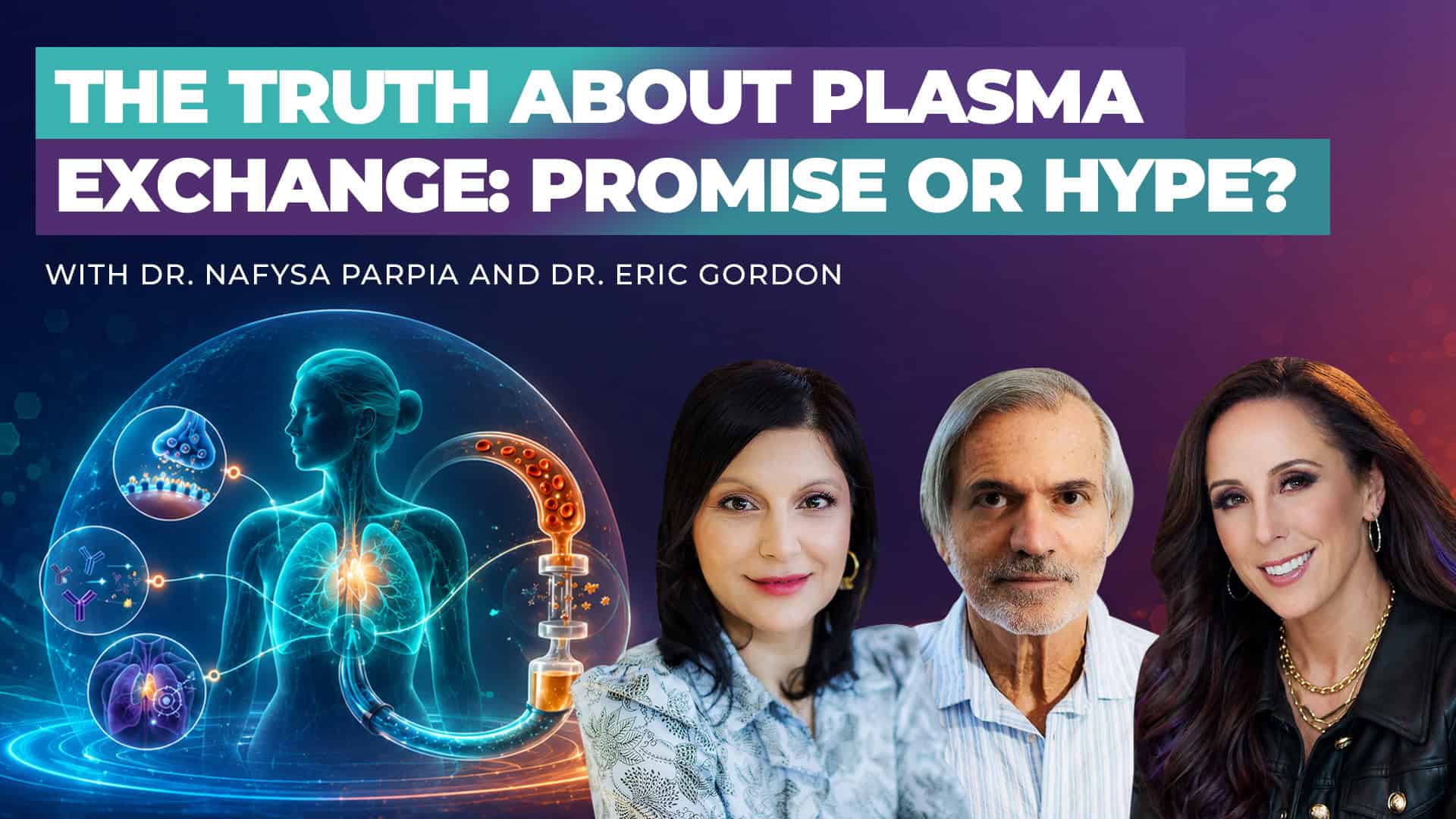
Is Therapeutic Plasma Exchange the breakthrough it’s sometimes made out to be—or is the reality more nuanced? Dr. Jill welcomes Dr. Nafysa Parpia and Dr. Eric Gordon to separate the myths from the facts about TPE, exploring how it works, who may benefit, why preparation matters, and its emerging role in complex chronic illness.
🔑 5 Key Discussions with Dr. Nafysa Parpia & Dr. Eric Gordon
① 🩸 What TPE Actually Does
TPE removes and replaces plasma, temporarily reducing circulating inflammatory substances and giving the immune system and liver a break from an ongoing inflammatory burden.
② 🧬 TPE & Complex Chronic Illness
The doctors explore its use in patients with interconnected issues including autoimmunity, PANS/PANDAS, tick-borne illness, MCAS, mitochondrial dysfunction, and chronic inflammation.
③ ⚠️ Why Preparation Matters
TPE isn’t necessarily the first step. Highly sensitive patients may need support for nutrition, gut health, mast cells, hormones, detoxification, and mitochondrial function beforehand.
④ 🦠 Bartonella, Autoantibodies & IVIG
For conditions involving autoantibodies or Bartonella, multiple TPE treatments may be needed, with treatments such as IVIG considered as part of an individualized strategy.
⑤ 🌎 Toxins, Longevity & Emerging Uses
TPE is increasingly discussed in relation to environmental exposures, PFAS, plastics, and longevity—but the doctors emphasize reducing overall toxic burden rather than viewing it as a complete detox solution.
🔑 Key Takeaways with Dr. Nafysa Parpia & Dr. Eric Gordon
🔹 TPE is a plasma-removal and replacement procedure—not a universal cure or simple “detox.”
🔹 Chronic illness often involves multiple interconnected systems that need to be addressed together.
🔹 Preparing highly sensitive or depleted patients before TPE may be critical to tolerability.
🔹 Peptides and bioregulators may be incorporated to support immune regulation, gut health, and cellular function.
🔹 TPE works best as part of a comprehensive, individualized treatment strategy guided by experienced clinicians.
About Dr. Nafysa Parpia & Dr. Eric Gordon
Dr. Nafysa Parpia is a board-certified naturopathic doctor and Director of Naturopathic Medicine at Gordon Medical, specializing in complex chronic illness, including Lyme and tick-borne disease, mold illness, autoimmunity, long COVID, ME/CFS, and MCAS.
Dr. Eric Gordon is an internationally recognized expert in complex chronic illness with more than 45 years of clinical experience. He is President of the Gordon Medical Research Center and has collaborated extensively on research involving ME/CFS, Lyme disease, autoimmunity, and mitochondrial dysfunction.
Gordon Medical: https://gordonmedical.com/
Gordon Medical Forums: https://gordonmedical.com/gma-events/
Dr. Jill Carnahan, MD – Leading Functional Medicine Doctor
Dr. Jill Carnahan, MD, ABIHM, ABoIM, IFMCP is internationally recognized as one of the most respected leaders in functional and integrative medicine. She is dually board-certified in Family Medicine and Integrative Holistic Medicine, and the founder and medical director of Flatiron Functional Medicine in Louisville, Colorado.
Widely known as a pioneer in environmental toxicity, mold-related illness, autoimmune disease, and resilience medicine, Dr. Carnahan combines cutting-edge science with compassionate, root-cause care. Her clinical approach integrates precision genomics, epigenetics, microbiome research, peptide therapy, and lifestyle interventions to transform health outcomes for patients worldwide.
She is the author of the best-selling memoir Unexpected, which weaves her personal journey through cancer, Crohn’s disease, and mold-related illness with her professional expertise. Dr. Carnahan is also the executive producer of the award-winning documentary Doctor/Patient and the host of the popular podcast Resiliency Radio, which reaches over 500,000 global subscribers.
As an international keynote speaker, Dr. Carnahan has been featured at leading medical conferences including A4M, IFM, EPIC, and IPM Congress, and her work is frequently highlighted in major media outlets such as NBC, CBS, Fox News, Forbes, Parade, People, and MindBodyGreen.
With a reputation as both a scientist and a healer, Dr. Jill Carnahan is regarded as one of the top functional medicine doctors in the world, offering a unique blend of evidence-based research, innovation, and deeply personalized care.
The Podcast with Dr. Nafysa Parpia & Dr. Eric Gordon
The Video with Dr. Nafysa Parpia & Dr. Eric Gordon
Transcript
00:01
Dr. Jill Carnahan
Hey everybody. Welcome to Resiliency Radio, your go to podcast for the most cutting edge insights integrative and functional medicine. I'm your host, Dr. Jill, and with each episode we dive into the heart of healing and personal transformation. Join me as I interview medical experts, world leaders, innovators of all types, helping you on your journey to optimal healing and performance. Today I have two special guests and friends from the Gordon Medical Clinic. I'll introduce them in just a moment. And our topic today is tpe. If you haven't heard of that, we now offer that in our clinic. You can learn more about that if this podcast episode interests you. At MD Lifespan, Dr. Jill, you can see my mold protocol and also many of the other protocols we've developed.
00:47
Dr. Jill Carnahan
You can actually get more information there and you can book a free consult with one of the doctors that will be helping you through your case. So if you want more information about TPE, especially after listening to this episode, go to MD Lifespan. DoctorJill check it out. Okay. I also want to remind you that if you have not checked out the retail store drjilltalk.com we have so many incredible products and services to help you on your way to health and healing. One of the topics you'll hear in this episode is peptides and we even have peptides available for you. Check it out there. I also want to mention the Dr. Jo Beauty line, which is a clean line that really helps you take optimal care of your skin.
01:26
Dr. Jill Carnahan
When one of our products that's been flying off the shelves I wanted to mention today is this Melabrite. Hopefully you can see that it is a lightener brightener for those dark spots on your skin. Recently someone messaged me on social media and asked what do I do about melasma, which has been a popular topic of conversation. This is our solution. Check it out. Mellow brightoctorjill health.com okay, now let's get to our show and introduce our guests. We have two guests today, Dr. Nafisa Parfia. She's a board certified naturopathic doctor and director of Naturopathic Medicine at Gordon Medical, specializing in complex chronic illness including Lyme and T disease, mold related illnesses, autoimmune, fibromyalgia, long Covid ME CFS and mast cell activation syndrome. That's a mouthful, isn't it?
02:11
Dr. Jill Carnahan
She's a recognized expert in peptide therapy and combines advanced testing with personalized treatment plans, integrating functional and conventional medicine, regenerative treatment and many other things. You're going to love her today. And Dr. Gordon is an internationally recognized expert in complex chronic illness as well, with more than 45 years of clinical expertise, treating many, as I just mentioned, autoimmunity, mitochondrial dysfunction, me, cfs, Lyme disease, so many more that I could mention. But I want to get them on the show so we can get right to it and talk about tpe. So let's welcome them to the show. Hello, everyone. So glad to be here with two of my favorite friends and colleagues, Eric and Nafisa. And we are going to talk today about a topic that's becoming much more popular.
02:55
Dr. Jill Carnahan
Many of you have heard a little bit about it if you've been around me, but if you haven't, we're going to dive deep into tpe, therapeutic plasma exchange. If you don't know what that is, stay tuned. I promise it'll be worth your while because this is an up and coming, it's kind of an old, new therapy. It's actually been around a very long time. And we're going to talk about busting the myths and talking about the facts around this therapy and how it can be especially helpful in the populations that we all serve, which is those of you with complex, chronic, mysterious types of illnesses. And as I mentioned in the beginning here, I think it's so important those of you listening, if you have friends, family, yourselves that are struggling with mysterious illnesses, stay tuned because we're going to talk about that.
03:36
Dr. Jill Carnahan
We're going to talk about a framework and we're going to especially be talking about tpe. So welcome to the show. So glad to have you both here.
03:44
Dr. Nafysa Parpia
So glad to be here. Thank you, Jill.
03:46
Dr. Eric Gordon
Always a pleasure, Jill.
03:47
Dr. Nafysa Parpia
Yeah.
03:48
Dr. Jill Carnahan
Yes. You're welcome. And I feel the same. We talked right before we got on to just how in this world of functional, integrative, personalized precision, we could give all these names, optimal performance, longevity medicine. It is such a treat to talk to colleagues that really get it. And I hold you guys in high regard in regards to how you view the map of illness and how we look at patients. And maybe before we dive into tpe, let's just start there and talk a little bit about you guys have both treated. And forgive me, you guys is an old term, I should retire, but I'm still used to that slang. Right. You both respectfully have treated some of the most complex patients in medicine. What have these patients taught you about how to map out what you're seeing in clinical practice?
04:37
Dr. Eric Gordon
I think probably the most important thing is that in chronic illness, it's not the cause that is the main driver Usually, I mean, you know, everybody looks for the cause. And these days people are starting with mast cell and mold and, you know, then go down the list and. But at the end of the day. And that works fine for people who are fairly robust. But if they've been sick for long enough, what we're dealing with is the compensations that the body has made. So it's. And in medicine, we're always looking for the thing that's broken. But in these people, generally you have a series, like five or 10 systems that are just working suboptimally and as well as, you know, the big quote, unquote triggers. And so.
05:34
Dr. Eric Gordon
And if you try to deal with the triggers right off the big things, people often get worse. And so we have to in. And again, there's no harm. I shouldn't say there's no harm, but when people are first ill, going after the big. The big things are probably the right way to go. You know, there's no harm in treating Lyme disease or, you know, treating, you know, chronic infections. But in most of the chronically ill people, you know, they have on top, they usually become mold sensitive or their mast cells are now activated. And so those have to be dealt with. And I'm going to. But underneath it all is a toxicity. And that's where I think maybe let Nafisa talk more about and then we'll come back to. What I'm talking about is compensations.
06:22
Dr. Nafysa Parpia
You know, before we go to talk about toxicity. I think about it this way, that there are five main reasons people get sick with complex chronic illness. Not acute illnesses, but persistent chronic infections, environmental toxins, stresses. And a lot of people have had adverse childhood events or personal stresses. They're going through at the same time, diet and lifestyle and their genes. And when people have the first four going on persistently, they get persistent inflammation, persistent oxidative stress, and they get stuck in this loop of those two things. And now we have persistent inflammation, oxidative stress, meeting the genes, meeting the different systems of the body. And now we have these secondary downstream illnesses. And what I found is that when we're working, when we work with the systems first, the downstream issues first, I'll call that mast cell activation syndrome.
07:27
Dr. Nafysa Parpia
I'll call that autoimmunity, call that endocrine disruption, sibo, leaky gut. When we can deal with these, which have really, these things have become, I would say, the ultimate root cause of chronic illness because we've got this persistent inflammation, oxidative stress, and we've got to calm that down that penultimate cause of chronic illness and then reach for the root causes. Because as Eric was saying, if you try to kill the infections or the toxins first, they can't handle it. But I say it's because inflammation, oxidative stress, it comes with the territory. When we're going to kill infections, persistent infections, and detox people, we're going to increase inflammation, we're going to increase oxidative stress. Their bucket is already to the limit, maxed out with those things.
08:20
Dr. Nafysa Parpia
So I want to calm those systems first, the secondary downstream effects first, and then come in and deal with the causes. And when Eric talks about compensations, that's, that's also what I'm talking about, the secondary downstream things. So I just wanted to say a little bit about that. But about environmental toxins, they sure are higher now than they ever were before. And we see a high load of environmental toxins in these patients. So what patients, diagnoses like me, cfs, long Covid, chronic Lyme autoimmune conditions, fibromyalgia, environmental toxins are a big piece of that contribution to persistent inflammation and oxidative stress. And very often we need to detoxify them. And we're coming in often, when needed, in the right patient, tpe. And so I'd love for you to bring that up.
09:22
Dr. Eric Gordon
Yeah, I think even before I go to tpe, what you brought up was the gut. You know, I mean, everybody's, We've all been dancing around the gut forever, you know, and in the old days it was easier because we didn't have as much information. We, we got, you know, we got test results on, you know, 10 bugs, and now we get hundreds. So there's a lot of learning there. But, yeah, but the, the gut, because once the gut gets inflamed, okay, you wind up in this situation where you're no longer absorbing nutrients like you should, and then, and you're stressing your liver. And so then that detox part is no longer a nothing or a mild headache or not feeling well. But people get really sick because the liver has been working too hard.
10:16
Dr. Eric Gordon
Because remember, everything that happens in the gut, all that blood gets drained into the liver. And that's what the liver has to deal with. And when it's full. It has to, it's one of your main detoxification organs. And once it's up to the top, it really doesn't do well.
10:35
Dr. Jill Carnahan
It's almost like we could have the liver metaphor be the bucket. I want to just restate what you've stated so that our audience who hears this clearly, because you guys have done such a great job of like this overview and kind of shifting people's thinking from just like, oh my gosh, I have Lyme disease. Oh, I have mast cell. And as you know so well, our social media platforms are a bust of whatever we're hearing or talking about. And then we get those things. And I'm always little disheartened by the kinds of things that are out there that are misinformation and from people who have no real credentials at all to be speaking. I cured myself from this. And so I'm the expert and I kind of cringe just a little because there's a lot of misinformation out there.
11:10
Dr. Jill Carnahan
So I want to talk about tpe, but before we do, I want to lay this groundwork. Nafisa, you said this, these five things, you gave us a really clear map of all the different things that are interplay. And rather than focus on just a diagnosis or name or ICD10 code, which could be vector borne illness like borrelia or mold related toxicity, or mast cell activation, which are all common popular things, it's more this underlying terrain that all comes with the mix of things. And then Eric, you said that this is, it's important to really calm down that first and think about this gut immune interface as really a core piece. I would love to frame that as just real quickly. Toxic load is so big, all of us see it every day.
11:57
Dr. Jill Carnahan
And I think one thing that you were mentioning, Eric, that people don't understand is we think of toxins from the outside, right? The air that we breathe, the water that we drink, metals, pfas, parabens, phthalates, mold. But what you're talking about, Eric, really importantly is these endotoxins which come from inside out and could be just as big of a load. Do either one you want to talk a little bit about? Because I think this is so important to, for people to realize they're getting toxic from the inside of their gut is a mess. Right? Hey guys. Interrupting the show for just a quick moment to let you know that if you're looking for therapeutic plasma exchange, I don't know if you knew this or not, but we offer therapeutic plasma exchange in my clinic in Louisville, Colorado. So you.
12:36
Dr. Jill Carnahan
If you're in the state of Colorado or anywhere in the area and looking for a great provider, we contract with a group called MD Lifespan, one of the national leaders in offering therapeutic plasma exchange. We have protocols for brain health, immune system, cardiovascular, prenatal preconception, mold related illness, which of course I've helped to create the protocols there. And really anything you could want or need, these are highly effective protocols. And I would love for you to get more information or schedule a free call with one of our physicians at MD Lifespan, Dr. Jill. So go to MD Lifespan, Dr. Jill, check it out. And let's get back to our show for more about tpe.
13:21
Dr. Eric Gordon
You know, the toxicity from the gut has always focused on the lipopolysaccharides. These are like part of the cell membranes of gram negative bugs, which your body is really primed to protect you from, because that's how people died from sepsis up until the last hundred years of antibiotics. That's how we usually died. And most often it was very common that the gram negatives were the things that got us. And so your body is really sensitive to that. And one way to start getting inflammatory cytokines going is to have a leaky gut where this lipopolysaccharide gets across into the bloodstream. And you know, these are comparatively low doses, but they're enough to activate a very sensitive system. So that keeps people chronically inflamed. But on top of that, there are many other chemicals.
14:14
Dr. Eric Gordon
And I've been working for the last year a lot with this fellow, Joshua Lees, who has, I think, a very good framework or way of looking at things, treat a little differently than he does, but I think it's a very good framework. And he focuses a lot on what happens once the gut gets inflamed. That you have a hormone called hepcidin that's made in the liver that is designed to protect you again from acute infection. Because what it does is it shuts down the mineral transport. This should be like everything else we talk about that keeps us ill. This should be a transient immune effect that is gone within three, five days, three weeks. Not long term, because it's designed to keep you alive and to keep the bugs from reproducing because the bugs need these minerals.
15:09
Dr. Eric Gordon
And so when you have bugs in your bloodstream, you want to stop them as fast as you can. So you shut down minerals that are available and so you stop absorbing them and you also lock them into your cells. But if you keep doing that, over.
15:24
Dr. Nafysa Parpia
Time,.
15:26
Dr. Eric Gordon
Over time, your trace minerals will begin to diminish. And remember, all your vitamins, all your B vitamins have cofactors that are minerals. Think of B12 is East Cobalt, but they all need B6. Doesn't get activated. Doesn't really get into the cell into the active form of P5P until you've got magnesium and zinc. You need these. They begin to diminish over time with chronic inflammation. It's very important. Also this also locks in the heavy metals into the cells so you get hurt both ways.
16:08
Dr. Jill Carnahan
A trapdoor is stuck.
16:10
Dr. Eric Gordon
It's stuck. Yeah. And your body's usually. I mean that's the other reason heavy metals are such a big deal. Didn't go through all the toxins, but that's ones that we've all known about for years and we all tried to deal with. But this is one of the reasons they keep building up in our patients. It's not just that their glutathione is low, but it's also that the body has stopped excreting them from the cells. When you have this constant inflammatory signal going. So long story but very important little side piece and also fascinating, I think.
16:44
Dr. Jill Carnahan
So, so important. I love these tangents because they're critical and fire a lot of people listening. I'm sure it's kind of new. One just question I have practically is I have found incredible power in very simple mineral adding back. Right. Like liquid minerals in different forms. I could name brands. I won't but I'd love to know some of your favorites if you want. But I feel like that's very simple. Very like most of my patients are on liquid minerals of some type. Have you guys found that because of this?
17:11
Dr. Nafysa Parpia
Absolutely.
17:12
Dr. Eric Gordon
It's something I learned from Nafisa when she first joined us about 10 years ago. You know, being. It was, you know, the basic naturopathic and you know, Dr. Paul's teachings for 30 years was how important the trace minerals were with all those people who would take glutathione and get headaches and feel terrible. And it's just if they don't have trace minerals, they can't metabolize it. You can't regenerate your glutathione. That was one of the watching how she was using IVs in a much more creative way than I had been over the years. Because we'd always talked about detox. But being medical doctors and not naturopaths, sometimes it was more lip service than real. We would throw detox.
18:03
Dr. Eric Gordon
That's been the biggest lesson of working together, I think for me has been when you actually handle the basics, the body can really start doing the rest.
18:18
Dr. Jill Carnahan
Super important. And I love that because I feel the same. I always say I learned most of my really Cool skills from naturopathic doctors. Because the same way you guys really know all of the ways of lymph and the circulation and all the things that we never were taught deeply in medical training. So I love that. Let's do this. I know you guys are so good at detox and Nafisa, you're one of the queens of detox and pre tox and all of that. We talked about our last episode. Episode. We'll link that up if you guys haven't seen that one. But I want to start before we go into tpe. I promise, guys, we're coming to that. Next, give us just basics 101 on detox. What would patients want to do? Maybe before tpe?
18:54
Dr. Jill Carnahan
Because TPE is this heroic, amazing thing that we have and I think it's going to become more common. But before TPE, what is the basics 101 on that people should know?
19:04
Dr. Nafysa Parpia
Yeah, I think that's such an important question because people are getting TPE all over the place now at various different clinics, but nobody is preparing them. Now, if you are a longevity patient and you're already in balance, you don't need as much preparation. Although I think that everybody has something brewing underneath these days because of combination of spike protein and multiple different toxins. So I think everybody needs some kind of support. The first thing I'm making sure is that my patients, our patients are having the cofactors they need for the detoxification process.
19:44
Dr. Nafysa Parpia
So the minerals, amino acids, the vitamins, some supporting fat for them first before giving them any phospholipid therapies, before giving them any glutathione, before I'm trying to use any substances to pull toxins from outside of the cell, off the cell membrane supporting the body to be able to handle it when that load comes out. So amino acids, minerals, B vitamins to start. Sometimes we'll give them substances to get rid of the zonky cells, like spermidine, for example. I'm also making sure that they don't have any malabsorptive issues. That's a big deal. Just say we're doing a heroic treatment for detoxification cpe, or prior to that, using the phospholipid exchange therapies and glutathione.
20:44
Dr. Nafysa Parpia
I want to make sure that they are, they're not constipated or they don't have diarrhea or they don't have leaky gut, because all three of those things going to just cause the toxic burden to recirculate into the system. Diarrhea, well, they might flush it out but their gut is so inflamed and toxins coming through it already inflamed that it's just gonna cause further leakage.
21:11
Dr. Jill Carnahan
Right?
21:11
Dr. Nafysa Parpia
Yeah. So I'm supporting their co factors dealing with senescence, dealing with the GI and of course I want the hormones balance. Now if someone comes in and they're hypothyroid, I do want to support their thyroid before I'm going to give them a lot of detoxification therapies. So those are the main things we're doing perfect.
21:38
Dr. Eric Gordon
And I think the other, I think you didn't talk much about, you know, how you're using peptides, bioregulators, because in that first step, healing the gut. Because healing the gut is not easy. We can't always get it done. I think that's one of the important people to understand is that it's nice to have a stepwise process, but sometimes it's maybe a step here and a step there. It's not so linear because you have to dance with the individual that you're dealing with. Because we're all so different. Some people can tolerate dealing with an invasive bug early on and most other people have to do that later. Really need to support first. So I just, I don't want people to think that there's only one way to do this.
22:31
Dr. Eric Gordon
It's just, it's that dance of understanding the person that you're dealing with and what their system can handle.
22:38
Dr. Jill Carnahan
I would love for you to talk.
22:39
Dr. Nafysa Parpia
About what happens when a person with Bartonella or any vector borne disease comes in and they want tp.
22:46
Dr. Jill Carnahan
How do we prepare that person for it? That's a great. Yeah, I love that. No, no, this is great because you're right, like the really complex. What do we do? Do we throw them into tb? Before we do, I'm gonna, I'm bookmark that. We're coming right back to that. Let's get just a real brief.
23:06
Dr. Eric Gordon
What is tb?
23:07
Dr. Jill Carnahan
What is therapeutic plasma T exchange? So that we all know what we're talking about and then we'll talk about. I think that's a brilliant question.
23:15
Dr. Eric Gordon
So therapeutic plasma exchange, lots of different names for it but basically it's just removing the plasma and basically removing the album and lots of antibodies that come out at the same time. It's a way of, to my mind it's giving the liver a little break. That's how I kind of think about it when people have a lot of autoimmunity it also is a way to give the immune system a break. When there is a lot of inflammation, it will give you a transient kind of a pause. And that can be, depending how often you do it and how many you do, it can be a few days to a few months. And it really depends on what it is you need. But essentially, hopefully, I'm sure, Jill, you've spoken about it, the process itself is unfortunately, a little.
24:17
Dr. Eric Gordon
You need a large needle in both arms. But now that we have the flexible ones, it's really not too hard. It's very safe because your blood does not leave the system. It's a closed system. The blood goes out from one arm, goes through a centrifuge where the blood is separated by its density. And the red blood cell, all the cellular elements of red blood cells, the white blood cells, platelets, all go back in, and the plasma, the liquid, the other liquids of the body are removed. And it takes, you know, depend on the person, a few hours.
24:59
Dr. Nafysa Parpia
We.
24:59
Dr. Eric Gordon
We tend to run it slow. We usually everybody. We like to keep people at a slow rate. Some folks move it quick, but I think for sick people, slow is much better, especially if there's a mast cell activation, because the. The body is. The mast cells in your body are sensitive to everything, the whole system.
25:18
Dr. Jill Carnahan
Yeah.
25:18
Dr. Eric Gordon
When you get sick, they're like the barometers, right?
25:21
Dr. Jill Carnahan
They're like.
25:23
Dr. Eric Gordon
They're watching. They're watching. And when the blood flow is too quick, your body notices it, even though it's coming right back in. But it's a transient. It's only about 125, so it's that about like 4 ounces of blood that's out of your body at any one time. It's not a whole lot, but it's enough for sensitive people to notice. So we tend to go slow and. And we replace the albumin. And I think that's a really big deal because albumin is your body's. We always thought that medicine is what kept the fluid in the bloodstream. If you don't have enough particles in your blood, the blood leaks out. And albumin is the most particles you have in your bloodstream. That can really hold fluid in the bloodstream, but it also is your spine.
26:14
Dr. Eric Gordon
It also gets into that, spaces between cells and picks up toxins.
26:21
Dr. Jill Carnahan
It's a master, original binder, isn't it? Albumin is the original binder, right?
26:27
Dr. Eric Gordon
It is, it is. And the thing is, you recycle your own. About every three weeks, you recycle all your albumin. But if the liver is overwhelmed, it's not going to be able to really remove all those toxins. So the toxins just recycle. By removing all the albumin over 2, 3 hours and replacing it with fresh albumin, we give the whole system a chance to recalibrate and also for the liver to offload more toxic load. That's why in how often you should do tpe. Again, we're learning. I think one of the most important things people have to understand is that as Jill said In the beginning, TPE has been used in medicine since the 60s and a lot since the 80s. And by 1980 almost every major hospital had their own plasma creesis center. So we know a lot about it.
27:23
Dr. Eric Gordon
But the idea of using it for anything but people who are basically close to dying or the other way plasma creases used is to harvest cells. If people need platelets or white blood cells, the machine can be set to remove them. But we're talking about giving you back all your blood cells. We're just taking anyway this has been used a long time, but using it for the kind of illnesses we're talking about now and using it for longevity, that's new. You know, Dr. Kiproff did work starting like writing about it probably 2010 or even before that they were trying it with dementias, but it's never. The development really has skyrocketed in the last three to five years.
28:15
Dr. Eric Gordon
I always tell people when I got my machine, I was the first office that the person had ever trained anybody in and she came back like a year ago and she'd been in another office every week for the last six months. So things, yeah, it's exploding, but we're still learning. So I just want people to understand this, it's absolutely safe. But exactly how often to do it, who's going to benefit the most from it?
28:42
Dr. Nafysa Parpia
That is still in the termination we're still researching.
28:47
Dr. Jill Carnahan
Right. But in that you're listening out there. Yeah, but I do love that because we've had a ton of evidence. Right. Like the truth is there is really long term safety data when it's done well. And now what we're doing is just a new indication that we're seeing this need as we have more plastics which have no real binder, we have more organophosphates, more mold and there's many toxins. But the big ones, pfas, mold, organophosphates and plastics are getting harder to treat.
29:17
Dr. Eric Gordon
Yeah, well, because they're getting so much more in our environment in Our bodies. You're not going to clean somebody's body in plastic with plasma paresis, but you're going to local load. You probably have to do about 60 of them to really clean the body. But the beauty of our system is that we just often need help. Because even though these are not natural to our environment, we created them, most of us are able to deal with them. So we just hope by lowering the load, we're going to help sicker people and help healthy people stay healthier longer. Because I've been in medicine long enough. I mean, 50 year olds, 50 years ago didn't feel that much worse than they did when they were 30.
30:04
Dr. Eric Gordon
And now they're coming in and this whole thing of testosterone levels, I mean, dropping, whether it's from all the phthalates and other chemicals that we have in the body, I mean, who knows? But it's different. But it is. People are different.
30:21
Dr. Jill Carnahan
People are. Yeah.
30:24
Dr. Nafysa Parpia
Even though.
30:24
Dr. Eric Gordon
Even though. And these are the thing, that thing that amazes me about people today is that so many of the folks that I see are eating well. Okay. I don't get to see, I don't see the McDonald's folks often. These people are eating organic food, they're exercising, they're doing all the right things, but yet they're still in their 50s, feeling like their brain isn't working quite as well. They're more tired. And that's to me, not normal. When you go to indigenous places, people in their 70s are still functioning physically and mentally at pretty high levels. Not many places like that left.
31:05
Dr. Jill Carnahan
Yeah, blue zones. Right. There's a few out there. So let's switch to talking a little bit about. Let's shift to talking a little bit about what you just mentioned before this, which was. I want to know why it two parts here. The one is the person with Lyme or Bartonella who. Why would we maybe not throw them immediately into tpe and what would we do first? But right along with that, why is there some people who do one TPE and they're like, I feel better already. Whereas like my average patient who does TP in our clinic does maybe three and they start to feel better. And some of them five or six and they start to feel better. So let's first talk about why. What's the difference in people feeling better?
31:46
Dr. Jill Carnahan
And then if you have a complex patient with a very inflamed immune system, you alluded to this Nafisa, but how would you prep that patient for the complex issues?
31:56
Dr. Nafysa Parpia
Yeah, so earlier when I talked about prepping that patient, I was talking about the different IV therapies I might use to bypass the gut so that now we can work at a cellular level. There's that. But I also want to modulate the immune system by speaking at the very beginning of this conversation about the downstream secondary illnesses that I want to calm down before I start to remove the early triggers, the triggers that came on in the patient. One of them is immune regulation, mcas. And so I use a lot of peptides and bioregulators to modulate the immune system. I always wanted to modulate the immune system first before detoxing, before killing persistent infections. And of course I tried with various herbs or supplements and patients who have MCAs.
32:57
Dr. Nafysa Parpia
Talking about our patients, the ones who come to you, the ones who come to us, very often you give them herbs and they're going to have a mass activation syndrome response to those herbs because there are so many different components, chemical components, so to those herbs that is seen as a threat to their immune system. So as much as I want to give someone quercetin at first, for example, they often reject that. Now, peptides are, as you know, I'm listening to our listeners who are wondering. They are. They're so much more simple in their structure. Not simple in what they do, but simple in their structure. And because they're simple in their structure, my patients immune systems don't reject them very often. Rejected peptide, if it's given at the wrong time, like the right medication at.
33:54
Dr. Jill Carnahan
The wrong time will be rejected.
33:56
Dr. Nafysa Parpia
But if we're sticking with the peptides, the bioregulators that are working the system, these patients, their mast cell will respond very nicely to that will actually calm down. So I might use amloxinox. I'll use lorazatide often. I'll use lorazatide first for leaky gut because then we won't have antigens crossing through the gut barrier and entering into circulation, triggering mast cells systemically. I always wanted to heal burst and I found that using lorazotide is much more efficacious.
34:37
Dr. Eric Gordon
It happens quicker.
34:39
Dr. Nafysa Parpia
Yeah. If we could even reject, then I may come to amluxinox, which is a mass cell stabilizer. It helps with insulin resistance. A lot of these patients have met inflammation. So inflammation in every system, including the metabolic system.
34:56
Dr. Jill Carnahan
Yeah.
34:56
Dr. Nafysa Parpia
So the amluxinox will helpful that is that as well. And also with rhinosinusitis because they often have mold funguses, all kinds of microbes in their sinuses that don't belong there. So amaloxinox is an important one to bring in for many different reasons. I might bring in KPV next, but KPV has antimicrobial effects against staph, against Candida. So all these patients will flare if you bring them in kpv. There's whole conversation we could have about peptide. Today is not that day. But this is just a little sample of what I might do to begin modulating the immune system. So with peptides, with different bioregulators as they relate to the systems that need the most support. So for me, for my patients, starting this way, even before herbs is faster. Now, if somebody doesn't have extreme MCAs, you can give them all the herbs.
35:54
Dr. Jill Carnahan
In the world, and they're going to.
35:56
Dr. Nafysa Parpia
Do so well with that. Right. So one of the biggest things I do to prep them is to modulate the immune system first, especially mcas, because once we start to use tpe, they could have a mast cell response to that, which is why we go very slow. But also supporting that system as well.
36:16
Dr. Jill Carnahan
Yeah, okay. That makes a ton of sense. And that's really the way that you're screening them makes a difference or even deciding timeline. And that's also part of the experiential that both of you have, you know, decades of experience and kind of knowing not only just scientifically, but intuitively when that right time is for the patient. Let's talk about just a little bit about. Is there contraindications? Who would you not give TPE to? And is there any other things that patients should know about before they're seeking out someone who can provide tpe?
36:48
Dr. Eric Gordon
Well, I think there's two main subgroups that I would be hesitant. One is not a reason not to do tp. That's folks with bartonella especially. That's probably one of the people we do most often, because pans and pandas is probably the strongest indication for tpe. It's actually one of the ones that you can get proved sometimes. And that's like that immune activation where you're making autoantibodies against proteins in the brain, antibodies in the brain, antigens in the brain. So those folks, and very often people talk about strep as being the trigger. But I think in the people who wind up in our clinic, the ones who've been sick for a few years with pans and pandas, Bartonella seems to be the bigger player. And the issue with Bartonella is that your antibodies are important to controlling it.
37:52
Dr. Eric Gordon
And if you do one TPE, you'll be okay because you remove about only 50% of the total IgG in your body with one plasma paresis because you've got about 50% of it in your tissues. So it redistributes very quickly and it's in the tissues where everything needs to be to protect you. But if you do a series of them, by the time you get to 3tpe, you're down to about 12%. And if you have active bartonella, you can flare quite severely. So the choices with people with pans and pandas or even people with bartonella is can you treat, can you pre treat them? That's optimal if they can tolerate antibiotics and if you can't follow it with IVIG is critical. Okay.
38:43
Dr. Eric Gordon
So I mean, depending on how sick they are and how severe the problem is, as little as maybe after the second one, 5 grams, but at least 10 by the third. And sometimes you need to even use, you know, full doses, 40 or 80 grams of albumin. Again, this depends on the patient and how severe they are, how sensitive and how sensitive they are. Because IVIG is not always the easiest thing tolerate, though I think they're doing better with the subcutaneous one these days. So that's for the bartonella. The only other big group, actually very tiny group that I've seen are people whose mitochondria are really not working at all. People who, you know, they're just totally depleted.
39:33
Dr. Eric Gordon
And I think you can see that sometimes even as simple thing as an oat test, an organic acid test, when you can see that the mitochondria are really very dysregulated, they will not do well because it's a stress. I mean, it's not a major stress, but if you're functioning on your will alone and the system is really weak and the O test really tells us because unfortunately people self report of how badly they feel doesn't always correlate with how really depleted their system is. The people who I'm most concerned about are not the bed bound people. It's the people who are forcing themselves out of bed, the people who should be in bed, the ones who like push themselves and will exercise to the point of nausea because they have that they have. They're not me.
40:29
Dr. Eric Gordon
I'm the kind of guy who goes, you know, like when's lunch? But the people who want to climb mountains are the people who get sick really badly because they will insist that they're fine. That's where it's really important to see what that energy supply is. Because if it's really depleted. Let's build you up for a little while.
40:49
Dr. Nafysa Parpia
It doesn't take forever, two or three.
40:51
Dr. Eric Gordon
Months and can get you to the place where the TP will really support you. Those are the two extremes I think are the people with Bartonella. We don't find as much of an issue with the viral people or even the Lyme people, but especially it's the bartonella ones that will really flare. But anybody with significant tick borne disease, if you can't pre treat, I think IVIG at least at some dose is indicated afterwards.
41:19
Dr. Jill Carnahan
Love that you're talking about that because that's always been. My question is patients with immune deficiency or immunocompromise or even underlying hypogammaglobulinemia, which means low IG level. I'm like, okay, how would they. And granted, just like you, I would say we need to absolutely be giving back that ivhen these really complex. And as far as a standard for those with immune issues at all, that's what we do. I'm sure you do the same. Like that's kind of a standard. This is so fun. We're gonna have to do a part two because we're coming to a close shortly and I really want to. This has been great though, great overview.
41:51
Dr. Jill Carnahan
What I want to kind of end with is in the last 20 years or so that you've been practicing, what is the one thing that's made the biggest difference in the wellness and the healing of your patients? Like obviously TB is this new incredible thing. But you look back over all the years, can you think of. And I'd love each of you to answer the one thing,.
42:17
Dr. Nafysa Parpia
You know,.
42:20
Dr. Eric Gordon
I.
42:20
Dr. Nafysa Parpia
Want to say hope. But hope is not a new thing. That's an old ancient thing about the practices of all three of us. So what is the one new thing? You know, for me it is peptides and bioregulators. And bioregulators are a class of small.
42:36
Dr. Eric Gordon
Peptides, food for those who don't know.
42:38
Dr. Nafysa Parpia
So I would say the whole crunching overview of the biggest thing that's been the impact, the physical impact is those, the peptides and bioregulators because they're so like I was saying, there's such small molecules that can actually make a difference. There's a lot of naysayers out there. I've been working with these small molecules for 10 years and so I see the impact they can have on my patients.
43:08
Dr. Jill Carnahan
So I couldn't agree more. So powerful. It's so fun to have these new tools. Dr. Gordon, what's your thinking?
43:16
Dr. Eric Gordon
Oh, God. I think it's just learning that there isn't.
43:31
Dr. Jill Carnahan
That there isn't one thing.
43:35
Dr. Eric Gordon
No, seriously. Because I think that what I've watched is I started off doing this type of medicine in 92, you know, after. So I've been doing this for almost 45 years, 46 years. So. And what I have seen is just how our knowledge grows. Okay. And it just understood. That's what's been amazing. Okay. Is because. And it's a circle. And really what it comes back to, it's just. Yeah. We just have to know that.
44:09
Dr. Nafysa Parpia
Yeah.
44:10
Dr. Eric Gordon
I think chronic inflammation is what I would come down to. The one thing is just learning how important that the body's own defense system is what's keeping us ill. It's that simple. Okay. Is that your body system is the problem. And it's not that it's bad, it's just. It's lost its balance and that's what keeps people ill, you know, and it's. I think it's that complex because the problem is that we don't understand the immune system.
44:43
Dr. Jill Carnahan
If I summarize. And again, this has been so powerful because tpe, I do think, is a future modality. I love the idea of peptides. And these days, I couldn't agree more. Finding them to be so powerful. And we're just going to continue learning more. I do believe, under the doctor's supervision, in the right way. They're so powerful, so safe, and so effective. I don't want to gloss over something you said, Nafisa, you said, oh, wisdom, but hope. I think all of us agree. This kind of being with a patient, giving them this place where they have hope. And even why I do the podcast here, is bringing brilliant people like you to give our audience hope that maybe they thought they wouldn't have, or maybe they thought they were out of answers.
45:21
Dr. Jill Carnahan
And so I kind of love ending there because I know we all agree on this spiritual, emotional level, holding that patient in a safe container, giving them hope, really being curious, which is what you alluded to, Dr. Gordon, in our whole decades of experience, is always remaining curious and learning more and realizing that how humbling it is because we only have scratched the surface. Right? And I know we all share that. So most of all, I just thank you both for being your brilliant selves and bringing this knowledge to the world. If people want to know more about your clinic, where can they find you?
45:54
Dr. Eric Gordon
Medical dot com. That's the simple place and everything for other places, but that's it. That's the simple place.
46:00
Dr. Jill Carnahan
Awesome. And you guys do all kinds of education.
46:02
Dr. Nafysa Parpia
Thank you so much for tapping in.
46:03
Dr. Jill Carnahan
Well, you're so welcome. It's always fun and such a pleasure.
46:08
Dr. Eric Gordon
And I guess I want to mention is that we have Gordon Medical Forum is where we interview people like yourself. You've been with us and, you know, and it's a place that we keep learning. I mean, that's the whole reason that all of us are doing this, because we want to get the hope out to people. And it's an opportunity to really talk to smart doctors and smart thinkers and figure out what we're missing and what's the next possibility because we all, you know, people are ill for so many different reasons.
46:39
Dr. Jill Carnahan
And I have, like I said in the beginning, I mean this from my heart. I have deepest respect for both of you because you're putting out incredible information in the world. So, guys, if you are walking, driving somewhere, you can't write this down. It's in the show notes. We're going to link to Gordon Medical Forum and your medical clinic. It'll be in the notes. And thank you again both for coming on the show.
46:59
Dr. Nafysa Parpia
Thank you so much.
47:00
Dr. Eric Gordon
It's a pleasure, Jill. Always fun to talk to you.
47:02
Dr. Nafysa Parpia
The respect is mutual. The respect and the love is mutual.
47:05
Dr. Jill Carnahan
Thank you.
47:09
Dr. Jill Carnahan
Guys. Hope you enjoyed that great episode with Dr. Parpia and Dr. Gordon. Gordon from the Gordon Medical Clinic. You can find all their information with the links below. They are some of my favorite people to talk to. Just always on the cutting edge of complex chronic illness. And no surprise, they are well versed in using TPE like I am in my clinic. We all found it to be incredibly helpful. And the backstory on this episode is were at a conference recently at A4M in Las Vegas and ran into them, gave them big hugs and how are you doings? And then we're both talking about the future of medicine, Peptides and tpe. And I said, hey guys, let's do an episode on that on my show. And here we are recording in the middle of summer. This episode will be released in September.
47:52
Dr. Jill Carnahan
And we talked about this, I don't know, nine months ago. So here we are. Hopefully you enjoyed that episode. Please do like and subscribe. Hit that bell to be notified of future episodes. We are over 1 million subscribers. So if you're listening out there and you have not yet subscribed, it would help us out so much if you hit that subscribe button. We're grateful for every single listener and for every review. So I will see you again next week for another episode of Resiliency Radio, right here on the Dr. Jill YouTube channel.
* These statements have not been evaluated by the Food and Drug Administration. The product mentioned in this article are not intended to diagnose, treat, cure, or prevent any disease. The information in this article is not intended to replace any recommendations or relationship with your physician. Please review references sited at end of article for scientific support of any claims made.





Share: