

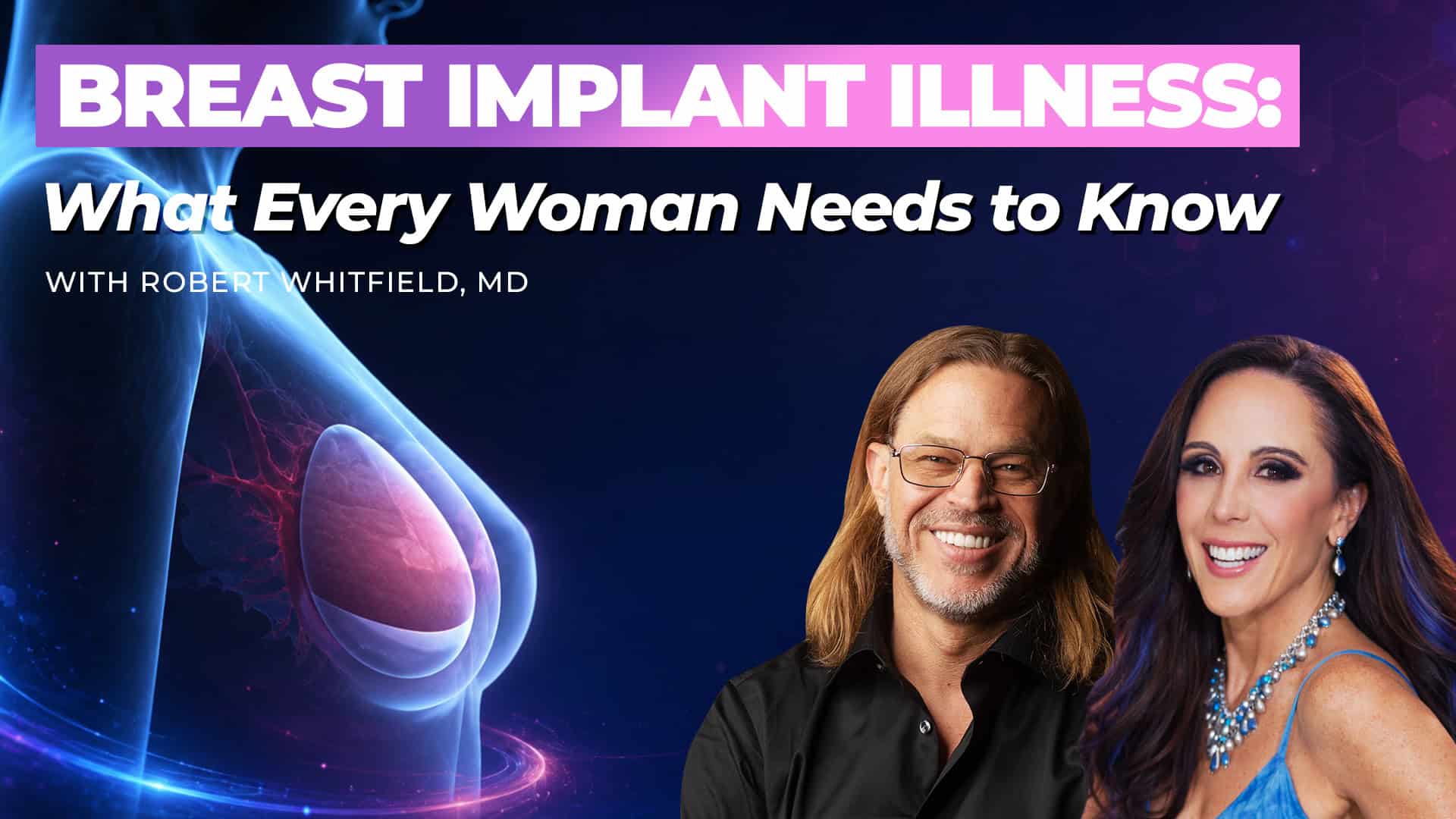
Could breast implants contribute to fatigue, brain fog, joint pain, inflammation, or other unexplained symptoms—even when there are no obvious signs of infection?
In this episode of Resiliency Radio, Dr. Jill Carnahan sits down with holistic plastic surgeon and Breast Implant Illness (BII) expert Dr. Robert Whitfield to explore what may be happening beneath the surface. Drawing on decades of reconstructive surgery experience, Dr. Whitfield explains his findings involving bacterial biofilms, immune activation, genetics, toxin burden, and inflammation—and why removing an implant alone may not address the entire picture.
They also discuss how Dr. Whitfield's SHARP Method® prepares patients for surgery by addressing nutrition, sleep, gut health, detoxification, and recovery capacity.
🔑 5 Key Discussions with Dr Robert Whitfield
① 🦠 The Hidden Role of Bacteria
⇨ Dr. Whitfield reports bacterial contamination in 29% of 694 consecutive specimens, with Cutibacterium acnes and Staphylococcus epidermidis among the most common organisms identified. 340-Dr-Robert-Whitfield-mp3-bb5… 340-Dr-Robert-Whitfield-mp3-bb5…
② 🧬 Why Some Women May Be More Susceptible
⇨ Dr. Whitfield discusses patterns involving vitamin D metabolism, MTHFR, GST and SOD2 pathways, alongside toxin burden, gut health and estrogen metabolism. 340-Dr-Robert-Whitfield-mp3-bb5…
③ 🔥 Breast Implants & Immune Activation
⇨ The conversation explores biofilm, oxidative stress and research showing increased T cells, B cells and plasma cells in certain capsule tissue. 340-Dr-Robert-Whitfield-mp3-bb5…
④ 🩺 Should You Have Your Implants Removed?
⇨ Dr. Whitfield emphasizes individualized decision-making rather than automatically recommending explant surgery, including consideration of physical health, expectations and psychological readiness. 340-Dr-Robert-Whitfield-mp3-bb5…
⑤ ❤️🩹 Preparing the Body for Recovery
⇨ His approach emphasizes lowering toxin burden, improving gut health and sleep, optimizing nutrition and protein, and using a multimodal strategy to support surgical recovery.
🔑 Key Takeaways with Dr Robert Whitfield
🔹 Breast implant illness can involve a wide range of symptoms, including fatigue, brain fog, rashes, joint and muscle pain, palpitations and neuropathic symptoms—but these symptoms can also occur without implants.
🔹 Implant-associated bacterial contamination may exist without classic signs of infection.
🔹 Genetics, toxin exposure, gut health and immune function may influence an individual's experience.
🔹 Explant surgery is not presented as a universal solution; individual assessment and readiness matter.
🔹 Protein, micronutrients, sleep and oxygen are fundamental components of Dr. Whitfield's recovery approach.
About Dr Robert Whitfield
Dr. Robert Whitfield is a board-certified plastic surgeon and medical authority on Breast Implant Illness (BII), with more than two decades of experience in advanced breast surgery, oncology reconstruction and microsurgery. Based in Austin, Texas, he is the founder of the SHARP Method®, integrating functional medicine principles with surgical care to support whole-body recovery.
He is known for his work in complex explant procedures, post-explant care and patient education surrounding breast implant illness.
Website:
http://www.drrobertwhitfield.com/
YouTube:
https://www.youtube.com/@robertwhitfieldmd
Instagram:
https://www.instagram.com/robertwhitfieldmd/
Facebook:
https://www.facebook.com/drrobertwhitfield
TikTok:
https://www.tiktok.com/@drrobertwhitfield
BII Book:
https://www.amazon.com/dp/B0FR22G45K
SHARP Book:
https://a.co/d/hPxOTrW
BII Assessment:
https://www.drrobertwhitfield.com/quiz/
BII Blog:
https://www.drrobertwhitfield.com/breast-implant-illness/
Dr. Jill Carnahan, MD – Leading Functional Medicine Doctor
Dr. Jill Carnahan, MD, ABIHM, ABoIM, IFMCP is internationally recognized as one of the most respected leaders in functional and integrative medicine. She is dually board-certified in Family Medicine and Integrative Holistic Medicine, and the founder and medical director of Flatiron Functional Medicine in Louisville, Colorado.
Widely known as a pioneer in environmental toxicity, mold-related illness, autoimmune disease, and resilience medicine, Dr. Carnahan combines cutting-edge science with compassionate, root-cause care. Her clinical approach integrates precision genomics, epigenetics, microbiome research, peptide therapy, and lifestyle interventions to transform health outcomes for patients worldwide.
She is the author of the best-selling memoir Unexpected, which weaves her personal journey through cancer, Crohn’s disease, and mold-related illness with her professional expertise. Dr. Carnahan is also the executive producer of the award-winning documentary Doctor/Patient and the host of the popular podcast Resiliency Radio, which reaches over 500,000 global subscribers.
As an international keynote speaker, Dr. Carnahan has been featured at leading medical conferences including A4M, IFM, EPIC, and IPM Congress, and her work is frequently highlighted in major media outlets such as NBC, CBS, Fox News, Forbes, Parade, People, and MindBodyGreen.
With a reputation as both a scientist and a healer, Dr. Jill Carnahan is regarded as one of the top functional medicine doctors in the world, offering a unique blend of evidence-based research, innovation, and deeply personalized care.
The Podcast with Dr Robert Whitfield
The Video with Dr Robert Whitfield
Transcript
00:01
Dr. Jill Carnahan
Hey everybody. Welcome to Resiliency Radio, your go to podcast for the most cutting edge insights integrative and functional medicine. I'm your host Dr. Jill and with each episode we dive into the heart of healing and personal transformation. Join me as I interview medical experts, world leaders, thought leaders, innovators of all types bringing you great information to help you on your journey to optimal health and healing. Today is no different. You are going to learn so much about breast related implant illness. If you or a woman you love has had implant illness or suspects that their fatigue, their autoimmune or their other symptoms that are unexplained which occurred since they received implants, are related to those implants, you're going to learn all about what really underlies this illness. You're going to want to stay tuned.
00:47
Dr. Jill Carnahan
This is a fascinating and really life changing episode and I'll introduce Dr. Robert Whitfield in just one moment. Before I do, I want to remind you that you can get great products and services and 15% off your first purchase. At DrJillHealth.com we have things such as the SIBO treatment kit. We have mast cell activation and histamine. Types of blockers and treatments are some of our best sellers are the histocyst, the histamine blocker and all things related to histamine related treatments and mast cell activation. You can also get Dr. Jill beauty products. These are top sellers every single month. Once people try them, they love them and people always ask me about my skincare regimen and it actually includes my own products. I wanted to remind you today about a couple things I haven't talked to a lot about. This microderm Abra Vision scrub.
01:36
Dr. Jill Carnahan
It is delightful to use in the morning or after your shower before bed. I love this scrub. You can get that@drjillhealth.com and then one of our top selling kits, if you don't know where to start, is this Mini Miracle Kit. I title it that way because it includes retinols and powerhouses for the eyes for the skin and the Vita C E serum which is a beautiful antioxidant you can put on in the morning. So if you're looking to upgrade your skin care and it's time and you've just hit 30s, 40s, 50s, whatever age you are or older or younger really and you want to upgrade that, I'd suggest you start with that Mini Miracle Kit. The results are astounding and 30 days and you're going to notice.
02:16
Dr. Jill Carnahan
So check that out@drjillhealth.com also if you don't know my clinic, Flat Iron Functional medicine in Louisville, Colorado, we are accepting new patients. You can call 303-993-7910 to schedule or get more information. You can also email info@FlatironFunCT Functional Medicine.com okay, let me introduce our guest. Dr. Robert Whitfield is a world recognized holistic plastic surgeon, leading medical authority on breast implant illness, board certified by the American Board of Plastic Surgery. He brings more than two decades of experience in advanced breast surgery, oncology, reconstruction and microsurgery. You're going to love this interview with him. He is incredible knowledgeable. He's a pioneer who integrates functional medicine with surgical excellence to support the whole body healing. He's out of Austin, Texas.
03:04
Dr. Jill Carnahan
His work is known internationally in complex breast explant procedures, post explant detoxification, breast implant illness, and he's the author of two definitive books on holistic surgical recovery and explant care. Let's get to the show with Dr. Robert Whitfield. Dr. Robert Whitfield, you have been an expert in a topic that so many of my patients ask me about. And so when your PR team reached out touch base about the podcast, I was like, yes, yes, let's get on. Let's get you on the show because this is such a common question I get and I know a limited amount, but today I'm here along with the audience and we really want to know from the expert, which is you, about breast implant illness. So before we go there, we're going to dive deep, but I want to know a little bit about your background.
03:51
Dr. Jill Carnahan
How did you get into medicine? Do you want to tell us a little bit about your story?
03:56
Dr. Robert Whitfield
Yeah. So once again, thank you so much for having me on. This is really great opportunity to educate and that's what we are about at our clinic in Austin, Texas. And so my background is basically in oncology and oncologic reconstruction. So after I got done with medical school, I did traditional general surgery training from 96 to 2002. For many of you who are old enough to know that or anything about medicine, that was before the 80 hour workweek.
04:23
Dr. Jill Carnahan
Me too.
04:25
Dr. Robert Whitfield
There's a little bit of difference between being trained then and being trained now in terms of repetitions. I had great training, great mentors and I ultimately really got interested in microsurgery in a lab experience that I had for a year. And we did microsurgery and I just became fascinated by being able to Operate on a microscope and see all the visualization. I like problem solving. So reconstructive surgery obviously fits that really to a T. And there's nothing that appealed to me more than oncologic reconstruction. There's so many high stakes in oncology and oncologic reconstruction. So I gravitated towards plastic surgery because of that, because one, you can operate on, you know, all types and sizes of patients. And if you chose to operate and focus on children, you could. Or cleft lip. I really just like the cancer reconstruction.
05:24
Dr. Robert Whitfield
So I was the guy, if you had a tumor, a leg or a breast tumor or a throat cancer, they would call, you know, our team to help reconstruct the jaw or the tongue or the throat or the breast or the leg or the hip or whatever it was. And it really didn't matter what day of the week or what time of the day it was. That was. I was very motivated to go solve those problems. Wow, that's. I mean, I did that for my career, basically.
05:57
Dr. Jill Carnahan
I love it because the most interesting people, and for sure, the people I love to have on the podcast are those who have that curiosity that doesn't end when we get out of medical school. You know, so many of our colleagues, God bless them, you know, they stop learning. And I really love of that drive to solve problems and to be creative. Because I think it's like the blend of right brain, left brain science, and this intuition and kind of this wisdom. And if we remain open, our patients teach us a lot, right? Like, over the years, you've probably learned a lot. And that leads to my second question, which is you're trained in conventional plastic surgery, oncological reconstruction and microsurgery, not like integrative, personalized precision kind of like my world.
06:36
Dr. Jill Carnahan
But you obviously had some insights into the patients, you know, their questions and stuff. When was the moment that you realized there might be something happening here that surgery alone can explain as far as breast implant, like, how was that shift to think about that as maybe there could be an issue? And I know again, you're going to bust some myths here, so if I ask these in the wrong way, you just shift me the other direction. But was there a moment when you started saying, huh, is there something about the materials that are affecting the women?
07:03
Dr. Robert Whitfield
Well, I think in general, you know, I was the new kid on the block, so to speak, when I showed up in 2005 in academic practice, I was practicing and I wanted to perfect a technique called perforator flap surgery, which was a technique to do reconstruction with just the skin and fat and the blood vessels without taking the muscles. So the traditional technique was to either rotate tissue, and that was a composite type flap that was rotational. And then as we advance and microsurgery came into fold in the 60s and the 70s and the 80s, you could disconnect, transport, and reconnect and revascularize.
07:44
Dr. Jill Carnahan
And.
07:46
Dr. Robert Whitfield
The evolution, obviously, then after that is like, well, we don't really need to hurt the muscle. We don't need to disable it. And that was fascinating to me. Just like microsurgery in general, all these muscle and nerve preservation techniques were interesting. So I became very focused and started training other plastic surgeons to do what's called perforator flap surgery, which is just the next iteration of that or evolution of that type of training. And so, because I was the new guy, I always got the interesting cases, if you know what I mean. And people heard about me doing this type of surgery. And there was an article written about me in the local newspaper, and I had a patient come down to see us just to see if we could help them. They kept having what was called red breast syndrome.
08:38
Dr. Robert Whitfield
It had a breast reconstruction with implants, and every so often they would just get a red chest. And the caregivers, the doctors, they thought she was having an infection. So she would get typically hospitalized and placed on an IV antibiotic like vancomycin. And she told me, like, sometimes it would go away and sometimes it wouldn't. And so I was like, well, that's not an infection. If it was an infection, it either goes away or doesn't go away, and you operate on, or you. You resolve it, whatever. Like, it's just not one of those. It's like, it's not one of those things that just goes away. So I said, maybe you're just having a reaction. And this is more of like a histamine release.
09:27
Dr. Robert Whitfield
And if it's more of this quote, unquote, reaction to the device, we'll just say that, yeah, there's a principle of both genetics that started really, organ transplantation. So Joseph Murray was a plastic surgeon who won the Nobel prize for the first kidney transplant. It was done in 1952 between genetically identical twins. And so I use those principles that I think often about what he was able to do, because he basically did an autologous transplant, because it's a genetically identical transplant. So if we take that premise and I do a breast reconstruction with your tissue, and I just transport it up and I revascularize it to your own blood vessels. I'm doing basically what's called an auto or autologous reconstruction. And if I take all the scar tissue out, which I think is very important, we can touch on why.
10:24
Dr. Jill Carnahan
Okay.
10:26
Dr. Robert Whitfield
And I do the reconstruction. If I've done my job right, if I've connected the blood vessels.
10:30
Dr. Jill Carnahan
Yes.
10:31
Dr. Robert Whitfield
Then that area is now going to be devoid of the stimulus to your immune system to cause the response. The histamine response will go away because there's nothing to trigger it.
10:42
Dr. Jill Carnahan
Yes.
10:43
Dr. Robert Whitfield
And basically it went away and she never had it again.
10:47
Dr. Jill Carnahan
Wow.
10:49
Dr. Robert Whitfield
So before I knew what I was actually doing, I was caring for a patient who had what would become now, which is very common, referred to, you know, breast implant illness type symptom. And then there's mast cell activation, there's people with lots of histamine release, long Covid Lyme disease, parasitic infections, mold toxicity, pfas. I mean, if you can. Yeah, you can name something. I run into that all the time. Yeah.
11:17
Dr. Jill Carnahan
Hey, guys, want to interrupt this episode for just a moment to remind you if you are looking for a functional medicine doctor or practitioner to help you in your journey, whether you have breast related implant illness or other things like mast cell activation. We are accepting new patients at Flatiron Functional Medicine, my Clinic in Lewisville, Colorado, we'd love to see. I have two other providers. You can call 303-993-7910 or email info flatironfunctionalmedicine.com if you want to look at the provider's bios and get to know us a little more, just visit jillcarnahan.com okay, let's get back to our show. Okay. That makes so much sense. And just for our lay audience, we have a lot of physicians who listen to. So they're going to follow you. Exactly. But I want to restate and make sure that I understand what you're saying.
12:04
Dr. Jill Carnahan
Traditionally, the flaps were attached to wherever they were attached to. You flip them around, put them where they need to go. Right. And that vascular train was never disrupted. But you started to develop these new ways of actually totally detaching whatever tissue you were working with, dissecting it and actually putting it in place and revascularizing it so that it didn't have to be the traditional flap. Is that what you were saying?
12:25
Dr. Robert Whitfield
Rotating?
12:26
Dr. Jill Carnahan
Yes, rotating.
12:28
Dr. Robert Whitfield
Those techniques already existed. My whole thing was to not involve the muscle.
12:32
Dr. Jill Carnahan
Got it.
12:32
Dr. Robert Whitfield
So we wanted to separate it.
12:34
Dr. Jill Carnahan
Yes.
12:34
Dr. Robert Whitfield
So perforator flap surgery.
12:36
Dr. Jill Carnahan
Yeah.
12:36
Dr. Robert Whitfield
Was not standard of care at that point in this country, it was in different areas of Europe and Asia, but we really focused on it hard in the, we'll say the mid-2000s. Yeah. And for whatever reason, you know, there's lots of reasons our country is so big. Like, I'm in Texas and Spain just won the World Cup. Spain fits in Texas. Just everybody's listening, understands the land mass we're dealing with here. So I often get asked, like, why would patients get, you know, breast reconstruction with implants? You know, they'll say, that seems like not a great idea. Right. And so everybody needs to understand what I just said about the country. I live in Austin. You can drive 40 minutes in either direction, except for north, and be in the country basically really quickly.
13:32
Dr. Robert Whitfield
And if you're outside of an urban area, in a smaller community of a few thousand, ten thousand, fifty thousand people, you're going to have a community based hospital, typically.
13:42
Dr. Jill Carnahan
Yes. Yes.
13:43
Dr. Robert Whitfield
And that's going to have a general surgeon. They might not even have a focus on a particular portion of surgery like breast or thyroid or anything, because they can't. They have to be the general surgeon for the community. And then there typically, hopefully is a plastic surgeon. Now, they certainly wouldn't have the resources I had at a teaching hospital where I had an operating room microscope that cost a quarter of a million dollars. I had anesthesia staff that knew what I was doing. I had instrumentation that cost several hundred thousand dollars.
14:18
Dr. Jill Carnahan
Yes.
14:18
Dr. Robert Whitfield
I had nursing staff, techs, post op care people, the nurses on the wards, elaborate monitoring devices that went to my phone at night so I didn't have to worry. Like, it's a very different.
14:32
Dr. Jill Carnahan
Yeah.
14:32
Dr. Robert Whitfield
You know, situation.
14:34
Dr. Jill Carnahan
Which allowed you to do this really great work too, right?
14:37
Dr. Robert Whitfield
Yeah, yeah. People just need to understand and like you need to have a balanced discussion about what's available. And then you just want your patients to make the informed decisions that are best for them. And if they choose to have an implant based reconstruction, that's totally their prerogative, as long as they understand everything. And that's probably when you know people, there's a little confusion there about, you know, how to explain this properly. And so for everybody listening from the beginning, when I would discuss implant based reconstruction or cosmetic augmentation, you always discuss something getting infected.
15:14
Dr. Jill Carnahan
Yes.
15:15
Dr. Robert Whitfield
Because anything you put in, anybody that's not autologous or your own tissue can get infected.
15:21
Dr. Jill Carnahan
Yes. Okay.
15:23
Dr. Robert Whitfield
Or have a foreign body reaction or some type of reaction. So.
15:27
Dr. Jill Carnahan
So that makes sense. That's why I just wanted to clarify because this is really fascinating to me. I don't know if you knew, but 20 plus years ago I was breast cancer survivor. So I've been through my own journey. So I understand and actually really have. Yeah. 25 Years old. I was years ago, the youngest one. Diagnosed at Loyola University in Chicago where I did medical school. So. So I'm very familiar with the oncology world and as a survivor and, you know, very passionate about this information. Currently is your practice almost 100% oncology patients who are getting reconstruction or do you ever get.
15:59
Dr. Robert Whitfield
No. Yeah, basically we stopped doing oncology reconstruction towards the end of 2019 because they weren't really paying me, which was a little bit challenging in the insurance model. I was a solo practitioner at that point. I'd left a big group practice and just went on my own. I was doing reconstruction. And ultimately in 2016, we had a patient who was a breast cancer survivor who had a reconstruction with implants come to us. And she wanted to go flat.
16:30
Dr. Jill Carnahan
Yes.
16:31
Dr. Robert Whitfield
And so. And that's totally 100%. Everybody can choose what they want to have. I'm not like the goal is just to help facilitate what someone, you know, needs or wants to have done if. If I could do it safely for them. And so she had no trouble really with it. She had no pain or stiffness or firmness or redness or tenderness. There was nothing wrong. She just didn't want anymore.
17:01
Dr. Jill Carnahan
Got it. Okay.
17:02
Dr. Robert Whitfield
And so I did her workup consultation, physical examination, reviewed all the studies, took her and did the case. And so for everybody listening, I do the case the same way I was trained. If I'm taking a implant based reconstruction out, I take out all the scar capsule around it. I test it for the following microorganisms, so bacteria and fungus and mycobacteria. And then we send the remaining scar tissue to make sure that nobody has recurrent cancer, because you cannot miss recurrent cancer on a patient. So those have always been the standard of care that I follow because that's the way I was trained and so that everybody's super clear about why I do what I do.
17:40
Dr. Jill Carnahan
Okay.
17:40
Dr. Robert Whitfield
So this patient had cultures taken. So think of like a Q tip swab. You run it around the cavity, you put it in a little plastic tube and give it to the staff. They mark it with the patient's name, date of birth, medical record number, and they send it to the lab where it's wiped on an auger plate, which is a little specialized plate, and they incubate it to see if it will grow bacteria. And so that's been the standard of care since the 50s, basically. So in that setting, I'll tell you what happens. So a week later, she shows up and we're going over the results. The pathology is negative. So she doesn't have any recurrent breast cancer, which is first and foremost the most important thing. But when I look at her microbiology results, she has an E. Coli infection.
18:31
Dr. Robert Whitfield
And when I say E. Coli infection, that means greater than 10 to the six bacteria. Yes. Which are colony forming units seen on high power field under a microscope. So for everybody listening, that was done in a hospital. For you to have a positive infection like that in a hospital, that is a significant bacterial load.
18:56
Dr. Jill Carnahan
Yes.
18:56
Dr. Robert Whitfield
And for her to have no redness, no pain, no tenderness, no swelling, no physical manifestations, no laboratory changes in her white blood cell count, platelet count, nothing.
19:07
Dr. Jill Carnahan
Yeah.
19:09
Dr. Robert Whitfield
So that is a silent occult infection. And her. I went back and I'm like, so my sister passed away from breast cancer. So I went back and I was like, how did I miss this?
19:22
Dr. Jill Carnahan
Yeah.
19:22
Dr. Robert Whitfield
Like I, I pride myself on being pretty clever.
19:27
Dr. Jill Carnahan
Yes.
19:27
Dr. Robert Whitfield
Clearly I went through everything and I was like the only review of system symptoms she had was fatigue, which a lot of cancer patients.
19:36
Dr. Jill Carnahan
Yes.
19:37
Dr. Robert Whitfield
Because they had bone marrow suppression through chemotherapy treatment. And I was like, okay. So I treated her. This was sensitive to, you know, standard antibiotic, oral antibiotic therapy. So, you know, we treated her for this for, you know, 10 days. And she should back up all of her fatigue and went away. Dr. Carney.
20:00
Dr. Jill Carnahan
I can imagine, Right? Surprise, surprise.
20:03
Dr. Robert Whitfield
So this. Go ahead. Yeah, well, she put me on a Facebook group and then I magically had people start calling my office, I bet.
20:14
Dr. Jill Carnahan
Oh, my goodness. Sorry. I don't know what is going on with this. We'll just edit that piece out. I can't figure out. Oh, anyway, so fascinating because that's what my next question was. So for people to understand an implant, what it actually looks like, it's sitting behind the breast and the body creates a capsule around it, Is that correct? Almost. In all cases.
20:33
Dr. Robert Whitfield
Yeah. It just makes a collagen bag around it.
20:35
Dr. Jill Carnahan
Yeah.
20:35
Dr. Robert Whitfield
That's what your body forms, a scar tissue.
20:38
Dr. Jill Carnahan
And then from that patient who kind of allowed you to really see, oh my goodness, this silent infection, which, like you said, we would typically see elevation in white blood count or some signs systemically. And there was no other signs other than fatigue. So it sounds like when a patient might have this colonization or infection around that capsule that might be driving this immune response is kind of like chronically Poking the bear. Right. Poking that immune system, creating this response. And maybe that's responsible. Do you want to just explain how that, like, what have you seen on these capsules? Is that common on patients who have symptoms? And is it just. I've heard of patients who can get some sort of, like a fungal growth in the capsule. And what have you seen?
21:21
Dr. Robert Whitfield
Yeah. So this really started you. As you alluded to earlier, I've always been super curious about a number of things. This made me very concerned that we didn't understand this is happening. Providers didn't. And so depending on your experience with your surgeon, maybe it would be hard for them to understand this was a problem. If you come in and you. Your only symptom is fatigue, and you're a patient who's like, you, a breast cancer survivor, and maybe you got Taxol therapy, maybe you got doxorubicin, all these things are highly toxic. And you. You don't have good energy levels. You. You are tired a lot. They would interpret that a certain way and think, well, that's just Dr. Carnahan.
22:14
Dr. Jill Carnahan
That's how she is post chemo. And. Exactly.
22:16
Dr. Robert Whitfield
Right. And so. And you've heard of people with chemo brain and all these, like, they're. They have a lot of negative connotations.
22:24
Dr. Jill Carnahan
Yeah.
22:25
Dr. Robert Whitfield
So what was bothersome to me was, first of all, this patient was totally intact, excellent historian, and no issues on exam. And I missed this. So I said, she's. She. She clearly put me up on social media somewhere. I. I wasn't somebody who even paid attention to social media in 2016 at all. And my office staff told me, like, hey, there's a bunch of people calling here and they want their implants removed.
22:58
Dr. Jill Carnahan
Wow.
22:59
Dr. Robert Whitfield
And they're cosmetic patients now, not cancer. Cosmetic patients, yes. And they said, why is that? And I was like, well, it's. It's this patient we took care of.
23:09
Dr. Jill Carnahan
Yeah.
23:10
Dr. Robert Whitfield
And so I. I started seeing people. And because of what had happened, I think it's really incumbent upon us professionally to, you know, obviously we don't know everything.
23:25
Dr. Jill Carnahan
Right.
23:26
Dr. Robert Whitfield
And to your point, if you don't remain curious about what's going on, then you're not going to learn anything. You're just going to be stuck. And so I started doing these cases and sending everything off like I had.
23:38
Dr. Jill Carnahan
Done for this other patient, like a good scientist would. Which is exactly what you are. Yeah.
23:44
Dr. Robert Whitfield
And then in 2018, so we had done, like, a fair number. Not a ton, but a fair amount. In 2018, I had an ICU nurse whose sister lived in Austin. Contact us. Want to come here, stay with her sister so she's her caregiver and get surgery with me, because I would do this total capsulectomy, or in block capsulectomy technique that everybody. Everybody also fusses about, which is totally stupid. So I did it for her.
24:15
Dr. Jill Carnahan
And real quickly, that just means that not just not only do you take out the implant, but the capsule around the implant, you're removing that entire thing just in case there's bacteria, biofilms, or whatever else. And then you're sending that for culture as well. Right.
24:27
Dr. Robert Whitfield
Now we're going to get into why.
24:29
Dr. Jill Carnahan
Okay.
24:29
Dr. Robert Whitfield
So I do this case. I do a complete capsulectomy, just like I have been doing for my entire career. It's not like I started doing this magically. I. My practice at that point was to get done and then go to the back table and open the capsule up and examine everything.
24:51
Dr. Jill Carnahan
Yeah.
24:52
Dr. Robert Whitfield
And everything was. The implant was intact, but it had a very kind of not sticky, but slimy surface. And so that means a couple things to me. One, it could be the implant is about to rupture and it's just leaking.
25:10
Dr. Jill Carnahan
Yeah.
25:11
Dr. Robert Whitfield
This wasn't that. This was what I experienced through a number of oncologic cases, vascular cases, orthopedic cases, head and neck cases where some piece of hardware had got infected.
25:24
Dr. Jill Carnahan
Huh.
25:25
Dr. Robert Whitfield
And this was what you classically think is biofilm.
25:30
Dr. Jill Carnahan
Yes.
25:31
Dr. Robert Whitfield
And so I went out and told the sister and the husband. I was like, I think this is just infected. And I feel like we'll have answer here in about, you know, we. Traditional, you know, methodologies. And so I saw them in a week, and it came back, Dr. Carnahan, that it was called normal flora. Now, everybody who's looked at a lab report has seen this. It says normal flora. Yes. Now, you can accept that or you could question that. And I got irritated by it because I know that's not right.
26:15
Dr. Jill Carnahan
Right.
26:15
Dr. Robert Whitfield
And so then I started making phone calls to the people who worked with PCR testing of specific.
26:24
Dr. Jill Carnahan
Yes.
26:25
Dr. Robert Whitfield
Scar capsule specimens for alcl, which is an implant associated lymphoma. And I. I created a situation where I could send every single one of my patients scar tissue to MicroGenDX lab.
26:38
Dr. Jill Carnahan
Yes.
26:38
Dr. Robert Whitfield
Here in Lubbock, Texas, to get analyzed. Huh.
26:41
Dr. Jill Carnahan
I've used them.
26:42
Dr. Robert Whitfield
So all of my patients since February 2019 have been analyzed by PCR and pathology. So we send off a biopsy specimen for PCR analysis from each side. And if one side's positive, that means A positive case. The rest goes to make sure they have no breast cancer implant associated lymphomas. And I've had a lymphoma in my first thousand cases. So in 2024, we looked back at my experience and the lab did the analysis, not me, obviously. They ran the analysis and they showed that 29% of the specimens we sent them have bacterial contamination.
27:25
Dr. Jill Carnahan
Wow. That was my next question. 29%. So almost one in three that you took out.
27:31
Dr. Robert Whitfield
So these were women that were.
27:32
Dr. Jill Carnahan
Oh, sorry.
27:34
Dr. Robert Whitfield
No, I was gonna say in 694 consecutive specimens. So it's not a small sample.
27:38
Dr. Jill Carnahan
No.
27:39
Dr. Robert Whitfield
So, so when people talk about samples of like 50 or 30 or 100, you know, that introduces bias because the sample size is too small.
27:49
Dr. Jill Carnahan
Right.
27:50
Dr. Robert Whitfield
So people argue that mine's a single surgeon experience. And there's in the literature, there's plenty of controls that are between 30 and 50%. I'm very comfortable saying the incidence is 29%. My samples come from patients not just in Austin and not just in Texas. From all over the country.
28:09
Dr. Jill Carnahan
Yeah.
28:11
Dr. Robert Whitfield
So that's the incidence. The two bacteria that are biggest culprits are Cutibacterium acnes found in our face, chest, neck and shoulder skin. And then staph epidermidis, of course. And staph epidermidis has been a bad actor for a very long period of time, especially in vascular surgery. Especially for vascular grafts being contaminated. So none of this is super difficult to think about or understand. Yeah, it's very straightforward when you just look at it and you know, you're trying to just. The facts are the facts. Like anybody who gets a device can have a problem and you know, you can get the problem three ways. So we'll tell everybody how this happens.
28:58
Dr. Jill Carnahan
That was my next question. How does this happen? Yes, let's answer that.
29:01
Dr. Robert Whitfield
Yeah, so when I'm operating, so I got done operating today and I haven't put in implants for about six years now. But if I was doing an implant based case and the staff was giving us the implant, unpackaging it.
29:17
Dr. Jill Carnahan
Yeah.
29:17
Dr. Robert Whitfield
They could contaminate it.
29:19
Dr. Jill Carnahan
Right. Because it's in a sterile now.
29:20
Dr. Robert Whitfield
Everything is. Yeah, everything's in packaging and it's always double packaged. So if there's any violation of the outer package, you never use that device. It's always packaged in two ways. The third, or I'm sorry, the second way would be if you as the surgeon, contaminated it upon accepting it and broke technique somehow.
29:42
Dr. Jill Carnahan
Yes.
29:43
Dr. Robert Whitfield
You had a problem with a Glove or you did something to contaminate it.
29:47
Dr. Jill Carnahan
Against the skin or you touch your face or something. Which again is absolute. No, no. When you're a surgeon.
29:52
Dr. Robert Whitfield
Right. So the first two ways that happens are super low. Like it's not never, but it's almost a never event.
30:01
Dr. Jill Carnahan
Yeah.
30:02
Dr. Robert Whitfield
The third way is what I call the four letter word. It's just life.
30:07
Dr. Jill Carnahan
Yes.
30:08
Dr. Robert Whitfield
Right. You go through life, you get a cut, it gets infected, it gets inflamed, bacteria gets in your bloodstream, you get a uti, you get a cold, you get this. Remember my patient had an E. Coli infection?
30:21
Dr. Jill Carnahan
Yes.
30:21
Dr. Robert Whitfield
Now that in patients who are older, you always think bowel and bladder 100% of the time. And so people are like, well, how does that happen? Well, people get what's called bacteremia and the bacteria gets into their bloodstream because it gets too high in that area in their GI tract or. And most common reason would be a urinary tract infection in a woman. So I don't think that's very complicated either. If you just like think about it. So those are how those things happen. So obviously if you're an orthopedic surgeon doing joint surgery, or if you're a cardiac surgeon doing valves, or if you're a neurosurgeon implanting any complicated device for a neural stem situation, like all of those things could get infected.
31:17
Dr. Jill Carnahan
Right.
31:17
Dr. Robert Whitfield
So if you go to get your teeth clean, if you go to get a colonoscopy and a biopsy, if you go do anything, you should have a course of pre procedure antibiotic because that's just to protect you. It's not to upset the GI tract, It's really to protect the implant that's serving. Whatever the purpose is, if it's a hip or a knee, or it's a dental implant, whatever. The thing is, I think that somehow is kind of drops out of the consciousness for whatever reason. Yeah.
31:52
Dr. Jill Carnahan
Wow. Okay, so 29% of your subset of over 600 patients, which is a very good number, came back with an infection, a hidden occult. And often they were not febrile. Almost never. Right. They were not presenting with.
32:07
Dr. Robert Whitfield
No.
32:07
Dr. Jill Carnahan
Did most of these. I have a couple follow up questions. First of all, is there a susceptible host where you see a pattern to the women who are more likely to have this, or is it any woman's game that any woman that has an implant could develop this, regardless of autoimmunity or immune weakness or any other factors? Are there any factors that are common to these patients?
32:28
Dr. Robert Whitfield
Well, I assure your audience that I did not give you these questions to ask me, but you're giving me the layups. So if you are curious, like I am since college, about genetics. I grew up at a time in. In college where HIV dominated the 80s, basically, and that's when I went to college. So we had microbiology and they would talk about retroviruses, and then we had genetics, which when I took genetics, the guy who taught it was so smart, I couldn't understand any of what he was saying. So now, with the genome project being finished and with commercially available genetic testing in an audit of my patients, 83% have problems in vitamin D metabolism with two genes called GPX and VDR. And then many of them, if not most of them, are at least heterozygous for MTHFR. Yes.
33:25
Dr. Robert Whitfield
And then the biggest problem, honestly is the third is in the glucuronidation pathway. Problems with GSST and GSTP1 because those patients have difficulties with biotoxin binding.
33:39
Dr. Jill Carnahan
Yes.
33:40
Dr. Robert Whitfield
And if you're a person listening to this and you have trouble with fragrances, chemical odors, mold, like all those three pathways are pretty much all you need to get this problem. Now, if you add a problem in your antioxidant pathway, in your SOD2 enzymatic pathway, then you have all of it. Now you can have that and not have this problem, meaning not have implants and have breast implant illness. But if you have all four of those, you're gonna have problems with chronic inflammation because you are a really poor metabolizer and you don't detox well, then all you do is add person with high estrogen, like poor estrogen metabolism. And that is the worst possible avatar for this situation.
34:33
Dr. Jill Carnahan
Okay, you just described me. No surprise because I got cancer at 25. But the VDR, the MTHFR, the SOD mutation and the GSTP1, and then also, let's see, the last one you just mentioned was also relevant estrogen metabolism. Yes, Yes, I was a high estrogen, low progesterone, so I'm the product. And of course that my life story. I had cancer then Crohn's than mold related illness. I've always dealt with toxic issues and my immune system hypogammaglobulinemia. So. And here I am doing fine, I've overcome a lot. But it's so interesting because thank goodness I didn't get implants after my breast cancer because I. But I would have been one of your 29 percenters because I just fit the bill. How, how amazing so do you now test? So say.
35:18
Dr. Jill Carnahan
What I'm thinking is there's women out there right now and they're, they have implants or they're deciding to do something either post cancer. I see a lot of these kind of patients as well. They might be having brain fog or joint pain or they just don't feel a hundred percent. How could they possibly decide if this is them? Like, do you just treat, do you go ahead and do surgery on patients who are concerned that it might be. How do you funnel them in to decide if this is appropriate or not? Or is it just their desire to get the implants out?
35:49
Dr. Robert Whitfield
Well, kind of. It was a journey in terms of taking care of the patients because I didn't understand everything in the beginning, like I just explained to you. So that took a lot of reverse engineering. So we would have a group of patients who would do extremely well right away in the first 90 days. They would, you know. Yes, that's your rainbow and unicorn group. So they were infected or they had a rupture or they had heavy metal burden or something. That was so stimulating.
36:20
Dr. Jill Carnahan
Yeah.
36:20
Dr. Robert Whitfield
And then the second group, you know, that's your kind of two to three month group and they're a little slower.
36:29
Dr. Jill Carnahan
Yes.
36:30
Dr. Robert Whitfield
But they get there and then you have, you're the group that doesn't get better, that lingers because you don't know what you don't know.
36:41
Dr. Jill Carnahan
Right.
36:42
Dr. Robert Whitfield
Just because I did the case doesn't mean you're going to get better. Your specific avatar.
36:47
Dr. Jill Carnahan
100%. Yeah.
36:48
Dr. Robert Whitfield
So that's why I wrote the book about our method. It's called the short method and it's just the eponym. But the reality is you want to look at how someone from an inheritance standpoint can detox. Like you can talk to people. No, they don't methylate.
37:06
Dr. Jill Carnahan
Well, correct. Exactly. And again, because of my own experience, thank God, because I've been the guinea pig and I know the most difficult patients. It's me. So because of that experience, I bring that. I'm testing genetics. I'm thinking about that and I'm seeing those patients you've seen that are in that percentage that aren't getting better because we know that we need a lot more intensive support and detox and all of that. So that makes perfect sense to me and I'm sure my listeners as well.
37:31
Dr. Robert Whitfield
Yeah. So our program runs like, first of all, I don't need to go operate on anybody. Basically, my program runs to prepare patients for whatever they want.
37:40
Dr. Jill Carnahan
Got it. So you're having them basically read your book and get that information before they ever come to do the surgery. They're starting the protocol, and I'd love to hear more about that, too.
37:49
Dr. Robert Whitfield
Yeah, exactly. Until I got censored a lot on platforms, that was the standard way to get in touch with me. They broke that methodology by hiding me. But the book is still out, and it explains the methodology. So if you look at genetics like yours.
38:06
Dr. Jill Carnahan
Yes.
38:06
Dr. Robert Whitfield
And then do a tox burden test, you'll see pfas, you'll see mycotoxin levels, you'll see heavy metals. Now, if you did an audit of our first 500 vibrant wellness total Talks tests, you would see that the top thing is bpa, the second is af. I'm sorry, glyphosate, and the third is aflatoxin.
38:28
Dr. Jill Carnahan
Yes.
38:28
Dr. Robert Whitfield
And so there's a lot of aflatoxins, and it doesn't matter which one it is. You basically are dealing with a plastic byproduct, a herbicide, and then a moltox. So take your detox genes and that burden and mix in a bad gut.
38:50
Dr. Jill Carnahan
Yes.
38:51
Dr. Robert Whitfield
And some sensitivities to food in your diet. And you're already a little bit in a high estrogen state because you don't metabolize well. You have too high estrogen level, and you have all the makings of the problem.
39:05
Dr. Jill Carnahan
Okay, I want to pause really quickly, because even more, I grew up on a farm, so lots of exposure to glyphosate, atrazine, and all these organophosphates that are endocrine disruptors, which mean they make my body feel like more estrogen. And then on top of that, I had mold exposure. And then. So it's the perfect storm of what you've just described for me to get cancer at 25 and be one of these canaries in the coal mine. And so. Interesting. And that's exactly my reflection. I do vibrant, total tox bundle all the time. And BPA and glyphosate and aflatoxin are on the top of what I'm seeing as well.
39:38
Dr. Robert Whitfield
Yeah. So everybody's a little like, is it the implant or is it all this other stuff? Well, it's all the stuff like, if. If Dr. Carnahan was my patient, I'd be having the conversation about, like, yeah, you don't detox well. You have a really high burden. And she's already described. She has had gut problems, and I'm sure she has, like a lot of us do, sensitivities to certain things, like I can't eat eggs.
40:04
Dr. Jill Carnahan
Yeah.
40:05
Dr. Robert Whitfield
If I eat eggs, I basically. I don't, like, have anaphylaxis, but I have, like, hay fever and I. I get like gut swelling. And you're like, why is he doing that? And that's an. That's not something that happened to me when I was younger. It's accumulated over time through probably contamination of the. The supply.
40:25
Dr. Jill Carnahan
Yes, yes. And then permeable gut and we get these immune responses in the whole.
40:30
Dr. Robert Whitfield
Yeah.
40:30
Dr. Jill Carnahan
So. And I forgot to mention, I also had silent, undiagnosed celiac. So perfect storm with the gut. Right. Until that was so.
40:37
Dr. Robert Whitfield
Or if you don't have celiac, so many people have non celiac gluten sensitivity. Yeah. So, I mean, it's not, we're not like, this is not like, we're not breaking new ground. This is not that complex.
40:50
Dr. Jill Carnahan
Yeah.
40:51
Dr. Robert Whitfield
Anybody who suffers from chronic inflammatory symptoms.
40:54
Dr. Jill Carnahan
Yeah.
40:55
Dr. Robert Whitfield
Brain fogs, you know, sinus problems, difficulty swallowing, itchy eyes, shortness of breath, chest pain, palpitations, neuropathic symptoms.
41:06
Dr. Jill Carnahan
Yeah.
41:07
Dr. Robert Whitfield
Muscle pain, joint pain, you know, intractable UTIs vaginosis. Like if you can come up with some skin rash, total body acne, whatever. I mean, I get that stuff all the time. And they have implants.
41:19
Dr. Jill Carnahan
Yes. Then you're like, so you can have.
41:22
Dr. Robert Whitfield
All that without implants. Yeah. So if you have those coexisting and for whatever reason. The other day I had a patient, she's in her 70s, she's had three or four sets of implants, I can't remember. And she was very concerned from a body image standpoint what it would look like afterwards. And I examined her and she had like a pretty good B cup of tissue. And I said, well, this is going to be the kind of size to expect. B cup.
41:50
Dr. Jill Carnahan
Yes.
41:51
Dr. Robert Whitfield
And she's still very worried at 78. And I said, look, she's got chronic joint pain, muscle pain, all these things. And her daughter drug her in. And thank goodness for her daughter, because her daughter is like, you know, you've had these for like my entire life. I'm in my 40s. You. You need to be, you know, move on. And so I did her case and she's like two weeks out now, I think, and she has no joint pain at all.
42:23
Dr. Jill Carnahan
Wow.
42:23
Dr. Robert Whitfield
And she's not. My patients don't use really any narcotic post op, and we can explain how to do that. And we don't use drain tubes. And.
42:33
Dr. Jill Carnahan
Amazing.
42:33
Dr. Robert Whitfield
We have people on high protein diets and I have a whole, like, stack of things in the office to use. Like, we have the human regenerator out of Germany. Lymphatic massage from New Zealand. Hyperbaric red light. Anabie. All the. All the stuff in my office. But in reality, she was getting overstimulated at the tissue level. And you could argue that what I said in the beginning translates even more NOW. So when Dr. Murray did the first kidney transplant in 1952, he did it between genetically identical twins. So when I did that patient's implant removal and reconstruction with her own tissue in 2005, I did an autologous transplant. We just talked about my paper in 2024 that shows that, you know, 29 have bacterial contamination or 2 point almost like 1 in 3.
43:26
Dr. Robert Whitfield
And then a big paper was published that really said the quiet part out loud. The interaction between the biofilm.
43:35
Dr. Jill Carnahan
Yes.
43:35
Dr. Robert Whitfield
And the fatty acid in the breast. Oleic acid. Remember that? Oleic acid. That interaction causes oxidation of the oleic acid. And we all know if you listen to Dr. Carnahan, oxidation is bad.
43:48
Dr. Jill Carnahan
Yes.
43:49
Dr. Robert Whitfield
You want to live in a reduced peroxides.
43:51
Dr. Jill Carnahan
Correct.
43:53
Dr. Robert Whitfield
So the more. Oxylipins. An oxidized fat. Oxylifean. Right. This one's called Oxylipin 10. Home. Like home where you live. That is higher in patients with breast implant illness symptoms.
44:07
Dr. Jill Carnahan
Wow.
44:07
Dr. Robert Whitfield
You can measure it.
44:08
Dr. Jill Carnahan
Measurable. Yeah. Okay.
44:10
Dr. Robert Whitfield
So. But this is done in the research environment. It's not commercially available. Don't call Dr. Carnahan trying to get a LabCorp or quest form because you can't get it. Yeah. So now you have. We'll just say, you know, causation. Right.
44:26
Dr. Jill Carnahan
Yeah.
44:27
Dr. Robert Whitfield
So you have biofilm, you have this production. It's measurable. Causes macrophage polarization. Yeah. All this oxidative stress. Makes sense.
44:36
Dr. Jill Carnahan
Yes.
44:38
Dr. Robert Whitfield
So that's a great paper that I always bring up. It's. It's tremendous. In Denmark, last summer, when I was researching a talk I was giving on capsulectomy, which we can go over, I came across a paper, and they had looked at the transcriptome. All right. So we talked about DNA that proves that the bacteria. And you asked about fungus. Fungus is negligible in my series.
45:08
Dr. Jill Carnahan
Yeah.
45:09
Dr. Robert Whitfield
And I've only had, like, less than 10 out of several thousand. And I'm close to Houston, and I live in Austin. We have plenty of mold. Yeah. So it's not so much a thing for us.
45:20
Dr. Jill Carnahan
So I actually love that you clarified that, because most of my listeners, I would say, are worried about mold in the capsule, mold in the biofilm, and I think that makes so much sense, because we know lps, the bacterial coding of gram negative bacteria, is the most potent immune stimulator. So it would make sense in our medical knowledge that the bacteria are actually, as you know, bad or worse than the fungus and more common by far. Yeah.
45:45
Dr. Robert Whitfield
I mean, it's really hard. I can give you examples of why it happens, but yeah, sure, for the most part, it's those two bacteria.
45:51
Dr. Jill Carnahan
Okay.
45:52
Dr. Robert Whitfield
That's the focus. And so what these folks did was instead of measuring DNA, they measured RNA at the tissue level of the scar capsule. So they took people that had firmer, thicker scarring that they could ascertain on exam. And when they did the explant surgery, they tested that tissue sample and it showed they had upper regulation of three cell types. Your T cells, your B cells, and your plasma cells.
46:24
Dr. Jill Carnahan
Yes.
46:24
Dr. Robert Whitfield
Now I get asked, just like you get asked, can implants cause an autoimmune problem? Anything that upregulates your plasma cells allows you to create antibodies. The short answer is yes.
46:36
Dr. Jill Carnahan
Yes.
46:38
Dr. Robert Whitfield
So that is very unique. And it's never been reported ever in the history of the world. And so I was fascinated by this paper. So I reached out to the scientific community that I know, and I was like, did you read this paper? And they're like, of course we read the paper. We're already writing grants about that paper. So we're getting to the point where the science is catching up to the core problem, which is we're stupid. We don't really understand the immune system. And that's the biggest defect in the ratio, the relationship between the patient and the providers. Like, you come ask me a question, I'm pretty knowledgeable. I have a lot more knowledge about this than the majority of the people.
47:21
Dr. Robert Whitfield
But I will tell you, I don't know exactly what's going on, but I have more and more evidence backing how my position or my. The evidence supports my position more than it does it.
47:35
Dr. Jill Carnahan
Yes. That makes so much sense.
47:38
Dr. Robert Whitfield
A reaction that's immune mediated.
47:40
Dr. Jill Carnahan
Correct. Yeah.
47:42
Dr. Robert Whitfield
If you take the next step, which you see a lot more people, just like I do with mast cell activation syndrome, than you ever did before.
47:48
Dr. Jill Carnahan
Yes, for sure.
47:49
Dr. Robert Whitfield
Where do the mast cells live? Right at the tissue level. In the scar caps.
47:52
Dr. Jill Carnahan
Yes. Yes. Yeah, that makes so much sense. And I'm actually doing deep dives in the immunology. And. And so I see some of these, you know, CD4, CD8 ratios that are down and B cells that are up. And so. And I'm sure you are as well. Are you standardizing?
48:09
Dr. Robert Whitfield
We didn't ask you. Did you have a really low natural killer cell count? Is that part of your problem?
48:14
Dr. Jill Carnahan
Early on I did, and now I don't know if it's from the chemo or if it was from birth and never detected, but very low. Now I'm actually low B cells and low immunoglobulins. So I, I get IVIg for that.
48:25
Dr. Robert Whitfield
But so for everybody listening, one of the ways to get cancer is having a low NK count.
48:32
Dr. Jill Carnahan
Exactly. Yep. Yep. And we would years always measure that because if it's below 50ish, we'd. We'd assume that patient is a high risk for viral activation, bacterial infections and cancer for sure. So it was always on the differential of making sure that we're screening. Now, one quick question. You. You talked about oxidation, lipid oxidation with the byproxy. We can measure lipid peroxides in certain tests. Is that a byproxy of that measurement you mentioned or is it completely unrelated or. We just don't know.
49:02
Dr. Robert Whitfield
I think we don't know because when they did that in the research setting, they were. He profiled a series of oxy lipids that had never been profiled.
49:12
Dr. Jill Carnahan
Okay. And we just can't get that right now because I'm thinking like oxidized ldl, oxy lipid peroxide. Could any of these oxidized.
49:18
Dr. Robert Whitfield
Right.
49:18
Dr. Jill Carnahan
Markers be proxy. But for now, we don't know that there's any correlation.
49:23
Dr. Robert Whitfield
Yeah. Yeah.
49:24
Dr. Jill Carnahan
Okay.
49:25
Dr. Robert Whitfield
He did a paper initially on the one actually like a tin home, and then they wrote a separate paper because they profiled a bunch of other ones, but 10 home was the main one.
49:37
Dr. Jill Carnahan
Okay. So I want to go back to again, I'm listening. I'm thinking about what the women listening who have implants or have a sister or mother or friends with implants, and they're thinking, okay, should I get my implants out now? That's. We. We've kind of answered that with a roundabout. But if someone's coming to you and asking you, Dr. Whitfield, you're the expert here. Do you go based on just the clinical history? Do you do a certain lab panel and obviously it's their decision. But how do you weigh in on that question?
50:05
Dr. Robert Whitfield
I don't. I don't tell anybody. Get explained.
50:08
Dr. Jill Carnahan
Yeah.
50:09
Dr. Robert Whitfield
So the people who are the most satisfied have already come to a realization that they're more interested that their health.
50:14
Dr. Jill Carnahan
Yes.
50:15
Dr. Robert Whitfield
And they're over any other concerns they had. But if you have untreated trauma, suppressed whatever.
50:25
Dr. Jill Carnahan
Yes.
50:25
Dr. Robert Whitfield
Or you have Body dysmorphic disorder or you lean that way, it doesn't matter what I say or do for you.
50:34
Dr. Jill Carnahan
Yeah.
50:35
Dr. Robert Whitfield
You're not going to be happy.
50:36
Dr. Jill Carnahan
Right.
50:37
Dr. Robert Whitfield
So I am not a psychiatrist. I'm not a psychologist. I tell patients, I tell my team, like our role is to be super supportive. So I've done thousands of the surgeries. I can take care of you in the operating room. Yeah. My staff, many of them have had explants by me. They know our program intimately. They can support the patients very well because we have a whole detox team that uses cell core and our functional medicine testing. And then my nurse practitioners have explant. So we're not the problem in the equation with right feedback or support or anything like that. But if you're not getting help at home, if you're not working on yourself, we're not going to solve that problem for you. You're going to get into deep, dark places that we can't get you out of. Yeah.
51:26
Dr. Robert Whitfield
And then you're going to get frustrated or dissatisfied or angry or just not do well. So, like, I concentrate on the things early on that I know everybody can change if they just track. Even though you may have a lot of cortisol, you can still sleep better if you just try. Sleep hygiene is the most important thing that I talk about. So if you get up in the middle of night to pee as a woman, you have a problem and it may be cortisol release, but you do not have a prostate. So that's not a reason.
52:01
Dr. Jill Carnahan
Yeah, correct.
52:02
Dr. Robert Whitfield
So you need to work on not over hydrating during the day or over hydrating towards the end of the day, or drinking liquor to go unwind before you go to bed or sleepy time tea or whatever the hell it is, because those things don't help you stay asleep. And you need to get into a deep enough sleep for the glymphatic system and the lymphatic system to do their jobs and then for your cortisol to wake you up, but your growth hormone to help you heal. And all of that's predicated on having enough nutrition. So we talk a lot about quality protein intake, how much to intake. The benchmark for us starts at a hundred. I don't care what your size is. And then we fill in the gaps with.
52:45
Dr. Robert Whitfield
We mostly use liposomal supplementation because our patient population has terrible absorption, just like you described earlier. And then the exercise, because everybody's like, I want to exercise. Well, you can walk as much as you want, I don't care. And Then, you know, everybody, the next day, you know, comes to our office. But so that programmatically, everybody understands. Like, if you prepare extremely well for anything, think of the recent event we had here in the. In the US The World Cup. All those guys spent their lives preparing to play in those games. They just didn't show up that day, put on the jersey and the cleats and go play. So everybody's busy. I get it. But if you don't start doing what Dr. Carnahan says or what I suggest for preparation, you're going to have a very difficult time in terms of the surgery itself.
53:40
Dr. Robert Whitfield
But more importantly, your. Your actual recovery is going to be more lengthy and less efficient than it should be. Everybody asks why I don't use drains, Dr. Carnahan. So drains are plastic tubes that sit in a pocket where you operate. And so the premise is, if I put the tube in Dr. Cardihan's, you know, breast pocket, I'll get all that fluid out and everything will be fine. Well, a tube doesn't stop fluid production. It can't.
54:18
Dr. Jill Carnahan
Right.
54:18
Dr. Robert Whitfield
And it can't stop bleeding. So what is the tube for? I actually consider the tube to be an act of. Not irresponsibility, but lack of understanding.
54:31
Dr. Jill Carnahan
Yeah.
54:32
Dr. Robert Whitfield
So if the patient's prepared properly to diminish their cortisol surge, there'll be less fluid retention and less need for a drain because less fluid will be produced. And then the body's lymphatic system will take care of the rest.
54:49
Dr. Jill Carnahan
Yeah.
54:49
Dr. Robert Whitfield
So depending on what you're doing, how you're doing it, we have some other technical things we perform during surgery, but we work really hard on the front end to lower toxicity burden, improve gut health to the best of our ability, pre op, improve sleep hygiene, fill in gaps for supplementation. Because I operate on supplements, I don't stop, but I operate on the ones that we use. And then the day before surgery, we see everybody in the office, we confirm all plans, make sure all questions are answered that day. They go to. I have a whole series of restaurants that have gluten free options.
55:22
Dr. Jill Carnahan
Amazing.
55:23
Dr. Robert Whitfield
They're dairy free, seed oil free in Austin. Particularly the well. We'll give a shout out to the well. They stay at their home, Airbnb hotel, whatever it is. We have a series of things they take to reduce nerve pain.
55:36
Dr. Jill Carnahan
Yeah.
55:37
Dr. Robert Whitfield
Swelling, nausea, and stop motion sickness to the best of our ability. They come in, they get an ultrasound guided nerve block after I mark them. So our anesthesia team is great at doing ultrasound guided nerve blocks. This is very important. Most people think that general anesthesia stops pain. That's not what general anesthesia does. Local anesthesia stops feedback. That's why you can get a wound close in the ER just with an injection of local. You know, when you go to sleep, that doesn't stop the stimuli back to your brain.
56:12
Dr. Jill Carnahan
Right.
56:14
Dr. Robert Whitfield
So what we want to do is basically create an environment where the stimuli is stopped before you ever go back. And then once we work. Yeah, once we work in the pocket. Think of the pocket like a pie chart. As soon as I'm around the capsule, which is your scar tissue around the implant, think of like a pie chart, a quadrant. I'm going to inject that with a long acting local anesthetic called exparel sliposomal bupivacaine. A lot of fanciness. So instead of lasting for a few hours, it lasts for about a week.
56:47
Dr. Jill Carnahan
Amazing.
56:49
Dr. Robert Whitfield
So by the time we get done, that ultrasound guided nerve block has been in for several hours. The medicine I put in has been in and percolating.
57:00
Dr. Jill Carnahan
Yes.
57:01
Dr. Robert Whitfield
And so now they go to recovery. We don't have drains in, so they're not having discomfort from a drain.
57:06
Dr. Jill Carnahan
Right.
57:07
Dr. Robert Whitfield
And so they wake up. Most of my patients wake up relatively like easily. And I would say overall, quickly. This is done under general, so there's no confusion. And they get up and leave.
57:21
Dr. Jill Carnahan
Amazing.
57:22
Dr. Robert Whitfield
And then they come to the office the next day. So everybody after surgery, no matter what day of the week it is, typically is showing up the next day. We operate it on a Friday. We don't see them on Saturday. We see them on Sunday, typically. Anyway, we have this recovery stack that I like. So we have the human regenerator. Germany. If you don't know what the human regenerator is, look it up online. It's really fancy device to help get you into parasympathetic states. Using cold plasma and stabilizing electron transport. Then we like to follow it up with lymphatic massage and we do nanov at the same time.
57:57
Dr. Jill Carnahan
I love it, Love the nanov. I have one here at the house.
58:02
Dr. Robert Whitfield
Right. So that's the second step. And then we do hyperbaric and we have a vertical chamber from summit to see. And I like a vertical chamber because just like we're sitting up talking now, I don't want my patients pushing up and down to get out of a tube. I don't want them having to do that movement. And so we do that and then we follow it up with we have a big 6 foot tall juve red light and that takes a couple hours in the office.
58:32
Dr. Jill Carnahan
Yeah.
58:33
Dr. Robert Whitfield
And you do that two, three, four times depending on how long you're going to be in town. I try to have everybody stay in town about a week now for every listening. You're not going to come into Austin and leave in two or three days with me because that's not part of my program. It's not allowed. Because when you go back to your home city, your home away from Austin, nobody has what I have in the office. Yeah, I have a great team. That is.
59:02
Dr. Jill Carnahan
That's what I'm hearing. I love this. I've created this, my house and some of it my office. But it's so rare. Even the, you know, really great personalized precision medicine people, it's hard to find what you just described.
59:15
Dr. Robert Whitfield
It's a big investment on our part, but it's best in terms of taking care of.
59:20
Dr. Jill Carnahan
Oh, your outcomes.
59:21
Dr. Robert Whitfield
That's part of my office.
59:22
Dr. Jill Carnahan
Yeah. And I was going to ask about outcomes because I can guarantee I would. Do you have statistics on the outcomes, you versus the standard? Because I can't imagine it isn't dramatically different.
59:33
Dr. Robert Whitfield
You know, I mean, it would be. It's hard because it's really. It would be a little unfair because you'd have to run it with a clinic like ours, and that's.
59:47
Dr. Jill Carnahan
There's no one out there doing that.
59:51
Dr. Robert Whitfield
Yeah, I don't. I don't think it's. I want people to be able to access the surgery and get the care and everything they need, and then you can learn, you know, I don't hide anything. We do. I don't. It's all of it. I've said it a million times on shows or done, you know, videos about it, whatever. So I don't like fundamental concepts. Should be super clear. If you know how wounds heal, you need a certain amount of nutrients. Right. And we'll say protein, I favor over all else. And then there's certain micronutrients and trace minerals you need. You need sleep, you need oxygen. Brain only lives four minutes without oxygen. For all you people with obstructive sleep apnea that snore at night, go get checked. Don't come to me for surgery without having that checked.
01:00:46
Dr. Jill Carnahan
Yes.
01:00:47
Dr. Robert Whitfield
Because if you don't sleep, you can't recover.
01:00:51
Dr. Jill Carnahan
You don't heal. Oh, this is absolutely amazing. I really. I love when I talk to a conventional, well respected surgeon like yourself. And again, I'm trained very traditionally medical doctor, but when we open our minds to these other things, I always Say, it's not just that I have never put aside any of my great medical training. I want to be the best physician, period. But I want to have more tools.
01:01:15
Dr. Jill Carnahan
And I really love seeing that with you because you've taken not only your skill set as an incredible, excellent surgeon with that you described even from the beginning, you're doing the same things in the right way, but now you're adding on these other things like testing for genetics and understanding how that plays in and then these other things that you know how you and I were taught in med school and I was before the work hour regulations as well. And it was like, well, patients won't change their diet or they won't do lifestyle. So were actually told to kind of not really talk about those things because who's going to really do them? And yet they are the foundation of the success that you're having. And the same with me in my clinic. So kudos to you.
01:01:52
Dr. Jill Carnahan
I am just delighted to have you here just so that patients can understand. You mentioned the Sharp method. And so I want to make sure. Sure, if people want to know more about your clinic, the method, your book, where can they find all that information?
01:02:05
Dr. Robert Whitfield
Yeah, we haven't been banned on the Internet yet, but give it time. If you go to drrobertwitfield.com that's our main website. We have about 500 pages of content devoted to understanding and really highlighting what we have learned about breast implants, explant surgery, breast implant illness. We didn't talk about fat transfers. I favor fat transfer for augmentation over implants. And we've put together as much in terms of video content through a YouTube channel that has what used to have a couple million followers, now it's only got like 1.98. You can access the show, the Dr. Robert Whitfield, you know, podcasts there or on Spotify or Apple.
01:02:53
Dr. Robert Whitfield
And then the two books, and I don't really talk about the books enough but we have one about sharp and then we have one about our patients experience through breast implant illness that we wrote to really help people. I think have the other viewpoint if you will. And it's called Breast Implants x Men Surgery and Breast implant Illness and it's available as well. We have our shop for, you know, supplements and things. And then we have started Dr. Carnahan be due to censorship, a private community called Dr.robcircle.com awesome. So I live stream there typically every Thursday night.
01:03:30
Dr. Jill Carnahan
Awesome. Well, if you guys are driving or riding your bike or wherever you're at. Don't worry, I will have this all in the show. Notes I feel like Dr. Whitley Hill, first of all, just so grateful for your work, your curiosity and what you've brought to our world and to women who are suffering from this kind of illness. And I just really am grateful for that work you've done and for all the amount of information because there's so many women who are really not only have benefited but are going to benefit if we get this word out. So thank you again for your work. Thanks for coming on the show. Hey guys, thanks for joining me for this episode with Dr. Robert Whitfield. Hopefully you enjoyed it as much as I did. What a fascinating topic on breast explant illness.
01:04:09
Dr. Jill Carnahan
I know I learned a lot and it's always incredible to hear from surgeons who really get it not only from the diet, lifestyle, nutrition aspects, but sleep, genetics, et cetera. So if you want to know more, you can find his website and information in the show Notes as you know, every week we have new episodes coming out for Resiliency Radio. And if you have not yet joined the over one million subscribers on YouTube, please hit that button. Hit the alarm bell so that you can be notified of future episodes. And if you're on Spotify, itunes, anywhere you listen to this podcast, would you please stop and leave us a review? Share this with someone you know might benefit and I will see you again next week for another episode of Resiliency Radio.
* These statements have not been evaluated by the Food and Drug Administration. The product mentioned in this article are not intended to diagnose, treat, cure, or prevent any disease. The information in this article is not intended to replace any recommendations or relationship with your physician. Please review references sited at end of article for scientific support of any claims made.





Share: